

AI Agents B 2 B Market Growth, $15 T Gartner Forecast, 18-Fold Market Expansion, and 1 Adobe Platform Launch (2025 to 2033)
AI Agents and the New B 2 B Go-to-Market Model
In 2025, the role of Artificial Intelligence in Business-to-Business operations has shifted from providing tactical support tools to deploying an autonomous, strategic workforce. This change is driven by the maturation of AI agents, which are now capable of executing complex go-to-market functions independently, compelling organizations to fundamentally restructure their sales and marketing strategies. The period of simple AI experimentation for tasks like content generation, which defined the years 2021 to 2024, has been superseded by the imperative to build orchestrated systems where AI agents manage significant portions of the B 2 B buyer journey.
From Tactical Tools to Strategic Workforce
Prior to 2025, B 2 B AI adoption was characterized by the deployment of disconnected, task-specific tools for functions like email marketing or lead scoring. While 69% of marketers had deployed AI, 56% admitted its use was ad-hoc and isolated. The current phase is defined by the rise of integrated AI agents that automate entire workflows. These agents are now used for lead discovery, assembling buying groups, and managing the initial stages of the sales cycle, a significant evolution from their earlier, more limited applications. This level of automation is mirrored in industrial sectors, where complex processes like drilling automation are becoming standard practice.
The Autonomous Buyer and Seller
The most significant change in 2025 is the introduction of AI agents as active participants in commercial transactions. These systems are moving beyond simple research and analysis to directly intermediate purchasing decisions. Projections from Gartner indicate that by 2028, AI agents will direct over $15 trillion in B 2 B purchases, automating a vast segment of the economy. This parallels the large-scale digital transformations seen in capital-intensive industries, such as the extensive Saudi Aramco AI & Digital 2026 program, where AI is embedded into core operations.
| Metric⇅ | Statistic⇅ | Source⇅ |
|---|---|---|
| B2B Sales Org AI Adoption | 75% incorporate AI into their processes | Statistics on the Effectiveness and Use of AI in B2B Sales ↗ |
| Marketer AI Usage | 69% have started using AI in marketing operations | How AI Is Transforming B2B Demand Generation in 2025–26 ↗ |
| Business Investment Intent | 92% of businesses want to invest in generative AI | 10 Eye Opening AI Marketing Stats ↗ |
| Current Business AI Usage | 50% of businesses currently use AI, with another 29% planning to | 65+ AI Marketing Statistics You Need to Know for 2025 ↗ |
| AI for Campaign Efficiency | 92% of marketers use AI to launch campaigns faster | AI in B2B Marketing: Balancing Efficiency and Trust ↗ |
| Private GenAI for Purchasing | 61% of B2B purchase influencers say their organization uses or will use a private genAI engine to support purchasing | Forrester’s 2026 B2B Marketing, Sales, And Product … ↗ |
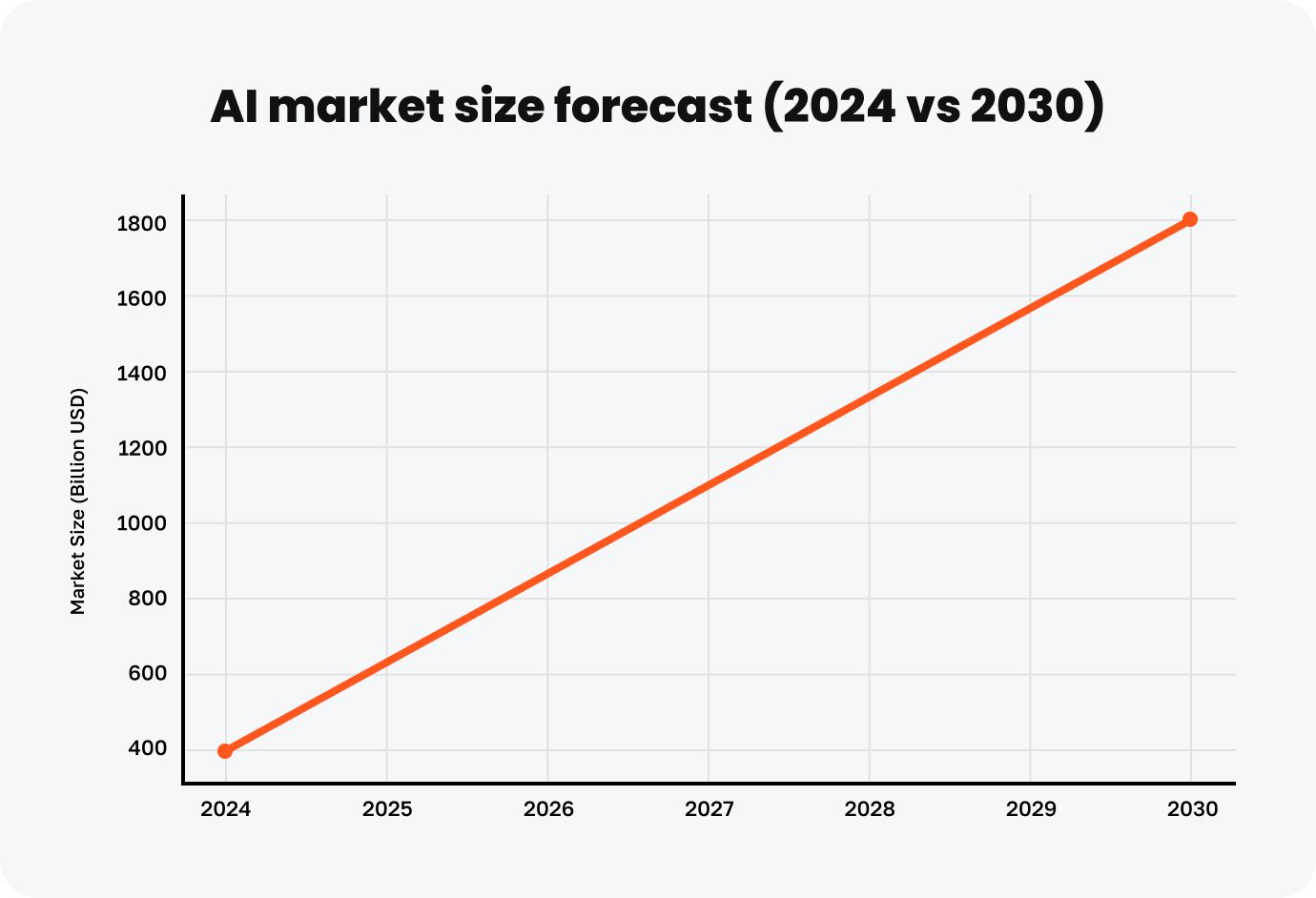
AI Market to Quadruple by 2030, Reaching $1.8 Trillion
The AI market is forecast for exponential growth, surging from approximately $400 billion in 2024 to $1.8 trillion by 2030. This near-quadrupling in just six years highlights massive investment and adoption across industries, driven by advancements in generative AI and intelligent automation.
(Source: AI in Business: A Deep Dive into Industry-Specific Use Cases)
$240 B Market Forecast, AI Agents Go-to-Market Investment
The strategic shift toward autonomous AI is supported by substantial investment and explosive market growth projections, confirming that B 2 B organizations are allocating significant capital to AI-driven revenue functions. Marketing and sales departments are leading this investment surge, with budget increases of 64% and 61% respectively in 2025. This financial commitment underscores the transition from viewing AI as a cost center to recognizing it as a primary driver of revenue and competitive advantage. The hardware powering this shift, particularly in the AI Accelerator Market 2026, is also seeing massive investment.
Explosive Growth Projections
Market forecasts illustrate the scale of this economic realignment. The overall market for AI in sales and marketing is projected to grow from $58.00 billion in 2025 to $240.59 billion by 2030, a compound annual growth rate of 32.9%. More specifically, the market for autonomous AI agents is expected to see an 18-fold increase, expanding from $7.6 billion in 2025 to over $139 billion by 2033. This requires immense computational power, driving demand for new AI & HPC in Oil & Gas 2026 and similar high-performance computing infrastructure.
Enterprise AI Spending Priorities
Enterprise spending reflects this trend, with 89% of leading businesses now actively investing in AI to drive revenue. In the United States, 60% of B 2 B marketers planned to increase their spending on AI tools in 2025. This focus on AI for revenue generation is a marked change from the 2021-2024 period, which was often characterized by experimental budgets and a primary focus on cost-saving efficiencies rather than top-line growth. The sophisticated silicon from companies like Qualcomm Semiconductor 2026 is essential to support these deployments at the edge.
Table: AI in B 2 B Market Growth Projections (2025-2033)
| Market Segment | Time Frame | Market Size & Growth Details | Source |
|---|---|---|---|
| Autonomous AI Agents | 2025 – 2033 | Projected to grow from $7.6 billion in 2025 to over $139 billion by 2033, an 18-fold increase. | Science Direct |
| AI in Sales & Marketing | 2025 – 2030 | Valued at $58.00 billion in 2025, projected to reach $240.59 billion by 2030 at a CAGR of 32.9%. | Marketsand Markets |
| AI in Sales (Specific) | 2024 – 2033 | Estimated at $24.64 billion in 2024, expected to grow to $145.12 billion by 2033 at a CAGR of 22.2%. | Grand View Research |
| AI Agent Intermediated Purchases | By 2028 | Gartner forecasts that AI agents will intermediate over $15 trillion in B 2 B purchasing decisions. | Digital Commerce 360 |
| Forecast Provider⇅ | Market Segment⇅ | 2025 Market Size ($B)⇅ | 2030 Forecast ($B)⇅ | 2033 Forecast ($B)⇅ | CAGR (%)⇅ | Source⇅ |
|---|---|---|---|---|---|---|
| MarketsandMarkets | AI for Sales and Marketing | 58 | 240.59 | 564.75 * | 32.90 | AI for Sales and Marketing Market worth $240.59 billion by … ↗ |
| Grand View Research | AI in Sales | 29.87 * | 81.39 * | 145.12 | 22.20 | AI In Sales Market Size And Share | Industry Report, 2033 ↗ |
| ScienceDirect / Market.us | Autonomous AI Agents | 7.60 | 46.73 * | 139 | 43.80 * | AI agents, agentic AI, and the future of sales ↗ |
| MarketsandMarkets | AI Agents | 52.62 | AI Agents Market worth $52.62 billion by 2030 ↗ |

AI Marketing Market Set for Explosive 13.5x Growth by 2034
The Artificial Intelligence in Marketing market is experiencing explosive growth, projected to surge from $16.09 billion in 2023 to $217.33 billion by 2034. This signifies a remarkable CAGR of approximately 27.7%, highlighting the critical role AI is playing in transforming marketing and B2B intelligence.
AI is Now a Core Competitive Differentiator in B2B Marketing
This exponential market expansion underscores AI’s transition from an innovative tool to a fundamental competitive differentiator in B2B. Early adoption and strategic integration of AI for market intelligence, personalization, and operational efficiency will determine market leadership, especially as the market moves from $25.83 billion in 2025 to its 2034 peak.
(Source: Precedence Research — via AI Adoption 2025: Stats, Market Growth & Insights)
Adobe Platform Launch and Dedicated B 2 B AI Agents
Major technology providers are now releasing dedicated platforms for B 2 B AI agents, signaling a market shift from generalized AI models to purpose-built commercial tools. These platforms are designed to address the entire B 2 B lifecycle, from initial research to final purchase, and represent a crucial step in the technology’s commercial maturation. The development of such specialized platforms is resource-intensive, mirroring efforts in other sectors to build dedicated infrastructure, such as the Eni Supercomputing 2026 initiative.
Adobe AI Agents for B 2 B
In October 2025, Adobe announced the general availability of AI Agents specifically for B 2 B businesses. This move provides a concrete example of how major software companies are productizing the concept of autonomous agents. The platform aims to help businesses reimagine their sales and marketing by automating complex processes that were previously manual. This launch marks a clear transition from the more generalized, consumer-facing AI tools that dominated the market before 2025.
The Rise of Agentic Platforms
The introduction of dedicated B 2 B agent platforms by companies like Adobe validates the growing demand for systems that can handle complex, multi-step commercial processes. These platforms are designed to integrate with existing CRM and marketing automation systems, creating a more cohesive and intelligent go-to-market engine. The focus is no longer just on generating content or analyzing data but on taking action based on that analysis. This requires robust infrastructure, akin to the large-scale data centers being developed by firms like Cipher Mining HPC Infrastructure 2026.
US Leads AI Adoption, B 2 B Marketing Spend Increases
While the adoption of AI in B 2 B is a global phenomenon, data from 2025 indicates that the United States is at the forefront of strategic investment and implementation. This regional leadership provides a model for how other markets are likely to evolve as AI technology becomes more accessible and integrated into core business platforms. The concentration of major technology providers and a competitive enterprise market are key factors accelerating this trend. This is similar to how certain regions pioneer industrial technologies, such as the SLB Drilling Automation 2026 efforts in key energy markets.
- During the 2021-2024 period, AI adoption was diffuse, with pockets of innovation in various global markets, though often without a centralized strategic purpose.
- In 2025, the U.S. market has shown a distinct commitment, with a e Marketer report revealing that 60% of U.S. B 2 B marketers planned to significantly increase their spending on AI tools during the year.
- This spending is increasingly directed towards sophisticated applications like predictive analytics and autonomous agents, moving beyond the basic automation tools that characterized earlier investments.
- The market leadership of U.S. based technology firms like Gartner, 6 sense, and Adobe in defining and building the B 2 B AI agent ecosystem further solidifies the region’s dominant position in setting global trends.
| Company⇅ | Market Segment⇅ | Key Activity / Product Launch in 2025⇅ | Date⇅ | Source⇅ |
|---|---|---|---|---|
| Adobe | Marketing Automation & AI Agents | Announced a suite of specialized B2B AI agents and a forthcoming 'Agent Composer' tool for customization. | Oct 9, 2025 | Adobe takes aim at business buyers with dedicated B2B AI … ↗ |
| 6sense | Revenue Intelligence | Released its 2025 Buyer Experience Report, highlighting that 94% of B2B buyers use LLMs in their purchasing process. | Nov 12, 2025 | The Timeline for Influencing B2B Buyers Is Shrinking ↗ |
| Madison Logic | Account-Based Marketing (ABM) | Named the only 'Visionary' in the 2025 Gartner® Magic Quadrant™ for Account-Based Marketing (ABM) Platforms. | Nov 12, 2025 | Madison Logic Named Visionary by Gartner ↗ |
| Pipedrive | CRM & Sales Automation | Prominently featured as an AI-powered CRM for B2B companies, with integrations evolving to include more AI and event analytics. | Oct 9, 2025 | 2025 …”>The 9 Best Pipedrive CRM Integrations for SMBs [2025 … ↗ |
| Google Cloud | Generative AI Solutions | Expanded partnership with Mediapro to develop innovative, media-focused GenAI solutions. | Feb 2025 | Top Companies in AI In Media Industry – Google (US) … ↗ |
AI Agent Maturity, From Ad-Hoc Tools to Orchestrated Systems
The maturity of AI in B 2 B is best understood as a progression from isolated, task-oriented applications to fully orchestrated, autonomous systems. In 2025, the market is navigating a critical transition point where the dominant, mature use case of tactical automation coexists with the emerging, strategically vital reality of AI agents. The key challenge for organizations is bridging the execution gap between possessing these powerful tools and integrating them effectively to generate measurable value. This mirrors the challenge in the energy sector of moving from pilot projects to commercial scale, as seen in efforts like the [Equinor Drilling Automation 2026 program.
- Between 2021 and 2024, technology maturity was defined by the widespread availability of tools for content creation, data analysis, and workflow automation. These tools were effective at a task level but often failed to deliver strategic value due to siloed implementation.
- In 2025, technological maturity is measured by the ability of AI agents to perform complex, multi-step functions autonomously, such as identifying an entire buying committee within a target account and initiating personalized outreach.
- Gartner predicts that by 2026, 40% of enterprise applications will feature task-specific AI agents, a significant increase from less than 5% in 2025, indicating rapid maturation and integration.
- However, a critical execution gap persists: a Jasper.ai report from March 2025 found that 51% of marketers are unable to track the ROI of their AI investments, highlighting a major weakness in strategic maturity despite the technology’s power. This is similar to the long lead times and unclear returns that can impact large infrastructure projects like those seen in the Chevron Geothermal 2026 space.
| Forecast Provider⇅ | Market Segment⇅ | 2025 ($B)⇅ | 2032 ($B)⇅ | CAGR (%)⇅ | Source⇅ |
|---|---|---|---|---|---|
| Persistence Market Research | Generative AI | 69.40 | 603.70 | 36.20 | Generative AI Market Size, Share & Forecast Analysis, 2032 ↗ |
SWOT Analysis, AI B 2 B Go-to-Market
The strategic position of AI in B 2 B has evolved rapidly, with new strengths and opportunities emerging alongside significant weaknesses and threats related to execution and market acceptance. The primary shift is from technology-centric challenges to strategic and human-centric ones. Below is a SWOT analysis comparing the state of B 2 B AI in the 2021-2023 period with the current realities of 2024-2025.
Table: SWOT Analysis for AI Market Intelligence in 2025: How It’s Transforming B 2 B
| SWOT Category | 2021 – 2023 | 2024 – 2025 | What Changed / Resolved / Validated |
|---|---|---|---|
| Strengths | Efficiency gains in content creation and data analysis. Automation of repetitive, low-value sales and marketing tasks. | Hyper-automation of entire GTM workflows. Predictive analytics for forecasting and segmentation. Autonomous lead generation and qualification at scale. | The core value proposition shifted from tactical efficiency to strategic, autonomous execution, as validated by the launch of platforms like Adobe’s AI Agents. |
| Weaknesses | AI tools were often used in silos. Difficulty in demonstrating clear ROI. Lack of skilled personnel to manage and integrate AI systems. | A persistent execution gap; 51% of marketers still cannot track ROI. Adoption remains ad-hoc for 56% of users, preventing strategic value. | The problem evolved from a lack of tools to a lack of strategy. The widespread availability of AI has not automatically translated into strategic business impact. |
| Opportunities | Enhanced personalization of marketing campaigns. Improved lead scoring and sales targeting. Better customer segmentation. | Creation of entirely new, AI-driven go-to-market models. AI agents intermediating trillions in B 2 B purchases ($15 trillion by 2028). Market entry for new AI-native B 2 B service providers. | The opportunity grew from optimizing existing processes to creating fundamentally new economic models for B 2 B commerce. |
| Threats | Data privacy and security concerns. Potential for algorithmic bias in lead scoring. Risk of generating generic, low-quality content at scale. | A potential market backlash, with Gartner projecting that by 2030, 75% of B 2 B buyers will prefer human interaction over purely AI-driven experiences. | The primary threat shifted from technical and ethical issues to a fundamental business risk: alienating customers by removing the human element from complex sales. |
Gartner $15 T Forecast, Scenario Modelling for AI Agent Adoption
The most critical variable for B 2 B leaders in the year ahead is navigating the dichotomy between the immense power of AI agents and the growing preference for human interaction in high-value transactions. Organizations that successfully architect a hybrid model, where AI agents augment human capabilities rather than replace them, will establish a durable competitive advantage. If the market continues its rapid adoption of rep-free buying experiences for simple transactions, watch for a bifurcation in sales strategies. We could be seeing a future where AI handles transactional sales while highly skilled human teams focus exclusively on complex, strategic accounts.
- The primary signal to monitor is the development and adoption of robust ROI measurement frameworks for AI agent deployments. Companies that can prove a clear link between agent activity and revenue growth will accelerate their investment and solidify their market position.
- Watch for how major platform providers like Salesforce, Adobe, and 6 sense evolve their messaging. A shift from promoting pure automation to highlighting human-AI collaboration will indicate that the market is responding to the threat of a buyer backlash.
- The success of early adopters in leveraging AI agents to manage the 90% of transactions that Gartner predicts will be handled by these systems within three years will be a key validation point. Failure to manage this transition smoothly could cede ground to more agile competitors who master the human-AI balance first.
The questions your competitors are already asking
This report covers one angle of the emerging market for autonomous B2B AI agents. The questions that matter most depend on your work.
- customer preference for human interaction in B2B buying
- companies developing autonomous B2B sales agents
- measuring the ROI of AI in B2B marketing
- real world examples of AI agents in sales workflows
This report does not answer these. Enki Brief Pro does.
Your question, your angle, your framework. SWOT, PESTL, scenario modelling. The same niche depth, built around the decision your work actually depends on.
