

Qualcomm AI Chips 2026, $15 B Revenue Target, 1 Meta CPU Deal, and 8 x Performance-per-Watt Claim (2025-2029)
AI Inference Market Risk, Qualcomm Challenges GPU Energy Inefficiency with 8 x Claim
The AI industry’s operational center of gravity is shifting from training to inference, exposing the unsustainable energy consumption and total cost of ownership (TCO) of GPU-dominated architectures and creating a significant market opening for power-efficient alternatives. Qualcomm’s Dragonfly platform is strategically positioned to exploit this vulnerability by focusing on tokens-per-watt rather than raw performance. This directly targets the primary economic and physical constraint facing hyperscalers: escalating operational expenditure (OPEX) tied to power usage.
- Between 2021 and 2024, the market prioritized capital expenditure for AI model training, solidifying NVIDIA’s dominance through its high-performance GPUs and CUDA software. Energy efficiency was a secondary consideration to securing computational capacity.
- Starting in 2025, the large-scale deployment of generative AI models for inference workloads made energy consumption a primary bottleneck. Data center operators now face power availability constraints and soaring electricity bills, making the OPEX of inference a more critical factor than the initial CAPEX of training hardware.
- Qualcomm’s June 2026 announcement of the Dragonfly platform, with its claimed 4 x to 8 x performance-per-watt improvement over incumbent GPUs, is a direct response to this market shift. The strategy is to win on efficiency, not just speed, by lowering the TCO for AI inference.
- The focus on energy efficiency is becoming a standard for new market entrants and established players. The growth of AI is driving data centers to seek novel power solutions, from partnerships with nuclear developers to pilots using geothermal energy to secure stable, carbon-free electricity.
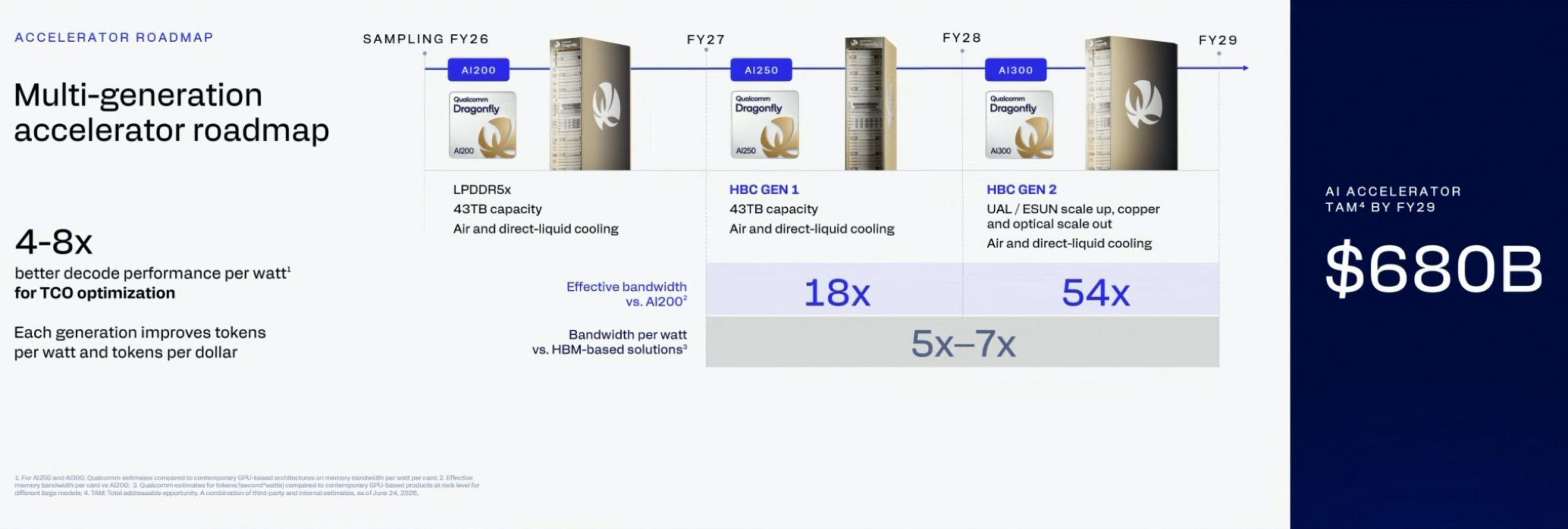
Qualcomm Dragonfly Accelerators Deliver 54x Bandwidth & 7x Energy Efficiency by FY28
Qualcomm’s Dragonfly AI accelerator roadmap projects significant energy efficiency gains, with the AI250 offering 18x effective bandwidth and the AI300 reaching 54x compared to the AI200. Crucially, these accelerators are designed for 5x-7x better bandwidth per watt versus HBM-based solutions, directly challenging traditional GPU dominance in AI inference by FY28.
TCO Optimization & ‘Tokens-Per-Watt” Drive AI Inference Market Shift
This roadmap positions Qualcomm to capitalize on the critical need for TCO-optimized AI inference hardware, especially for large language models. The projected ‘tokens per watt” improvements address a key bottleneck in scaling AI, opening up new opportunities in data centers and edge deployments where power consumption and cooling (direct-liquid) are paramount operational costs.
$3.92 B Acquisition, Qualcomm Buys Modular AI to Target NVIDIA’s CUDA Moat
Qualcomm’s most significant strategic investment to enable its data center entry is the $3.92 billion acquisition of Modular AI, a move designed to directly confront its greatest weakness and NVIDIA’s most durable competitive advantage: the CUDA software ecosystem. This acquisition is the cornerstone of Qualcomm’s plan to build a viable software and developer platform, without which its hardware efficiency claims would be irrelevant.
- The acquisition of Modular AI is an explicit acknowledgment that hardware performance alone is insufficient to compete in the AI accelerator market. A robust, open, and easy-to-use software stack is critical for developer adoption and displacing the deeply entrenched CUDA programming model.
- This investment underpins Qualcomm’s ambitious financial targets, which project data center revenues growing from near zero to approximately $5 billion by fiscal 2027 and over $15 billion by fiscal 2029. Achieving these goals is entirely dependent on successfully integrating Modular AI and creating a competitive software alternative.
- Modular AI’s technology is intended to provide a unified compiler and runtime that can abstract away the underlying hardware, theoretically making it easier for developers to port existing AI models and workloads from NVIDIA GPUs to Qualcomm’s architecture.
Table: Qualcomm Strategic Data Center Investments
| Partner / Project | Time Frame | Details and Strategic Purpose | Source |
|---|---|---|---|
| Modular AI | June 2026 | $3.92 billion acquisition to build a software ecosystem to compete with NVIDIA’s CUDA. The goal is to create a unified compiler and runtime to simplify workload migration to Qualcomm’s new hardware. | AI News Today |
Qualcomm 1 Hyperscaler Deal, Meta Adopts Dragonfly CPU for 2028 Deployment
The multi-generation strategic agreement with Meta serves as the foundational validation for Qualcomm’s data center ambitions, providing a crucial anchor customer and de-risking the company’s entry into a market dominated by incumbents. This partnership is the most tangible signal that hyperscalers are actively seeking viable alternatives to NVIDIA to enhance supply chain diversity and reduce TCO.
- Meta has committed to deploying Qualcomm’s Dragonfly C 1000 CPU in its server fleet, with production scheduled to begin in the second half of 2028. This long-term commitment from a major hyperscaler provides Qualcomm with a predictable revenue stream and a real-world environment to prove its performance-per-watt claims at scale.
- The partnership extends beyond a single product, covering multiple generations of technology. This indicates a deeper strategic alignment, with Meta likely collaborating on the design to ensure the chips meet its specific requirements for AI inference and other data center workloads.
- In parallel, Qualcomm announced an expanded relationship with Hugging Face to optimize open-source AI models for its hardware. This is a critical move to build a developer community and ensure that popular models run efficiently on the Dragonfly platform, complementing the Modular AI acquisition.
Table: Qualcomm Data Center Partnerships
| Partner / Project | Time Frame | Details and Strategic Purpose | Source |
|---|---|---|---|
| Meta | June 2024 | Multi-generation agreement for Meta to become the first publicly announced customer for Qualcomm’s Dragonfly C 1000 data center CPU, with deployment planned for the second half of 2028. | CNBC |
| Hugging Face | June 2024 | Expanded relationship to optimize and validate top Hugging Face models on Qualcomm’s cloud and device platforms, aimed at fostering a developer ecosystem for its new hardware. | Business Wire |
Global Data Center Market, Qualcomm Targets Hyperscalers in North America
Qualcomm’s data center strategy is initially concentrated on North American hyperscalers, the entities with the most acute need for power-efficient hardware and the technical capability to validate and integrate a new architecture. Success in this region is a prerequisite for any future global expansion, as these customers represent the largest and most sophisticated segment of the AI infrastructure market.
- While the 2021-2024 period saw a global scramble for GPU capacity, the focus from 2025 onward has sharpened on the operational realities within specific regions. North American data center hubs face significant grid constraints, making power efficiency a critical factor in expansion decisions for companies like Meta, Google, and Amazon.
- The agreement with Meta confirms this geographic focus. By securing a flagship U.S. technology company as its first customer, Qualcomm establishes credibility within the most important target market.
- Future expansion into Europe and Asia will depend on proving the economic and performance case in the North American market first. The competitive landscape for semiconductors and AI chips is global, but market entry is often regional, with success dependent on meeting the specific needs of local infrastructure, such as the power-constrained data centers managed by firms like Hut 8.
Technology Maturity, Qualcomm’s Dragonfly Platform Faces Long 2028 Runway
Although Qualcomm leverages decades of mature expertise in designing low-power, high-performance ARM-based chips for the mobile market, its Dragonfly data center platform is an unproven new entrant with a long and high-risk development timeline. The flagship products announced in June 2026 will not be deployed at scale until 2028, creating a significant window for competitors to advance their own technologies and fortify their market positions.
- Before 2025, Qualcomm’s core competency was in System-on-a-Chip (So C) technology for smartphones and other edge devices. While this provides a strong foundation in power efficiency, the data center market presents entirely different challenges related to scale, reliability, and software integration.
- The Dragonfly platform’s key technological innovation is its High Bandwidth Compute (HBC) memory solution. This proprietary interconnect is designed to circumvent the supply chain and cost challenges associated with HBM memory and advanced Co Wo S packaging from manufacturers like TSMC, which have become a major bottleneck for GPU production.
- The 2028 production target for the Dragonfly C 1000 CPU creates substantial execution risk. This two-year gap between announcement and deployment gives NVIDIA, AMD, and other custom ASIC developers time to respond with their own next-generation, power-efficient architectures, potentially eroding Qualcomm’s claimed TCO advantage before its products even reach the market.

Qualcomm Dragonfly Delivers 8x Energy Efficiency Over GPUs
Qualcomm’s Dragonfly platform boasts up to “8x better Tokens-Per-Watt” than GPU-based systems and “200x better memory capacity per watt” than SRAM-based systems. This significant energy efficiency targets the rapidly growing inference workloads for large language models (LLMs).
Massive TCO Reduction for AI Inference Workloads
The dramatic improvement in ‘Tokens-Per-Watt” directly addresses the escalating energy consumption and operational costs associated with AI inference in data centers. For hyperscalers and enterprises, this translates into potentially massive Total Cost of Ownership (TCO) reductions, making AI deployment more scalable and sustainable.
Qualcomm Dragonfly Achieves 5x-7x Bandwidth Per Watt Edge Over GPUs
Qualcomm’s multi-generation Dragonfly accelerator roadmap projects up to 54x effective bandwidth gains by FY28 (AI300) compared to its AI200 baseline. Crucially, it anticipates a 5x-7x improvement in bandwidth per watt against HBM-based GPU solutions, directly addressing the energy efficiency challenge.
(Source: Qualcomm’s 2026 Investor Day Has Hidden Goodies – Semiaccurate)
SWOT Analysis, Qualcomm’s $15 B Data Center Ambition
Qualcomm’s data center strategy is built on a strong foundation of power-efficiency expertise and a key partnership with Meta, but it faces formidable weaknesses in its lack of a mature software ecosystem and a long time-to-market. Its success will depend on capitalizing on the market’s urgent need for TCO reduction while defending against incumbent responses and overcoming significant execution hurdles.
- Strength: Proven leadership in designing energy-efficient ARM-based processors.
- Weakness: The absence of an established software ecosystem to compete with NVIDIA’s dominant CUDA platform.
- Opportunity: The massive, growing demand from hyperscalers for AI inference accelerators that lower electricity costs.
- Threat: The rapid pace of innovation from NVIDIA and AMD, which could close the performance-per-watt gap.
Table: SWOT Analysis for Qualcomm’s Data Center Strategy
| SWOT Category | Key Factors | Strategic Implications |
|---|---|---|
| Strengths | • Proven expertise in low-power ARM chip design from the mobile market. • High Bandwidth Compute (HBC) memory avoids HBM/Co Wo S supply chain bottlenecks. • Anchor partnership with Meta provides critical validation. |
Provides a credible foundation for its performance-per-watt claims and a clear path to initial market entry, reducing risk for other potential customers. |
| Weaknesses | • No established data center software ecosystem to rival NVIDIA’s CUDA. • Long product runway with scaled deployment not expected until 2028. • Zero current market share in data center CPUs or AI accelerators. |
The software gap is the single largest barrier to adoption. The long lead time gives competitors a window to counter Qualcomm’s value proposition. |
| Opportunities | • AI inference market is shifting focus from raw performance to TCO and tokens-per-watt. • Hyperscalers are actively seeking to diversify their AI chip suppliers away from NVIDIA. • Escalating data center power consumption and grid limitations. |
The market’s primary pain point aligns directly with Qualcomm’s core value proposition, creating a strong demand pull for its products if it can execute. |
| Threats | • NVIDIA’s accelerated one-year product cadence (e.g., Rubin platform). • Strong competition from AMD’s MI-series accelerators. • In-house custom silicon from Google (TPU) and Amazon (Inferentia). • Entrenched developer loyalty to the CUDA ecosystem. |
The competitive environment is intense and fast-moving. Qualcomm is entering a crowded race where incumbents have deep moats and significant momentum. |
Qualcomm 2027 Outlook, Watch for C 1000 CPU Milestones and Modular AI Integration
For Qualcomm to achieve its ambitious $15 billion revenue target by 2029, the next 12-18 months are critical for demonstrating tangible progress on its software strategy and execution of the C 1000 CPU roadmap with Meta. Any perceived delays or stumbles will be punished, while clear milestones will attract further ecosystem support and customer interest.
- If Qualcomm shows strong progress in integrating Modular AI and begins attracting developers to a viable CUDA alternative, watch for other hyperscalers to announce pilot programs in late 2026 or early 2027. This would be a strong signal that the market sees Qualcomm as a credible second source for AI hardware.
- Conversely, if the Dragonfly C 1000 CPU encounters silicon-level delays or early benchmarks fail to substantiate the 4 x-8 x performance-per-watt claim in real-world inference workloads, watch for Meta to publicly temper expectations for its 2028 deployment. This would severely damage market confidence.
- The competitive environment remains a key variable. If NVIDIA accelerates its roadmap and releases an inference-optimized GPU that significantly improves energy efficiency, it could neutralize Qualcomm’s main value proposition before the Dragonfly platform even reaches the market.
The questions your competitors are already asking
This report covers one angle of Qualcomm’s entry into the AI data center market. The questions that matter most depend on your work.
- Nvidia next generation chip power efficiency
- Open source alternatives to Nvidia CUDA
- Google and Amazon deals for new AI chips
- Qualcomm data center chip memory technology
This report does not answer these. Enki Brief Pro does.
Your question, your angle, your framework. SWOT, PESTL, scenario modelling. The same niche depth, built around the decision your work actually depends on.
