Please login to bookmark Close

CCUS Infrastructure, Baker Hughes $13.6 B Chart Industries Deal, $7 B DOE Hydrogen Hubs, and 16 Project FIDs (2021-2026)

Industry Adoption: Baker Hughes Shifts to Integrated Solutions for LNG and Hydrogen Infrastructure

The acquisition of Chart Industries by Baker Hughes signals a strategic pivot in the energy technology sector from supplying individual components to delivering fully integrated, de-risked systems for Liquefied Natural Gas (LNG) and low-carbon infrastructure projects. This move is a direct response to customer demands for simplifying complex project execution, reducing integration risk, and accelerating timelines for facilities critical to the energy transition.

  • Prior to 2025, the market operated with a fragmented supply chain where developers procured core components from different vendors, such as turbomachinery from Baker Hughes and cryogenic processing equipment from Chart Industries. This model placed the significant and costly integration risk entirely on the project developer, often leading to budget overruns and schedule delays.
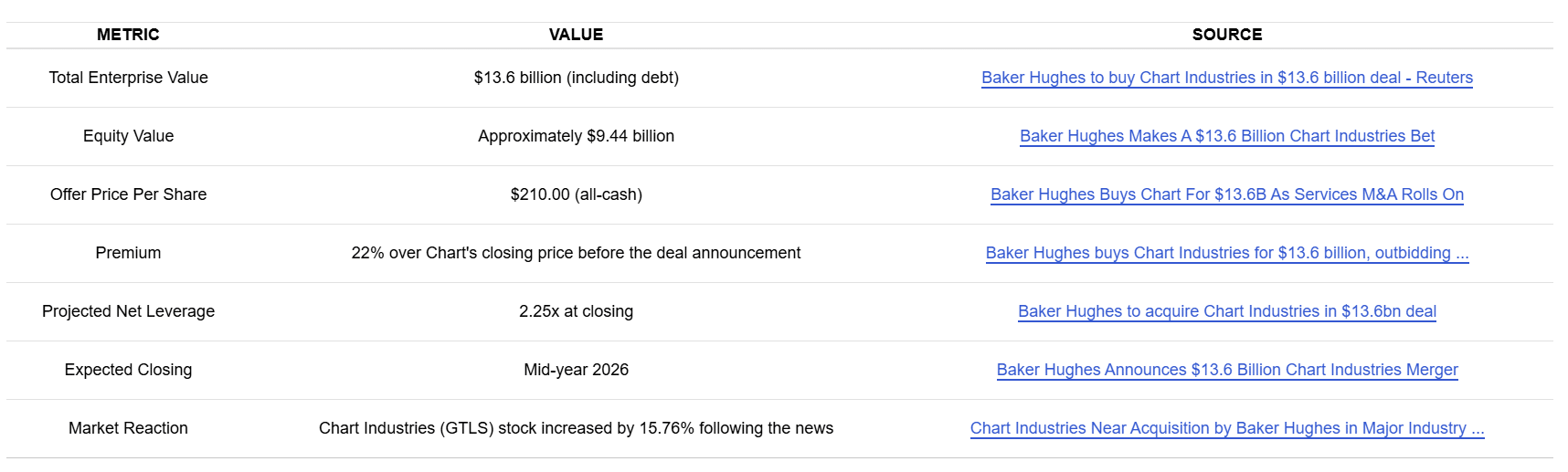
  • The $13.6 billion transaction in 2025 creates a vertically integrated entity capable of offering end-to-end solutions, from gas processing and liquefaction to storage and transport. The core commercial offering now includes complete, factory-integrated mid-scale liquefaction trains and comprehensive systems for green and blue hydrogen hubs, a strategy mirroring BP’s 2022 acquisition of Archaea Energy to control the entire Renewable Natural Gas value chain.
  • The primary commercial risk now shifts from technology performance to post-merger execution. The challenge for Baker Hughes is to successfully merge two distinct corporate cultures, supply chains, and engineering philosophies to realize projected synergies, a risk highlighted by the integration complexities faced during the GE-Alstom merger in 2015.
  • The deal also positions Baker Hughes to compete more effectively against firms like MHI that offer extensive technology portfolios for carbon capture in hard-to-abate industrial sectors, expanding its addressable market beyond traditional oil and gas.
Energy Sector Pivots from LNG to Hydrogen

Energy Sector Pivots from LNG to Hydrogen

This chart illustrates the strategic pivot from traditional LNG to new hydrogen and CCUS solutions, directly mirroring the section’s topic of shifting to integrated systems in response to customer demand.

(Source: MarketsandMarkets)

Investment: Baker Hughes $13.6 B Acquisition and $7 B in DOE Funding De-Risk Energy Transition Capital

The $13.6 billion all-cash transaction by Baker Hughes, combined with the U.S. government’s substantial public funding commitments, creates a powerful tailwind for energy transition infrastructure. This alignment of private M&A capital with public incentives fundamentally de-risks large-scale investments in LNG, hydrogen, and carbon capture, shifting the primary bottleneck from capital availability to project execution and regulatory permitting.

  • The scale and all-cash nature of the Chart Industries acquisition, which prompted the termination of a prior agreement with Flowserve, demonstrates high conviction from Baker Hughes in the long-term cash flow generation of LNG and the growth trajectory of the clean hydrogen market.
  • This private capital deployment is validated and amplified by public investment, most notably the U.S. Department of Energy’s $7 billion program to establish regional clean hydrogen hubs. These hubs create concentrated zones of guaranteed demand for the integrated company’s equipment portfolio, including electrolyzers, liquefiers, and storage tanks.
  • This investment climate stands in stark contrast to the pre-2022 period, where the clean hydrogen market struggled with project cancellations due to high production costs and a lack of firm offtake agreements. The introduction of the Section 45 V production tax credit in the Inflation Reduction Act, offering up to $3.00/kg, has made green hydrogen cost-competitive and unlocked significant private investment.

Table: Strategic Energy Infrastructure Investments (2023-2025)

Partner / Project Time Frame Details and Strategic Purpose Source
Baker Hughes / Chart Industries Jul 2025 Baker Hughes agrees to acquire Chart Industries in a $13.6 billion all-cash deal to create an integrated, end-to-end technology provider for LNG, hydrogen, and carbon capture infrastructure. Wall Street Journal
U.S. Department of Energy Oct 2023 Awarded $7 billion in federal funding to develop seven regional clean hydrogen hubs across the United States, creating concentrated demand centers for production and transport infrastructure. White & Case

Geography: US Drives Global LNG and Hydrogen Growth, Focusing Baker Hughes’ Strategy

The acquisition strategically anchors Baker Hughes’ growth strategy to the United States, which has emerged as the undisputed global leader for new LNG export capacity and policy-driven clean hydrogen development. While global opportunities remain, the combination of vast natural gas resources, a robust industrial base, and powerful legislative incentives like the Inflation Reduction Act makes the U.S. the primary market for energy transition infrastructure for the remainder of the decade.

  • From 2021 to 2024, the global LNG market saw intense competition for new capacity announcements between the U.S. and Qatar. However, by 2025, the U.S. established a decisive lead in projects moving toward Final Investment Decision (FID), with projections showing an 85% expansion in U.S. LNG export capacity by 2028. The acquisition positions the new Baker Hughes to capture a significant share of this domestic build-out.
  • The deal directly targets the U.S. market, where an additional 13.9 billion cubic feet per day (bcfd) of liquefaction capacity is projected through 2029, creating sustained demand for integrated liquefaction trains.
  • The U.S. policy-driven approach to stimulating a domestic hydrogen market contrasts with Europe’s focus on industrial decarbonization mandates and import strategies. This is visible in projects like the large-scale green steel plant in Spain from Arcelor Mittal, which is driven by industrial demand rather than production tax credits.

Technology Maturity: TRL 9 LNG Funds TRL 7 Hydrogen Scale-Up Within Baker Hughes

The acquisition merges mature, commercially proven LNG technologies (Technology Readiness Level 9) with developing hydrogen solutions (TRL 7-8), creating a balanced portfolio where predictable cash flows from the former can finance the technological and commercial scaling of the latter. This internal funding mechanism allows the company to de-risk its entry into the nascent hydrogen economy while simultaneously reinforcing its market-leading position in natural gas.

  • LNG and Gas Processing (TRL 9): Both Baker Hughes‘ turbomachinery and Chart Industries‘ cryogenic equipment are fully commercialized, bankable technologies. The core innovation post-acquisition lies not in fundamental research but in system integration: optimizing the packaging of turbines, compressors, and cold boxes to reduce cost, footprint, and delivery time for mid-scale LNG projects.
  • Liquid Hydrogen (TRL 7-8): Chart Industries provides a leading portfolio for liquid hydrogen (LH 2) storage and transport, but the technology remains at an early commercial stage. The primary challenges are not scientific but engineering and economic: scaling up large-scale liquefaction plants, improving the efficiency of the liquefaction process, and reducing the high costs associated with cryogenic handling to make LH 2 competitive with other hydrogen transport vectors like ammonia.
  • Carbon Capture (TRL 8-9): The combined entity’s portfolio includes multiple proven technologies applicable to CCUS, including Chart’s cryogenic CO₂ capture processes and Baker Hughes’ post-combustion systems. This enables a competitive, integrated offering for blue hydrogen projects that require both gas reforming and carbon capture.

SWOT Analysis: Baker Hughes’ Market Leadership vs. Integration and Policy Risks

The acquisition of Chart Industries transforms Baker Hughes into a market leader with a unique, integrated technology offering for the energy transition, but this strength is counterbalanced by substantial post-merger execution risks and a heavy dependence on the stability of energy policies, particularly in the hydrogen sector.

  • The primary strength is the creation of a one-stop-shop for complex LNG and hydrogen projects, a direct response to market demand.
  • The most significant threat is the policy cliff associated with the U.S. 45 V clean hydrogen production tax credit, which is set to expire and could undermine the long-term growth thesis for a key part of the acquisition.

Table: SWOT Analysis for Baker Hughes’ Acquisition of Chart Industries

SWOT Category 2021 – 2024 2025 – 2026 What Changed / Validated
Strengths Leading positions in separate, complementary markets (turbomachinery vs. cryogenics). Creation of a single-source, end-to-end provider for LNG and hydrogen value chains. Portfolio diversified into industrial gases and data center cooling. The market validated the need for integrated solutions to de-risk complex energy projects, justifying the strategic pivot from component supplier to solution architect.
Weaknesses Exposure to cyclicality of upstream oil and gas. Limited market share in nascent hydrogen equipment sector. Significantly increased debt load to finance the $13.6 billion all-cash acquisition. Massive and complex post-merger integration task. The company traded a cyclical weakness for an execution-based weakness. Its success now depends on its ability to integrate two large global organizations effectively.
Opportunities Growing LNG market and emerging interest in hydrogen and CCUS. Surging global LNG demand driven by energy security. Massive, policy-driven growth in the U.S. hydrogen market (IRA). Cross-selling into high-growth industrial markets like data centers. The Inflation Reduction Act and global energy security concerns created powerful, durable tailwinds that transformed speculative opportunities into bankable, near-term markets.
Threats Commodity price volatility. Uncertainty over hydrogen technology costs and supportive policy. Potential LNG oversupply post-2026 delaying new project FIDs. Expiration of the 45 V hydrogen tax credit in 2027 creating a policy cliff. Integration failure destroying shareholder value. The primary threat shifted from market uncertainty to policy uncertainty. The viability of the U.S. green hydrogen project pipeline now hinges on legislative action to extend key tax credits.

Scenario Modelling: Baker Hughes’ 2026 Focus on Integrated LNG Sales and Hydrogen Policy

The critical variable for Baker Hughes in 2026 is its ability to translate its new integrated offering into firm orders for mid-scale LNG projects, which will generate the near-term cash flow needed to weather the significant policy uncertainty surrounding the U.S. 45 V hydrogen tax credit.

Energy Strategy Shifts to Execution over Narratives

Energy Strategy Shifts to Execution over Narratives

This chart’s focus on execution and milestones by 2026 perfectly matches the section’s theme of scenario modeling based on firm orders and tangible progress over policy uncertainty.

(Source: LinkedIn)

  • If the company announces multiple FIDs for its integrated mid-scale LNG offering through 2026, watch for customer testimonials highlighting reduced project risk and faster timelines. This could mean the market is strongly validating the single-source-supplier model, giving Baker Hughes a decisive competitive advantage.
  • If U.S. legislative efforts to extend the 45 V hydrogen production tax credit beyond its 2027 expiration fail, watch for a slowdown or cancellation of announced green hydrogen projects. This could mean that a core pillar of the acquisition’s long-term growth story is at risk, a market fragility seen in sectors where subsidy-dependent companies like Hopium faced significant setbacks.
  • If the company reports growing revenue from industrial gas and data center cooling applications, watch for announcements of new, non-energy customers. This could mean the portfolio diversification strategy is working, providing a valuable hedge against energy market volatility and tapping into the immense energy demand from data centers being built by companies like Microsoft.

The questions your competitors are already asking

This report covers one angle of the strategic shift in the LNG and hydrogen supply chain. The questions that matter most depend on your work.

This report does not answer these. Enki Brief Pro does.

Your question, your angle, your framework. SWOT, PESTL, scenario modelling. The same niche depth, built around the decision your work actually depends on.

Run your first brief in Enki Brief Pro

Experience In-Depth, Real-Time Analysis

For just $200/year (not $200/hour). Stop wasting time with alternatives:

  • Consultancies take weeks and cost thousands.
  • ChatGPT and Perplexity lack depth.
  • Googling wastes hours with scattered results.

Enki delivers fresh, evidence-based insights covering your market, your customers, and your competitors.

Trusted by Fortune 500 teams. Market-specific intelligence.

Explore Your Market →

One-week free trial. Cancel anytime.


Erhan Eren

Erhan Eren is the CEO and Co-Founder of Enki, a commercial intelligence platform for emerging technologies and infrastructure projects, backed by Equinor, Techstars, and NVIDIA. He spent almost a decade in oil and gas, first at Baker Hughes leading market intelligence, strategy, and engineering teams, then at AI startup Maana, where he spearheaded commercial strategy to acquire net new accounts including Shell, SLB, and Saudi Aramco. It was across these roles, watching teams stitch together executive briefings from scattered PDFs and Google searches, that the idea for Enki was born. Erhan holds a BS in Aeronautical Engineering from Istanbul Technical University and an MS in Mechanical and Aerospace Engineering from Illinois Institute of Technology. He has spent over 20 years at the intersection of energy, strategy, and technology, and built Enki to give professionals the clarity they need without the analyst-grade budget or timeline.

Privacy Preference Center