

Beyond Lithium: The Top 10 Mega Battery Projects Redefining China’s Grid in 2025
China’s 2025 energy storage landscape is undergoing a monumental transformation, characterized by a strategic pivot to gigawatt-hour-scale projects and a diversification of battery chemistries beyond traditional lithium-ion. This shift is driven by the urgent need to stabilize the grid and integrate vast amounts of renewable energy. The data reveals a clear theme: the deployment of multi-technology, standalone storage assets is no longer a niche experiment but a foundational element of the nation’s energy infrastructure. Landmark projects, such as the planned 1, 000 MW / 6, 000 MWh Ulanqab shared storage facility and Narada Power’s groundbreaking 2, 800 MWh semi-solid-state battery order, underscore a market that is rapidly scaling in both size and technological sophistication. This move is solidifying battery storage as an independent, indispensable asset class for managing China’s clean energy transition.
Top 10 Mega Battery Projects for 2025
The following installations highlight the scale and diversity of China’s grid-storage ambitions. While some projects became operational in late 2025 or early 2026, their development and commissioning phases define the market activity of 2025.
1. Ulanqab Shared Energy Storage Project
Company/Entity: Not specified
Installation Capacity: 1, 000 MW / 6, 000 MWh
Applications: Grid services, renewable energy integration, shared storage for multiple generators
Source: Industry News — China Energy Storage Alliance
2. Narada Power Independent Energy Storage Project
Company/Entity: Narada Power
Installation Capacity: 2, 800 MWh
Applications: Grid-scale energy storage, commercialization of next-generation battery technology
Source: 2.8 GWh! Narada Power Wins World’s Largest Semi-Solid Battery Energy Storage Project
3. Tongliao Standalone Battery Storage Project (Phase 1)
Company/Entity: Not specified
Installation Capacity: 500 MW / 2, 000 MWh
Applications: Peak-shaving, grid-balancing services for a high-renewable penetration area
Source: China’s largest standalone battery storage project powers up
4. Tongliao Standalone Battery Storage Project (Phase 2 Expansion)
Company/Entity: Not specified
Installation Capacity: Additional 500 MW / 2, 000 MWh (Total 1 GW / 4 GWh)
Applications: Expansion of grid-balancing and peak-shaving capacity
Source: China switches on its largest standalone battery storage project
5. CATL Dongying Energy Storage Project
Company/Entity: CATL
Installation Capacity: 2, 000 MWh (2 GWh)
Applications: Grid energy storage, vertical integration of battery manufacturing and project development
Source: ESS Business Emerges as a New Growth Engine for Multiple Top-Tier Battery Producers
6. Jiayuguan Ning Sheng Independent Energy Storage Project
Company/Entity: China National Nuclear Corporation (CNNC)
Installation Capacity: 500 MW / 1, 000 MWh
Applications: High-power, fast-response grid services using supercapacitor technology
Source: China’s connects the world’s first GWh-scale supercapacitor-energy …
7. Xinjiang Vanadium Flow Battery Energy Storage Project
Company/Entity: China Three Gorges and Rongke Power
Installation Capacity: 200 MW / 1, 000 MWh
Applications: Long-duration storage, reducing solar curtailment, renewable energy shifting
Source: China Three Gorges’ 200 MW/1, 000 MWh Vanadium Flow Battery …
8. EVE Energy Ruite New Energy Project
Company/Entity: EVE Energy
Installation Capacity: 200 MW / 400 MWh
Applications: Utility-scale grid services using innovative large-format LFP cells
Source: World’s first 628 Ah grid-scale battery enters operation – PV Magazine
9. Henan Grid-Side Distributed BESS Project
Company/Entity: Not specified
Installation Capacity: 100.8 MW
Applications: Improving local power quality and reliability through distributed grid assets
Source: Role of battery energy storage systems: A comprehensive review on …
10. Haixi Keluke Shared Energy Storage Power Plant Project
Company/Entity: Trina Solar
Installation Capacity: Not specified
Applications: Shared, multi-user energy storage infrastructure
Source: Trina Solar
Table: Top 10 Mega Battery Projects in China (2025)
| Project/Company | Installation Capacity | Applications | Source |
|---|---|---|---|
| Ulanqab Shared Energy Storage Project | 1, 000 MW / 6, 000 MWh | Shared storage, grid services | China Energy Storage Alliance |
| Narada Power | 2, 800 MWh | Grid-scale semi-solid-state storage | China Energy Storage Alliance |
| Tongliao Standalone BESS (Phase 1) | 500 MW / 2, 000 MWh | Peak-shaving, grid-balancing | ess-news.com |
| Tongliao Standalone BESS (Phase 2) | +500 MW / 2, 000 MWh | Capacity expansion for grid services | ess-news.com |
| CATL Dongying Project | 2, 000 MWh | Grid energy storage | metal.com |
| Jiayuguan Ning Sheng Project (CNNC) | 500 MW / 1, 000 MWh | Fast-response services (Supercapacitor) | ess-news.com |
| Xinjiang VFB Project (CTG/Rongke) | 200 MW / 1, 000 MWh | Long-duration solar storage (VFB) | vanitec.org |
| EVE Energy Ruite Project | 200 MW / 400 MWh | Grid services (628 Ah LFP cells) | PV Magazine |
| Henan Grid-Side Distributed BESS | 100.8 MW | Distributed grid support | Science Direct |
| Haixi Keluke Shared Project (Trina Solar) | Not specified | Shared storage infrastructure | Trina Solar |
Centralization and Integration: How BESS Is Being Adopted
The pattern of adoption in 2025 reveals a strategic evolution from co-located projects to centralized, standalone assets. The rise of “shared energy storage power stations, ” exemplified by the massive 6, 000 MWh plan in Ulanqab and the operational project by Trina Solar in Haixi, shows that storage is being treated as a core piece of grid infrastructure, capable of serving multiple renewable generators and providing ancillary services on demand. This model decouples storage from specific generation assets, maximizing its utilization and economic viability. Furthermore, the direct involvement of battery giants like CATL, with its 2 GWh project in Dongying, signals a powerful vertical integration trend. Manufacturers are no longer just suppliers; they are becoming project developers to guarantee offtake for their expanding production lines and capture more value across the supply chain.
Inner Mongolia and Xinjiang: The Proving Grounds for GWh-Scale Storage
Geographically, China’s largest battery deployments are concentrated in regions that are both rich in renewable resources and plagued by grid constraints. Inner Mongolia is a clear leader, hosting both the Tongliao standalone project (totaling 4 GWh planned) and the even larger Ulanqab project. Similarly, Xinjiang is home to the world’s largest Vanadium Flow Battery system at 1, 000 MWh. This geographic clustering is intentional. These provinces are at the forefront of China’s wind and solar boom, and without GWh-scale storage, they face crippling levels of energy curtailment. By deploying these mega-projects here, China is using these regions as real-world laboratories to perfect the integration of massive storage capacity, creating a blueprint for grid modernization that can be replicated nationwide as renewable penetration grows.

China’s Storage Projects Are Geographically Concentrated
This chart shows the provincial distribution of energy storage projects, directly supporting the section’s focus on key regions. It highlights Xinjiang as a major hub for new installations, which is explicitly mentioned in the text.
(Source: China Energy Storage Alliance)
Beyond LFP: A Maturing Portfolio of Storage Technologies
While Lithium Iron Phosphate (LFP) technology remains the commercial workhorse, the 2025 projects demonstrate China’s strategic investment in a diverse portfolio of maturing storage technologies. This diversification is critical for addressing different grid needs. The commissioning of the 1, 000 MWh Jiayuguan project marks the world’s first GWh-scale deployment of supercapacitors, a technology ideal for high-power, fast-response services like frequency regulation that LFP batteries are less suited for. On the other end of the spectrum, the 1, 000 MWh VFB project in Xinjiang proves the case for long-duration storage (5 hours), essential for time-shifting solar generation from midday to evening peak demand. Perhaps most significantly, Narada Power’s 2, 800 MWh order for a semi-solid-state battery project represents a major commercial leap for next-generation chemistries, moving them from the lab to utility-scale reality. Even within LFP, innovation continues, as shown by EVE Energy’s deployment of novel 628 Ah cells to reduce system costs.
The Gigawatt-Hour Era: A New Standard for Grid Infrastructure
The mega-projects of 2025 signal an unmistakable trend: gigawatt-hour scale is the new baseline for strategic energy storage in China. These installations are no longer one-off flagships but are becoming standard components of regional energy planning. The “shared storage” model is emerging as a dominant commercial and policy framework, enabling more efficient capital deployment and asset utilization. The simultaneous push into multiple technologies—from advanced LFP and semi-solid-state to flow batteries and supercapacitors—indicates a sophisticated, portfolio-based approach to building a resilient and flexible grid. Looking forward, these projects serve as foundational pillars for China’s energy security, enabling deeper decarbonization by ensuring that its massive investments in wind and solar power are reliable, dispatchable, and fully integrated into the national grid.
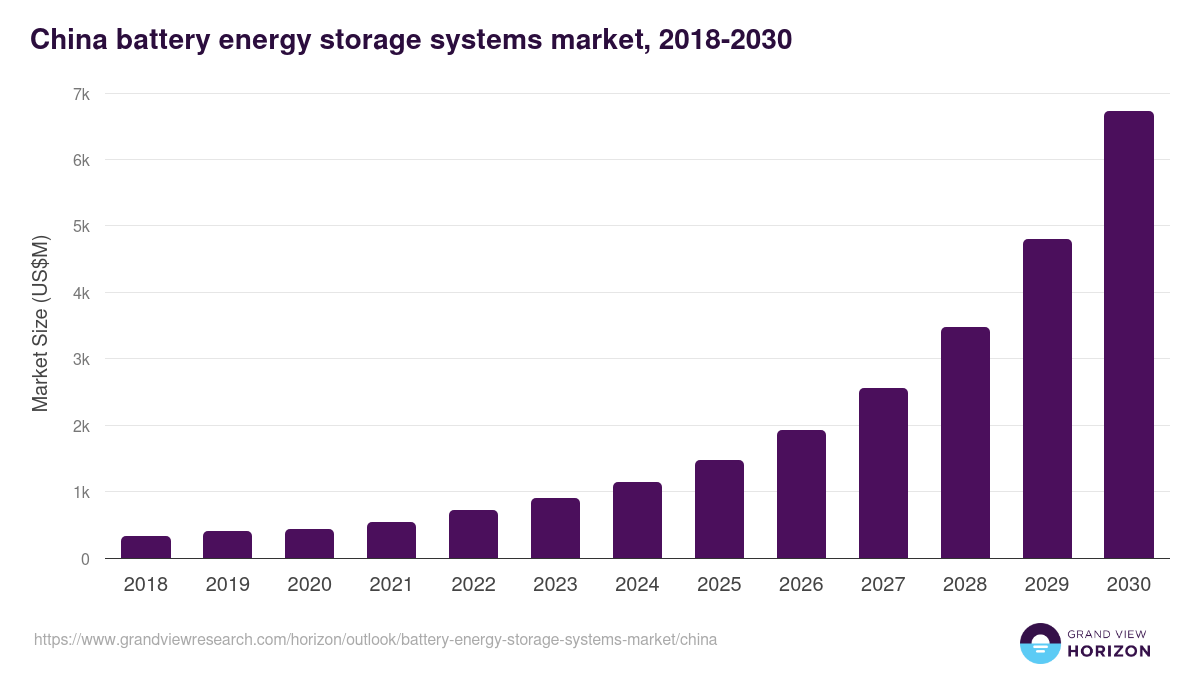
China’s BESS Market Enters Explosive Growth
This forecast illustrates the massive market expansion expected through 2030, projected to reach nearly $7 billion. It quantifies the ‘Gigawatt-Hour Era’ described in the section, showing storage is becoming standard grid infrastructure.
(Source: Grand View Research)
Frequently Asked Questions
Why is China building so many large-scale battery projects?
China is rapidly building these mega-scale battery projects to stabilize its power grid and integrate the vast amounts of electricity generated from its wind and solar farms. These batteries help manage the intermittent nature of renewables, prevent energy waste, and ensure a reliable, dispatchable clean energy supply for the nation.
Are all these projects using the same type of battery technology?
No, the projects show a strategic diversification beyond traditional lithium-ion batteries. While Lithium Iron Phosphate (LFP) is common, the list includes a 1,000 MWh Vanadium Flow Battery (VFB) for long-duration storage, a 1,000 MWh supercapacitor project for fast grid response, and a major 2,800 MWh order for next-generation semi-solid-state batteries.
What is a ‘shared energy storage’ project?
A ‘shared energy storage’ project, like the massive 6,000 MWh Ulanqab facility, is a large, centralized battery system that is not tied to a single power plant. It functions as an independent grid asset, providing storage and grid services to multiple renewable energy generators and the grid operator, which maximizes its use and economic viability.
Which regions in China are the main hubs for these mega battery projects?
The article identifies Inner Mongolia and Xinjiang as the primary hubs for these GWh-scale deployments. These regions are rich in wind and solar resources but have grid constraints. Inner Mongolia hosts the Ulanqab and Tongliao projects (totaling 10 GWh), while Xinjiang is home to the world’s largest Vanadium Flow Battery system (1 GWh).
What is the most powerful and highest-capacity project on the list?
The Ulanqab Shared Energy Storage Project is the largest mentioned, with a planned capacity of 1,000 MW (power) and 6,000 MWh (energy). Its immense scale exemplifies the shift towards treating battery storage as a core piece of national grid infrastructure.
Want strategic insights like this on your target company or market?
Build clean tech reports in minutes — not days — with real data on partnerships, commercial activities, sustainability strategies, and emerging trends.
