

JFE Steel CCUS Partnership, 1 Mizushima Plant Deal with Mitsubishi, and ¥50, 000 Green Steel Subsidy (2021-2026)
Industrial Symbiosis Projects, JFE Steel’s Blueprint for Carbon Recycling
The strategic partnership between JFE Steel and Mitsubishi Chemical to convert steelmaking emissions into methanol signals a critical market evolution from isolated decarbonization projects toward integrated, cross-industry circular economies. This model of industrial symbiosis, where the waste of a heavy industry giant becomes the feedstock for a chemical producer, provides a tangible blueprint for monetizing hard-to-abate emissions.
- Between 2021 and 2024, the collaboration was framed as a forward-looking announcement for a project set to begin in fiscal 2026. The focus was on the technical feasibility of capturing by-product gases from JFE‘s operations for Mitsubishi Gas Chemical to convert into methanol, establishing the conceptual basis for Carbon Capture and Utilization (CCU) in Japan’s industrial sector.
- From 2025 onward, the dynamic shifted from concept to a detailed techno-economic model. The partnership is now validated by tangible market-pull signals, most notably Toyota Motor‘s commitment to purchasing low-emission “green” steel from major producers including JFE Steel. This moves the core challenge from technology to economics, centering on the need for robust policy and commercial frameworks to make such circular value chains profitable.
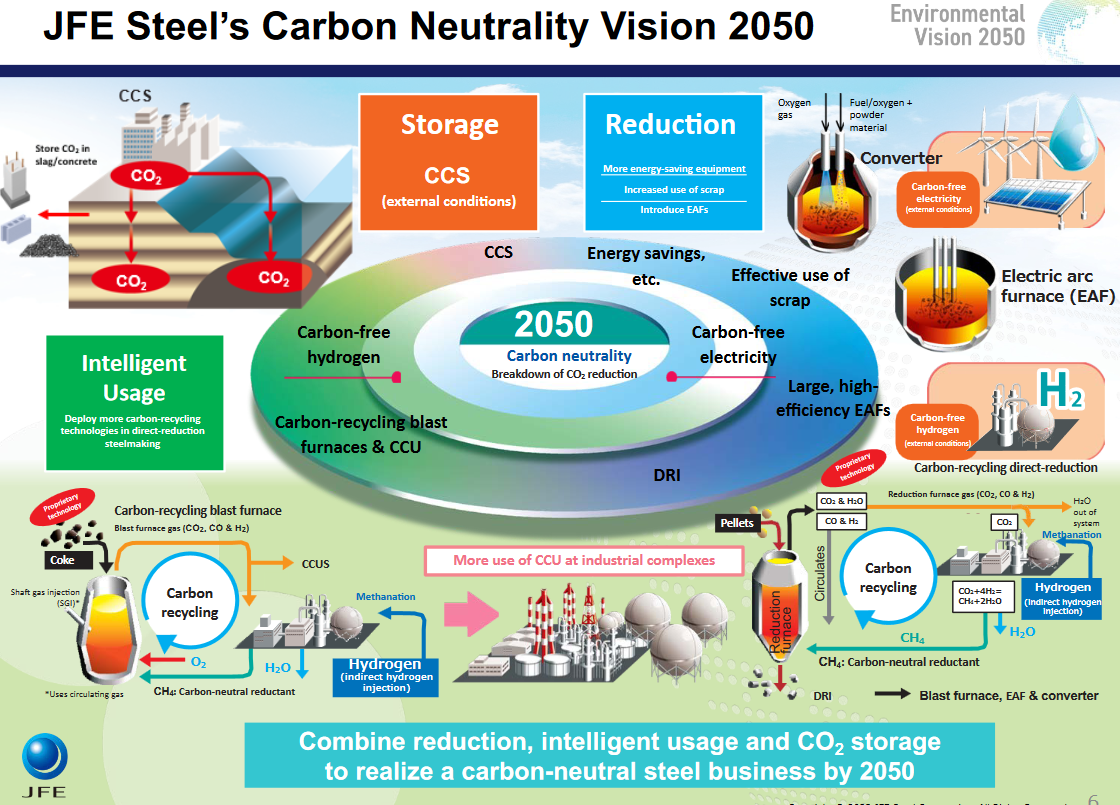
JFE Steel’s Vision for Carbon Neutrality
This infographic outlines JFE’s high-level strategy, providing context for the specific carbon recycling project discussed in the section.
(Source: Ignacio Ibarrondo – Iron and Steelmaking)
$430/ton Carbon Price, JFE Steel Methanol Production Economics
The economic viability of turning steel emissions into methanol hinges entirely on bridging the “green premium, ” a significant cost gap that requires substantial policy support and guaranteed revenue streams to overcome the higher expense of low-carbon production. Without intervention, the project’s economics are not competitive with conventional fossil-fuel-based methods. A carbon price exceeding $430.50 USD/ton-CO 2 would be required for green methanol to become cost-effective on its own.
- The cost to produce low-carbon e-methanol from captured CO 2 and green hydrogen is estimated to be between $518 and $1, 670 per ton. This is substantially higher than conventionally produced methanol, which costs between $100 and $450 per ton.
- Government policy is the primary mechanism to close this economic gap. Japan’s Ministry of Economy, Trade and Industry (METI) has already signaled its support for creating green product markets by offering a subsidy of approximately $535 (¥50, 000) for vehicles built with low-emission steel, creating a direct incentive for JFE‘s decarbonization investments.
- Long-term offtake agreements are the most critical financial lever for de-risking the high initial capital expenditure. These contracts, where a buyer commits to purchasing the methanol at a pre-agreed price, provide the revenue certainty needed to secure financing for the new production facility.
Table: Methanol Production Cost Comparison by Feedstock
| Methanol Type | Production Pathway | Estimated Cost per Ton (USD) | Source |
|---|---|---|---|
| Conventional | Natural Gas / Coal | $100 – $450 | C&EN |
| Blue Methanol | Natural Gas with CCUS | $400 – $550 | C&EN |
| Bio-Methanol | Biomass / Biogas | $580 – $1, 500 | Clean Technica |
| e-Methanol | Green Hydrogen + Captured CO 2 | $518 – $1, 670 | Science Direct |
JFE Steel 1 Mizushima Complex Partnership with Mitsubishi (2024-2026)
The JFE Steel and Mitsubishi Chemical collaboration is structured as a symbiotic relationship where each partner leverages its core competencies to build an integrated value chain. This model creates a significant competitive advantage that is difficult for standalone companies to replicate, combining a large-scale, concentrated emissions source with world-class chemical processing and market access.

How Carbon is Captured in Steelmaking
This flowchart directly illustrates JFE Steel’s role in the partnership by showing how CO2 is captured from the blast furnace for subsequent use.
(Source: Ignacio Ibarrondo – Iron and Steelmaking)

Process for Producing e-Fuels from CO2
This diagram visually explains the production pathway for e-Methanol, one of the high-cost, low-carbon methanol types listed in the section’s table.
(Source: Ignacio Ibarrondo – Iron and Steelmaking)
- JFE Steel‘s primary role is to supply a consistent, high-purity stream of captured CO 2 from its steelmaking operations at the Mizushima Complex. This transforms a waste liability into a valuable, revenue-generating feedstock for its partner.
- Mitsubishi Chemical and Mitsubishi Gas Chemical are responsible for the chemical engineering and commercial aspects. They will leverage their expertise to design, build, and operate the methanol synthesis plant and manage the marketing and sales of the final low-carbon product.
- The partnership extends to creating end markets. The produced methanol can be sold as a low-carbon feedstock for Mitsubishi Chemical‘s own production lines, creating a fully circular economy, or marketed to external sectors like marine transport, a primary target for green methanol.
Japan Industrial Hubs, JFE Steel’s CCUS Leadership
The JFE-Mitsubishi partnership solidifies Japan’s strategy of developing advanced industrial decarbonization solutions by concentrating CCU activities within existing industrial complexes. This approach leverages established infrastructure, minimizes transportation costs for captured CO 2, and fosters deep collaboration between emitters and users, positioning Japan as a testbed for circular economy models.
- The project is strategically located at the Mizushima Complex, demonstrating a clear focus on co-locating CO 2 sources and utilization facilities. This creates an efficient “carbon recycling supply chain” that is more practical and cost-effective than distributed or disparate models.
- This industrial hub strategy is heavily reliant on national industrial policy. The project’s success is linked to support from agencies like METI, framing it as a national strategic initiative to decarbonize hard-to-abate sectors and build a domestic market for green commodities.
- By proving this model, JFE Steel and its partners are creating a blueprint for decarbonizing other major industrial zones in Japan. This leadership provides a competitive advantage in a global market that is increasingly demanding sustainable supply chains. Similar hub-based projects are being explored by firms like BHP to support steelmakers.
Technology Readiness, JFE Steel’s Commercial-Scale Methanol Synthesis
The technological pathway for converting steel emissions to methanol is not a scientific research project but an engineering and integration challenge, as it relies on a combination of mature, commercially available components. The primary risk has shifted from technological feasibility to economic scalability and system integration.

Technical Process for Methanol Distillation
This detailed process diagram supports the section’s claim that the technology is mature, illustrating the established engineering steps for methanol purification.
- Data from 2025 confirms the high maturity of the core technologies. Point-source carbon capture, such as amine scrubbing, is considered commercially proven with a Technology Readiness Level (TRL) of 9.
- Likewise, the catalytic methanol synthesis process, typically using a copper-based catalyst, is rated at a TRL of 8–9, making it suitable for immediate industrial-scale deployment. A total carbon conversion ratio as high as 97.1% is achievable.
- The most critical technology variable is not the CO 2-to-methanol conversion itself, but the source of the hydrogen feedstock. The carbon intensity and cost of the final product are entirely dependent on whether the process uses conventional “gray” hydrogen or low-carbon “blue” or “green” hydrogen, which remains the most significant technical and economic uncertainty.
JFE Steel SWOT Analysis for CO 2-to-Methanol (2021-2026)
The partnership’s strengths lie in its strategic integration of mature technology and access to a concentrated CO 2 source, giving it a first-mover advantage in Japan’s circular economy. However, it faces significant economic threats from high production costs and relies heavily on external policy support and market development for its opportunities to be fully realized.
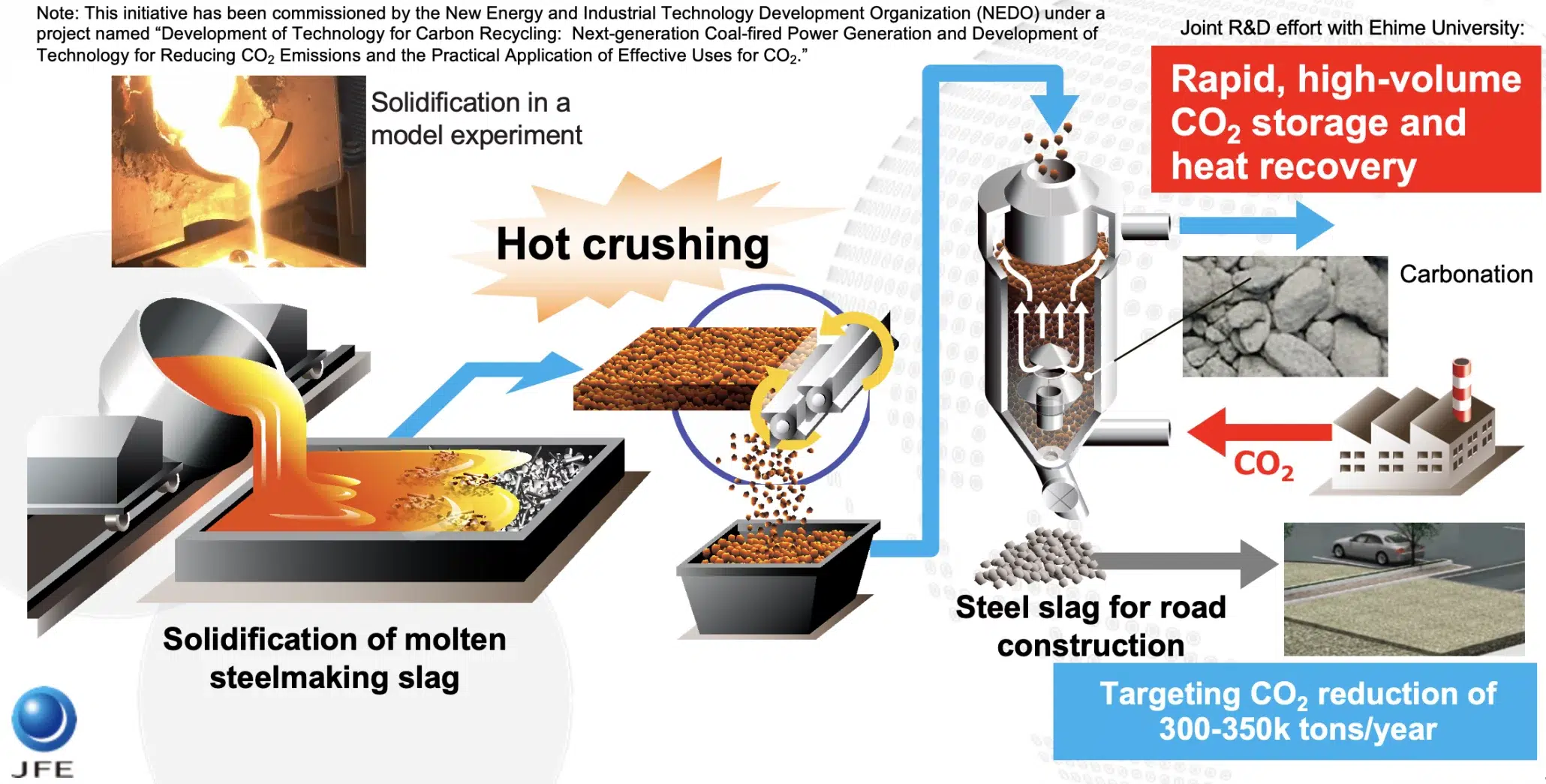
JFE Steel’s Carbon Capture via Slag
This diagram illustrates another of JFE Steel’s carbon recycling initiatives, reinforcing the ‘Strengths’ mentioned in the SWOT analysis by showcasing corporate expertise.
(Source: www.jfe-holdings.co.jp)
Table: SWOT Analysis of JFE Steel’s CO 2-to-Methanol Strategy
| SWOT Category | 2021 – 2024 | 2025 – 2026 | What Changed / Validated |
|---|---|---|---|
| Strengths | Conceptual partnership with a major chemical producer; Access to steelmaking off-gas as a feedstock. | First-mover advantage in Japan’s industrial CCU market; Integrated model combining CO 2 source (JFE) with chemical expertise (Mitsubishi). | The initial concept was validated as a powerful industrial symbiosis model, hard for competitors to replicate. |
| Weaknesses | Uncertain economics of CCU; High anticipated capital expenditure for a new synthesis plant. | High “green premium” with e-methanol costing up to $1, 670/ton vs. $450/ton for conventional; Dependency on an undefined, costly low-carbon hydrogen supply. | The cost gap (“green premium”) was quantified and confirmed as the single largest internal challenge. |
| Opportunities | Potential to create “green steel”; Growing global interest in methanol as a fuel. | Tangible demand from customers like Toyota for green steel; Marine fuel market emerges as a primary offtaker for green methanol; Japanese government subsidies (¥50, 000/vehicle). | Market demand for green products shifted from theoretical to concrete, with major customers and government incentives creating a viable revenue pathway. |
| Threats | Competition from other steel decarbonization pathways (e.g., green hydrogen DRI); Lack of strong carbon pricing in Japan. | Volatile renewable energy prices impacting green hydrogen cost; Insufficient policy support (carbon price below $430/ton) could make the project unbankable. | The project’s reliance on external factors like carbon pricing and offtake agreements became the most critical external risk factor. |
1 Critical Variable, JFE Steel’s Offtake Agreement Strategy
The single most critical factor determining the project’s success and scalability in the next 18 months is the signing of long-term, bankable offtake agreements for its low-carbon methanol. These agreements are necessary to de-risk the significant capital investment, secure financing, and prove to the market that a “green premium” for CCU-derived products is commercially sustainable.

Recycling Gas in a Steel Blast Furnace
This diagram illustrates the ‘Strength’ listed in the SWOT table by showing how JFE already captures and recycles off-gases, a core competency for the methanol project.
(Source: Ignacio Ibarrondo – Iron and Steelmaking)
- If this happens: JFE Steel or Mitsubishi Chemical announces a binding, multi-year offtake agreement with a major shipping line or chemical buyer for a significant volume of the plant’s output.
- Watch this: The price premium specified in the offtake contract. This figure will establish a critical benchmark for the commercial value of CCU-derived methanol in the Asian market and signal the bankability of similar industrial decarbonization projects.
- These could be happening: In response, other industrial pairings in Japan, such as Nippon Steel or Kobe Steel, may accelerate their own CCU partnership announcements to avoid ceding first-mover advantage. Concurrently, the Japanese government could introduce specific production tax credits or mandates for green methanol, directly mirroring the policy support already established for green steel.
The questions your competitors are already asking
This report covers one angle of turning steel emissions into commercial chemical feedstocks. The questions that matter most depend on your work.
- JFE Steel and Mitsubishi Chemical activities. Is the Mizushima plant project progressing from concept to commercial deployment on schedule for 2026?
- What is the outlook for deploying CCU-to-methanol technology across Japan’s steel sector by 2030?
- Which steel producers are adopting industrial symbiosis models to turn emissions into chemical feedstocks?
- What is the cost breakdown for producing methanol from steel emissions, and how does it compare to conventional production?
This report does not answer these. Enki Brief Pro does.
Your question, your angle, your framework. SWOT, PESTL, scenario modelling. The same niche depth, built around the decision your work actually depends on.
