

Thryve.Earth Agroforestry Removal, 635 k Tonnes Google Deal, 3 Offtakes, and 1 Sulawesi Project (2026)
Corporate Offtake Agreements, Thryve.Earth Signals VCM Maturation
The voluntary carbon market (VCM) is moving from a reliance on short-term, lower-quality avoidance credits, prevalent before 2024, to a new model defined by long-duration, high-integrity removal offtakes, exemplified by the 2026 Thryve.Earth agreements. This structural pivot is driven by sophisticated corporate buyers demanding measurable, permanent carbon dioxide removal (CDR) to meet their net-zero goals, providing the financial certainty needed to scale high-quality projects.
- Before 2025, corporate climate claims often relied on avoidance credits, such as those from prevented deforestation, which faced scrutiny over additionality and permanence. The market lacked the long-term price signals required to fund capital-intensive removal projects.
- The July 2026 Thryve.Earth deal signifies a structural change, with buyers like Google and Tencent committing to 10-year forward purchases of verified CDR. This provides developers with the bankable revenue streams necessary for project financing and execution.
- Buyer coalitions, such as the Symbiosis Coalition involving Google and Mc Kinsey, became a key mechanism in 2026 for aggregating demand, de-risking large-scale projects, and enforcing quality standards, a function that was fragmented in the earlier VCM.
- This shift is not isolated. It mirrors moves by other major corporations like Microsoft, which have also been securing multi-million tonne removal portfolios, indicating a broader industry trend toward direct climate impact investment over purchasing lower-quality offsets.
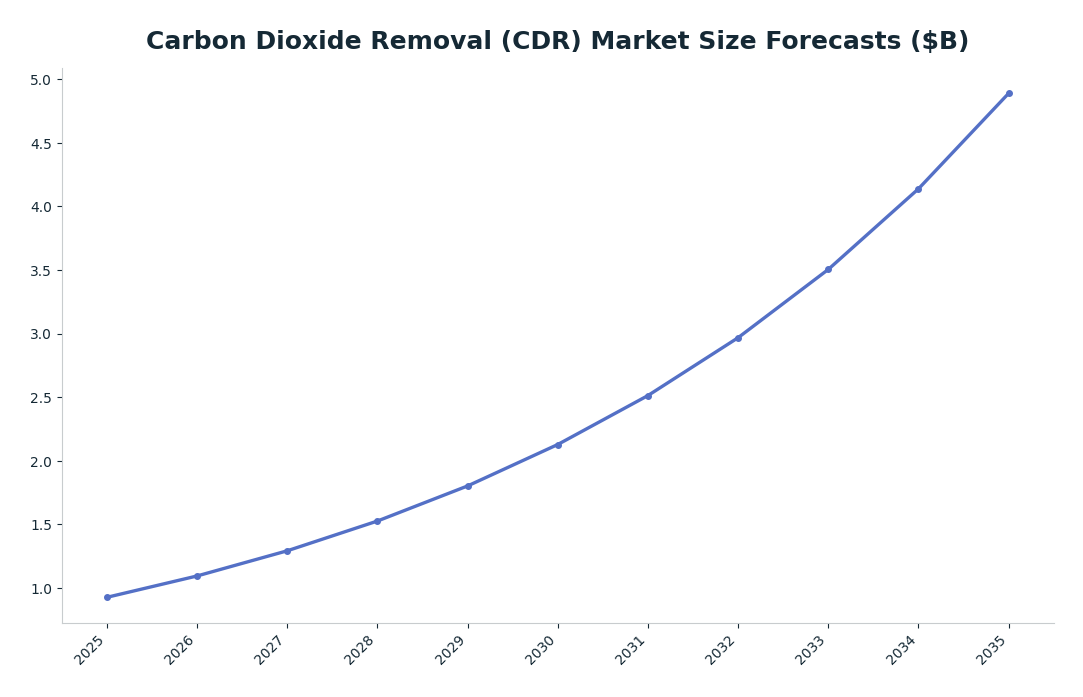
CDR Market Forecasts Nearly 450% Growth by 2035
The Carbon Dioxide Removal (CDR) market is forecast for substantial growth, projected to expand nearly five-fold from approximately $0.9B in 2025 to $4.9B by 2035. This upward trend signals a robust and increasing demand for permanent carbon solutions.
Corporate Demand Fuels CDR Market Validation and Scale
The sustained market growth shown validates corporate commitments to carbon removal, like Thryve.Earth’s contracts with Google, McKinsey, and Tencent. These long-term agreements are critical for de-risking investments and funding the scale-up of nascent CDR technologies, moving beyond speculative offsets.
Global Carbon Removal Market to Reach $4.89B by 2035
The Global Carbon Dioxide Removal Market is projected to reach USD 4.89 billion by 2035, growing at an 18.1% CAGR from 2026. In 2026, the market is already valued at $1,094.04 Mn, with Geological storage consistently being the dominant method, highlighting strong demand and investment in carbon removal solutions.
(Source: Carbon Dioxide Removal Market to Hit USD 4889.7 Mn by 2035)
Thryve.Earth 3 Corporate Alliances, Google and Tencent Deals (2026)
Thryve.Earth’s success in July 2026 was not built on a single transaction but on a structured, multi-partner approach that leveraged both direct agreements and a buyer coalition to secure the 635, 000-tonne commitment required for its large-scale agroforestry project. This strategy effectively distributed risk and aggregated demand to a level that could underwrite a major nature-based solution.
- The largest single commitment came from Tencent, which signed a direct 10-year offtake for 300, 000 tonnes. This transaction marked the tech firm’s first major CDR purchase outside of China and signaled its expanding global climate ambitions.
- The Symbiosis Coalition acted as a critical aggregator, coordinating a combined purchase of 335, 000 tonnes from Google (260, 000 tonnes) and Mc Kinsey & Co. (75, 000 tonnes), demonstrating the power of pooled procurement to unlock supply at scale.
- This coalition model is becoming increasingly important, similar to initiatives like Frontier, which uses advance market commitments to fund a portfolio of technology-based removal solutions from various suppliers, including those also working with companies like Google.
- The structure of these partnerships, with 10-year durations, provides the long-term financial certainty that was absent in the spot-market-dominated VCM of the early 2020 s, enabling developers like Thryve.Earth to finance capital-intensive restoration work.
Table: Thryve.Earth 2026 Partnership Breakdown
| Partner / Coalition | Time Frame | Details and Strategic Purpose | Source |
|---|---|---|---|
| Tencent | July 2026 | A 10-year direct offtake agreement for 300, 000 tonnes of carbon removal. This is Tencent’s first such deal outside China, supporting its 2030 carbon neutrality goal. | Tencent Signs 300000 Carbon Credit Deal in Landmark Move |
| Symbiosis Coalition (Google) | July 2026 | A 10-year offtake agreement for 260, 000 tonnes of carbon removal credits as part of a coordinated purchase. | Google supports Thryve.Earth agroforestry efforts |
| Symbiosis Coalition (Mc Kinsey & Co.) | July 2026 | An agreement to purchase 75, 000 tonnes of carbon removal credits, contributing to the coalition’s total 335, 000-tonne commitment to the project. | Tencent inks first deal for carbon-removal credits outside China |

CDR Market Sees Exponential Growth Driven by Major Tech Buyers
Durable Carbon Removal (CDR) purchases are experiencing rapid expansion, projected to reach 30 million tonnes by 2025, up from 641,000 tonnes in 2022. This 46-fold increase over three years is largely fueled by Microsoft’s aggressive procurement and contributions from other “Frontier Buyers”, signaling strong corporate commitment to net-zero targets.
Corporate Demand Outpaces Supply, Driving Premium for Scalable CDR Solutions
The dramatic increase in contracted tonnes highlights a critical supply-demand imbalance in the nascent CDR market. While major tech companies like Microsoft are front-running purchases, the growth curve indicates that innovative, verifiable, and scalable carbon removal technologies will command a significant premium, especially for projects coming online post-2025 to meet future demand.
Carbon Removal Investment Skyrockets, Led by Direct Air Capture
Investment in carbon removal technologies surged from $0.1 billion in H1’20 to $3.7 billion by H1″26, marking a 37x increase. Direct Air Capture (DAC) consistently attracts the largest share of this investment, highlighting its current leadership in attracting capital, while the deal count shows robust market activity.
Indonesia vs. Global, Thryve.Earth Nature-Based Project Focus
While the buyers in the Thryve.Earth deal are global corporations, the project’s location in Sulawesi, Indonesia, highlights Southeast Asia’s growing importance as a hub for high-quality, large-scale nature-based carbon removal projects. This represents a strategic geographic concentration compared to the dispersed and often smaller projects of the early 2020 s.
- Prior to 2024, many VCM projects were scattered globally with varying levels of quality control and community engagement. The market lacked a focus on regions with the potential for large-scale, high-impact restoration.
- The selection of Sulawesi for a 6, 000-hectare agroforestry project in 2026 signals a strategic focus on areas with significant degraded land, high potential for co-benefits like biodiversity and wildfire prevention, and a supportive local context.
- Tencent’s decision to source credits from Indonesia represents a significant international expansion for the company’s climate strategy, which had previously been China-focused, demonstrating growing confidence in projects in the region.
- This trend is not limited to Asia; other large-scale nature-based deals, such as Microsoft’s major agreement in Uganda, show a pattern of corporate buyers seeking high-impact projects in the Global South where climate solutions can deliver substantial ecological and social co-benefits.
635, 000 Tonnes, Thryve.Earth Validates Agroforestry CDR Scale
The Thryve.Earth agreement provides commercial validation that advanced agroforestry can deliver carbon removal at a scale sufficient to attract major corporate investment, moving it from a niche ecological practice to a bankable, industrial-scale climate solution in 2026. It establishes a market precedent for high-integrity, nature-based removals.
- In the years leading up to 2025, nature-based solutions were often perceived as difficult to scale and measure, with concerns about permanence and leakage that led some corporate buyers to favor engineered removals.
- Thryve.Earth’s model, which focuses on restoring degraded land with multi-layered farming systems rather than simple monoculture tree planting, demonstrates a more sophisticated and resilient approach to nature-based CDR that addresses these concerns.
- The 10-year, 635, 000-tonne commitment from sophisticated buyers like Google, Tencent, and Mc Kinsey serves as a powerful market signal, validating the methodology and MRV (monitoring, reporting, and verification) framework for this project type.
- This commercial validation places advanced agroforestry alongside other scaling CDR pathways, such as the photosynthesis-enhanced reforestation projects from companies like Living Carbon, which also secured offtakes from the Symbiosis Coalition in March 2026.
SWOT Analysis of VCM Maturation and Thryve.Earth’s Model
The Thryve.Earth agreements highlight key strengths and opportunities in the maturing voluntary carbon market but also expose underlying risks tied to project execution and market structure. The model’s success depends on balancing the high demand from corporate buyers with the operational realities of delivering large-scale, long-duration carbon removal.
Table: SWOT Analysis for Large-Scale Nature-Based CDR Offtakes
| SWOT Category | Strengths | Weaknesses | Opportunities | Threats |
|---|---|---|---|---|
| Thryve.Earth Model Analysis (2026) | Long-term (10-year) offtakes provide revenue certainty. Buyer coalitions (Symbiosis) de-risk projects. High-quality projects offer co-benefits (biodiversity, wildfire reduction). | Reliance on a few large corporate buyers creates concentration risk. Long delivery timelines (over a decade) introduce performance risk. Scaling this model is operationally complex. | Tapping into growing corporate net-zero demand. Replicating the model in other regions with degraded land. Attracting institutional investors alongside corporate buyers. | Evolving MRV standards could challenge credit validity retroactively. Reputational risk for buyers and sellers if projects under-deliver on carbon or social co-benefits. Competition from technology-based removals for funding. |
Scenario Modelling: Will Buyer Coalitions Dominate Thryve.Earth-Style Deals?
The primary signal to watch in the coming 12-18 months is whether the buyer coalition model, successfully used by the Symbiosis Coalition in the Thryve.Earth deal, becomes the dominant mechanism for funding large-scale carbon removal projects. This development would fundamentally reshape the supply side of the carbon market.
- If this trend accelerates, watch for the formation of new industry-specific or region-specific buyer coalitions. These groups will aim to aggregate demand and standardize procurement for both nature-based and technology-based CDR.
- A key signal of this trend gaining traction would be project developers increasingly structuring their offerings to meet the quality and MRV requirements of these large buyer groups, rather than pursuing bespoke, one-off deals.
- Conversely, a signal of this trend losing steam would be a return to fragmented, direct bilateral agreements, or if major buyers like Microsoft and Google pivot their large-scale commitments exclusively toward advanced market commitment vehicles like Frontier.
- This could be happening if smaller developers find themselves unable to meet the stringent requirements of coalitions, leading to market bifurcation between large projects funded by consortiums and a smaller, more fragmented market for other projects.
The questions your competitors are already asking
This report covers one angle of the corporate deals funding large-scale carbon removal. The questions that matter most depend on your work.
- Symbiosis Coalition other carbon removal projects
- Verifying carbon removal in agroforestry
- Other corporate deals for nature based carbon removal
- Carbon removal credit prices versus avoidance credit prices
This report does not answer these. Enki Brief Pro does.
Your question, your angle, your framework. SWOT, PESTL, scenario modelling. The same niche depth, built around the decision your work actually depends on.
