

DAC Market Dynamics, Microsoft’s 52 Mt Portfolio, Bio Circ Deal, and 63% Market Share Dependence (2021 to 2026)
CDR Market Risks, Microsoft’s Pause, and the Pressure for Buyer Diversification
Microsoft’s April 2026 pause on new Carbon Dioxide Removal (CDR) purchases, despite its massive existing portfolio, exposed the market’s dangerous over-reliance on a single buyer and forced a necessary, albeit painful, market recalibration toward a more diversified customer base. The company’s procurement strategy created the modern CDR market, but its subsequent pause acted as a demand shock that revealed deep structural fragilities. This event marks a critical inflection point, shifting the industry’s focus from servicing one anchor client to building a broader, more resilient foundation of demand.
- Between 2021 and early 2026, Microsoft established itself as the principal market maker, accumulating a portfolio of approximately 50 million tonnes of CDR and accounting for an estimated 87-96% of all durable removal purchases in 2025. This aggressive procurement was driven by its goal to be carbon negative by 2030.
- The strategic pause was a direct consequence of two conflicting pressures: a 25% surge in Microsoft’s carbon emissions, fueled by the energy demands of its AI data center expansion, and the high cost of the very CDR solutions it needed to offset this growth.
- The announcement sent a shockwave through the nascent industry, with reports describing the market as “reeling” from the decision. This reaction highlighted the critical dependence of many CDR suppliers on anticipated future contracts from Microsoft to underwrite their growth and financing.
- The situation forces a crucial market evolution, compelling CDR suppliers to actively court a wider range of customers and accelerating the importance of buyer coalitions. This makes organizations like Frontier, which aggregates demand from multiple corporations, central to the market’s next stage of development.
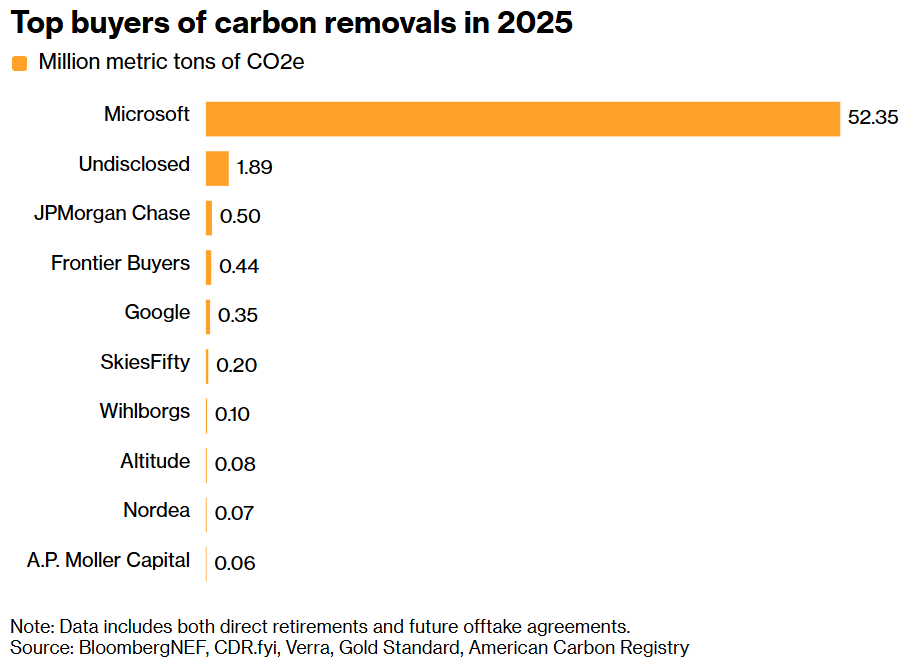
Microsoft Dominates Carbon Removal Market
Microsoft secured 52.35 million metric tons of carbon removal in 2025, significantly outpacing all other disclosed buyers. This establishes Microsoft as the undisputed leader in the carbon removal market, driving substantial capital into nascent CDR technologies.
CDR Market Maturation Hinges on Corporate Leadership
Microsoft’s overwhelming commitment (52.35 Mt, implying a significant portion like the 63% mentioned in the question) highlights the nascent CDR market’s heavy reliance on major corporate anchor buyers. This concentration fuels early-stage innovation but creates dependency risk for suppliers.
Microsoft Monopolizes Carbon Removal Demand Amidst Declining Investment
Microsoft overwhelmingly dominates the carbon removal market, purchasing over 27 million tonnes in 2025, accounting for more than 90% of the observed demand. This severe concentration of buyer power creates an imbalance as venture and growth investments in carbon capture & removal, while reaching a high of ~$2.3 billion in 2022, saw a dramatic drop in deal count from 90 in 2024 to 40 in 2025.
(Source: Durable CDR Market 2023: Year in Review & Key Trends | CDR.fyi)
$915 M Frontier Commitment, Microsoft’s Recalibration After 45 Mt Procurement Spree
While Microsoft’s pause on new deals created a significant demand-side risk, its existing portfolio of nearly 50 million tonnes and new capital injections from other major buyers signal a market transition rather than a collapse. The industry is moving from a model dependent on a single, dominant procurer to a more distributed multi-buyer ecosystem. Microsoft’s temporary retreat from new deal-making forces this maturation, compelling other corporations to translate climate pledges into tangible procurement contracts.
- By January 2026, Microsoft had contracted approximately 45 million tonnes of CDR, effectively underwriting the early stages of market development across various technologies. This figure grew to nearly 50 million tonnes with deals announced before the pause.
- The April 2026 procurement pause is best understood as a strategic recalibration, not a complete withdrawal. It allows the company to assess the performance and cost-effectiveness of its vast portfolio before committing further capital, a necessary step given its own rapidly increasing emissions.
- Microsoft’s 650, 000-tonne deal with Bio Circ in May 2026, shortly after the pause was reported, served as a crucial market signal. It demonstrated that the company’s program was not ending but was becoming more selective, focusing on deals that meet its evolving strategic criteria.
- The most significant counter-signal to the pause was the June 2026 announcement of a $915 million commitment to the Frontier advance market commitment vehicle. This funding, from tech leaders including Google and Anthropic, represents a critical diversification of the buyer base and provides a new demand channel for CDR suppliers.
Table: Key Microsoft CDR Market Events and Signals
| Partner / Project | Time Frame | Details and Strategic Purpose | Source |
|---|---|---|---|
| Frontier (Google, Anthropic) | June 2026 | Tech companies committed $915 million to the Frontier fund, diversifying the buyer base for carbon removal and creating a significant new demand signal independent of Microsoft. | WSJ Pro |
| Bio Circ | May 2026 | Microsoft announced a 650, 000-tonne biochar removal deal, its first major purchase after the pause was reported. The move was interpreted as a reassurance to the market of its continued, if more selective, commitment. | ESG Today |
| Market-Wide Pause | April 2026 | Reports emerged that Microsoft was pausing all new carbon removal purchases to conduct a portfolio review, creating a “demand shock” for the sector due to its outsized market share. | Heatmap News |
| Portfolio Milestone | January 2026 | Microsoft announced a series of deals that brought its total contracted CDR volume to 45 million tonnes, more than doubling its portfolio and cementing its status as the market’s primary buyer. | Carboncredits.com |
| Vaulted Deep | July 2025 | Microsoft signed a deal to purchase carbon removals from Vaulted Deep’s biomass-to-slurry process, showcasing its strategy of investing in a diverse range of technological pathways. | PR Newswire |
Global Impact of Microsoft’s CDR Strategy from the US to Europe
Microsoft’s procurement strategy has been global in scope, but its pause disproportionately affects North American and European CDR startups that had built business models anticipating continued aggressive purchasing from their primary anchor customer. The company’s actions first seeded projects worldwide and then introduced a uniform layer of commercial uncertainty, shifting the geographic focus toward regions with strong policy support that can buffer the volatility of corporate demand.
- Between 2021 and 2024, Microsoft’s global deal-making supported a range of international projects, including a significant Bioenergy with Carbon Capture and Storage (BECCS) agreement with Stockholm Exergi in Sweden. These early deals helped validate different technologies in various regulatory environments.
- The acceleration phase in 2025 and early 2026 saw major investments in the U.S., including large-scale deals for soil carbon with Indigo Ag and biomass sequestration with Vaulted Deep. This activity concentrated both opportunity and risk within the North American CDR ecosystem.
- The April 2026 procurement pause introduced significant uncertainty for the global pipeline of projects. This was particularly acute in the U.S., where many venture-backed Direct Air Capture and biochar companies had been relying on Microsoft’s demand signals to secure financing.
- The market’s future geographic distribution now depends more heavily on sovereign policy incentives, such as the U.S. Inflation Reduction Act’s 45 Q tax credits and emerging EU carbon removal frameworks, rather than being primarily shaped by a single corporation’s strategy. The approval for Climeworks to build a DAC plant in Louisiana is an example of a project moving forward where public policy and corporate offtake intersect.
CDR Technology Maturity, Microsoft’s Shift from Volume to Portfolio Optimization
Microsoft’s procurement strategy has transitioned from broad acquisition across a diverse technology portfolio to a more focused optimization of cost and durability, a change driven by the economic reality of offsetting its AI-related emissions. While the company’s early investments helped validate multiple CDR pathways, the 2026 pause indicates these technologies have not yet achieved the cost efficiency required for deployment at the massive scale Microsoft now needs.
- In the period from 2021 to 2024, Microsoft constructed a varied portfolio to stimulate the entire market, signing deals for nature-based solutions like soil carbon alongside engineered methods like biochar, BECCS, and Direct Air Capture (DAC).
- By 2025 and early 2026, the focus of new, larger deals shifted toward more durable and verifiable pathways. However, the high price of these permanent removals, with engineered solutions reportedly increasing in cost, created a direct conflict with the escalating volume of removals needed to meet its climate goals.
- The pause signals that while CDR technologies have advanced from concept to commercial pilots, their cost curves have not declined fast enough to be an economically viable countermeasure for the rapid, AI-driven growth in corporate emissions.
- The market now faces intense pressure to accelerate cost reductions, particularly for high-durability solutions like DAC and BECCS. The future of financing for DAC and other capital-intensive methods now hinges on demonstrating scalable, cost-effective operations to attract the broader coalition of buyers needed to replace Microsoft’s former role as the primary offtaker.
SWOT Analysis of Microsoft’s CDR Market Role
The strategic analysis shows Microsoft’s market-making role was a foundational strength for the nascent CDR industry but also created a critical weakness of single-buyer dependency. The 2026 pause presents an opportunity for necessary market diversification, but it simultaneously poses an existential threat to suppliers who cannot secure new customers quickly. This SWOT reveals a market at a decisive turning point, where its greatest catalyst has also become its most significant source of uncertainty.
Table: SWOT Analysis for the CDR Market’s Reliance on Microsoft
| SWOT Category | 2021 – 2023 | 2024 – 2026 | What Changed / Validated |
|---|---|---|---|
| Strength | Market creation through early, diverse deals (e.g., biochar, soil carbon) that provided initial revenue for startups. | De-risking of large-scale, durable CDR projects (e.g., BECCS, DAC) through multi-year offtake agreements totaling nearly 50 Mt. | The strategy shifted from catalyzing a wide range of technologies to validating their potential for deployment at a scale relevant to corporate climate goals. |
| Weakness | Limited number of viable, high-quality CDR suppliers and pathways, creating supply-side risk. | Extreme demand concentration, with Microsoft accounting for up to 96% of durable CDR purchases, creating a single point of failure. | The primary structural weakness shifted from a fragile supply base to a dangerously fragile and concentrated demand base. |
| Opportunity | Prove the technical viability of various CDR technologies across a portfolio. | Microsoft’s pause forces suppliers to diversify and creates a vacuum that new buyers (e.g., Frontier coalition) must fill, leading to a more resilient market. | The market opportunity has evolved from technology demonstration to commercial maturation and the development of a robust, multi-buyer ecosystem. |
| Threat | Technological failure or inability for CDR methods to scale affordably. | Market momentum stalls or collapses due to the “demand shock” from the pause, leading to supplier insolvency before new buyers can step in. | The primary threat transitioned from technical and scientific risk to acute commercial and financial risk centered on demand continuity. |

Microsoft Cornering 63% of CDR Market Amidst Lagging Investment
Microsoft is poised to dominate 63% of the global Carbon Dioxide Removal (CDR) market by 2026, purchasing 52 million tonnes. This hyper-concentration is evident as Microsoft’s 2025 purchases (nearly 28M tonnes) overwhelmingly outpaced all other buyers. Simultaneously, venture investments in CDR technologies declined significantly from a peak of ~$2.25 billion in 2022 to below $1 billion by 2025, alongside a sharp drop in the number of deals, indicating a supply-side crunch or lack of diverse investment interest.
Single-Buyer Dependency Poses Systemic Risk to CDR Market Growth
The CDR market’s heavy reliance on a single buyer, Microsoft, creates systemic risk and stifles broader market development. Declining venture capital, despite a clear anchor buyer, indicates underlying issues in scalability, cost-effectiveness, or a lack of diverse, strong demand signals from other corporations. This dependency inhibits the growth of a robust, diversified CDR ecosystem, making it vulnerable to shifts in Microsoft’s strategy and deterring wider corporate adoption.
Microsoft Dominates Corporate Carbon Removal Purchases
Microsoft acquired 52.35 million metric tons of CO2e in 2025, dwarfing all other known corporate buyers. This volume represents over 27 times the purchases of the next largest disclosed buyer, highlighting unparalleled leadership in corporate carbon removal.
(Source: Microsoft Isn’t Actually the Savior of Carbon Removal – Bloomberg)
Scenario Modeling Microsoft’s CDR Future After its 2026 Procurement Pause
The most critical indicator for the Carbon Dioxide Removal market over the next 12 months is the rate at which new corporate buyers, particularly those within the Frontier coalition, convert financial commitments into large-scale offtake agreements. The market’s ability to fill the demand vacuum left by Microsoft’s pause will determine whether this moment marks a stumble or the start of a more sustainable growth phase.
- If this happens: Other major tech companies like Google and financial institutions accelerate their own procurement programs, and Frontier announces several new offtake deals in the multi-hundred-thousand-tonne range by early 2027. Then watch this: The total market for durable CDR will likely exceed the 82.5 Mt projection for 2026 as supplier confidence returns, leading to new project financing announcements. This could be happening: The market is successfully diversifying its demand base, reducing systemic risk and proving that corporate climate action can extend beyond a single leader.
- If this happens: Microsoft formally resumes programmatic purchasing by mid-2027, following the completion of its internal portfolio review, perhaps with a focus on specific, cost-effective technologies. Then watch this: Microsoft will likely publish a new framework or set of criteria for its future CDR purchases, signaling a more mature and cost-conscious procurement strategy. This could be happening: Microsoft has identified a financially sustainable path to reconcile its AI-driven emissions growth with its 2030 carbon-negative goal, restoring its role as a market leader, albeit a more cautious one.
- If this happens: The market remains quiet through late 2026, with few major procurement announcements from new buyers and continued silence from Microsoft. Then watch this: News of smaller CDR suppliers delaying projects, laying off staff, or seeking distressed sales will begin to appear. This could be happening: The demand shock was too great for the nascent market to absorb, leading to a period of consolidation and failure that will significantly delay the scaling of carbon removal technologies.
The questions your competitors are already asking
This report covers one angle of the carbon removal market’s commercial development. The questions that matter most depend on your work.
- Companies buying carbon removal besides Microsoft
- Carbon removal projects getting new funding 2026
- Cost of direct air capture per ton today
- Frontier fund new carbon removal deals
This report does not answer these. Enki Brief Pro does.
Your question, your angle, your framework. SWOT, PESTL, scenario modelling. The same niche depth, built around the decision your work actually depends on.
