

USA Rare Earth Supply Chain Strategy, $1.6 B Commerce Dept. Funding, $2.8 B Serra Verde Deal, and 3 Partnerships (2025 to 2026)
Supply Chain Risk, USA Rare Earth’s $1.6 B Onshoring Mandate
The U.S. government’s direct financial intervention in USA Rare Earth marks a strategic pivot from acknowledging supply chain risk to actively funding a vertically integrated, domestic alternative to counter China’s market control. This federal action is designed to build a strategic national asset capable of mitigating decades of dependence on a single foreign source for materials critical to defense, energy, and transportation sectors.
- Prior to 2025, the U.S. approach to rare earth elements (REE) involved identifying vulnerabilities but largely relied on market forces and smaller-scale Department of Defense (Do D) grants to companies like Lynas Rare Earths. The finalization of the USA Rare Earth funding package in June 2026 represents a fundamental policy shift, committing substantial capital to construct a complete domestic supply chain.
- The $1.6 billion in financing through the CHIPS and Science Act is explicitly intended to establish a “mine-to-magnet” capability. This will connect feedstock from the company’s Round Top project in Texas with its processing and magnet manufacturing facility in Stillwater, Oklahoma, directly challenging China’s control of approximately 85% of global REE refining.
- This industrial strategy is reinforced by a clear demand signal from the U.S. military. A 2027 deadline will prohibit Chinese-origin rare earth magnets in defense platforms, creating a protected, foundational market for USA Rare Earth’s future output and de-risking offtake.
- The scale of this investment distinguishes it from previous efforts. While other domestic players like Energy Fuels are building out segments of the supply chain, the USA Rare Earth deal is the first attempt to fund a fully integrated domestic competitor from mining to finished product.
$1.6 B in Funding, USA Rare Earth Secures Federal Backing
The $1.6 billion funding package is not a conventional venture investment but a state-backed industrial policy action, providing USA Rare Earth with the capital to execute an otherwise prohibitively expensive and high-risk industrial build-out. This financing fundamentally changes the company’s ability to compete with state-subsidized foreign entities.
- The definitive agreements finalized with the Department of Commerce in June 2026 provide access to a total of $1.6 billion. This comprises $277 million in direct federal grants and a $1.3 billion senior secured loan capacity, which together underwrite the massive capital expenditure required.
- In a move to secure its upstream supply chain, USA Rare Earth also announced a definitive agreement in April 2026 to acquire Brazil’s Serra Verde Group for approximately $2.8 billion. The deal includes a 15-year, 100% offtake agreement, securing a vital, large-scale source of non-Chinese rare earth oxides.
- This government backing is critical when viewed against the company’s current financials. With just $5.7 million in revenue reported for Q 1 2026, the federal capital injection is the primary enabler, bridging the gap between its high market valuation (up to $5.87 billion) and its pre-commercial operational status.
Table: USA Rare Earth Strategic Funding and Acquisitions
| Partner / Project | Time Frame | Details and Strategic Purpose | Source |
|---|---|---|---|
| U.S. Department of Commerce | Jun 2026 | Finalized agreements for access to up to $1.6 billion in funding ($277 M grant, $1.3 B loan) via the CHIPS Act. This capital is designated for building a fully domestic, mine-to-magnet supply chain. | mining.com |
| Serra Verde Group | Apr 2026 | Announced definitive agreement to acquire the Brazilian REE producer for ~$2.8 billion. The deal includes a 15-year offtake agreement, securing a non-Chinese feedstock supply for its U.S. operations. | Nasdaq |
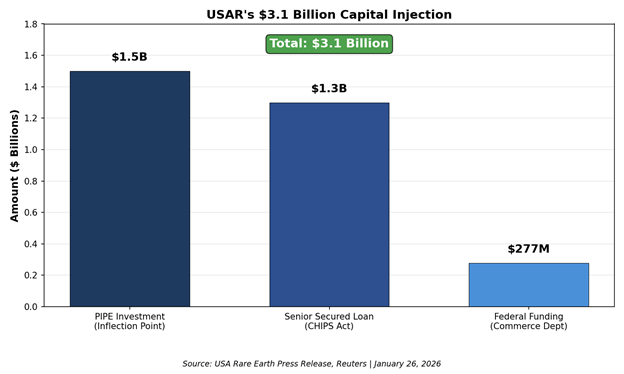
USAR Secures $3.1B Capital for Rare Earth Independence
USA Rare Earth (USAR) has secured a significant $3.1 billion capital injection, including $1.5 billion from PIPE investment, a $1.3 billion Senior Secured Loan under the CHIPS Act, and $277 million in Federal Funding from the Commerce Department, underscoring strong commitment to domestic rare earth supply chains.
De-risking Supply Chains & Boosting Domestic Production
This substantial funding aims to accelerate the development of a secure, domestic mine-to-magnet supply chain, mitigating reliance on foreign sources for critical materials essential for defense, EVs, and high-tech manufacturing. The CHIPS Act loan signals a broader strategic pivot beyond semiconductors to foundational critical minerals.
USA Rare Earth Secures $1.6B for Domestic Mine-to-Magnet Supply Chain
The Commerce Department’s $1.6B funding for USA Rare Earth signals a critical national initiative to establish a secure, domestic supply chain for rare earth elements and permanent magnets. This investment is set to reduce reliance on foreign sources, particularly in a market where geopolitical stability impacts key technologies from EVs to defense systems.
(Source: FEBRUARY ISSUE – The Rare Earth Scramble: Washington’s $1.6B Mine-to-Magnet Bet)
USA Rare Earth 3 Key Alliances, from Do D to Serra Verde (2026)
USA Rare Earth has structured three critical partnerships in 2026 that collectively de-risk its supply, demand, and financing, forming a complete ecosystem for its mine-to-magnet ambitions. These alliances create a protected environment for the company to scale its operations.
- The cornerstone partnership with the U.S. Department of Commerce provides the massive capital infusion (up to $1.6 billion) necessary to build out its industrial facilities. This public-private partnership gives the U.S. government a direct stake in the company’s success, aligning corporate goals with national security objectives.
- Strategic alignment with the Department of Defense provides a guaranteed end-market. The upcoming 2027 ban on Chinese-made magnets in U.S. military systems effectively creates a captive customer base for USA Rare Earth’s future production, insulating it from initial price competition with established Chinese suppliers.
- The acquisition of and 15-year offtake agreement with Brazil’s Serra Verde Group secures a large, stable, and non-Chinese source of rare earth oxides. This vertical integration on the upstream side mitigates feedstock supply risk, a critical vulnerability for any Western processor.
Table: USA Rare Earth Strategic Partnerships
| Partner / Project | Time Frame | Details and Strategic Purpose | Source |
|---|---|---|---|
| U.S. Department of Commerce | Jun 2026 | Finalized a public-private partnership for up to $1.6 billion in CHIPS Act funding to finance the construction of its integrated supply chain. | usare.com |
| Serra Verde Group | Apr 2026 | Acquisition and 100% offtake agreement to secure a 15-year supply of REE feedstock from Brazil, diversifying away from Chinese sources. | mining.com |
| U.S. Department of Defense | Mar 2026 | Ongoing collaboration to meet the requirements of the upcoming 2027 ban on Chinese magnets in military platforms, ensuring foundational demand. | investingnews.com |
US & Brazil vs. China, USA Rare Earth Geographic Realignment
USA Rare Earth’s strategy establishes a new Western Hemisphere-centric supply axis for critical minerals, directly challenging the long-standing China-dominated global map. This reshapes trade flows for some of the world’s most strategic commodities.
- Before 2025, the dominant geographical model involved mining REE in Western nations like the U.S. and Australia, only to ship the concentrates to China for the complex and capital-intensive stages of separation, refining, and magnet production.
- The model being built by USA Rare Earth creates a self-contained North and South American supply chain. Feedstock will be sourced from its Round Top project in Texas and the newly acquired Serra Verde mine in Brazil, with all subsequent value-add processing and manufacturing consolidated at its facility in Stillwater, Oklahoma.
- This action is a key pillar of a broader US Gov Critical Minerals strategy, which seeks to build resilient supply chains with allied nations. The Serra Verde acquisition is particularly notable as it leverages other U.S. government financial support for Brazilian REE projects.
- This regional consolidation strategy mirrors efforts by other allied governments to secure their own supply. For instance, the government of Canada has advanced its own critical minerals strategy, often in partnership with U.S. and European allies, to develop a North American mineral and manufacturing hub.
Commercial Scale Execution, USA Rare Earth’s Mine-to-Magnet Challenge
Despite monumental funding, USA Rare Earth is moving from a resource-validated stage to a high-risk commercial execution phase, with its success dependent on integrating multiple complex industrial processes at scale for the first time outside of China. The company’s valuation prices in flawless execution of one of the most difficult industrial challenges.
- Between 2021 and 2024, the primary focus for Western REE companies was on resource definition and securing early-stage funding. USA Rare Earth now faces the far greater challenge of translating its mineral assets and government financing into a commercially viable, at-scale manufacturing operation.
- The company’s stated production targets are ambitious, aiming for an annual capacity of 10, 000 metric tons of high-grade Nd Fe B permanent magnets by 2030. This requires mastering technical processes that have been dominated by Chinese firms for decades.
- The first major validation of its operational capability is expected in Q 4 2026, when the company projects it will deliver its first qualification-scale materials. Meeting this milestone is critical for building confidence with future commercial and defense customers.
- Significant execution risk remains. The company’s market capitalization has been reported as high as $5.87 billion despite minimal revenue, indicating that investors are betting on future success. Any delays or technical setbacks in the complex USA Rare Earth Processing plan could significantly impact its valuation.
$5.87 B Valuation, USA Rare Earth SWOT Analysis
USA Rare Earth’s primary strength is its unparalleled government backing, but this is offset by immense operational execution risks and a valuation that anticipates success before it is achieved. The company’s strategic position is formidable on paper, but its operational reality is still in its infancy.
- The company’s greatest Strength is the definitive financial and political backing from the U.S. government, which provides both capital and a guaranteed market via the Do D.
- Its most significant Weakness is the near-total lack of revenue and operational history in the highly complex fields of REE processing and magnet manufacturing, creating substantial execution risk.
- A major Opportunity lies in becoming the cornerstone of a secure North American magnet supply chain for the defense, EV, and renewable energy industries, a multi-billion dollar market.
- The primary Threat is the potential for technical failures in scaling production and the possibility of competitive reactions from China, such as price dumping, to undermine the viability of new Western producers.
Table: SWOT Analysis for USA Rare Earth
| SWOT Category | 2021 – 2024 | 2025 – 2026 | What Changed / Resolved / Validated |
|---|---|---|---|
| Strengths | Possessed a significant U.S.-based REE resource at Round Top, Texas. | Secured up to $1.6 B in U.S. government funding and acquired a major Brazilian REE asset (Serra Verde). | The company’s financial and resource positions were massively de-risked and validated by federal backing and strategic acquisition. |
| Weaknesses | Lacked the immense capital required to build out a full mine-to-magnet supply chain. No operational history in processing or magnet production. | Execution risk becomes the primary weakness. The company has capital but must now prove it can build and operate complex facilities. Minimal revenue ($5.7 M in Q 1 2026). | The problem shifted from a lack of capital to the challenge of successfully deploying it. The high valuation ($5.87 B) amplifies the risk of any execution stumbles. |
| Opportunities | Growing awareness of REE supply chain vulnerability and potential for government support. | A protected, foundational market created by the 2027 Do D ban on Chinese magnets. Massive commercial demand from EV and wind turbine manufacturers seeking non-Chinese supply. | The opportunity moved from theoretical to tangible, with a clear and guaranteed U.S. defense market and urgent commercial demand providing a strong offtake outlook. |
| Threats | Dominance of Chinese state-subsidized producers and risk of price manipulation. High technical barriers to entry. | Intensified execution risk and potential for targeted competitive actions from China to undermine the project’s economics. | The threat is now less about being unable to compete on a level playing field and more about the internal risk of failing to execute a complex industrial project on an aggressive timeline. |
USA Rare Earth Q 4 2026 Milestone, Qualification Material Delivery
The most critical near-term signal to watch is whether USA Rare Earth can deliver its first qualification-scale magnet materials by its stated Q 4 2026 deadline, as this will be the first tangible validation of its operational progress. This single event will serve as a major proof point for the entire U.S. onshoring strategy.
- If USA Rare Earth successfully delivers qualification materials on schedule, watch for a series of follow-on announcements. These would likely include initial offtake agreements or joint development partnerships with major defense contractors and potentially U.S. or European automotive OEMs.
- If the Q 4 2026 deadline is missed, watch for increased market scrutiny of the company’s execution capabilities and project timeline. A significant delay could trigger stock price volatility and raise questions about the viability of its aggressive 2030 production targets.
- These could be happening in the background: China may implement further export controls on rare earth processing technologies or finished magnets to disrupt nascent Western supply chains. Meanwhile, competitors like Australia’s Iluka Resources may be accelerating their own downstream processing plans to capture market share.
The questions your competitors are already asking
This report covers one angle of USA Rare Earth’s commercial trajectory. The questions that matter most depend on your work.
- Other US rare earth projects getting federal money
- Rare earth mining projects in Brazil and Australia
- Automakers and wind turbine companies signing rare earth deals
- China’s control over rare earth processing technology
This report does not answer these. Enki Brief Pro does.
Your question, your angle, your framework. SWOT, PESTL, scenario modelling. The same niche depth, built around the decision your work actually depends on.
