

Rio Tinto Critical Minerals Pivot, $900 M Codelco JV, 200, 000 Tonne Lithium Goal, and 7 Key Partnerships (2025-2026)
Critical Minerals Pivot, Rio Tinto’s Shift to Copper and Lithium
Rio Tinto is executing a decisive strategic pivot from its traditional reliance on iron ore to future-facing commodities, primarily copper and lithium, to supply the global energy transition and the AI data center boom. This shift, which accelerated between 2025 and 2026, is defined by aggressive production targets, significant capital deployment into specific projects, and a focus on joint ventures to de-risk growth, contrasting with a prior period focused more on optimizing its legacy iron ore business.
- Prior to 2025, Rio Tinto‘s growth narrative was dominated by its iron ore operations. The post-2025 strategy shows a clear re-allocation of capital and strategic focus, with the company targeting 1 million tonnes of annual copper output by 2030 and 200, 000 tonnes of lithium carbonate equivalent (LCE) capacity by 2028.
- The financial results validate this change, as copper’s contribution to profit nearly doubled to $7.4 billion in 2025. This performance is driven by the ramp-up of the Oyu Tolgoi underground mine and strong commodity prices, aligning the company with market projections of copper demand reaching 42 million metric tons by 2040.
- The company’s expansion is structured to meet escalating demand, with lithium markets expanding by 30% year-over-year in 2024. Rio Tinto‘s moves mirror broader industry trends where miners like Hudbay Minerals and Teck Resources are also securing capital for critical mineral projects.
- This pivot is not just about new mines but also about operational efficiency. Rio Tinto successfully lowered its 2026 copper C 1 unit cost guidance to $0.30–$0.50 per pound, a substantial improvement that strengthens its competitive position as it increases capital expenditures, which are forecast at $11 billion for 2025.
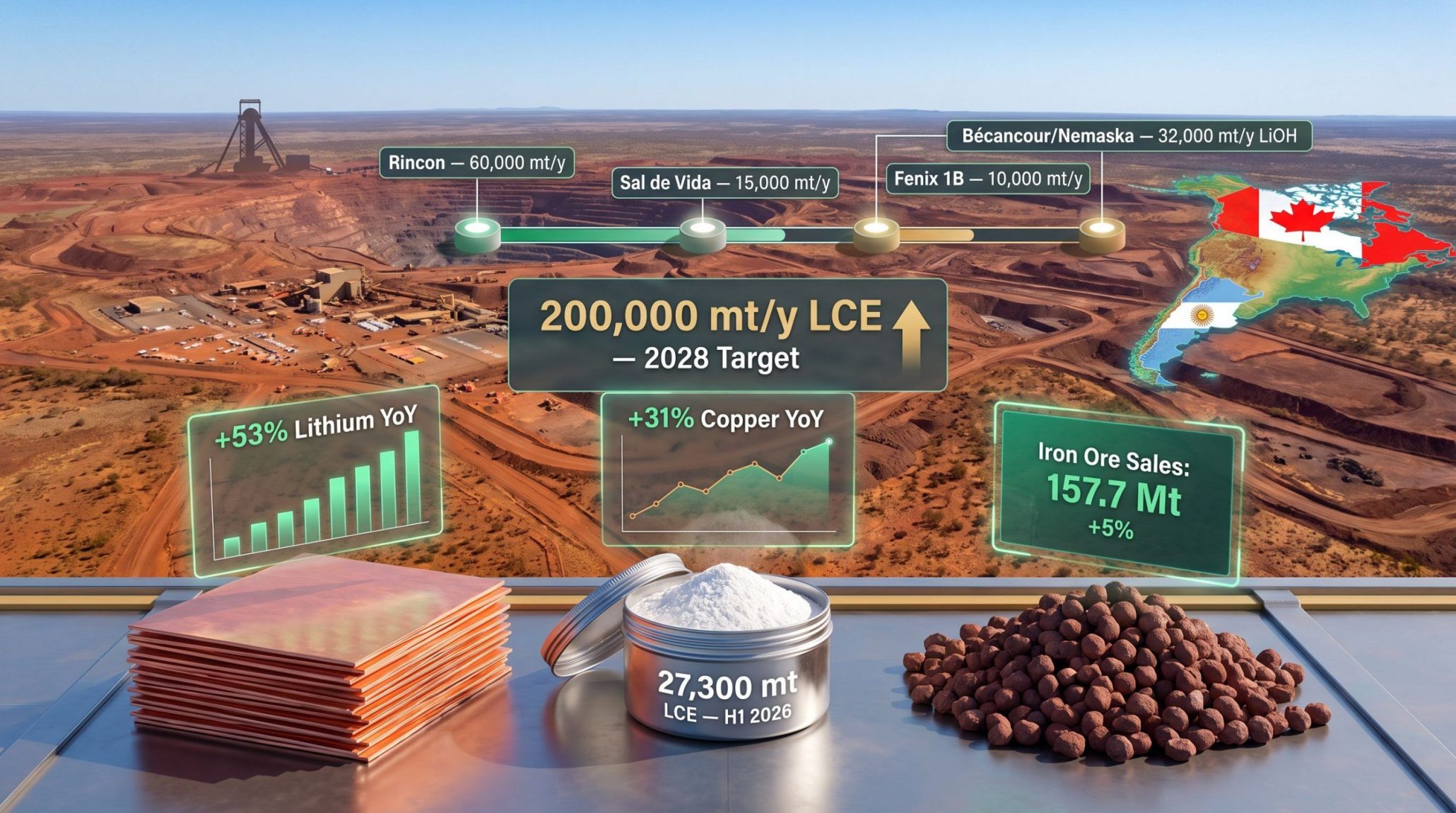
Rio Tinto Targets 200,000 mt/y LCE by 2028, Driving Lithium & Copper Growth
Rio Tinto is aggressively expanding its critical minerals portfolio, targeting 200,000 mt/y LCE (Lithium Carbonate Equivalent) by 2028 from key projects in Argentina and Canada, including Rincon, Sal de Vida, Fenix 1B, and Bécancour/Nemaska. This strategy is already yielding results, with a notable +53% Lithium YoY and +31% Copper YoY growth, alongside 27,300 mt LCE produced in H1 2026.
Strategic Mineral Expansion De-risks Supply for EV & Energy Transition
This significant ramp-up in lithium and copper production signals Rio Tinto’s commitment to capitalizing on the surging demand for critical minerals essential for electric vehicles and renewable energy storage. The geographical diversity of these projects (Argentina, Canada) also enhances supply chain resilience amidst global geopolitical shifts, ensuring future material security.
Lithium Dominates U.S. Mining Project Spending; Rio Tinto Second
Lithium Americas leads U.S. mining project spending at nearly $2.9 billion across 2.3 projects, signaling significant investment in critical battery minerals. Rio Tinto follows closely with over $2.5 billion for 3 projects, highlighting its strategic focus on expansion within the U.S.
(Source: Coal Zoom | Forging a Supermajor: What a Rio-Glencore Merger Means for Metals and Mining)
$4.8 B in Capital, Rio Tinto’s Lithium and Copper Project Investments
Rio Tinto has committed over $4.8 billion in announced capital towards its lithium and copper expansion between late 2024 and 2026, using a combination of direct project investment and strategic joint venture buy-ins to accelerate its entry into key production regions. This investment strategy marks a clear departure from its indefinite suspension of the Jadar project in Serbia and the dropped merger talks with Glencore in February 2026, indicating a preference for targeted, de-risked organic growth over large-scale M&A or politically complex greenfield developments.
Table: Rio Tinto Strategic Investments (2025-2026)
| Partner / Project | Time Frame | Details and Strategic Purpose | Source |
|---|---|---|---|
| Rincón Lithium Project | Mar 2026 | Secured a $1.175 billion financing package, including support from the International Finance Corporation (IFC), for the project’s development in Argentina. This follows an initial $2.5 billion investment decision to build out the asset. | Rio Tinto secures $1.175 billion financing package |
| ENAMI (Salares Altoandinos) | Jul 2025 | Committed to invest up to $425 million to acquire a 51% controlling interest in the Salares Altoandinos lithium project in Chile. The partnership provides access to new brine assets for deploying Direct Lithium Extraction technology. | Rio Tinto and ENAMI sign binding agreement |
| Codelco (Salar de Maricunga) | May 2025 | Agreed to invest up to $900 million to form a joint venture with Chile’s state-owned Codelco, acquiring a 49.99% interest to develop the Salar de Maricunga lithium project. | Rio Tinto strikes near $1 bn deal in Chilean lithium project |
Rio Tinto 7 Strategic JVs, Codelco to ENAMI (2025-2026)
Instead of pursuing a singular, large-scale acquisition, Rio Tinto has structured its growth around a network of strategic partnerships and joint ventures, primarily between 2025 and 2026, to gain access to high-quality assets while sharing capital and geopolitical risk. This collaborative model, particularly evident in Chile’s lithium sector, allows the company to partner with state-owned entities, securing a social license to operate in regions with rising resource nationalism.
Table: Rio Tinto Critical Mineral Partnerships (2025-2026)
| Partner | Time Frame | Details and Strategic Purpose | Source |
|---|---|---|---|
| International Finance Corporation (IFC) | Mar 2026 | Financing partnership to support the development of the Rincón Lithium Project in Argentina, focusing on job creation and strengthening the regional critical minerals sector. | IFC Partners with Rio Tinto on Rincón Lithium Project |
| Prysmian | Mar 2026 | Industrial partnership to deploy low-carbon aluminium cable solutions for data centres, directly linking Rio Tinto‘s mineral output to the AI infrastructure supply chain. | Rio Tinto Projects Link Copper Aluminium And Lithium To AI |
| Ideon Technologies | Oct 2025 | Global partnership to apply cosmic-ray muon tomography for subsurface mapping. This technology aims to accelerate discovery and reduce the costs of finding new critical mineral deposits. | Ideon and Rio Tinto Global Partnership |
| ENAMI | Jul 2025 | Formation of a joint venture for the Salares Altoandinos lithium project in Chile, with Rio Tinto taking a controlling interest to explore and develop new lithium brine resources. | Rio Tinto signs JV deal for Chile lithium project |
| Codelco | May 2025 | Joint venture to develop the Salar de Maricunga lithium project in Chile, combining Rio Tinto‘s capital and technical expertise with Codelco‘s asset ownership and local presence. | Rio Tinto partners with Codelco to develop lithium project |
South America vs. North America, Rio Tinto’s Geographic Focus
Rio Tinto’s critical minerals expansion is heavily concentrated in the Americas, with a clear strategic split: South America is the center of its lithium ambitions, while North America and Mongolia anchor its copper growth. This geographic focus intensified significantly post-2024, with major investments and partnerships targeting lithium brines in Argentina and Chile, while existing copper assets in the U.S. and Mongolia are scaled up.
- South America (Lithium Hub): The company’s lithium strategy is almost entirely focused on the “Lithium Triangle.” It is advancing the Rincon project in Argentina toward first production in 2028 and has established major JVs with state-owned firms in Chile (Codelco and ENAMI) to develop the Maricunga and Altoandinos salars. This contrasts with its pre-2024 activity, which included the now-suspended Jadar project in Europe.
- North America & Asia (Copper Growth): Copper growth is driven by the ramp-up of the massive Oyu Tolgoi underground mine in Mongolia, which is the primary source of its increased production volumes in 2025 and 2026. In the U.S., the company operates the Kennecott mine and is advancing the Resolution Copper project in Arizona, which it expects to open by the mid-2030 s. These efforts align with broader government initiatives for USA rare earth processing and securing domestic supply chains.
- Geopolitical Risk Exposure: This geographic concentration exposes Rio Tinto to significant geopolitical risks, including resource nationalism in Chile, permitting challenges in the U.S., and complex negotiations with the Mongolian government over the Oyu Tolgoi deal terms. These regional challenges are a primary driver for its JV-heavy strategy, which aims to build local support. Other nations like Canada are also working to build critical mineral supply chains.

Copper Becomes Key Critical Mineral Contributor to EBITDA, Lithium Remains Minor by H1 2026
By H1 2026, Copper is projected to contribute a significant 36% to Rio Tinto’s underlying EBITDA, making it the dominant critical mineral within its portfolio. Lithium, despite its strategic importance, contributes only a marginal 1%, with Iron Ore retaining the largest share at 43%.
Copper Aligns with Energy Transition, Lithium Represents Long-Term Growth Potential
Copper’s substantial contribution reinforces its role in the global energy transition, validating Rio Tinto’s strategic focus on electrification materials. Lithium’s minimal share signals that its full impact on the company’s financials is a long-term play, requiring sustained investment to capitalize on future EV and battery demand rather than short-term returns.
Rio Tinto’s FY2026 Ebitda Heavily Leans on Iron Ore & Copper
Rio Tinto’s projected FY2026 Ebitda mix shows Iron Ore contributing nearly 50%, with Copper representing a significant ~27%. This highlights its established exposure to key base metals, crucial for existing industrial demand and early-stage energy transition needs.
Technology Deployment, Rio Tinto’s Use of DLE and Nuton
Rio Tinto is deploying proprietary and emerging technologies to establish a competitive advantage in both cost and sustainability, a key pillar of its strategy that gained momentum in 2025. The company is banking on Direct Lithium Extraction (DLE) to unlock its Chilean assets and its in-house Nuton technology to improve copper recovery rates from new and existing resources, positioning these innovations as critical enablers for its growth targets.
- Direct Lithium Extraction (DLE): In the period before 2025, DLE was largely in pilot stages across the industry. Rio Tinto‘s JVs in Chile with Codelco and ENAMI are explicitly designed to deploy DLE technology at scale. This technology promises higher recovery rates and significantly lower water usage compared to traditional evaporation ponds, which is critical for operating in arid regions and securing environmental permits.
- Nuton™ Copper Technology: In December 2025, Rio Tinto announced its proprietary Nuton™ technology produced its first copper. The technology is designed to leach copper from low-grade ores and waste materials, potentially increasing recovery rates up to 85%. It also offers significant environmental benefits, with claims of using up to 80% less water and generating 60% lower carbon emissions.
- Technology as a De-Risking Tool: The successful scaling of these technologies is fundamental to the economic viability of Rio Tinto‘s project pipeline. While DLE and Nuton carry their own technical and scaling risks, they are also positioned as solutions to the environmental, social, and governance (ESG) challenges that have stalled mining projects globally, such as the company’s own Jadar project.
Rio Tinto’s 2027 Outlook: Will Project Execution Match Targets?
The central question for Rio Tinto moving into 2027 is whether its operational execution can keep pace with its ambitious production targets and capital deployment schedule for copper and lithium. Having committed to a high-risk, high-reward strategy centered on organic growth and new technologies, the company’s success now hinges entirely on disciplined project management and navigating complex geopolitical landscapes.
- Signal to Watch (Project Milestones): Progress at the Rincon lithium project in Argentina will be a key indicator. Watch for updates on construction timelines and initial production, currently slated for 2028. Any delays could signal broader challenges in scaling DLE technology or navigating regional permitting.
- Signal to Watch (Cost Discipline): The company’s ability to maintain its low copper C 1 cost guidance ($0.30–$0.50/lb) will be critical. Monitor quarterly production reports for any revisions to this guidance, as inflationary pressures or lower by-product credits could erode the profitability that funds its expansion.
- Signal to Watch (Geopolitical Developments): Developments in Chile and Mongolia require close attention. Successful negotiations and stable operating agreements with the governments are necessary for the Chilean lithium JVs and the Oyu Tolgoi copper mine to deliver on their long-term potential.
The questions your competitors are already asking
This report covers one angle of Rio Tinto’s strategic shift into copper and lithium. The questions that matter most depend on your work.
- BHP copper and lithium strategy
- Direct lithium extraction commercial projects
- Chile new mining royalty impact
- Resolution Copper mine permitting status
This report does not answer these. Enki Brief Pro does.
Your question, your angle, your framework. SWOT, PESTL, scenario modelling. The same niche depth, built around the decision your work actually depends on.
