

Moog Data Center Pump Capacity, $100 M Revenue Surge, 1, 300 Pumps/Week Production, and 3 Factory Lines (2025-2026)
AI Demand Shock, Moog Responds with Rapid Production Scaling
The AI-driven shift to direct-to-chip liquid cooling has created an intense demand shock for specialized component suppliers, forcing companies like Moog Inc. to execute unprecedented production ramps to secure a foothold in the rapidly expanding data center market.
Hyperscale Demand Triggers Component Bottleneck
The proliferation of high-density AI clusters is pushing rack power densities towards 140 kilowatts, making traditional air cooling obsolete and creating an urgent, large-scale need for liquid cooling solutions. Before 2025, the market for specialized components like high-reliability liquid cooling pumps was a niche segment. The sudden, massive orders from hyperscale data center operators since 2025 have strained the supply chain, creating bottlenecks for critical components like pumps, which are essential for Coolant Distribution Units (CDUs).
Moog’s Revenue Quadruples in One Year
Moog has capitalized on this demand shock, with its data center cooling pump revenue projected to nearly quadruple from approximately $25 million in fiscal year 2025 to nearly $100 million in fiscal year 2026. This single product line is responsible for approximately half of the Industrial segment’s 18% year-over-year revenue growth reported in Q 3 2026. This demonstrates a broader industry trend where established industrial technology companies can pivot core competencies to capture explosive growth in adjacent high-tech markets. The broader market for data center liquid cooling is being addressed by numerous players including Trane and Siemens.
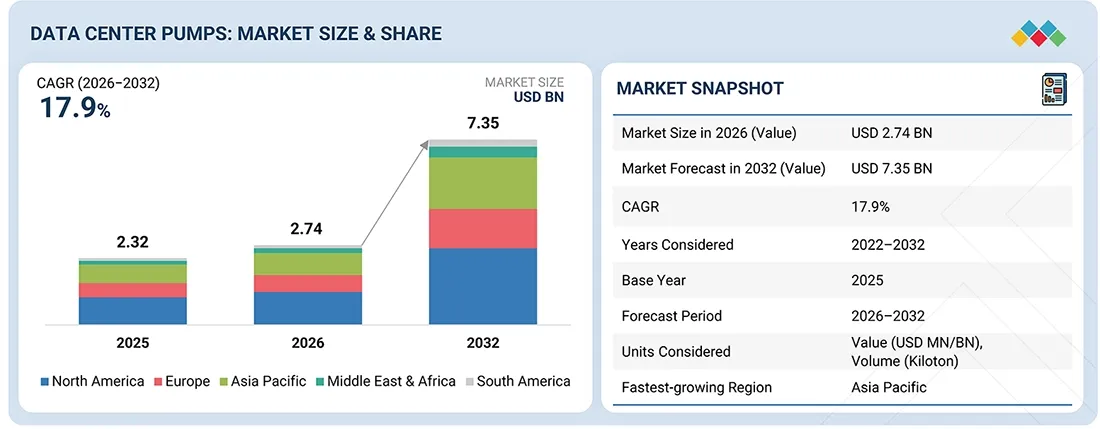
Data Center Pump Market to Grow 2.7x by 2032, Hitting $7.35B
The global data center pump market is set for rapid expansion, projecting a 17.9% CAGR from 2026 to 2032, reaching $7.35 billion. This surge from $2.74 billion in 2026 underscores massive scaling needs for cooling infrastructure, directly impacting manufacturing capacity planning.
Asia-Pacific Dominance Signals Strategic Manufacturing Shift
Asia-Pacific is highlighted as the fastest-growing region, implying that future manufacturing capacity expansion for data center pumps, especially for FY2027 production, must heavily prioritize this region. Ignoring this shift risks missing out on the largest emerging market share and incurring higher logistics costs.
(Source: Data Center Cooling CDU Pumps Market Size to Hit USD 5,500.47 Million by 2035)
$100 M Revenue Target, Moog’s Murphy NC Facility Expansion
To meet its aggressive revenue targets, Moog has concentrated its strategic investments on a rapid, focused expansion of its manufacturing capabilities at its Murphy, North Carolina facility, creating a blueprint for high-volume production.
Moog’s 1, 300 Pump-Per-Week Capacity
Moog’s primary investment has been in scaling its production infrastructure, adding new shifts and production lines to reach a current capacity of approximately 1, 300 pumps per week as of July 2026. This represents a dramatic increase from an initial ~70 pumps per week, highlighting the speed and scale of the ramp-up required by its hyperscale customer. The company has explicitly stated that both current and next-generation data center pumps are planned for production in fiscal year 2027, signaling a long-term investment commitment beyond the current demand spike.
Murphy Facility as a Strategic Asset
The Murphy, NC facility has become the central hub for Moog’s data center business, with the company operating three dedicated production lines for these pumps. This successful high-volume ramp serves as an internal proof-of-concept for Moog, providing valuable experience for anticipated production increases in its defense and space segments. The operational excellence at the facility was recognized with the 2026 Manufacturing Excellence Leadership Award, validating its investment in scaling and process improvement.
Table: Moog Inc. Strategic Investments and Capacity Expansions (2025-2026)
| Partner / Project | Time Frame | Details and Strategic Purpose | Source |
|---|---|---|---|
| Data Center Pump Production Ramp | 2026 | Expansion at Murphy, NC facility to three production lines, reaching a capacity of 1, 300 pumps per week to meet hyperscale data center demand. | Seeking Alpha |
| COTSWORKS Inc. | 2025 | Acquired the company to expand its portfolio of fiber optic components for the Space and Defense markets. | Moog Inc. |
| Electromechanical Actuation Facility | 2025 | Opened a new facility in East Aurora, NY, to increase manufacturing and R&D capacity for space and defense actuation systems. | WKBW |
Moog’s Concentrated Partnership Model, 1 Hyperscaler via 2 CDUs
Moog’s current growth is driven by a highly concentrated partnership structure, depending on a single hyperscale end-user through two intermediary Coolant Distribution Unit (CDU) manufacturers, creating both explosive short-term growth and significant long-term risk.
The Double-Edged Sword of Customer Concentration
The entirety of Moog’s near-$100 million data center pump business in FY 2026 is attributed to a single, unnamed hyperscale customer. This arrangement, while fueling incredible growth, makes the revenue stream highly vulnerable to the strategic shifts, purchasing decisions, or supplier diversification of one end-user. The company’s next strategic challenge is to leverage its proven execution to diversify its customer base among other hyperscalers and colocation providers to de-risk its outlook for FY 2027 and beyond. This is a common challenge for companies in the supply chain for major tech players like Intel and IBM.
Core Motion Technology as a Lure for New Partners
The key to attracting new partners is Moog’s proprietary Core Motion™ technology, which features magnetic pumps with intelligent controls designed for high-efficiency, direct-to-chip liquid cooling. This technology provides higher flow in a smaller, more power-efficient package, a critical value proposition for data centers facing space and energy constraints. Moog’s demonstrated ability to scale production of this advanced technology to 1, 300 units per week serves as a powerful proof-of-concept for other potential clients, transforming a successful delivery into a potent marketing tool.
North Carolina Focus, Moog Manufacturing Hub for Global AI Demand
Moog has strategically centralized its data center pump manufacturing ramp-up in its Murphy, North Carolina facility, establishing it as a critical production hub to serve the burgeoning global demand for AI infrastructure.
Murphy, NC: The Epicenter of Moog’s Pump Production
The Murphy, NC site is the exclusive location for the company’s data center pump production, with all three dedicated manufacturing lines housed there. This geographic concentration allows Moog to consolidate expertise, streamline supply chains, and rapidly iterate on production processes, which was critical to scaling from ~70 to 1, 300 pumps per week. This contrasts with the period before 2025, where the product was likely in a lower-volume or development stage without a dedicated, scaled manufacturing center.
Moog’s Broader US Manufacturing Footprint
While Murphy is the data center hub, Moog maintains a significant manufacturing presence elsewhere in the U.S. for its other core business segments. For example, the company expanded its space and defense manufacturing in East Aurora, New York, in June 2025. This regional specialization strategy allows each facility to develop deep domain expertise, whether in high-reliability aerospace components or high-volume data center pumps, while still benefiting from shared corporate knowledge on scaling and manufacturing excellence.
Commercial Scale, Moog Adapts Motion Control Tech for Data Centers
Moog successfully adapted its mature, high-reliability motion and fluid control technology for the new, high-volume data center market, proving the commercial viability and scalability of its Core Motion™ pumps for a demanding new application.
Adapting Legacy Expertise for a New Market
The core technology behind Moog’s pumps, including magnetic bearings and intelligent fluid controls, is derived from its long history in high-performance industrial and aerospace applications, which were well-established before 2024. The key technological shift from 2025 onwards was not invention but application and industrialization: redesigning the technology for the cost, volume, and reliability requirements of the data center industry. The successful production ramp to 1, 300 units per week validates that the technology is now at full commercial scale for this market, moving beyond the pilot or development phase. Other industrial giants like Johnson Controls have made similar pivots to address the AI cooling boom.
FY 2027 Next-Generation Pump Roadmap
Moog is not resting on its current success, with plans already in place for the production of next-generation data center cooling pumps during fiscal year 2027. This indicates a forward-looking product roadmap designed to meet the evolving thermal management needs of future AI hardware, which will likely require even higher performance. This proactive development cycle is crucial for maintaining a competitive edge and cementing long-term relationships with hyperscale customers who plan their infrastructure years in advance.
SWOT Analysis, Moog’s Data Center Pump Business
Moog’s entry into the data center cooling market is characterized by strong technological differentiation and rapid execution, but this strength is counterbalanced by significant risk from customer concentration and broader industry supply chain pressures.
- Strengths: Proven, high-performance Core Motion™ pump technology and demonstrated ability to rapidly scale manufacturing to high volumes.
- Weaknesses: Extreme revenue dependence on a single, unnamed hyperscale customer, creating significant concentration risk.
- Opportunities: A massive and fast-growing market for data center liquid cooling, with clear potential to diversify its customer base to other hyperscalers and colocation providers.
- Threats: Potential for the primary customer to switch suppliers or dual-source, and broader supply chain constraints for advanced cooling components affecting the entire industry.
Table: SWOT Analysis for Moog’s Data Center Pump Business
| SWOT Category | 2021 – 2024 | 2025 – Today | What Changed / Validated |
|---|---|---|---|
| Strength | Core expertise in high-performance motion and fluid controls for industrial/aerospace markets. | Proven Core Motion™ pump technology and a demonstrated ability to scale manufacturing to 1, 300 pumps/week. | The company successfully adapted its legacy expertise to a new, high-volume market and validated its manufacturing prowess at scale. |
| Weakness | No significant presence or revenue stream in the data center market. Product likely in development or niche application phase. | Extreme revenue concentration, with nearly $100 M in FY 2026 sales tied to a single hyperscale customer via two CDU partners. | The rapid success created a new, significant business risk that now requires strategic management and diversification efforts. |
| Opportunity | Emerging need for liquid cooling in data centers as a potential new market for fluid control technology. | A booming liquid cooling market projected to grow at a CAGR of over 20-30%. Proven success serves as a case study to attract new hyperscale clients. | The opportunity moved from theoretical to tangible. Moog is now a validated supplier in a multi-billion dollar growth market. |
| Threat | General competition in industrial controls markets from established players. | Primary customer could diversify its supply chain. Competitors are also entering the liquid cooling market. Industry-wide supply chain constraints. | Threats became more specific and acute, shifting from general competition to the specific risk of losing a key account or facing new, focused rivals. |
Scenario Modeling, Moog’s Path to Customer Diversification in 2027
Moog’s primary strategic imperative for fiscal year 2027 is to leverage its proven manufacturing scale to diversify its hyperscale customer base, mitigating the concentration risk inherent in its current success.
- If Moog announces a new design win with a different hyperscaler or a major colocation provider in its quarterly earnings, watch for a positive stock reaction and upward revisions to its long-term revenue forecast for the industrial segment. This would signal that its diversification strategy is succeeding.
- If competitors like Juniper or other industrial players announce new, high-volume pump manufacturing capabilities, watch for commentary from Moog on market competition and potential margin pressure. This would indicate the competitive field is intensifying.
- If reports emerge that Moog’s current key customer is qualifying a second pump supplier, this could signal a future reduction in order volume. Watch Moog’s forward-looking guidance for any signs of slowing growth in the data center segment beyond the initial ramp. The ability to manage the power grid is also a major concern for data center growth, a challenge being met by solutions like EV smart charging.
The questions your competitors are already asking
This report covers one angle of Moog’s commercial trajectory. The questions that matter most depend on your work.
- Data center liquid cooling pump manufacturers
- Hyperscalers using direct liquid cooling
- Top coolant distribution unit manufacturers
- Future data center cooling technology
This report does not answer these. Enki Brief Pro does.
Your question, your angle, your framework. SWOT, PESTL, scenario modelling. The same niche depth, built around the decision your work actually depends on.
