

Data Center Manufacturing 2026: The Race to Build the AI Boom’s Foundation
Manufacturing Bottlenecks: The Critical Constraint on 2026 AI Data Center Growth
The explosive demand for AI has created a critical bottleneck in the data center supply chain, forcing a strategic shift from incremental product sales to massive investments in vertically integrated manufacturing. Before 2025, industrial leaders like Siemens focused on software optimization and technology partnerships to enhance existing infrastructure. The period from 2025 to today marks a fundamental change, with companies committing billions to build new factories for essential power and cooling hardware. This pivot from software-led efficiency to capital-intensive manufacturing is a direct response to the realization that the pace of AI deployment is now dictated by the physical capacity to produce and deliver electrical equipment.
- Prior to 2025, the strategy centered on digital tools like Simcenter Flotherm for thermal simulation and partnerships to integrate technologies. The focus was on optimizing the performance of existing and planned data centers.
- Starting in 2025, the strategy evolved to address severe supply chain constraints. Siemens announced over $1.5 billion in U.S. manufacturing expansions, including new factories in Texas and Mississippi, to directly control the production of critical components like switchgear and power transformers.
- This shift is validated by financial performance, with Siemens Energy reporting a record order backlog of €17.61 billion in Q 1 2026, a year-over-year increase of over 30%. This backlog is overwhelmingly driven by data center demand, confirming that manufacturing output is the primary limiting factor for market growth.
- The market now prioritizes speed and scalability, as shown by multi-year agreements for prefabricated systems. The agreement between Siemens and Compass Datacenters for 1, 500 modular power units exemplifies the move toward standardized, factory-built solutions to accelerate construction timelines.
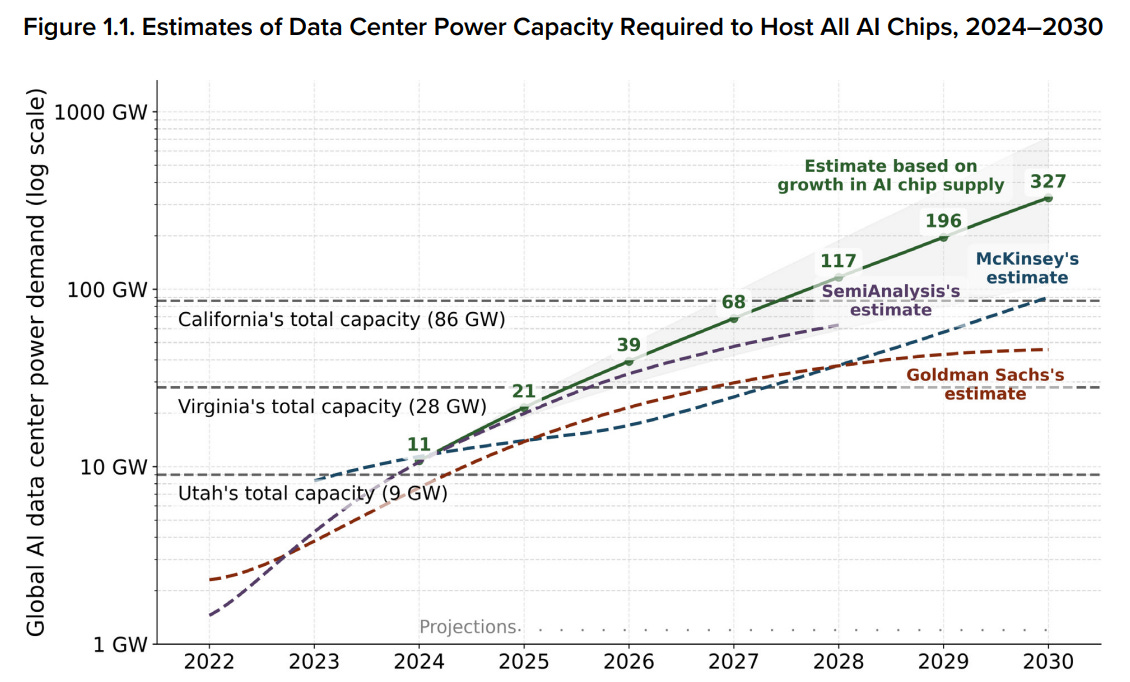
AI Power Demand Creates Supply Bottlenecks
This forecast shows AI’s soaring power needs, which explains the immense pressure creating bottlenecks in the manufacturing supply chain. The projected growth to 327 GW is the core reason for the industry’s strategic shift.
(Source: AI Supremacy)
Investment Surge: Billions Pour into U.S. Manufacturing to Power AI
Industrial giants are aggressively onshoring manufacturing capabilities with multi-billion dollar investments, signaling a long-term commitment to resolving the power infrastructure deficit created by the AI boom. These massive capital expenditures are not speculative; they are a direct reaction to extreme lead times for critical components and a strategic move to secure market share in North America, the primary hub for AI infrastructure development. This investment wave aims to de-risk the supply chain and shorten deployment cycles for data center operators.
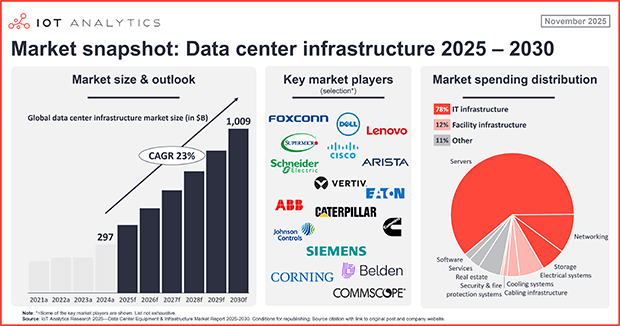
Infrastructure Market Soars Past $1 Trillion
The projected surge in the data center infrastructure market to over $1 trillion quantifies the investment boom discussed in the section. This spending, including on power and cooling, is a direct reaction to the AI-driven demand.
(Source: IoT Analytics)
- Siemens Energy committed $1 billion in February 2026 to expand its U.S. factories and construct a new plant, specifically to increase the production of power transformers and other grid technologies essential for AI data centers.
- Complementing this, Siemens AG is investing a total of $510 million to expand its U.S. supply chain and manufacturing capacity, which includes the opening of a $190 million, 500, 000 sq. ft. hub in Fort Worth, Texas.
- The Fort Worth facility, which opened in March 2025, is designed to more than double the company’s production capacity of low and medium-voltage electrical equipment, directly addressing the hardware shortages faced by data center builders.
Table: Strategic Investments in U.S. Data Center Manufacturing (2025-2026)
| Investor / Project | Time Frame | Details and Strategic Purpose | Source |
|---|---|---|---|
| Siemens Energy | 2026-02-03 | Announced a $1 billion plan to expand U.S. factories and build a new plant to increase production of power transformers and grid equipment for AI data centers. | The New York Times |
| Siemens AG | 2026-06-25 | Part of a broader $510 million U.S. investment to expand manufacturing and supply chain capacity for data center electrical equipment, including new plants. | Data Center Knowledge |
| Siemens AG (Fort Worth Hub) | 2025-03-06 | Opened a $190 million, 500, 000 sq. ft. manufacturing hub in Texas to more than double production of critical electrical equipment for data centers. | Dallas Innovates |
Partnerships Evolve to Secure Supply Chains and Accelerate Deployment
Strategic alliances have matured from co-developing technology to guaranteeing manufacturing capacity and streamlining deployment through modular infrastructure. Before 2025, partnerships focused on integrating different technologies, such as the collaboration between Siemens and NVIDIA to link their digital twin platforms. The new era of partnerships is defined by large-scale supply agreements and co-designed, prefabricated systems that directly address the market’s urgent need for speed. This ecosystem approach, combining industrial scale with specialist expertise from partners like Vertiv and n Vent, is critical for building AI data centers at an unprecedented pace.
- The alliance among Siemens, n Vent, and NVIDIA, announced in December 2025, produced a reference architecture for 100 MW hyperscale AI data centers. This provides a standardized blueprint combining power distribution with advanced liquid cooling, accelerating design and construction.
- A partnership between Siemens Energy and Eaton, formed in June 2025, focuses on creating modular, off-grid power systems. This collaboration aims to bypass grid connection delays, a major bottleneck for new data center projects.
- The multi-year agreement from December 2024 for Siemens to supply Compass Datacenters with up to 1, 500 custom electrical units highlights the shift to securing long-term manufacturing capacity for modular systems that significantly reduce installation time.
- In January 2026, Siemens Energy was selected by Babcock & Wilcox to supply steam turbine generator sets for a power project supporting an Applied Digital AI data center, reinforcing its role in the entire power generation value chain.
Table: Key Partnerships for Data Center Infrastructure Acceleration (2025-2026)
| Partners | Time Frame | Details and Strategic Purpose | Source |
|---|---|---|---|
| Siemens Energy, Babcock & Wilcox | 2026-01-08 | Supply of steam turbine generator sets for a large-scale power project dedicated to an Applied Digital AI data center. | Data Center Dynamics |
| Siemens, NVIDIA, n Vent | 2025-12-09 | Released a joint reference architecture for 100 MW hyperscale AI data centers to accelerate deployment with integrated power and liquid cooling. | Siemens Press |
| Siemens, Delta | 2025-11-19 | Formed a global partnership to deliver prefabricated, modular power solutions, aiming to cut data center deployment time by up to 50%. | Capacity Media |
| Siemens Energy, Eaton | 2025-06-03 | Collaboration to develop modular, scalable, and grid-independent onsite power generation concepts to bypass utility connection queues. | Siemens Energy Press |
| Siemens, Compass Datacenters | 2024-12-04 | Multi-year agreement to supply up to 1, 500 custom, prefabricated electrical solution units to accelerate data center construction. | Siemens Press |
North America Emerges as the Epicenter of Data Center Manufacturing Investment
The United States has become the definitive focal point for new manufacturing investment aimed at supporting the AI data center build-out. While data center construction is a global activity, the strategic response to supply chain vulnerabilities has been a decisive concentration of capital in North America. This geographic focus is intended to reduce lead times, mitigate geopolitical risks, and better serve the world’s largest and fastest-growing market for AI infrastructure, a strategy also being pursued by competitors like Trane and Johnson Controls.

U.S. Data Center Hotspots Dominate Landscape
This map highlights the heavy concentration of data centers in key U.S. states, visually confirming the section’s point that North America has become the epicenter for infrastructure development and investment.
(Source: Pew Research Center)
- Between 2021 and 2024, Siemens’ activities were geographically diverse, including projects in Europe and Asia, such as providing equipment for Microsoft’s data center in South Korea and establishing a technology hub in Spain.
- From 2025 onward, the investment strategy pivoted heavily toward the U.S. Siemens committed over $1.5 billion to expand American manufacturing, a direct move to onshore production for the data center market.
- Key projects anchoring this strategy include the $190 million Fort Worth, Texas, plant for electrical equipment and Siemens Energy’s $1 billion plan that includes a new facility in Mississippi for power transformers.
- This onshoring strategy is a direct response to the immense power demand from U.S.-based hyperscalers like AWS and Azure, ensuring a more resilient and responsive domestic supply chain for the critical hardware needed to build out their AI capacity.
Technology Matures From Digital Simulation to Commercial-Scale Modular Systems
Data center infrastructure technology has rapidly advanced from a focus on design and simulation software to the commercial-scale production of integrated, prefabricated hardware systems. In the period leading up to 2024, the emphasis was on using digital twins and CFD software like Simcenter Flotherm to optimize thermal management in virtual environments. The period from 2025 to today is defined by the physical manifestation of these designs, with companies now delivering complete, factory-built power and cooling modules engineered for rapid deployment. This transition from digital modeling to physical execution marks the maturation of the market’s response to the AI challenge.

Data Centers Transition to Advanced Liquid Cooling
This chart perfectly illustrates the technological maturation from traditional air to advanced liquid cooling. This shift directly visualizes the move from older methods to the new hardware systems described in the section.
(Source: Blogs – Siemens)
- Between 2021-2024, technology leadership was demonstrated through software innovations. Siemens promoted its digital twin capabilities, connecting its Xcelerator platform with NVIDIA Omniverse and launching secure methods for sharing thermal models.
- The turning point occurred in 2025-2026 with the launch of tangible, scalable hardware solutions. In January 2026, Siemens and n Vent released a detailed technical blueprint for a 100 MW hyperscale AI data center, providing an actionable template for builders.
- The collaboration with Cadolto and Legrand to introduce a modular “All In One” data center in June 2025 further proves this shift. Siemens acts as the exclusive technology partner, integrating power, cooling, and management systems into a prefabricated module.
- The commercial success of this maturity is validated by large-scale procurement deals. The agreement to supply 1, 500 modular electrical units to Compass Datacenters shows that the market is now adopting these prefabricated systems as a standard solution to accelerate construction.
SWOT Analysis: Manufacturing Expansion for the AI Data Center Market
Siemens’ strategic repositioning is defined by its aggressive expansion of manufacturing capacity, creating a formidable competitive advantage while also introducing significant execution risks. The company’s core strength in providing integrated “grid-to-chip” solutions is now backed by massive capital investment to control the supply chain. However, this strategy remains vulnerable to external factors like grid availability and intense competition from other major players like STULZ and Panasonic who are also targeting the AI infrastructure market.

Siemens Energy Stock Soars Past Nvidia
This chart shows Siemens Energy’s stock dramatically outperforming Nvidia, validating the success of the strategic manufacturing expansion discussed in the SWOT analysis. It reflects strong market approval for the company’s repositioning.
(Source: LinkedIn)
- Strengths have been amplified by moving from a broad portfolio to direct manufacturing control.
- Weaknesses have shifted from supply chain reliance to the financial and operational risks of large-scale factory construction.
- Opportunities are centered on capturing market share through reduced lead times and scalable modular solutions.
- Threats include persistent grid constraints that could strand new capacity and aggressive moves by competitors also investing heavily in the sector.
Table: SWOT Analysis for Siemens’ Data Center Manufacturing Strategy
| SWOT Category | 2021 – 2024 | 2025 – 2026 | What Changed / Resolved / Validated |
|---|---|---|---|
| Strengths | Integrated “grid-to-chip” portfolio and strong software capabilities (e.g., Simcenter, Building X). Deep existing customer relationships. | Massive manufacturing scale and vertical integration. End-to-end solutions from power generation (Siemens Energy) to in-rack hardware (Siemens AG). | The company leveraged its portfolio strength by investing $1.5 B+ in U.S. manufacturing, transforming a product advantage into a supply chain advantage. |
| Weaknesses | Dependence on external supply chains for key components, exposing the company to market-wide lead time issues. | High capital expenditure and execution risk associated with building and ramping up multiple large-scale factories simultaneously. | The weakness shifted from external dependency to internal execution risk. Success now hinges on bringing the new Texas and Mississippi plants online efficiently. |
| Opportunities | Growing demand for data center efficiency and sustainability, addressed through AI-optimized cooling software (WSCO). | Capture significant market share by offering shorter lead times for critical electrical equipment. Drive standardization with modular blueprints (e.g., 100 MW AI reference design). | The opportunity was validated by the Compass Datacenters deal for 1, 500 modular units, proving market appetite for solutions that prioritize speed-to-market. |
| Threats | Competition from other industrial giants (e.g., Schneider Electric, Vertiv). Slowing global economy impacting enterprise spending. | Severe grid connection delays and power shortages limiting the deployment of new data centers. Intense competition from rivals also investing in capacity. | The threat of competition intensified, but the primary external threat is now utility power availability, which is being addressed via partnerships like the one with Eaton for off-grid solutions. |
2026 Outlook: Factory Output is the New Barometer for AI Growth
The single most critical factor for the data center industry in 2026 is the successful execution of new manufacturing capacity. If industrial leaders like Siemens can bring their new factories online and ramp up production as planned, it will alleviate a primary bottleneck and sustain the rapid pace of AI infrastructure deployment. Watch for signals related to factory output, adoption of modular designs, and the finalization of large-scale energy projects. These indicators will confirm whether the industry’s massive capital investments are successfully translating into the physical hardware needed to power the next wave of AI innovation.

AI Data Center Market to Exceed $800B
Projecting the market’s growth to over $800 billion underscores the high stakes for the 2026 outlook. This massive potential market size is what makes factory output the critical barometer for future AI growth.
(Source: Grand View Research)
- Monitor Manufacturing Ramp-Up: The operational progress of Siemens’ Fort Worth facility and the new plants under development will be a direct indicator of the industry’s ability to overcome supply chain constraints for electrical equipment.
- Track Adoption of Modular Blueprints: The market’s adoption rate of the Siemens/n Vent 100 MW reference architecture will signal if standardization is taking hold as a key strategy to accelerate construction.
- Watch for Finalized Energy Contracts: The final contract signing between Siemens Energy and Babcock & Wilcox for the 1 GW Applied Digital power project in Q 1 2026 will be a major milestone, demonstrating progress on the power generation front.
- Observe Traction in Prefabricated Solutions: The success of modular power and data center offerings through partnerships with Eaton and Delta will be a key growth driver, as speed-to-market remains the most critical competitive differentiator.
Frequently Asked Questions
What is the biggest challenge holding back the growth of AI data centers in 2026?
The biggest challenge is a critical manufacturing bottleneck for essential hardware, specifically power and cooling equipment like switchgear and power transformers. The article states that the pace of AI deployment is now “dictated by the physical capacity to produce and deliver electrical equipment.”
How has the strategy of industrial leaders like Siemens changed since 2025?
Before 2025, the strategy focused on software optimization and technology partnerships to improve existing infrastructure. Since 2025, there has been a fundamental shift to massive capital investment in building new factories to directly control the manufacturing and supply of critical hardware, a pivot from software-led efficiency to capital-intensive production.
Why are companies investing billions of dollars specifically in U.S. manufacturing?
Companies are investing heavily in U.S. manufacturing to shorten extreme lead times for critical components, reduce geopolitical supply chain risks, and directly serve North America, which is the primary and fastest-growing market for AI infrastructure development. For example, Siemens has committed over $1.5 billion to expand its U.S. manufacturing capacity.
What are ‘modular’ or ‘prefabricated’ solutions, and why are they important?
Modular solutions are standardized, factory-built systems, such as power units or entire data center modules, that are delivered to a construction site ready for installation. They are crucial because they significantly accelerate deployment timelines, which is a top priority for data center operators in the fast-paced AI market. The agreement for Siemens to supply 1,500 modular units to Compass Datacenters highlights this trend.
What is the main threat to the success of these new manufacturing investments?
According to the SWOT analysis, the primary external threat is severe grid connection delays and power shortages. Even if companies successfully ramp up factory production of hardware, the deployment of new data centers can be limited by the lack of available utility power. Partnerships to create off-grid solutions, like the one between Siemens Energy and Eaton, are aimed at mitigating this risk.
