

Oklo Advanced Reactor for AI, 12 GW Switch Deal, 6.6 GW Meta Agreement, and 5 Nvidia Partnerships (2024 to 2026)
Industry Adoption Signals: Oklo Nuclear Power for AI Data Centers from LOIs to GW-Scale Agreements
The data center industry’s adoption of advanced nuclear power has accelerated from speculative interest into gigawatt-scale commitments, establishing a new infrastructure class that integrates power generation directly with AI compute. Before 2025, the concept was validated by early-stage agreements, such as Oklo‘s Letters of Intent for 750 MWe. The period since January 2025, however, has been defined by concrete, large-scale offtake agreements from hyperscalers, validating advanced fission as a primary solution to the AI-driven energy demand crisis and shifting the paradigm from grid dependency to self-sufficient, co-located power.
- Prior to 2025, market signals consisted of collaborations and non-binding Letters of Intent (LOIs). For instance, Oklo had secured LOIs with two unnamed data center providers for up to 750 MWe of power, indicating initial commercial interest but lacking firm, large-scale commitments.
- The turning point occurred in January 2026, when Meta signed agreements for up to 6.6 GW of nuclear power by 2035 from multiple providers, including a specific 1.2 GW development plan with Oklo in Southern Ohio. This was the first major commitment from a hyperscaler, moving beyond pilot-level interest to strategic, long-term procurement.
- The Oklo–Nvidia-Los Alamos National Laboratory collaboration, announced in April 2026, further cemented this trend by creating a feedback loop where advanced fission powers AI factories, and AI, in turn, accelerates the validation and design of nuclear reactors. This formalizes the convergence beyond a simple power purchase agreement into a co-development model.
- This trend is not isolated to Oklo. The broader market pivot includes Microsoft‘s “AI for nuclear” partnership with Nvidia and Google‘s partnership with Kairos Power, confirming a sector-wide recognition that advanced nuclear is a critical component for scaling AI infrastructure.
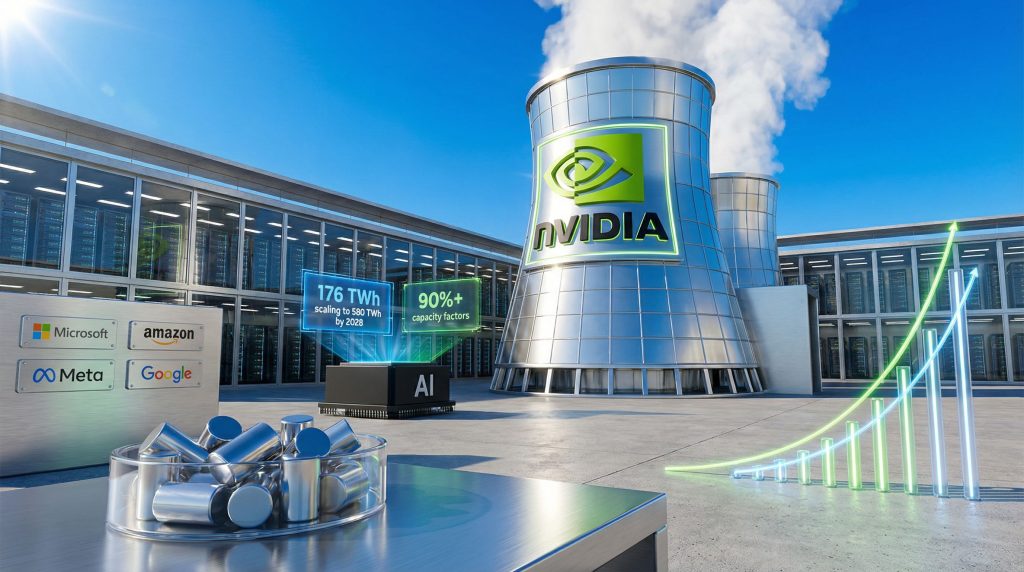
AI Energy Demand Drives Nuclear Adoption
This section discusses the industry’s adoption of nuclear power for AI, and the chart perfectly visualizes the escalating energy demand that is driving this trend.
(Source: Discovery Alert)
$650 M Terra Power Round, Nvidia’s Strategic Nuclear Investment
Direct investment from AI technology leaders into advanced nuclear companies confirms a strategic belief that solving the power challenge is integral to securing long-term growth in the AI hardware market. While tech giants have been procuring clean energy for years, Nvidia‘s financial stake in Terra Power signals a deeper, more integrated strategy where the compute provider actively enables the development of its own power source, treating energy not as a utility but as a fundamental part of the AI technology stack.
- In June 2025, Nvidia‘s venture capital arm, NVentures, participated in a $650 million funding round for Terra Power, a company developing advanced reactors. This move marks a direct financial commitment, reinforcing Nvidia‘s strategic view that its future hardware sales are dependent on the availability of massive, reliable, clean power sources.
- The broader tech industry is mobilizing immense capital, with the top five tech companies projected to spend $600 billion on GPUs and data centers by 2026. A growing portion of this is allocated to power, with over $10 billion already committed by tech firms toward small modular reactors (SMRs).
- This investment thesis is supported by forecasts from financial institutions. Goldman Sachs projects that data center power demand will grow 160% by 2030, creating a generational investment opportunity in new power infrastructure, with nuclear being a primary beneficiary.
Table: Strategic Investments in Nuclear for AI
| Investor | Time Frame | Details and Strategic Purpose | Source |
|---|---|---|---|
| Nvidia (NVentures) | Jun 18, 2025 | Participated in a $650 Million funding round for Terra Power. This direct investment shows Nvidia‘s commitment to ensuring a power source exists for its AI hardware, linking its growth to the success of advanced nuclear. | The Register |
| Big Tech Companies | Aug 8, 2025 | Committed over $10 billion to small modular reactors (SMRs) to meet a projected 945 TWh of AI-related energy demand by 2030. This represents a collective industry move to secure off-grid, baseload power. | Introl Blog |
Oklo 5 Key Partnerships, From Nvidia to Meta (2024 to 2026)
A series of strategic partnerships forged between 2024 and 2026 has constructed the commercial and technical foundation for the nuclear-powered AI factory, with Oklo and Nvidia at the center of this emerging ecosystem. These collaborations extend beyond simple power offtake agreements to include technology co-development, supply chain integration, and joint research, illustrating a coordinated effort to build out a new, vertically integrated infrastructure category.

Meta Commits to 1.1GW of Nuclear Power
The section highlights key partnerships with companies like Meta, and the chart provides a concrete example of this by detailing Meta’s specific 1.1GW nuclear power agreement.
(Source: LinkedIn)
- The foundational partnership is the three-way collaboration between Oklo, Nvidia, and Los Alamos National Laboratory announced in April 2026. This alliance aims to use Nvidia‘s AI and digital twin technology to accelerate nuclear fuel research, directly supporting the deployment of Oklo‘s reactors that will, in turn, power Nvidia‘s AI infrastructure.
- The landmark commercial validation came in January 2026 with Meta‘s agreement to develop 1.2 GW of nuclear power with Oklo in Southern Ohio. This deal directly links an advanced reactor developer with a hyperscaler’s specific AI supercluster, providing a definitive commercial use case.
- Before the Meta deal, Oklo‘s December 2024 non-binding agreement with data center operator Switch for up to 12 GW of power through 2044 served as a massive demand signal to the market, even with its non-binding status.
- To build the complete data center solution, Oklo partnered with Vertiv in July 2025. This collaboration focuses on integrating Oklo’s power plants with Vertiv’s critical cooling systems, addressing the holistic infrastructure needs of a high-density AI data center.
Table: Key Partnerships Building the Nuclear-AI Ecosystem
| Lead Partner(s) | Time Frame | Details and Strategic Purpose | Source |
|---|---|---|---|
| Oklo, Nvidia, LANL | Apr 23, 2026 | Collaboration to use Nvidia‘s AI to accelerate nuclear fuel validation for Oklo‘s reactors. This creates a self-reinforcing cycle where AI helps build the infrastructure needed to power itself. | Business Wire |
| Meta, Oklo | Jan 9, 2026 | Agreement for Oklo to support the development of 1.2 GW of nuclear power for Meta‘s data centers in Southern Ohio, a key part of Meta‘s broader 6.6 GW nuclear procurement plan. | Business Wire |
| Oklo, Switch | Dec 18, 2024 | Non-binding Master Power Agreement for Oklo to supply up to 12 GW of power to Switch’s data centers through 2044. This served as a major market demand signal for gigawatt-scale nuclear. | Reuters |
| Oklo, Vertiv | Jul 22, 2025 | Collaboration to develop integrated power and cooling solutions for data centers, combining Oklo‘s reactors with Vertiv‘s thermal management systems for a complete infrastructure package. | Vertiv |
| INL, Nvidia | Feb 17, 2026 | Partnership to use AI to accelerate the design, licensing, and construction of advanced reactors as part of the federal “Genesis Mission.” This aligns federal research with the industry’s push for faster deployment. | Idaho National Laboratory |
US Market Focus, Oklo Data Center Siting in Southern Ohio
The development of nuclear-powered AI data centers is currently concentrated in the United States, driven by a combination of established technology leadership, federal support, and the urgent need to find power solutions outside of constrained regional grids. The geographic focus is shifting away from traditional data center hubs and toward regions with favorable regulatory environments and land availability for new nuclear construction, such as Southern Ohio, which is emerging as an early blueprint for this new infrastructure model.
- Between 2021 and 2024, the discussion was largely national in scope, focusing on the U.S. regulatory framework under the Nuclear Regulatory Commission (NRC) and the potential for SMRs in general.
- The period from 2025 to today has brought geographic specificity. The Oklo–Meta agreement announced in January 2026 explicitly targets Southern Ohio for a 1.2 GW nuclear energy development, creating a clear geographic center for the first large-scale, commercial nuclear-powered AI data center project.
- Federal initiatives are reinforcing this U.S.-centric focus. The U.S. Department of Energy is advancing a program to site AI data centers at federal nuclear facilities, and the Idaho National Laboratory’s “Genesis Mission” with Nvidia aims to make the U.S. the leader in AI-accelerated nuclear deployment.
- This geographic concentration is a direct response to grid limitations. Reports from November 2025 highlighted that data centers, even in Nvidia‘s hometown, were being built but stood empty awaiting power connections, demonstrating that future growth requires moving to locations where dedicated, off-grid power can be developed.
Technology Maturity: Oklo’s Shift From Concept to Commercial Validation with AI Acceleration
The maturity of advanced fission for data centers has progressed from a conceptual solution in the 2021-2024 period to a commercially validated and actively pursued technology from 2025 onward, with AI itself becoming a critical tool to accelerate its deployment. The primary challenge remains the regulatory and construction timeline, but the technical and commercial theses are now firmly established through major offtake agreements and strategic technology partnerships.

Oklo Stock Performance Signals Commercial Validation
The section describes the shift from concept to commercial validation. The chart’s depiction of Oklo’s massive stock outperformance serves as a strong market signal for this validation.
(Source: Stocktwits)
- In the years leading up to 2025, Oklo‘s Aurora powerhouse was primarily an advanced reactor concept seeking regulatory approval and a first customer. Its potential for data centers was clear, but commercial validation was absent.
- The key shift in 2025-2026 has been the use of AI to de-risk and accelerate the nuclear technology development lifecycle. The Oklo–Nvidia-LANL partnership uses AI for physics-based modeling and fuel validation, a critical step that could shorten the notoriously long timelines for nuclear R&D and licensing.
- The commercial maturity was proven by the Meta and Switch agreements, which collectively represent over 18 GW of potential demand. This provides Oklo and the broader SMR industry with the anchor tenants needed to move from design to construction and manufacturing at scale.
- Oklo‘s Aurora powerhouse technology, a sodium-cooled fast reactor, is designed for scalability (15 MW to 75 MW) and can operate on recycled fuel. This technical design is well-suited for the modular power needs of data centers and addresses long-term fuel supply and waste concerns, key aspects of technology maturity.
Oklo’s SWOT: Strengths and Execution Risks in the AI Power Market
The convergence of advanced fission and AI has created a significant market opportunity for first-movers like Oklo, but it also presents substantial execution risks related to regulatory approval and project delivery timelines. The strategic landscape has changed dramatically since 2024, with market demand becoming a major strength while regulatory and construction hurdles remain the primary threat.
Table: SWOT Analysis for the Integrated Nuclear-AI Infrastructure Model
| SWOT Category | 2021 – 2024 | 2025 – 2026 | What Changed / Validated |
|---|---|---|---|
| Strengths | Conceptual alignment of SMRs with data center needs (baseload, carbon-free). Support from high-profile figures like Sam Altman. | Delivers clean, 24/7 baseload power, a perfect match for AI’s constant energy demand. Technology co-development with Nvidia creates a powerful competitive moat and accelerates R&D. | The strength shifted from a theoretical fit to a proven commercial model with the Meta and Switch agreements, validating the demand for co-located nuclear power at scale. |
| Weaknesses | High regulatory risk and long, uncertain NRC approval timelines. Lack of firm commercial contracts to justify investment. | Aggressive deployment timelines (first commercial plant by 2027) present significant execution risk. Reliance on non-binding agreements (e.g., Switch) for a large portion of the demand pipeline. | While demand is now clear, the core weakness of regulatory speed and construction feasibility remains. The Meta deal adds a firm contract, but the 12 GW Switch deal is still non-binding. |
| Opportunities | Explosive but poorly quantified growth in AI energy demand. Nascent interest from tech companies in alternative power sources. | Unprecedented, quantified AI power demand (945 TWh by 2030). Opportunity to become the standard power solution for the entire AI industry. Ability to site data centers in new regions, free from grid constraints. | The opportunity has crystallized from a general trend into specific, multi-gigawatt procurement plans from hyperscalers, creating a massive, defined, and addressable market. |
| Threats | Public perception of nuclear energy. Competition from other clean energy sources like green hydrogen or geothermal. | Failure to meet construction deadlines could lead to loss of contracts and market confidence. Competing advanced reactor designs (e.g., Terra Power) also backed by tech money could capture market share. | The primary threat has shifted from market acceptance to pure execution. The race is no longer about proving the concept but about delivering reactors on time and on budget. |
Scenario Modelling: Oklo’s Path to Commercial Operation Hinges on NRC Approval
The single most critical factor for the realization of nuclear-powered AI factories in the near term is the velocity of regulatory approvals from the U.S. Nuclear Regulatory Commission (NRC). While market demand is now overwhelmingly clear and technology development is being accelerated by AI itself, the entire value chain is contingent on the ability to license and build new reactors in a timely manner. The primary signal to watch is the NRC’s progress on Oklo‘s and other advanced reactor applications; any sign of acceleration could trigger the conversion of non-binding agreements into firm contracts and ignite a wave of new projects.

SMR Technology Awaiting Regulatory Approval
This section states that commercial operation hinges on regulatory approval for the technology. The chart provides a clear, technical illustration of the SMR technology that is under review.
(Source: Introl)
- If the NRC provides a clear and expedited path for licensing advanced reactors, supported by initiatives like the INL-Nvidia “Genesis Mission” aimed at streamlining the process with AI, then expect to see the 12 GW non-binding Switch agreement convert to a series of firm, site-specific contracts.
- Watch for other hyperscalers like Amazon and Google to follow Meta‘s lead by signing their own multi-gigawatt nuclear power agreements. The success of the Oklo–Meta project in Southern Ohio will serve as the definitive blueprint.
- This could be happening as tech companies become more directly involved in the regulatory process, using their influence to advocate for policies that support faster deployment of advanced nuclear to secure their own growth. The formation of industry lobbying groups focused specifically on powering AI is a likely next step.
The questions your competitors are already asking
This report covers one angle of the commercial adoption of advanced nuclear power for AI data centers. The questions that matter most depend on your work.
- Is Oklo a good investment as the market shifts from Letters of Intent to GW-scale offtake agreements?
- What is actually happening with Meta’s 1.2 GW development plan with Oklo in Southern Ohio since the announcement?
- Which hyperscale data center operators, besides Meta, are adopting advanced fission power for their AI compute infrastructure?
This report does not answer these. Enki Brief Pro does.
Your question, your angle, your framework. SWOT, PESTL, scenario modelling. The same niche depth, built around the decision your work actually depends on.
