

Heavy-Duty Electric Trucks Grid Constraints, 40% China Target, 1.6 M Vehicle Fleet, and 3, 000 Charging Station Plan (2021 to 2026)
Grid Capacity Risk, China’s 40% Heavy-Truck Goal Faces 3, 000 Station Infrastructure Gap
China’s mandate to achieve a 40% market share for new energy heavy-duty trucks (HDTs) by 2030 exposes a critical system-level risk: the nation’s grid and charging infrastructure is unprepared for the concentrated power demand. While vehicle sales are surging in controlled applications like ports and mines where battery swapping is viable, the broader goal is threatened by the severe lag in deploying the megawatt-scale chargers and undertaking the massive grid upgrades necessary for regional and long-haul freight. This creates a clear division between the rapid adoption in niche segments and the significant barriers facing mass-market electrification.
- Between 2021 and 2024, the market demonstrated the viability of electric HDTs in applications with predictable, short-haul routes. The rise of battery swapping effectively masked the larger charging infrastructure problem by offering a non-grid-intensive refueling solution for these early adopters.
- The period from 2025 to today has seen an explosion in sales and policy ambition. Sales of new energy HDTs grew 182% in 2025, and the government’s 2030 plan calls for a 1.6 million vehicle fleet. This scale has brought the infrastructure deficit into sharp focus, with reports confirming that most local distribution systems cannot support the simultaneous high-power charging of multiple heavy trucks.
- The government’s plan to build 3, 000 charging and swapping stations is a direct acknowledgment of this gap. However, the primary bottleneck remains the slow, costly process of upgrading grid capacity at a local level, a challenge that vehicle production timelines are far outpacing.
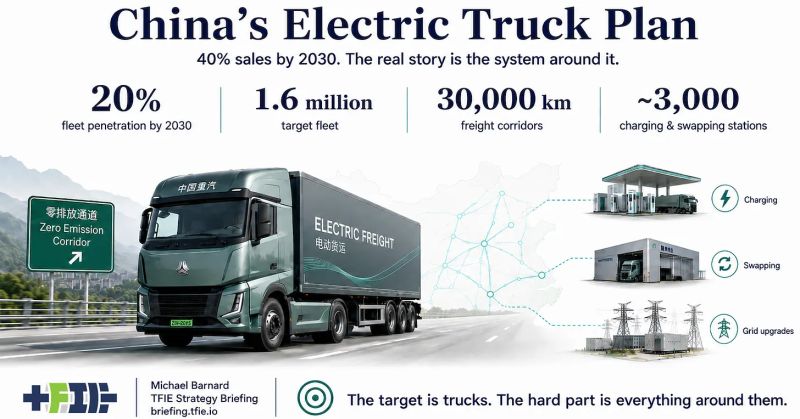
China’s Electric Truck Plan Targets Visualized
The section discusses the infrastructure gap created by China’s 40% heavy-truck goal. This chart, by visualizing these ambitious targets, provides a clear graphical representation of the scale of the plan, which in turn underscores the magnitude of the required infrastructure and associated grid capacity risk.
(Source: LinkedIn)
$2.6 B in OEM Investment, TRATON Group Electrification Plan Highlights Infrastructure Need
Major global and domestic vehicle manufacturers are committing billions to developing and producing electric trucks, a clear signal of their alignment with policy targets. However, these substantial capital investments in vehicle technology are fundamentally dependent on the parallel build-out of a reliable and powerful charging network, an area where direct investment and deployment timelines are lagging significantly. This disparity puts manufacturers’ investments at risk, as the total addressable market for their products remains constrained by infrastructure availability.
- Fleet operators face a significant capital barrier, with electric trucks costing 1.5 to 2 times more than diesel equivalents. While government subsidies and lower operating costs help, the high upfront price remains a hurdle, particularly for smaller companies.
- Global OEMs are moving forward with major investment plans. In the first quarter of 2025, TRATON Group announced a €2.6 billion electrification plan, demonstrating industry commitment to the transition despite infrastructure uncertainties.
- In a sign of a potential workaround and adjacent opportunity, Ford announced plans in December 2025 to begin shipping battery energy storage systems (BESS) in 2027, partly using repurposed batteries. These systems can help buffer the grid at charging depots, mitigating the strain of high-power demand.
- The risk of a mismatch between vehicle supply and infrastructure readiness is real. In the U.S., policy uncertainty led to the cancellation of nearly $5.4 billion in planned EV and battery manufacturing investments in 2025, showing how external factors can quickly disrupt capital plans.

Electric Truck Market to Exceed $10B by 2034
This section details significant OEM investment in electrification. The chart provides the financial justification for such investments by forecasting the substantial future market value of electric trucks, showing that companies are investing to capture a piece of a rapidly growing, multi-billion dollar market.
(Source: Straits Research)
Table: Strategic Investments and Cancellations in Heavy-Duty Electrification
| Entity / Project | Time Frame | Details and Strategic Purpose | Source |
|---|---|---|---|
| Ford | December 2025 | Announced plans to enter the energy storage market, shipping BESS systems by 2027. This creates a market for second-life truck batteries and provides a solution to buffer weak points in the grid during high-demand charging. | Ford |
| TRATON Group | Q 1 2025 | Announced a €2.6 billion electrification plan, signaling a major OEM’s commitment to producing electric commercial vehicles despite known infrastructure challenges. | Fact.MR |
| U.S. EV and Battery Manufacturing | 2025 | Companies canceled nearly $5.4 billion in planned investments due to political uncertainty surrounding EV mandates. This serves as a cautionary signal for how non-technical risks can derail capital-intensive transitions. | Clean Energy News |
| Volvo / Holcim | January 2025 | Holcim committed to deploying 1, 000 electric trucks from Volvo by 2030, the largest commercial order of its kind. This end-user demand creates significant pressure on charging infrastructure providers to scale up. | World Economic Forum |

Battery System Costs See Steep Decline
The section is a table summarizing investment and cancellation decisions. The chart illustrates a primary economic driver behind these strategies: the steep decline in battery costs. This cost reduction makes electrification projects more viable, explaining new investments, while the rapid pace of change can also lead to cancellations of projects based on older technology.
(Source: Nature)
China vs. US Partnerships, CATL and State Grid vs. Pilot and Tesla Charging Plans
The structure of partnerships driving heavy-duty electrification differs starkly between China and other markets, reflecting divergent national strategies. In China, progress is centrally orchestrated through tight collaboration between state-owned enterprises like the State Grid Corporation, battery titan CATL, and domestic OEMs. This integrated approach enables rapid standardization and deployment in targeted areas. In contrast, efforts in the U.S. and Europe are more fragmented and commercially driven, led by private initiatives that face greater challenges in achieving interoperability and scale.

China Leads Global EV Adoption, Reaching 40% Share
The section compares partnership models for charging infrastructure between China and the US. The chart establishes the global context for this comparison by showing China’s dominant position in overall EV adoption. This leadership role highlights the significance and potential scalability of China’s partnership models.
(Source: EVBoosters)
Table: Key Partnerships in Heavy-Duty Truck Electrification
| Partner / Project | Time Frame | Details and Strategic Purpose | Source |
|---|---|---|---|
| CATL and Truck OEMs | May 2025 | CATL launched standardized battery swap packs for heavy-duty trucks. This partnership with OEMs is critical for creating an interoperable battery-as-a-service model, de-risking the high upfront cost of batteries for fleet operators. | CNEVPost |
| China Electricity Council & CHAde MO | May 2025 | This joint effort is developing the “ultra Chao Ji” charging standard, which is designed to enable the megawatt-scale charging required for heavy-duty vehicles. This standardization is a prerequisite for building out a long-haul charging network. | UNECE |
| Volvo and Holcim | January 2025 | Holcim‘s commitment to purchase 1, 000 electric trucks from Volvo by 2030 represents a major validation from a large fleet operator. This partnership sends a strong demand signal to the market that will necessitate infrastructure development. | World Economic Forum |

Electric Commercial Vehicle Market to Hit $197B
The section presents a table of key partnerships. The chart quantifies the overall economic prize these partnerships are chasing by projecting the total electric commercial vehicle market to reach $197 billion. This massive market potential is the primary motivator for companies to form strategic alliances.
(Source: MarketsandMarkets)
China’s 80% Short-Haul Target, Electric Truck Adoption Dominates Global Sales (2021 to 2026)
China has firmly established itself as the epicenter of the heavy-duty truck electrification movement, a leadership position cemented by decisive state policy and a protected domestic market. The government’s strategy of targeting specific, high-viability applications first, such as the mandate for 80% electrification of short-haul shuttle routes, has created a guaranteed demand base that drives scale. This contrasts sharply with progress in the United States and Europe, where adoption has been slower and more fragmented due to a combination of policy uncertainty, higher energy costs, and a less coordinated approach to infrastructure development.
- From 2021 to 2024, China’s market share of global zero-emission HDT sales consistently exceeded 90%. This early dominance was fueled by strong subsidies and a focus on domestic OEMs like SANY and Sinotruk.
- In 2025 and 2026, this leadership was codified into the national 2030 plan. The strategy prioritizes electrifying applications where TCO is already favorable, including ports, mining sites, and urban logistics. This pragmatic approach ensures early wins and builds momentum for the harder-to-abate long-haul sector.
- Meanwhile, the IEA reported in May 2025 that progress in heavy-truck electrification was stalling in Europe and the United States. This divergence highlights how critical a coordinated industrial policy is for overcoming the initial high costs and infrastructure hurdles of the transition.

Electric Truck Sales Share to Near 30% by 2025
The section describes the rapid adoption of electric trucks, with a focus on projections from 2021 to 2026. The chart provides a concrete data point supporting this trend, forecasting that the sales share of electric trucks will approach 30% by 2025, which aligns perfectly with the section’s narrative of dominating adoption.
(Source: LinkedIn)
Commercial Scale Vehicle TRL, Megawatt Charging Infrastructure Lags at TRL 7
A critical maturity gap exists between the vehicles and the infrastructure required to power them at scale. Battery electric vehicles (BEVs) for heavy-duty applications have reached commercial maturity (TRL 9), proven by their widespread deployment in China. However, the enabling technology for mass-market, long-haul trucking, specifically megawatt-scale charging, remains at a lower readiness level (TRL 7) and faces significant deployment challenges related to standardization, cost, and grid integration. This gap is the single largest technical barrier to achieving the 2030 goal.
- From 2021 to 2024, the technological focus was on validating the trucks themselves. The commercial success of battery swapping (TRL 8-9) in this period provided a crucial, non-charging-intensive pathway for early adoption in closed-loop systems.
- In 2025, the launch of CATL‘s standardized swap pack for heavy trucks marked a major milestone, validating the battery-as-a-service model. This shifted the technological bottleneck squarely onto charging for non-swappable applications.
- The development of the “ultra Chao Ji” megawatt charging standard is now the key technical milestone to watch. While the technology is advancing, its deployment is in its infancy, and scaling a nationwide network by 2030 represents a monumental engineering and logistical challenge.

Grid’s Carbon Footprint Defines EV Truck Benefit
The section points out a technology gap where vehicles are ready but charging infrastructure lags. The chart complements this by showing that the ultimate benefit of an EV truck (decarbonization) is dependent on the infrastructure (the grid’s carbon intensity). It conceptually illustrates that the vehicle alone is insufficient, reinforcing the section’s point about the critical lag in infrastructure readiness.
(Source: ScienceDirect.com)
SWOT Analysis, China’s Strengths in Manufacturing vs. Infrastructure Weakness
China’s strategic push for heavy-duty truck electrification is defined by its immense manufacturing and policy strengths, which are directly pitted against a fundamental weakness in its power grid’s readiness. The opportunity to set global standards and create new service-based markets is significant, but it is threatened by the sheer scale of the required infrastructure investment and the potential for economic headwinds or supply chain volatility to derail progress.

China’s Heavy Truck Market Pivots to BEV
The section introduces a SWOT analysis, highlighting China’s manufacturing strength. The chart visually represents this strength by showing a clear and decisive ‘pivot’ in the heavy truck market towards battery electric vehicles (BEVs). This market transformation is a direct result of the nation’s strong manufacturing capabilities and policy support.
(Source: CleanTechnica)
Table: SWOT Analysis for China’s Heavy-Truck Electrification Goal
| SWOT Category | 2021 – 2024 | 2025 – 2026 | What Changed / Validated |
|---|---|---|---|
| Strengths | Dominant battery manufacturing (CATL, BYD). Strong policy support through subsidies. Initial TCO advantages in niche applications. | Policy certainty locked in with 2030 mandate. TCO advantage becomes undeniable with 65% lower energy costs. Battery swapping model validated at scale (49.5% of e-trucks). | The economic and policy case for electrification was validated and scaled up, moving from pilot-phase to a national industrial strategy. |
| Weaknesses | High upfront vehicle cost for operators. Range anxiety and long charging times for early models. Nascent charging infrastructure. | Grid capacity emerges as the primary bottleneck. Lack of megawatt charging prevents long-haul adoption. High CAPEX remains a barrier for small fleets. | The central weakness shifted from the vehicle’s technical limitations to the supporting ecosystem’s lack of readiness for deployment at scale. |
| Opportunities | Develop a domestic EV truck industry. Reduce reliance on imported diesel. Pioneer battery swapping business models. | Establish global standards for heavy-duty charging (“ultra Chao Ji”). Create a massive market for second-life batteries for grid storage (BESS). Export technology and vehicles. | The scale of the 2030 plan expanded the adjacent opportunities from vehicle manufacturing to include energy services, grid management, and recycling. |
| Threats | Potential for subsidy withdrawal. Fluctuations in diesel prices affecting TCO calculations. Battery raw material supply concerns. | Delays in grid upgrades stranding assets. Post-subsidy sales slumps (projected 5-10% decline in 2026). An economic slowdown impacting freight demand and fleet investment. | Threats became more systemic, shifting from market-based risks (price volatility) to infrastructure-based execution risks (deployment delays). |

Charts Project China’s HDT Decarbonization Pathways
This section is a SWOT analysis table. The chart provides a strategic overview of the potential outcomes, or ‘pathways,’ for decarbonization. This visualization of future scenarios directly relates to the ‘Opportunities’ and ‘Threats’ components of a SWOT analysis, illustrating the high-stakes future that the strategic plan aims to navigate.
(Source: Nature)
China’s 2030 Goal, Critical Catalysts Include Megawatt Charging and Grid Investment
The success or failure of China’s ambitious 2030 target will be determined by its ability to execute a massive, coordinated infrastructure build-out over the next five years. The critical path forward is no longer about vehicle technology but about the physical deployment of megawatt chargers and the corresponding upgrades to the national power grid. Failure to meet these infrastructure milestones will likely lead to a bifurcated market where electrification is successful only in limited, short-haul segments, leaving the larger prize of long-haul freight decarbonization out of reach.
- If this happens: The State Grid Corporation of China announces a dedicated, multi-year, multi-billion dollar investment program specifically for upgrading distribution networks along key national freight corridors. This would be the strongest signal that the central government is committed to overcoming the grid bottleneck.
- Watch this: The deployment rate of the “ultra Chao Ji” megawatt charging standard. Monitor the number of operational, public-access megawatt chargers as a direct measure of progress in enabling long-haul electric trucking. Pilot projects by companies like ADS-TEC Energy and others will be early indicators.
- These could be happening: A growing reliance on alternative fuels like LNG or hydrogen for long-haul routes as a “plan B” if charging infrastructure fails to scale. OEMs may also focus on developing trucks with even larger battery packs (750 k Wh+) to complete regional routes without intermediate public charging, further straining depot-based grid connections.

NEV Adoption Key to Decarbonizing China’s Trucks
The section identifies ‘critical catalysts’ for achieving China’s 2030 goal. The chart’s headline, ‘NEV Adoption Key to Decarbonizing China’s Trucks,’ directly echoes this theme. It reinforces the central argument that achieving the decarbonization goal is fundamentally dependent on driving the adoption of New Energy Vehicles, a primary catalyst.
(Source: Nature)
The questions your competitors are already asking
This report covers one angle of China’s heavy-duty truck electrification. The questions that matter most depend on your work.
- Megawatt charging station deployments China
- China State Grid investment freight corridors
- Hydrogen truck development vs electric trucks China
- Fleet operator strategies for private truck charging depots
This report does not answer these. Enki Brief Pro does.
Your question, your angle, your framework. SWOT, PESTL, scenario modelling. The same niche depth, built around the decision your work actually depends on.
