

Green Hydrogen Grid Power, National Grid $2 M NYSERDA Pilot, 5 Regional Projects (2025 to 2026)
The deployment of dispatchable, zero-emission generation assets is the most critical constraint to achieving a fully decarbonized and reliable power grid. National Grid’s pilot project at its Northport, Long Island facility validates a specific, high-value role for green hydrogen not as a bulk energy replacement, but as a surgical tool to provide grid stability. This project proves that hydrogen-fueled generators can replace aging, carbon-intensive “peaker” plants, creating a bankable business model for hydrogen in high-value grid services, which in turn justifies the development of a regional hydrogen supply chain.
$11 M in NYSERDA Funding, National Grid’s Hydrogen Pilot Signals Shift to Grid Resilience
Recent public funding initiatives signal a strategic shift away from treating hydrogen as a universal fuel and toward cultivating its use in targeted, high-value applications like grid stabilization. The Northport project, which uses a Mainspring Energy linear generator, is the prime example of this refined strategy, proving a model that can be replicated in other grid-constrained regions to ensure reliability as intermittent renewables increase their share.
- In August 2025, the New York State Energy Research and Development Authority (NYSERDA) awarded over $11 million across five clean hydrogen projects, demonstrating a concentrated effort to build a complete regional hydrogen ecosystem.
- National Grid Ventures secured $2 million of this funding to install the world’s first commercial 100% hydrogen-fueled linear generator, specifically to test its function as a Dispatchable Emission-Free Resource (DEFR) for a one-year pilot.
- This focused approach contrasts with the broader, less-defined hydrogen strategies common between 2021 and 2024, which often lacked a clear business case beyond general decarbonization goals.
- The funding was allocated to build out the entire value chain on Long Island, with Stony Brook University receiving $4.9 million for hydrogen storage and Plug Power receiving $2 million for hydrogen transport, creating the necessary infrastructure to support generation.
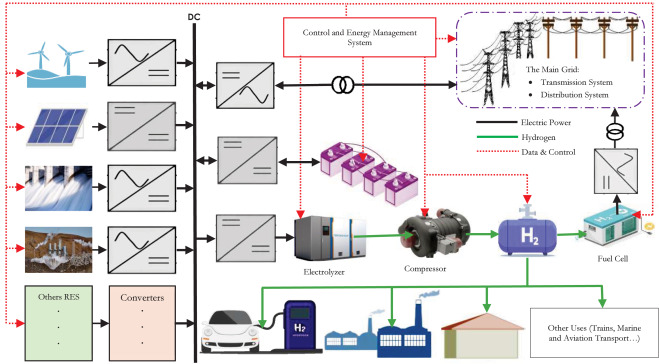
Diagram Visualizes Green Hydrogen for Grid Support
This section introduces the strategy of using hydrogen for grid resilience. The general diagram perfectly illustrates this high-level concept of converting renewables to hydrogen for grid support.
(Source: ScienceDirect.com)
National Grid’s $2 M Grant for Northport Hydrogen Project (2025 to 2026)
Public investment is the primary mechanism being used to de-risk the first commercial deployments of hydrogen-powered generation, bridging the current cost gap with fossil fuels and establishing the operational track record needed to attract future private capital. The NYSERDA funding for the Northport project is not just a subsidy; it is a strategic investment to validate a new asset class for the zero-carbon grid.
- The $2 million grant awarded to National Grid directly targets the primary barrier to hydrogen adoption: demonstrating commercial viability in a real-world grid environment. The pilot is scheduled to become operational by September 2026.
- This investment is part of a larger $6.9 million allocation for Long Island-based hydrogen projects, signaling a deliberate policy choice to create a concentrated hub of innovation and infrastructure.
- The funding enables National Grid and Mainspring Energy to collect critical performance data on efficiency, ramp rates, and maintenance costs, which is essential for developing a bankable business model for future, unsubsidized projects.
- Success in this pilot will provide a clear market signal for scaling similar technologies, much as other energy providers like AEP are doing with their large-scale fuel cell deployments for data centers.
Table: New York Clean Hydrogen Project Investments (August 2025)
| Recipient / Project | Time Frame | Details and Strategic Purpose | Source |
|---|---|---|---|
| Stony Brook University | Sep 10, 2025 | Received $4.9 million from NYSERDA to demonstrate an efficient, long-duration hydrogen storage system, providing a crucial supply component for the regional hydrogen economy. | Stony Brook University |
| National Grid Ventures | Aug 21, 2025 | Awarded $2 million by NYSERDA to install the first commercial 100% hydrogen-fueled linear generator at the Northport Power Plant to act as a dispatchable, emissions-free grid resource. | NYSERDA |
| Plug Power & Verne | Aug 22, 2025 | Secured $2 million from NYSERDA to co-develop advanced, high-density cryo-compressed hydrogen trailers, addressing the logistical challenge of moving hydrogen from production to use. | Fuel Cells Works |
| GTI Energy | Aug 21, 2025 | Received $220, 000 to evaluate New York’s potential for geological hydrogen storage, a key enabler for long-duration energy storage and grid-scale deployment. | NYSERDA |
Hydrogen Generation Partnerships, National Grid and Mainspring Energy’s Pilot
The successful integration of hydrogen into the power grid depends on a new class of partnerships that unite utilities, technology innovators, academic institutions, and government bodies. The Northport project exemplifies this collaborative model, where each partner contributes a critical component to solve the complex technical, economic, and logistical challenges of deploying a first-of-its-kind energy asset.
- The core partnership between National Grid Ventures (the asset operator) and Mainspring Energy (the technology provider) demonstrates a viable path for utilities to integrate innovative, non-traditional generation technologies into their portfolios.
- NYSERDA’s role as a funding and coordinating body is essential, as it aligns multiple, separate projects—such as National Grid’s generation pilot and Stony Brook University’s storage demonstration—into a cohesive regional strategy.
- The inclusion of Plug Power and Verne to develop transportation solutions shows that the ecosystem is being built concurrently, addressing the entire value chain from production to end-use. This parallels efforts in other sectors, where companies like Daimler and Toyota are building out hydrogen infrastructure for transportation.
New York’s Hydrogen Focus, National Grid’s Long Island Project
New York State, and Long Island in particular, has emerged as the key geography for demonstrating hydrogen’s role in grid modernization due to a convergence of policy mandates, grid infrastructure needs, and targeted public investment. This regional concentration accelerates learning and creates a blueprint for other areas facing similar energy transition challenges.

Offshore Wind to Hydrogen for Grid Support
This section focuses on Long Island, a hub for offshore wind development. The chart is highly relevant as it specifically illustrates how offshore wind can be used to produce hydrogen for the grid.
(Source: ScienceDirect.com)
- Long Island’s grid constraints and reliance on aging peaker plants make it an ideal test case for demonstrating the value of clean, dispatchable resources. The Northport project is located at an existing power plant, showing a path to “repowering” fossil fuel sites.
- New York’s climate law, which mandates a zero-emission grid by 2040, creates regulatory certainty and a powerful incentive for utilities like National Grid to invest in and test non-emitting technologies.
- The state’s decision to award $6.9 million of the $11 million hydrogen funding round to Long Island projects concentrates resources, fostering a localized ecosystem where generation, storage, and transport solutions can be developed and integrated in parallel.
- This focused geographic approach is a marked evolution from the more scattered, experimental projects seen between 2021 and 2024, indicating a maturing market that is now targeting specific, high-impact regions.
Commercial-Scale Validation, National Grid’s Mainspring Generator Pilot
The Northport project advances hydrogen power generation from the laboratory and small-scale demonstrations to a commercially relevant pilot, proving the technical readiness of innovative hardware for a critical grid application. The choice of Mainspring Energy’s linear generator over traditional turbines or even other fuel cell types highlights a focus on operational flexibility and rapid dispatchability, key requirements for balancing a renewables-heavy grid.
- Unlike a research project, this pilot places the technology in a commercial operating environment within a legacy power station, subjecting it to real-world performance demands for a full year.
- The linear generator technology offers a distinct advantage over batteries for longer-duration events and over traditional peaker plants due to its near-zero emissions (when running on hydrogen) and high efficiency. Its dispatchability is comparable to thermal power assets.
- The generator’s inherent fuel flexibility (capable of running on natural gas and ammonia in addition to hydrogen) de-risks the asset, allowing it to function even if a green hydrogen supply chain takes longer than expected to develop. This feature is also a focus for companies like Bloom Energy with their flexible fuel cell platforms.
- By proving this technology at a commercial scale, the project provides the technical validation needed for utilities and investors to consider fleets of similar units for peaker plant replacement programs.
SWOT Analysis, National Grid’s Hydrogen Grid Power Strategy
The Northport pilot project illuminates the strategic strengths and vulnerabilities of using hydrogen for grid resilience. It capitalizes on the pressing need for clean, dispatchable power while simultaneously exposing the system’s dependency on a still-nascent hydrogen supply chain and the high cost of green fuel.
Table: SWOT Analysis for Hydrogen in Grid Power Applications
| SWOT Category | 2021 – 2023 | 2024 – 2025 | What Changed / Validated |
|---|---|---|---|
| Strengths | Theoretical potential for zero-emission, dispatchable power. R&D-level technology demonstrations. | Demonstrated ability to replace peaker plants at an existing site. Proven fast-ramping capability of linear generator technology. Fuel flexibility (H 2, NG, ammonia) is a key feature. | The Northport project moved the concept from theory to a validated commercial pilot, proving its viability as a DEFR and its ability to be sited at existing fossil fuel locations. |
| Weaknesses | Prohibitively high cost of green hydrogen. Lack of a defined business model beyond wholesale power competition. Fragmented and non-existent local supply chains. | Green hydrogen remains expensive ($4-$12/kg), requiring subsidies. The project is a single-unit pilot, not yet a fleet-scale solution. Dependency on a single technology provider (Mainspring). | The project validates a high-value business model (grid services) that can justify higher fuel costs, and the NYSERDA funding directly addresses the need to build out local supply chains. |
| Opportunities | Broad climate goals and policy targets. General need to replace aging fossil fuel plants. | Targeted replacement of retiring peaker plants on Long Island. Access to dedicated state funding (NYSERDA’s $11 M round). Creating a replicable model for other grid-constrained areas. | The 2025 NYSERDA funding and the specific need to repower Northport crystallized the general opportunity into a concrete, bankable project with a clear strategic purpose. |
| Threats | Competition from cheaper natural gas. Rapid cost declines in battery storage for ancillary services. Lack of public acceptance for hydrogen infrastructure. | Battery storage (BESS) remains a strong competitor for short-duration services (2-4 hours). Delays in building out hydrogen production and storage could strand the generation asset. Potential for policy shifts away from hydrogen. | The project’s focus on longer-duration dispatchability differentiates it from BESS. The parallel funding for storage (Stony Brook) and transport (Plug Power) is a direct attempt to mitigate the supply chain threat. |
National Grid 2026 Outlook, Scaling Hydrogen Generation After Northport
If the one-year Northport pilot, concluding in late 2027, successfully validates the operational reliability and economic model of the hydrogen-fueled linear generator, the most critical signal for market expansion will be a move from a single pilot to a programmatic, fleet-scale replacement strategy for retiring peaker plants. This would confirm hydrogen’s role as a cornerstone of a resilient, zero-emission grid.
- If this happens: The Mainspring Energy generator at Northport meets or exceeds its performance targets for availability, ramp rate, and maintenance costs throughout the one-year pilot.
- Watch this: Look for National Grid or other New York utilities to issue a Request for Proposals (RFP) in late 2027 or 2028 specifically calling for Dispatchable, Emissions-Free Resources to replace a portfolio of retiring fossil fuel peaker plants.
- These could be happening: Private equity and infrastructure funds will begin financing the build-out of dedicated green hydrogen production and storage facilities on Long Island and in other grid-constrained regions, confident in offtake agreements from a new class of power generation assets. Other utilities in California, New England, and Europe will announce similar pilot projects, citing the data from the Northport success.
The questions your competitors are already asking
This report covers one angle of green hydrogen’s role in grid resilience. The questions that matter most depend on your work.
- Is National Grid’s Northport pilot progressing from a test case to a replicable model for other grid-constrained regions?
- What is the outlook for deploying hydrogen-fueled generators to replace peaker plants in New York by 2030?
- How do hydrogen-fueled linear generators compare to battery energy storage systems (BESS) for grid stability services?
- What is the status of the five NYSERDA-funded projects and the push to build a regional hydrogen supply chain in New York?
This report does not answer these. Enki Brief Pro does.
Your question, your angle, your framework. SWOT, PESTL, scenario modelling. The same niche depth, built around the decision your work actually depends on.
