

WATT Fuel Cell SOFC Utility Model, 7, 250 Hope Gas Lease Deal, 2 k W Rollout, and 2 Major Utility Agreements (2021 to 2026)
SOFC Residential Adoption, WATT Fuel Cell’s 7, 250 Unit Utility-Leasing Model
The primary barrier to residential fuel cell adoption, high upfront cost, is being systematically dismantled by a utility-led leasing model, transforming the technology from a niche product into a scalable home energy service. This business model innovation leverages the utility’s existing infrastructure and customer relationships to create a viable go-to-market strategy for Solid Oxide Fuel Cells (SOFCs).
- Between 2021 and 2024, the strategy was in a validation phase, characterized by pilot programs and crucial technological and financial endorsements. WATT Fuel Cell increased its SOFC stack output to 2 k W in 2021, a critical threshold for residential use, and secured a key equity investment from backup power leader Generac in December 2022, affirming the technology’s market potential.
- Beginning in 2025, the model shifted decisively from pilot to commercial scale, proving its viability. In June 2025, WATT Fuel Cell and Hope Gas launched a leasing program for 7, 250 WATT HOME systems in West Virginia, followed by the first 2 k W system installation in December 2025, marking the start of a full residential launch planned for 2026.
- This strategic shift repositions the gas utility from a commodity provider to an energy-as-a-service company. It creates a new revenue stream while reinforcing the value of the natural gas network for providing resilient, distributed power, a direct response to the increasing strain on the traditional electrical grid.
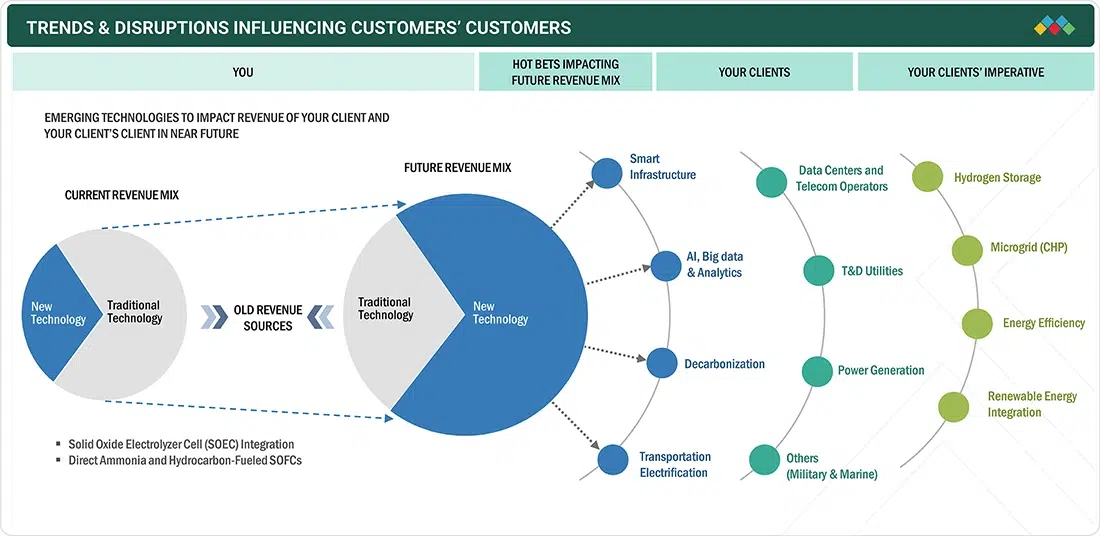
SOFCs Drive Future Utility Revenue Shift
This chart illustrates the strategic shift to new revenue models for utilities, which directly aligns with the section’s focus on the utility-led leasing model as a new home energy service.
(Source: MarketsandMarkets)
$40 B Merger, Essential Utilities’ Capital Strategy for Fuel Cell Deployment
Essential Utilities is securing significant capital through strategic financial maneuvers, positioning it to fund and accelerate the large-scale deployment of residential fuel cell programs across its territories. The company is assembling the financial resources needed to move the utility-led leasing model from a regional pilot to a national strategy.
- In October 2025, Essential Utilities announced an all-stock merger with American Water, creating a combined entity valued at approximately $40 billion. This consolidation is designed to provide the necessary scale and capital to fund investments in new technologies, including the expansion of the residential SOFC program.
- To support near-term growth initiatives, Essential Utilities completed a $500 million senior notes offering in August 2025. The proceeds are allocated for general corporate purposes, which include funding for sustainable growth and innovative technology projects like the fuel cell deployments.
- This financial strategy is validated by external investment, notably Generac’s equity stake in WATT Fuel Cell in December 2022. This move by a major energy technology manufacturer signaled strong market confidence in the viability of residential SOFCs and the utility partnership model.
Table: Essential Utilities and WATT Fuel Cell Strategic Financial Activities
| Partner / Project | Time Frame | Details and Strategic Purpose | Source |
|---|---|---|---|
| Merger with American Water | October 2025 | Announced all-stock merger creating a $40 billion combined utility. The purpose is to gain scale and capital for strategic technology investments, including residential fuel cells. | WTAE |
| Senior Notes Offering | August 2025 | Completed a $500 million senior notes offering to fund general corporate purposes, including sustainable growth projects and innovative energy solutions. | Baird |
| Generac Equity Investment | December 2022 | Generac acquired an equity stake in WATT Fuel Cell, validating the SOFC technology and creating a partnership to develop integrated residential energy systems. | Generac Investor Relations |
WATT Fuel Cell’s 2 Key Utility Partnerships for Residential SOFC (2022 to 2025)
WATT Fuel Cell has executed a focused partnership strategy, aligning with forward-thinking gas utilities to create a direct-to-consumer channel that bypasses traditional retail and accelerates market entry. This approach solves the critical last-mile challenges of customer acquisition, installation, and service.

Mapping the SOFC Partner Ecosystem
As the section details WATT’s specific utility partnerships, this chart provides a broader visualization of the corporate ecosystem, showing how providers, integrators, and distributors collaborate.
(Source: MarketsandMarkets)
- The partnership with Hope Gas, an affiliate of Essential Utilities, serves as the commercial blueprint for the leasing model. Following initial program discussions in 2023, the collaboration culminated in a formal agreement in June 2025 to lease 7, 250 WATT HOME™ systems to residential customers in West Virginia for backup power.
- The long-standing collaboration with Peoples Natural Gas in Pennsylvania has served as the incubation and validation ground. After years of trials, a successful pilot installation of the latest generation WATT HOME™ system was completed in May 2025, proving the technology and setting the stage for a potential large-scale commercial program.
- These utility partnerships create a symbiotic relationship. WATT Fuel Cell gains immediate access to a large, established customer base and a trusted service channel, while the utilities secure a new, resilient energy service offering that reinforces the value of their core gas distribution infrastructure.
Table: WATT Fuel Cell Strategic Partnerships
| Partner / Project | Time Frame | Details and Strategic Purpose | Source |
|---|---|---|---|
| Hope Gas Residential Leasing Program | June 2025 | Commercial agreement to lease 7, 250 WATT HOME™ SOFC systems to residential customers in West Virginia, establishing a scalable commercialization framework. | WATT Fuel Cell |
| Peoples Natural Gas Technology Deployment | May 2025 | Successful pilot installation of the latest generation WATT HOME™ SOFC system, serving as a proof-of-concept for offering fuel cells as a residential product. | Essential Utilities |
| Hope Gas Grid Resiliency Program | July 2023 | Initial plan to provide clean, reliable power for 500 homes in West Virginia, laying the groundwork for the larger leasing agreement. | PR Newswire |
Appalachia Focus, WATT Fuel Cell’s Regional Deployment Strategy
WATT Fuel Cell and its utility partners are concentrating their commercial rollout in the Appalachian region, specifically West Virginia and Pennsylvania, leveraging the area’s robust natural gas infrastructure and a customer base familiar with grid reliability challenges. This geographic focus allows for the development of an efficient and replicable deployment model before expanding to other markets.

North America a Key Market
This chart provides geographic context for the Appalachia-focused strategy, showing that North America represents a significant (27%) portion of the global SOFC market.
(Source: MarketsandMarkets)
- Between 2021 and 2024, the operational footprint was centered in Pennsylvania, home to WATT’s manufacturing facility and the service territory of its initial partner, Peoples Natural Gas. West Virginia became a strategic target with the October 2023 announcement linking Hope Gas to the Appalachian Regional Clean Hydrogen Hub (ARCH 2) project.
- From 2025 onward, this regional strategy has become commercially concrete, with West Virginia established as the beachhead for the mass-market leasing model. The first commercial installation in Clarksburg, WV, in December 2025 confirms the state as the primary launch market for the 7, 250-unit program with Hope Gas.
- This concentrated approach creates significant operational efficiencies. By focusing on a specific geography, the partners can streamline logistics for installation, maintenance, and service, building a center of excellence and a trained workforce before attempting a broader national rollout.
Commercial Validation, WATT Fuel Cell’s 2 k W SOFC System Deployment
The WATT HOME™ SOFC system has transitioned from a developing technology in limited trials to a commercially validated product, a progression marked by an increase in power output and the initiation of mass-market deployment through utility partners. The technology is now treated as a market-ready consumer appliance rather than a developmental system.

WATT’s SOFC Technology Explained
This section discusses the commercial validation of the WATT HOME™ SOFC system, and this infographic is a perfect match as it explains the technology behind the product.
(Source: WATT Fuel Cell)
- In the 2021-2024 period, the technology was focused on refinement and proving its viability for residential use. A key milestone was achieved in 2021 when WATT doubled its fuel cell stack output to 2 k W, making it powerful enough to cover essential home loads and compete with other backup power solutions.
- The start of 2025 marked the transition to a commercially available product. The deployment of the “latest generation” system with Peoples Natural Gas in May 2025 and the first official 2 k W commercial unit installation with Hope Gas in December 2025 confirmed its readiness for a full-scale residential launch.
- While competitors like Bloom Energy and Fuel Cell Energy target large-scale commercial and industrial applications, WATT’s exclusive focus on the sub-2 k W residential unit, combined with the utility leasing model, has created a distinct and validated product for the consumer market.
SWOT Analysis, WATT Fuel Cell and Essential Utilities’ SOFC Model
The utility-led SOFC leasing model demonstrates significant strategic strengths by creating a new revenue stream and leveraging existing infrastructure, though it faces challenges in scaling logistics and navigating a competitive energy landscape. The model’s success hinges on executing the commercial rollout while managing operational complexities and market pressures.

Market Growth Represents Major Opportunity
This chart quantifies the market opportunity discussed in the SWOT analysis, showing the global SOFC market is projected to reach $11.6 billion by 2030.
(Source: MarketsandMarkets)
Table: SWOT Analysis of the Utility-Led Residential SOFC Model
| SWOT Category | 2021 – 2023 | 2024 – 2025 | What Changed / Resolved / Validated |
|---|---|---|---|
| Strengths | Technology development (2 k W stack), initial utility partnership (Peoples Gas), and external validation (Generac investment). | Secured a large-scale commercial leasing deal (7, 250 units with Hope Gas) and access to significant capital via merger and notes offering. | The business model was validated, moving from a theoretical concept to a contracted, large-scale commercial agreement. |
| Weaknesses | High upfront product cost for consumers, limited manufacturing scale, and reliance on a single utility partner for field trials. | The primary challenge shifts to scaling installation and service logistics for thousands of units and managing long-term reliability. | The core weakness shifted from consumer-side cost barriers (solved by leasing) to provider-side operational execution at scale. |
| Opportunities | Growing consumer demand for energy resilience due to grid instability and extreme weather events. | The $40 B merger with American Water opens a pathway to replicate the model in new states. The stationary fuel cell market is projected to grow to $5.97 billion by 2034. | The addressable market and the mechanism to access it (merger) became significantly larger and more concrete. |
| Threats | Competition from rapidly improving solar-plus-storage solutions and policy pressures for full electrification. | Larger competitors (e.g., Bloom Energy) could pivot to residential, and regulatory hurdles for distributed generation could arise. | The threat evolved from conceptual competition to direct market execution risk and the potential entry of well-capitalized competitors. |
Essential Utilities’ Next Move: Scaling its 7, 250-Unit SOFC Program (2026)
The success of the initial 7, 250-unit Hope Gas deployment in 2026 will be the critical trigger for Essential Utilities to replicate the leasing model across its other territories, starting with Peoples Natural Gas in Pennsylvania. The next 12-18 months will determine whether this becomes a national strategy or remains a regional innovation.

Strong Market Growth Justifies Scaling
The section discusses scaling the SOFC program; this chart provides the macroeconomic rationale by forecasting strong (34.9%) market growth through 2030.
(Source: MarketsandMarkets)
- If the 2026 residential launch in West Virginia proceeds smoothly, with positive customer adoption and reliable unit performance, then watch for an announcement of a similar large-scale leasing program with Peoples Natural Gas in late 2026 or early 2027.
- If the merger with American Water is completed and integrated successfully, then watch for pilot programs to be initiated in new states where the combined entity operates, testing the model’s applicability and regulatory reception outside of Appalachia.
- A key signal to monitor is an announcement from WATT Fuel Cell regarding a further expansion of its manufacturing capacity beyond the one announced in May 2024. This would indicate confidence in a project pipeline extending beyond the initial Hope Gas order and confirm the model’s momentum.
The questions your competitors are already asking
This report covers one angle of the utility-led commercialization of residential fuel cells. The questions that matter most depend on your work.
- What is actually happening with the 7,250-unit Hope Gas and WATT Fuel Cell leasing program since its launch?
- Which gas utilities, besides Hope Gas and Peoples Natural Gas, are adopting the residential fuel cell-as-a-service model?
- How does WATT’s 2 kW residential SOFC compare to solar-plus-battery systems for home power resiliency and cost?
This report does not answer these. Enki Brief Pro does.
Your question, your angle, your framework. SWOT, PESTL, scenario modelling. The same niche depth, built around the decision your work actually depends on.
