

PEM Fuel Cell Trucks 2026: Hyundai’s 20 M km Milestone, Daimler’s 100 Truck Pilot, and Honda-GM’s Exit
PEM Fuel Cell Commercial Pilots: Hyundai’s 20 M km vs. Daimler’s 100 Truck Plan
The heavy-duty trucking market for Polymer Electrolyte Membrane (PEM) fuel cells is transitioning from research and development to commercial validation, a shift defined by Hyundai’s accumulation of extensive real-world operational data against competitors now preparing their initial customer-facing deployments. This pivot from speculative trials to scalable operations marks a critical maturity point for the technology.
- Between 2021 and 2024, PEM fuel cell truck deployments were characterized by small, contained pilots focused on technical feasibility. In 2026, the focus has shifted to commercial-scale validation, exemplified by Hyundai’s XCIENT fleet surpassing 20 million kilometers of cumulative driving in Europe. This provides a substantial data set on durability, reliability, and total cost of ownership under real-world logistics conditions.
- While Hyundai has an established, globally deployed vehicle, major competitors are now moving from the lab to the road. Daimler Truck is solidifying its market entry with plans to deploy a small series of 100 fuel cell trucks to customers starting in late 2026, signaling the start of a new competitive phase focused on direct customer feedback.
- The market’s expansion is demonstrated by the diverse range of applications being tested. These include supermarket logistics, industrial freight, and refuse collection across multiple European countries, confirming the technology’s adaptability beyond simple long-haul routes and proving its utility in various heavy-duty cycles.
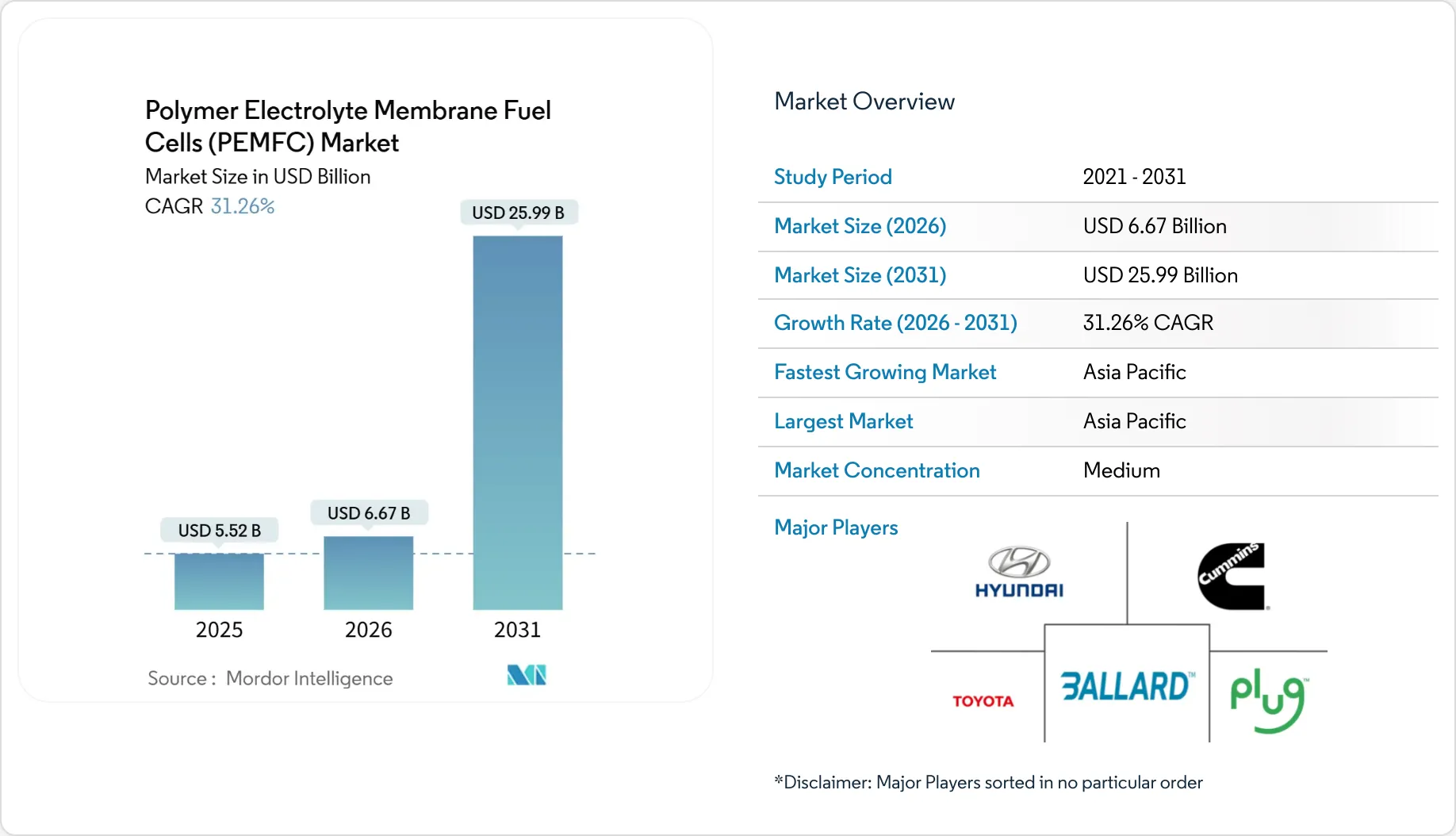
PEM Fuel Cell Market Nears $26B
This forecast highlights the significant market opportunity driving the shift from R&D to commercialization, framing the competitive landscape between Hyundai and Daimler.
(Source: Mordor Intelligence)
OEM Alliances: Toyota Joins Cellcentric as Honda-GM Venture Dissolves
The competitive structure of the PEM fuel cell truck market is being reshaped as manufacturers consolidate into large-scale alliances to de-risk investment and standardize technology, while less focused partnerships dissolve. This strategic realignment prioritizes economies of scale and clear commercialization roadmaps over siloed research efforts.
- The most significant strategic move in 2026 is Toyota Motor Corporation joining the Cellcentric joint venture as an equal shareholder with founders Daimler Truck and Volvo Group. This creates a powerful bloc of three of the world’s largest vehicle manufacturers, aiming to develop and produce a common fuel cell system to lower costs and accelerate deployment across their respective truck brands.
- In stark contrast, the Fuel Cell System Manufacturing (FCSM) joint venture between Honda and General Motors is being dissolved by the end of 2026. The split reflects a strategic recalibration driven by weak near-term market demand and a mutual decision to pursue independent hydrogen and electrification strategies, with GM pivoting its HYDROTEC technology toward broader industrial applications.
- Hyundai continues to build a vertically integrated ecosystem through targeted collaborations. The company’s global partnership with Air Liquide is focused on co-developing hydrogen infrastructure, while its work with Plus aims to integrate Level 4 autonomous driving technology, creating a comprehensive vehicle-and-fueling solution.
Table: Strategic Partnerships and Divestments in Heavy-Duty PEM Fuel Cells (2026)
| Alliance / Partnership | Time Frame | Details and Strategic Purpose | Source |
|---|---|---|---|
| Cellcentric (Daimler, Volvo, Toyota) | March 2026 | Toyota joins the existing JV as an equal shareholder. The goal is to pool resources to develop, produce, and commercialize a standardized fuel cell system for heavy-duty trucks, achieving economies of scale and reducing individual R&D costs. | Reuters |
| Hyundai & Air Liquide | April 2026 | The companies advanced their global partnership to co-develop hydrogen infrastructure. This collaboration is designed to accelerate the adoption of Fuel Cell Electric Vehicles (FCEVs) by addressing the critical need for reliable refueling networks. | Hyundai News |
| Hyundai & Plus | March 2026 | Collaboration to demonstrate the first Level 4 autonomous fuel cell electric truck in the U.S. market. This partnership aims to integrate advanced autonomous driving systems into the Hyundai XCIENT truck, enhancing safety and operational efficiency. | Hyundai |
| Fuel Cell System Manufacturing (FCSM) | January 2026 | Honda and General Motors announced the dissolution of their manufacturing JV by year-end. The decision was attributed to weak market demand and a mutual agreement to reshape their separate hydrogen and EV strategies. | Automotive Manufacturing Solutions |
Europe vs. North America: Hyundai’s Global PEM Fuel Cell Push
Europe currently serves as the primary proving ground for commercial-scale PEM fuel cell truck operations, driven almost entirely by Hyundai’s extensive deployments, while North America is rapidly emerging as the next critical battleground with strategic pilot programs designed to capture major fleet operators.

Europe’s FCEV Market to Exceed $1B
Projecting the European market’s growth to $1.18 billion, this chart quantifies the region’s leadership in commercial fuel cell deployments, as described in the section.
(Source: Global Market Insights)
- Europe is the clear leader in real-world deployment. As of January 2026, Hyundai’s XCIENT fleet had already accumulated 20 million kilometers across countries including Switzerland, Germany, the Netherlands, and France. This extensive operation provides an unparalleled advantage in operational data and maintenance history, which was not present in the 2021-2024 period.
- North America has become the key expansion target in 2026. Hyundai is actively courting major fleet operators through high-profile pilots, including the “Run on Less – Messy Middle” trial with Penske and Pilot. In Canada, transportation company Trimac initiated a regional pilot in early 2026, indicating a focused strategy to prove the business case to large-scale North American buyers.
- Market expansion efforts are extending beyond established regions. In March 2026, Hyundai launched South America’s first XCIENT Fuel Cell truck fleet in Uruguay as part of a 10-year project to decarbonize local timber logistics, demonstrating a strategy of entering new markets through dedicated, long-term industrial partnerships.
PEM Fuel Cell Commercial Viability: Hyundai XCIENT vs. Competitor Roadmaps
The technology for PEM fuel cells in heavy-duty trucks has achieved commercial viability, led by Hyundai’s mass-produced and globally deployed XCIENT truck, while the rest of the industry focuses on validating component systems and preparing for initial vehicle rollouts. The market has moved past the question of whether the technology works to how it can be deployed at scale economically.

PEM Tech to Dominate FCV Market
With PEM technology projected to hold 85% market share, this chart validates the commercial viability and dominant position of the fuel cells discussed in the section.
(Source: Persistence Market Research)
- In 2026, Hyundai’s XCIENT stands as the only fully integrated, commercially available Class 8 fuel cell truck deployed globally. Its 180 k W hydrogen fuel cell system and refueling time of 10-20 minutes provide performance metrics comparable to diesel, a significant validation compared to the more fragmented and experimental prototypes seen between 2021 and 2024.
- The formation of the expanded Cellcentric alliance demonstrates a different path to maturity. Rather than a single integrated vehicle, Daimler, Volvo, and Toyota are prioritizing the development of a standardized core fuel cell system. This component-focused strategy aims to ensure reliability and cost-effectiveness at the stack level before integrating it into multiple truck brands.
- The dissolution of the Honda-GM venture highlights a critical aspect of technology maturity: the business case. While both companies possessed advanced fuel cell technology, their decision to separate suggests that a clear, focused vehicle integration and market strategy is as important as the underlying technology itself.
SWOT Analysis for Heavy-Duty PEM Fuel Cell Trucks in 2026
The PEM fuel cell truck market’s primary strength is its now-proven ability to match diesel in range and refueling speed, but this is counterbalanced by a critical weakness in the scarcity and cost of hydrogen infrastructure. This dynamic creates an opportunity for vertically integrated players and large alliances to build defensible ecosystems while facing the persistent threat of improving battery-electric alternatives.
Table: SWOT Analysis for PEM Fuel Cells for Heavy Duty Trucks (2026)
| SWOT Category | 2021 – 2024 | 2025 – 2026 | What Changed / Validated |
|---|---|---|---|
| Strength | Theoretical advantages in long range and fast refueling compared to battery-electric trucks. | Proven real-world performance with Hyundai’s XCIENT fleet logging 20 million km. Technology durability and operational readiness are now validated by extensive data. | The key strength has shifted from a theoretical benefit to a commercially validated and data-backed performance metric. |
| Weakness | High cost of fuel cell systems and unproven vehicle reliability were the primary concerns for fleet operators. | The primary weakness has shifted from vehicle technology to the lack of widespread, reliable, and cost-effective hydrogen refueling infrastructure. The vehicle is ready, but the fueling network is not. | The main barrier to adoption is no longer the truck itself but the external ecosystem, specifically the availability and price of hydrogen. |
| Opportunity | Securing government R&D grants and participating in small-scale, subsidized pilot projects. | Formation of large-scale OEM alliances (Cellcentric) to standardize technology and reduce costs. Building integrated ecosystems (vehicle + fuel) with partners like Air Liquide. | The opportunity has scaled from securing project funding to building entire market ecosystems and establishing industry-wide technology standards. |
| Threat | Competition from improving battery-electric truck technology and uncertainty over future regulations. | The dissolution of the Honda-GM JV highlights the risk of strategic misalignment. The primary threat is the bifurcation of the market, where different technology and infrastructure standards could slow overall adoption. | The main threat is now strategic fragmentation and the immense financial commitment required, which can cause even major players to retreat or pivot strategy. |
2027 Outlook: Hydrogen Infrastructure Buildout Will Dictate Market Winners
If hydrogen refueling infrastructure development accelerates along key freight corridors in 2027, the Cellcentric alliance could rapidly close the operational gap with Hyundai; however, if infrastructure buildout remains slow and localized, Hyundai’s first-mover advantage in establishing closed-loop ecosystems with dedicated fueling partners will solidify its market leadership.
- Watch for announcements of large-scale hydrogen hub developments. The success of partnerships like Hyundai and Air Liquide will be a key signal. Progress will be measured by the number of high-capacity refueling stations deployed along major routes, not just at depot locations.
- The first real-world performance data from Daimler Truck’s 100-unit customer pilot, expected in late 2026 and early 2027, will be critical. This will provide the market’s first direct, at-scale comparison of a Cellcentric-powered system against Hyundai’s established XCIENT data.
- Monitor the economic results from North American trials like the “Run on Less – Messy Middle” project. The total cost of ownership (TCO), including fuel, maintenance, and vehicle uptime, will be the ultimate determinant of adoption speed, overriding purely technical specifications.
The questions your competitors are already asking
This report covers one angle of the commercial deployment of PEM fuel cell trucks. The questions that matter most depend on your work.
- Which companies are gaining or losing ground in the PEM fuel cell heavy-duty truck market?
- Hyundai’s XCIENT activities in Europe. Is the 20 million km milestone translating from validation to broader commercial deployment?
- What is the outlook for PEM fuel cell truck deployment in Europe now that the Honda-GM venture has dissolved?
- Which logistics and freight operators are adopting PEM fuel cell trucks for real-world operations?
This report does not answer these. Enki Brief Pro does.
Your question, your angle, your framework. SWOT, PESTL, scenario modelling. The same niche depth, built around the decision your work actually depends on.
