

Fuel Cell Energy MCFC Strategy, 450 MW SDCL Deal, Exxon Mobil Pilot, and 1.5 GW Pipeline (2021-2026)
Commercial Scale Risk, Fuel Cell Energy’s 1.5 GW Pipeline Conversion
In 2026, Fuel Cell Energy is pivoting its Molten Carbonate Fuel Cell (MCFC) platform to target the high-growth data center and industrial decarbonization markets, but its history of execution challenges makes the conversion of its large project pipeline the company’s primary commercial risk. While the company’s technology is scientifically sound, its ability to translate a $1.17 billion project backlog and a 1.5 GW data center pipeline into profitable, recurring revenue remains unproven. Success hinges on validating its unique carbon capture capability at scale and avoiding the financial instability that has historically plagued the company.
- Prior to 2025, Fuel Cell Energy‘s commercial activity was characterized by smaller-scale, long-duration projects like the 1.4 MW combined heat and power (CHP) plant at Trinity College and module sales to established partners in South Korea. These projects demonstrated the technology’s reliability for power generation but did not validate its high-value carbon capture application at an industrial scale.
- Starting in 2026, the company’s focus shifted dramatically to large-scale, strategic validation projects. The pilot with Exxon Mobil in Rotterdam and a deployment agreement with SDCL for up to 450 MW of power plants represent a significant increase in both scale and strategic importance, placing immense pressure on the company’s execution capabilities.
- The launch of a standardized 12.5 MW power block in March 2026 signals a strategic move to productize its offering for the data center market. However, the company must now prove it can manufacture, deliver, and service these large-scale systems profitably, a challenge it has struggled with in the past.
- Despite a promising technological advantage over competitors like Plug Power, Fuel Cell Energy remains persistently unprofitable. This financial fragility means that failure to convert its current high-profile projects into commercial successes could perpetuate a cycle of dilutive capital raises and undermine its long-term viability.
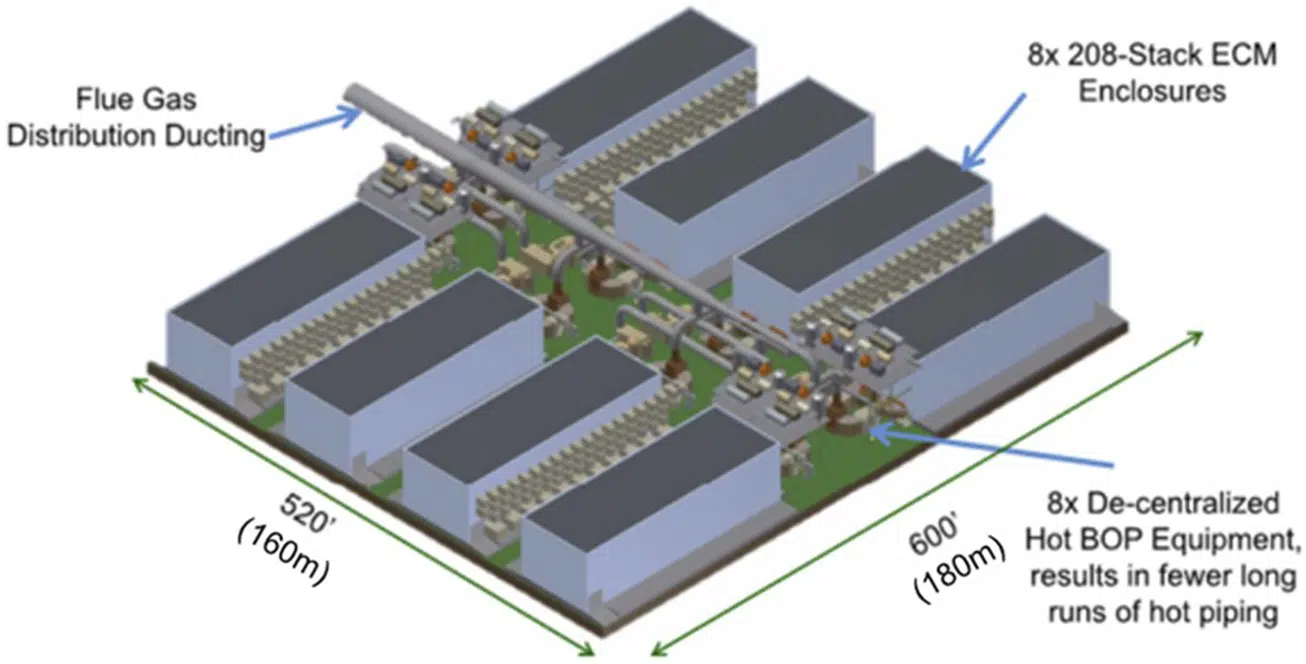
Schematic of Commercial-Scale MCFC Plant
The section discusses the risk of converting a large pipeline to ‘commercial scale’ projects, and this chart provides a schematic for a large, commercial-scale MCFC carbon capture plant.
(Source: Frontiers)
$30.5 M in Q 1 Revenue, Fuel Cell Energy’s Persistent Cash Burn
Despite a significant 61% year-over-year revenue increase in Q 1 2026, Fuel Cell Energy‘s financial position remains precarious, defined by persistent unprofitability, negative cash flow, and a reliance on dilutive financing to fund operations. The company’s strategy of investing in manufacturing capacity to meet future demand is necessary for growth but intensifies the immediate pressure to secure profitable contracts and manage its high cash burn rate. This dynamic creates a high-risk financial environment where operational execution must deliver near-term results.
- For Q 1 2026, Fuel Cell Energy reported revenues of $30.5 million, largely driven by product sales to partners in South Korea. However, this revenue growth was offset by continued operational losses and negative cash flow, indicating the company is not yet generating profit from its core business activities.
- To meet anticipated demand from its 1.5 GW data center pipeline, the company announced a planned capital expenditure of $20 million to $30 million to expand its production capacity toward a target of 100 MW annually. This investment underscores the company’s strategic commitment but also adds to its short-term financial burdens.
- Fuel Cell Energy continues to fund its operations through the sale of common stock. Following Q 1 2026, the company raised $2.5 million in net proceeds from open market sales. This ongoing reliance on equity markets has led to significant shareholder dilution, with the share count increasing by 45.7% in just over a year.
Table: Fuel Cell Energy Strategic Investments
| Partner / Project | Time Frame | Details and Strategic Purpose | Source |
|---|---|---|---|
| Manufacturing Capacity Expansion | Q 1 2026 | Announced a $20 M to $30 M capital expenditure to increase factory output toward 100 MW/year, aimed at servicing the 1.5 GW data center pipeline. | Seeking Alpha |
| Open Market Share Sale | Post-Q 1 2026 | Raised $2.5 million in net proceeds from the sale of 0.3 million common shares to fund ongoing operations and manage working capital. | Seeking Alpha |
Fuel Cell Energy 450 MW SDCL Deal and Exxon Mobil Pilot (2026)
In 2026, Fuel Cell Energy secured two strategically vital partnerships that are designed to validate its technology for industrial carbon capture and provide a scalable entry into the data center market. The joint development agreement with Exxon Mobil provides a pathway to commercialize its core carbon capture technology with an industry leader, while the collaboration with SDCL offers a financing and deployment vehicle to de-risk large-scale projects. The outcomes of these two partnerships will be the primary determinants of the company’s commercial success or failure in the near term.
- The partnership with Exxon Mobil focuses on a pilot project at a manufacturing site in Rotterdam, Netherlands. In April 2026, Fuel Cell Energy is scheduled to ship two carbon capture modules for a demonstration targeting over 90% capture efficiency from an industrial flue gas stream, with the captured CO 2 slated for integration into the Porthos storage network.
- Announced in January 2026, the strategic collaboration with Sustainable Development Capital LLP (SDCL) aims to deploy up to 450 MW of Fuel Cell Energy‘s power platforms. This agreement targets the data center market by pairing Fuel Cell Energy‘s technology with SDCL‘s expertise in financing and operating large energy infrastructure assets.
- These major 2026 agreements build upon a foundation of existing collaborations, such as the ongoing project with Toyota at the Port of Long Beach. This “Tri-gen” system demonstrates the platform’s versatility by producing clean electricity, renewable hydrogen, and water, supporting Toyota‘s hydrogen vehicle and sustainable logistics initiatives.
Table: Fuel Cell Energy Strategic Partnerships
| Partner / Project | Time Frame | Details and Strategic Purpose | Source |
|---|---|---|---|
| Exxon Mobil Carbon Capture Pilot | 2026 | Demonstration project at a Rotterdam industrial site to validate >90% CO 2 capture from flue gas using MCFC technology. The pilot is a critical commercial proof point for industrial decarbonization. | Zacks |
| Sustainable Development Capital LLP (SDCL) | 2026 | Agreement to deploy up to 450 MW of fuel cell power plants, primarily targeting data centers. SDCL provides project financing and operational expertise to accelerate deployments. | Fuel Cell Energy |
| Toyota Tri-gen System | Ongoing | Operating a Tri-gen system at the Port of Long Beach to produce electricity, renewable hydrogen for transportation, and water. Validates multi-output applications of the MCFC platform. | Eastern Progress |
US vs. International, Fuel Cell Energy’s Deployment Focus
Fuel Cell Energy‘s geographic strategy is bifurcated, focusing on North America for the emerging data center power market while leveraging established relationships and new industrial partnerships in Europe and Asia. The company’s U.S. activities are centered on its new standardized power block offering, while its international efforts are dominated by the high-profile carbon capture pilot in the Netherlands and legacy module supply agreements in South Korea. This dual-front approach allows the company to pursue distinct regional opportunities but also stretches its commercial and operational resources.

North America to Dominate MCFC Market
The section details Fuel Cell Energy’s geographic focus on North America versus international markets, and this chart directly forecasts the MCFC market by region, showing North America’s dominance.
(Source: Market Research Future)
- In North America, the primary focus is capturing demand from the power-constrained data center sector, driven by the AI boom. The launch of the 12.5 MW power block and the SDCL partnership are squarely aimed at the U.S. market, building on long-term domestic reference projects like the CHP plant at Trinity College in Connecticut and the Tri-gen project with Toyota in California.
- Europe has become the critical proving ground for the company’s industrial decarbonization strategy. The Exxon Mobil pilot in Rotterdam is its most significant international project, intended to serve as a commercial blueprint for capturing CO 2 from heavy industries across the continent, which are facing stringent emissions regulations.
- Asia, particularly South Korea, remains a key market for revenue generation through long-term service and module supply agreements. A significant portion of the company’s Q 1 2026 revenue came from delivering modules to its South Korean partners, demonstrating a mature and stable, albeit lower-margin, business channel.
MCFC Technology Maturity, Fuel Cell Energy’s Carbon Capture Play
While Fuel Cell Energy‘s core MCFC technology is commercially mature for stationary power generation, its most promising and differentiating application, integrated industrial carbon capture, is currently at a critical pre-commercial validation stage. The company’s strategic success in 2026 and beyond depends entirely on proving that this dual-function capability is not just technically feasible but economically viable at an industrial scale. This contrasts with other fuel cell technologies like Solid Oxide Fuel Cells (SOFC), where companies like Ceres Power have focused primarily on power and hydrogen generation efficiency.
- Between 2021 and 2024, the maturity of Fuel Cell Energy‘s platform was demonstrated through consistent operation in utility-scale and CHP projects. These deployments validated the technology’s reliability and efficiency for producing low-emission baseload power, but the integrated carbon capture function remained largely a theoretical value proposition.
- In 2026, the technology entered a pivotal validation phase with the Exxon Mobil pilot. This project is designed to be the first large-scale, industrial demonstration of the MCFC platform’s ability to capture CO 2 from an external flue stream while simultaneously producing power, a feature no other major fuel cell technology offers.
- The launch of the standardized 12.5 MW power block in March 2026 represents a maturation of the company’s product strategy for the data center market. By packaging its technology into a scalable, repeatable format, Fuel Cell Energy is signaling a shift from bespoke projects to a more commercially streamlined product offering.
SWOT Analysis, Fuel Cell Energy’s High-Risk Execution Play
Fuel Cell Energy‘s strategic position in 2026 is a classic high-risk, high-reward scenario, where a unique and timely technological strength is counterbalanced by significant financial weaknesses and a history of commercialization failures. The company’s future depends on its ability to leverage its opportunities in the data center and carbon capture markets while mitigating the threats posed by formidable competition and its own execution risk. The stark contrast between its pre-2024 status and its current high-stakes projects highlights a definitive inflection point.

MCFC Market to Exceed $32B by 2035
The section describes a ‘high-risk, high-reward’ scenario, and this chart’s forecast of exponential market growth quantifies the ‘high-reward’ opportunity the company is pursuing.
(Source: Market Research Future)
- Strengths: The company’s primary strength is its proprietary MCFC technology, which is uniquely capable of simultaneous power generation and high-efficiency carbon capture.
- Weaknesses: Its most significant weaknesses are chronic unprofitability, negative cash flow, and a dependency on dilutive financing that has eroded shareholder value.
- Opportunities: Massive demand from power-hungry AI data centers and incentives like the Inflation Reduction Act’s 45 Q tax credits for carbon capture create enormous market opportunities.
- Threats: The primary threats are a failure to execute on its landmark projects with Exxon Mobil and SDCL, and intense competition from more commercially successful players like Bloom Energy.
Table: SWOT Analysis for Fuel Cell Energy MCFC Technology
| SWOT Category | 2021 – 2024 | 2025 – 2026 | What Changed / Validated |
|---|---|---|---|
| Strengths | MCFC platform demonstrated high efficiency and fuel flexibility in smaller-scale power projects. | Dual-function capability (power + carbon capture) is positioned as the primary competitive differentiator for industrial and data center markets. | The strategic value of integrated carbon capture became the central focus of the company’s commercial strategy, moving from a feature to the core value proposition. |
| Weaknesses | History of net losses and reliance on capital markets to fund operations. Project execution was often slow and bespoke. | Persistent unprofitability, negative cash flow, and significant shareholder dilution (45.7% increase in share count) continue despite revenue growth. | The financial weakness has become more acute as the company attempts to fund a major manufacturing scale-up ($20 M-$30 M) to meet a large but uncontracted pipeline. |
| Opportunities | General market interest in clean energy and hydrogen. | Explosive demand for on-site power from AI data centers and major federal incentives (IRA 45 Q credits) for carbon capture projects. | The market opportunity became highly specific and urgent, directly aligning with the two core applications of Fuel Cell Energy‘s technology. |
| Threats | Competition from other fuel cell technologies and traditional power generation. | Intense competition from financially stronger rival Bloom Energy in the data center market and the primary threat of execution failure on key validation projects. | The threat shifted from general competition to a direct challenge from a larger, profitable competitor and the internal risk of failing to deliver on high-profile commitments. |
Fuel Cell Energy 2027 Outlook, Exxon Mobil Pilot Validation
The operational results from the Exxon Mobil Rotterdam pilot will be the single most critical catalyst for Fuel Cell Energy‘s trajectory into 2027, as its outcome will either validate the economic case for its carbon capture technology or relegate it to a niche power generation solution. If the pilot successfully demonstrates greater than 90% capture efficiency at an acceptable cost, it could unlock a significant pipeline of industrial decarbonization projects. Conversely, any technical or economic shortcomings will severely damage its credibility and likely force another strategic reset.

Diagram Shows FCE’s Carbon Capture Technology
The section focuses on the critical importance of the Exxon Mobil pilot for validating the company’s technology. This chart specifically illustrates how Fuel Cell Energy’s technology works to capture carbon from industrial sources.
(Source: JPT – SPE)

Diagram Details Molten Carbonate Fuel Cell
The section is a SWOT table that highlights the ‘dual-function’ capability as a key strength, and this diagram visually explains the core technological process of separating CO2.
- If the Exxon Mobil pilot is successful, watch for follow-on announcements for additional carbon capture projects, either at other Exxon Mobil sites or with new partners in hard-to-abate sectors like cement and chemicals. This would be the strongest signal that the company has crossed the commercial chasm.
- Watch for the first firm contract announcements under the 450 MW SDCL framework agreement. Securing a definitive, multi-megawatt deal with a data center operator would validate the new 12.5 MW power block and prove the bankability of the partnership model.
- Monitor the company’s gross margins and cash burn in its upcoming quarterly earnings reports. A tangible improvement in profitability on product sales and a reduction in operating losses would indicate that the manufacturing scale-up is achieving efficiencies and that the company is on a path to financial stability.
The questions your competitors are already asking
This report covers one angle of FuelCell Energy’s commercial pivot to MCFC-based carbon capture. The questions that matter most depend on your work.
- FuelCell Energy investments and funding. Is the conversion of its 1.5 GW pipeline on track for its data center market targets?
- FuelCell Energy activities in industrial carbon capture. Is the Exxon Mobil pilot progressing from pilot to commercial deployment?
- Which data center operators are adopting MCFC-based carbon capture power solutions?
- Which companies are gaining or losing ground in the market for fuel cell-based carbon capture?
This report does not answer these. Enki Brief Pro does.
Your question, your angle, your framework. SWOT, PESTL, scenario modelling. The same niche depth, built around the decision your work actually depends on.
