

Doosan Fuel Cell PAFC Niche, 460 k W Pure Cell System, 1 LG Electronics MOU, and 1 CES Showcase (2025 to 2026)
PAFC Commercial Adoption, Doosan Fuel Cell 460 k W CHP Projects
Phosphoric Acid Fuel Cell (PAFC) adoption is concentrated in the specialized Combined Heat and Power (CHP) market segment, where its value is defined by total system efficiency and proven reliability rather than peak electrical output. This focus on a high-value niche has allowed the technology to persist commercially despite competition from newer fuel cell types.
- From 2021 to 2024, the PAFC market was characterized by its established maturity and stable operation in existing CHP installations. The primary market signal was one of persistence and reliability in its established niche.
- The period from 2025 to today shows a strategic reinforcement of this niche focus, led by the market’s primary manufacturer, Doosan Fuel Cell. At CES 2026, Doosan’s US subsidiary Hy Axiom showcased the Pure Cell® Model 400, a 460 k W system specifically designed as a compact power plant for commercial and industrial CHP applications.
- The business case for PAFC is built on its total energy utilization. While electrical efficiency is a moderate 35-42%, the systems achieve a total CHP efficiency approaching 90% by capturing high-quality waste heat at approximately 200°C, ideal for space heating and industrial processes.
- As the most mature fuel cell technology (TRL 9), PAFC offers a de-risked, bankable solution for facility owners and infrastructure investors who prioritize operational predictability and long-term stability for critical on-site power and heat generation. PAFC systems are also noted for their fuel flexibility, capable of running on natural gas, biogas, or pure hydrogen.
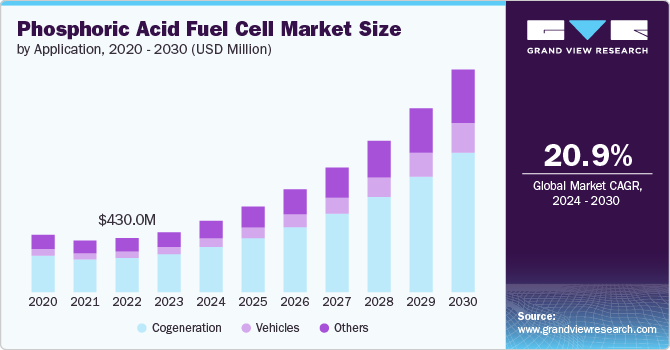
PAFC Market Growth Driven by Cogeneration
This chart validates the section’s focus on commercial adoption in the CHP segment by showing market size and growth is primarily driven by cogeneration applications.
(Source: Grand View Research)
Doosan Fuel Cell 1 LG Electronics MOU and CHP Market Focus (2025 to 2026)
Strategic partnerships in the PAFC market are evolving from simple supply agreements to sophisticated collaborations designed to maximize the total economic value of CHP systems. This signals a strategic shift toward selling integrated energy solutions rather than standalone hardware.
- The defining partnership in the recent period is the Memorandum of Understanding (MOU) signed between Doosan Fuel Cell and LG Electronics in February 2026.
- The explicit goal of the alliance is to develop a business model that captures and utilizes the waste heat from Doosan’s PAFC units, converting it into a source for clean cooling and heating for buildings.
- This collaboration directly addresses the core value proposition of PAFC technology by creating new revenue streams from its thermal output, thereby improving the overall return on investment for customers.
- This move contrasts with the 2021-2024 period, where partnerships were less focused on integrated energy services. The Doosan–LG agreement indicates the market is maturing toward a more service-oriented and holistic energy management approach.
Table: Doosan Fuel Cell Strategic Partnerships
| Partner / Project | Time Frame | Details and Strategic Purpose | Source |
|---|---|---|---|
| Doosan Fuel Cell & LG Electronics | Feb 2026 | Announced an MOU to jointly develop a business model for utilizing waste heat from fuel cells for clean cooling and heating. The partnership aims to maximize the CHP value proposition by creating new revenue streams from thermal energy. | Next MSC |
South Korea and US, Doosan Fuel Cell Geographic Focus
The global PAFC market is geographically concentrated, with South Korea serving as the central hub for manufacturing and large-scale deployment, while the United States remains a key commercial market for targeted applications, complemented by niche adoption in other regions.
- South Korea, as the home base for market leader Doosan Fuel Cell, is the epicenter of PAFC manufacturing, R&D, and policy support. The country’s broader commitment to fuel cell technologies provides a stable domestic market for Doosan’s CHP products.
- The United States represents a primary target market for commercial sales, driven by Doosan’s subsidiary, Hy Axiom. The showcase of the Pure Cell® system at CES 2026 in Las Vegas highlights a focused effort to capture opportunities in the US commercial building and light industrial sectors.
- Outside of these core commercial zones, PAFC technology sees limited but critical adoption. India’s Defence Research and Development Organisation (DRDO) is developing PAFC-based systems for submarine propulsion, a consistent niche application noted in both the 2021-2024 and current periods, validating the technology’s high reliability.
- Market data also indicates that Japan has been a consistently growing market for PAFC technology through 2026, reflecting the country’s strategic focus on distributed energy resources for enhanced energy security and grid resilience.
90% CHP Efficiency, Doosan Fuel Cell Technology at Commercial Scale
In 2026, Phosphoric Acid Fuel Cell technology is fully commercialized and technologically mature, with industry efforts now centered on system integration and application-specific value engineering rather than fundamental science. The technology’s progression is measured by its economic performance in CHP applications, not by incremental gains in electrical efficiency.
- PAFC is a Technology Readiness Level (TRL) 9 technology, a status it has maintained since the 2021-2024 period. This maturity provides customers with predictable performance, established maintenance schedules, and reliable operational costs.
- The focus of innovation has shifted from the cell stack to the total system. The Doosan-LG MOU in 2026 to monetize waste heat is a clear signal that development has moved beyond the hardware to optimizing its economic output within an energy ecosystem.
- While the electrical efficiency of 35-42% is lower than competing technologies, it is the total system efficiency in CHP mode, reaching up to 90%, that defines its competitive advantage. The high-quality waste heat at ~200°C is a key differentiator from low-temperature fuel cells.
- The continued development of PAFC for mission-critical defense applications, such as submarine power by India’s DRDO, serves as an ongoing validation of its core attributes of reliability and durability, underscoring its status as a proven, dependable technology.
SWOT Analysis, Doosan Fuel Cell PAFC Strengths and Threats
The strategic position of PAFC technology is defined by its deep entrenchment in the CHP niche, which provides a durable market. However, this specialization also creates vulnerabilities, as it limits the addressable market and exposes it to long-term competition from more flexible and electrically efficient technologies like Solid Oxide Fuel Cells (SOFCs).

Cogeneration’s Overwhelming Market Share for PAFC
This chart visually proves the key strength mentioned in the SWOT analysis by showing that cogeneration (CHP) makes up over 92% of the PAFC market, demonstrating its deep entrenchment.
(Source: Fortune Business Insights)
- Strengths: The technology’s primary strength is its proven reliability and high total efficiency (up to 90%) in CHP applications, making it a bankable asset for risk-averse customers.
- Weaknesses: Its moderate electrical efficiency (36-42%) is a significant disadvantage compared to SOFCs (>60%), and the market’s heavy reliance on a single major manufacturer, Doosan Fuel Cell, presents a potential supply chain concentration risk.
- Opportunities: The primary opportunity lies in further monetizing the technology’s thermal output, as exemplified by the Doosan–LG MOU. This strategy shifts the value proposition from a power unit to an integrated energy-saving solution.
- Threats: The rapid advancement and cost reduction of SOFC and PEMFC technologies pose a significant long-term threat. As these alternatives scale, they could begin to compete on a total cost of ownership basis even in CHP applications.
Table: SWOT Analysis for Doosan Fuel Cell and PAFC Market
| SWOT Category | 2021 – 2023 | 2024 – 2026 | What Changed / Resolved / Validated |
|---|---|---|---|
| Strengths | Proven reliability and established commercial presence in niche CHP applications. | High total CHP efficiency (up to 90%) and useful heat quality (~200°C) are established as the core value drivers. A mature product line exists with the Doosan Pure Cell®. | The market has validated that total system efficiency and reliability are more valuable than raw electrical efficiency for the core PAFC customer base. |
| Weaknesses | Lower electrical efficiency compared to emerging SOFC technology. High upfront capital cost. | The electrical efficiency gap with SOFCs (>60%) has become more pronounced. The manufacturing base has consolidated, increasing reliance on Doosan Fuel Cell. | The technology has not closed the electrical efficiency gap; instead, the market strategy has doubled down on the CHP niche, accepting the efficiency trade-off. |
| Opportunities | Growing market for distributed generation and on-site power to improve grid resilience. | The Doosan–LG MOU (Feb 2026) creates a formal pathway to monetize waste heat for cooling and heating, opening new service-based revenue models. | The strategic focus has shifted from simply selling fuel cells to creating integrated energy systems that maximize the value of both electrical and thermal outputs. |
| Threats | SOFC and PEMFC technologies were improving and gaining market traction in other sectors. | SOFCs are now being deployed at scale in high-value stationary markets like data centers. The overall fuel cell market is growing rapidly (39.5% projected CAGR), but PEMFCs and SOFCs are capturing the majority of this growth. | The threat from competing technologies has materialized, with SOFCs securing adjacent markets and demonstrating rapid performance gains that could eventually challenge PAFC’s CHP stronghold. |
Doosan Fuel Cell Future: CHP Integration or SOFC Pivot?
The strategic imperative for the PAFC market in the year ahead is for Doosan Fuel Cell to successfully execute its integrated CHP strategy. The success or failure of initiatives to monetize waste heat will likely determine the level of future investment in the mature PAFC platform versus the company’s own developing SOFC technology.
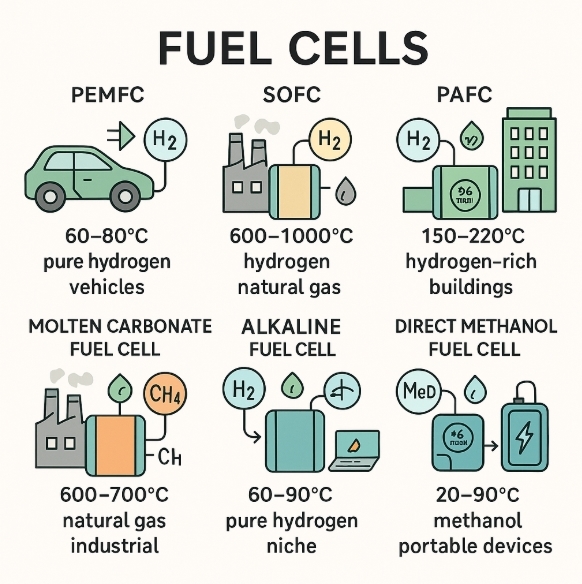
Comparing Fuel Cell Technology Options
This infographic provides context for the strategic pivot discussed in the section, visually comparing PAFC against other fuel cell types and their respective applications.
(Source: SunLith Energy)
- If the Doosan-LG partnership leads to the announcement of new commercial projects that feature integrated cooling and heating solutions by early 2027, then watch for a renewed marketing push from Doosan and Hy Axiom focused on Total Cost of Ownership (TCO) for customers in the hospitality, healthcare, and light industrial sectors.
- This could be happening if sales announcements begin to quantify the financial savings from captured thermal energy, positioning the Pure Cell® system as a comprehensive energy management tool rather than just a power source.
- If, however, there are no significant commercial developments stemming from the LG MOU by the end of 2026, then watch for an acceleration of Doosan’s public messaging and R&D announcements related to its SOFC business.
- This could be happening if Doosan’s investor presentations and capital expenditure plans show a distinct pivot in resource allocation toward the higher-growth SOFC market, signaling that the company is hedging against the limited growth ceiling of its mature PAFC business.
The questions your competitors are already asking
This report covers one angle of PAFC’s commercial persistence in the CHP market. The questions that matter most depend on your work.
- Which companies are gaining or losing ground in the commercial PAFC market, and how dominant is Doosan Fuel Cell’s position?
- How does Doosan’s 460 kW PAFC system compare to newer fuel cells (like SOFC or PEM) on total CHP efficiency versus electrical efficiency?
- Which commercial facility operators are adopting PAFC for on-site CHP, and what makes it a bankable solution for them?
This report does not answer these. Enki Brief Pro does.
Your question, your angle, your framework. SWOT, PESTL, scenario modelling. The same niche depth, built around the decision your work actually depends on.
