

PEM Fuel Cell Aircraft, Zero Avia FAA Milestone, $1.1 B Beyond Aero LOIs, and Hy Point Acquisition (2026)
Hydrogen Aircraft Adoption, Zero Avia’s FAA Progress, and Universal Hydrogen’s Failure
The hydrogen-electric aircraft market is undergoing a necessary correction in 2026, shifting from the ambitious, large-scale retrofit concepts that defined the 2021-2024 period to more focused and viable commercial strategies. The sector is now bifurcating into two distinct paths: the incremental certification of powertrains for existing small aircraft and the development of clean-sheet designs for high-value niche markets. This strategic pivot is a direct response to the immense capital and logistical constraints that proved insurmountable for early pioneers.
- The collapse of Universal Hydrogen in early 2026 marks a critical inflection point. Its strategy, which involved retrofitting large regional aircraft like the ATR-72 while simultaneously building a complex modular refueling network, highlighted the extreme difficulty of overhauling aircraft technology and ground infrastructure at the same time.
- French startup Beyond Aero acquired Universal Hydrogen‘s assets, signaling market consolidation and a strategic shift. Instead of retrofits, Beyond Aero is pursuing a purpose-built, hydrogen-electric business jet, a “clean-sheet” approach that avoids the complexities of modifying diverse, aging airframes.
- Zero Avia continues to lead the incrementalist path, focusing on certifying its ZA 600 powertrain for 10-20 seat aircraft. Its progress is validated by a key regulatory milestone from the FAA in April 2026, providing a clear, albeit challenging, path to commercial operation for its retrofit model.
- The slowdown of major OEM projects, such as Airbus’s ZEROe program, has further tempered market expectations, reinforcing the near-term focus on regional and business aviation as the most practical entry points for hydrogen propulsion.
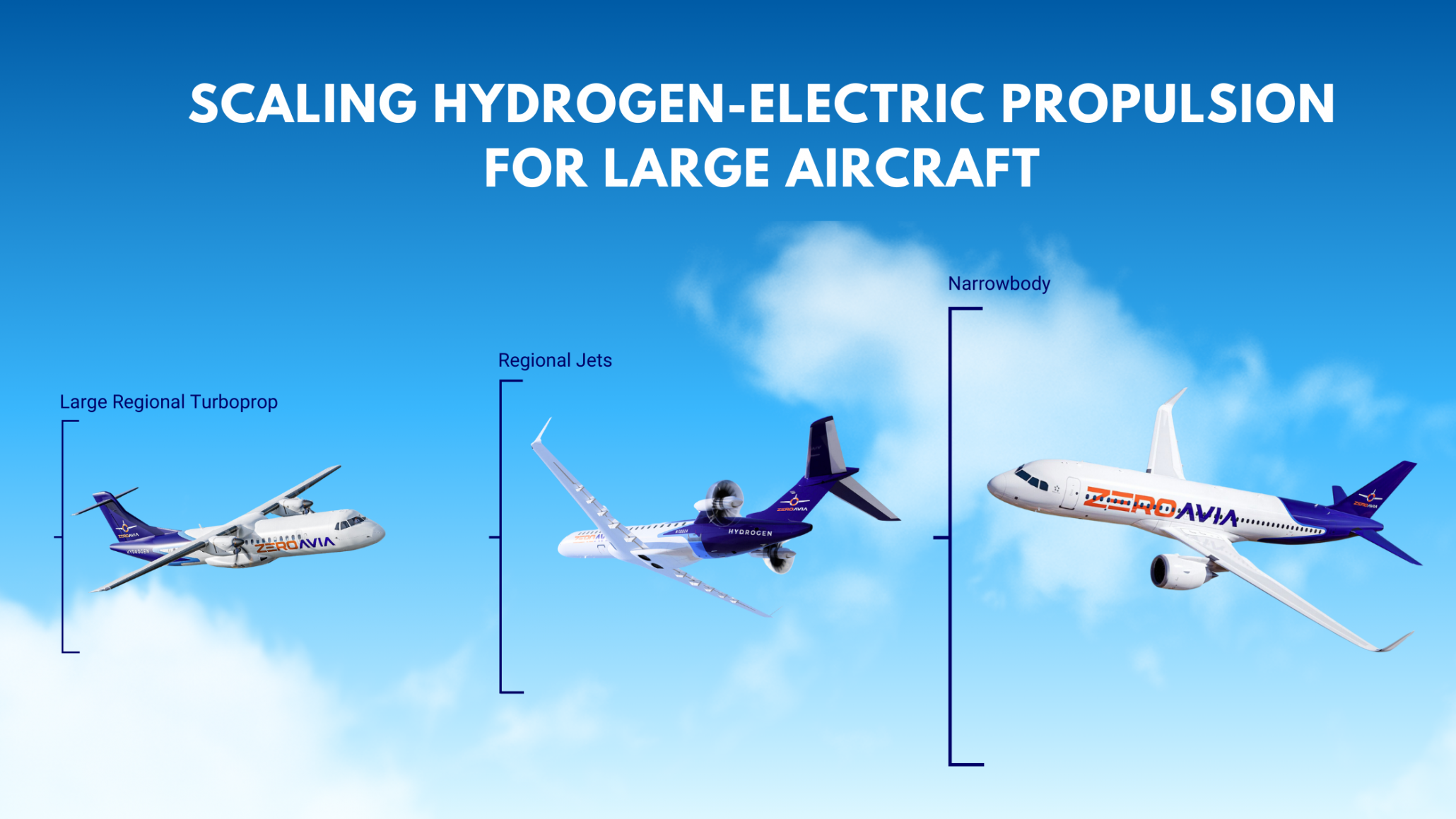
ZeroAvia’s Ambitious Hydrogen Aircraft Scaling Roadmap
The section discusses a strategic shift away from ambitious, large-scale concepts. This chart visualizes ZeroAvia’s scaling roadmap, providing essential context for the strategic pivot mentioned in the text.
(Source: ZeroAvia)
$1.1 B in LOIs, Beyond Aero’s Asset Purchase and Zero Avia’s $38 M Round
Investment patterns in 2026 reflect the market’s strategic bifurcation, with capital flowing toward companies demonstrating tangible certification progress or strong demand in a well-defined niche. The period is defined by strategic acquisitions that consolidate technology and funding that rewards methodical, milestone-driven development, a departure from the speculative, vision-based investments of prior years.
- Beyond Aero‘s acquisition of Universal Hydrogen‘s assets for an undisclosed sum is the year’s most significant consolidation event, allowing the startup to absorb a competitor’s technology and flight-testing experience to accelerate its own program.
- The commercial viability of Beyond Aero‘s niche strategy is underscored by the $1.1 billion in Letters of Intent (LOIs) it has secured for its business jet, indicating strong preliminary demand from the high-value private aviation market.
- Zero Avia executed a strategic acquisition of Hy Point, a developer of high-temperature fuel cells, in April 2026. This move vertically integrates a critical powertrain technology, giving Zero Avia greater control over its system’s performance and development timeline.
- Continued investor confidence in Zero Avia‘s incremental approach was confirmed with a funding round of nearly $38 million in February 2026, providing capital to advance its powertrain development and certification activities.
Hydrogen Aviation Investments & Acquisitions (2026)
| Company / Acquirer | Time Frame | Details and Strategic Purpose | Source |
|---|---|---|---|
| Zero Avia | April 2026 | Acquired Hy Point to vertically integrate high-temperature fuel cell technology and its engineering team, accelerating powertrain development. | Priv Source |
| Beyond Aero | March 2026 | Acquired the assets of the defunct Universal Hydrogen Co. to gain access to its technology, IP, and test flight experience for its business jet program. | Aerospace Manufacturing and Design |
| Beyond Aero | March 2026 | Secured $1.1 billion in non-binding Letters of Intent (LOIs), demonstrating significant early market interest for its hydrogen-electric business jet concept. | autoevolution |
| Zero Avia | February 2026 | Secured approximately $38 million in a funding round to continue the development and certification of its hydrogen powerplant technology. | FLYING Magazine |
Zero Avia 3 Key Technology Alliances for LH 2 and Fuel Cells (2026)
Strategic partnerships in 2026 have matured from general expressions of interest to targeted collaborations aimed at solving specific and critical technology gaps. The most important alliances are now focused on enabling technologies for next-generation systems, particularly liquid hydrogen (LH₂) storage and fuel cell optimization, which are essential for extending aircraft range and performance.

ZeroAvia’s End-to-End Hydrogen Powertrain Ecosystem
The section details technology alliances for fuel cells and hydrogen storage. The chart illustrates the complete ecosystem, showing how these critical components integrate into ZeroAvia’s larger system.
(Source: CleanTechnica)
- Zero Avia‘s multi-year agreement with the Korean Atomic Energy Research Institute (KAERI), signed in March 2026, focuses on the development of composite liquid hydrogen storage systems. This partnership gives Zero Avia a crucial role in advancing a technology required to move beyond short-range, gaseous hydrogen-powered flight.
- The ongoing collaboration between Zero Avia and Intelligent Energy highlights the focus on core component optimization. The partnership is dedicated to adapting Intelligent Energy‘s high-power fuel cell technology for the unique demands of aviation, a critical step for powertrain efficiency and reliability.
- Infrastructure development is proceeding in parallel, with projects like Bristol Airport’s liquid hydrogen refueling initiative announced in January 2026. This project is explicitly designed to support future aircraft from pioneers like Zero Avia and Airbus, representing a crucial early step in building the ground support ecosystem.
Hydrogen Aviation Partnerships (2026)
| Lead Company / Partner | Time Frame | Details and Strategic Purpose | Source |
|---|---|---|---|
| Zero Avia / KAERI | March 2026 | Multi-year R&D support agreement for Zero Avia to advise on the design and testing of composite liquid hydrogen (LH₂) tanks for aviation. | Composites World |
| Zero Avia / Intelligent Energy | March 2026 | Technology partnership to optimize high-power fuel cell technology specifically for the demanding performance requirements of aviation applications. | Enapter |
| Conscious Aerospace / De Havilland | February 2026 | Developing a program to convert existing De Havilland Dash 8 regional aircraft to hydrogen-electric propulsion, representing another take on the retrofit model. | AINonline |
| Industry / Bristol Airport | January 2026 | Launch of an infrastructure project to establish liquid hydrogen (LH₂) refueling capabilities to support future hydrogen aircraft operations. | Airside International |
US vs. Europe, Zero Avia’s UK Base and Beyond Aero’s French Flight
In 2026, the United Kingdom and France solidified their positions as the dominant geographic hubs for hydrogen-electric aviation development, driven by concentrated startup activity, government support, and key testing infrastructure. While European players lead development, the United States holds a critical position as the primary regulatory gatekeeper, whose decisions shape the global path to commercialization.
- The UK is the operational center for Zero Avia, hosting its powertrain development, testing facilities, and key government-backed R&D programs through the Aerospace Technology Institute (ATI). The country’s commitment is further shown by airport-led initiatives like Bristol’s LH₂ refueling project.
- France has emerged as a hub for clean-sheet design, led by Toulouse-based Beyond Aero. The company’s successful completion of France’s first manned hydrogen-electric flight and its aircraft’s preliminary design review have established the nation as a key player in next-generation hydrogen aircraft.
- The U.S. Federal Aviation Administration (FAA) plays an indispensable role in validation. By publishing the final special conditions for Zero Avia‘s ZA 601 powertrain, the FAA has established a definitive regulatory framework that will influence certification standards worldwide.
- R&D collaboration is becoming increasingly global. Zero Avia‘s partnership with South Korea’s KAERI to advance liquid hydrogen storage technology demonstrates that while physical development is concentrated, the search for enabling technologies spans multiple continents.
Powertrain Certification, Zero Avia’s FAA Milestone and Beyond Aero’s PDR
Hydrogen-electric propulsion technology has matured from the proof-of-concept flight tests of 2021-2024 to achieving critical engineering and regulatory milestones in 2026. This progress signals a definitive shift toward productization, although significant technical and regulatory work remains before the first commercial entry into service. This focus on optimizing fuel cells for specific, high-value applications mirrors trends seen in the stationary power sector, where companies like Bloom Energy have found success by targeting data centers and industrial users.
- The most significant validation of technology maturity in 2026 is the FAA’s publication of special conditions for Zero Avia‘s ZA 601 electric propulsion unit. This moves the technology from the experimental phase into a defined, albeit complex, regulatory certification pathway.
- Beyond Aero‘s completion of its Preliminary Design Review (PDR) in March 2026 marks another key milestone. This achievement finalizes the aircraft’s architecture, demonstrating that the design is viable and ready to proceed to detailed engineering, a crucial step for any new aircraft program.
- The industry is already commercializing its core technology in adjacent markets. In January 2026, Zero Avia began shipping its Super Stack Flex fuel cell system to defense customers for use in Unmanned Aerial Vehicles (UAVs), creating an early revenue stream and providing operational data.
- A forward-looking technology shift is evident in the growing focus on liquid hydrogen (LH₂) systems. Partnerships like Zero Avia‘s with KAERI are tackling the challenges of LH₂ storage, a necessary step to unlock the longer ranges required for meaningful regional air travel.
SWOT Analysis, Zero Avia’s Strengths and Market-Wide Threats (2026)
The hydrogen aviation sector’s primary strength is its advancing powertrain technology, which now sits on a clearer path to certification. However, this is counterbalanced by significant weaknesses related to capital intensity and infrastructure dependency. While major opportunities exist in targeted niche markets, the entire sector remains threatened by the potential for regulatory delays and the high-profile failure of overly ambitious business models.
- Strengths have evolved from successful test flights to tangible regulatory and technology integration milestones.
- Weaknesses remain centered on funding, with the collapse of Universal Hydrogen providing a stark example of how capital-intensive business models can fail.
- Opportunities are becoming more focused, shifting from broad airline MOUs to substantial pre-order interest for specific, viable aircraft designs.
- Threats are now more concrete, including the real-world challenge of building ground infrastructure and the risk of development slowdowns from major OEMs.
SWOT Analysis for Hydrogen-Electric Aircraft (2026)
| SWOT Category | 2021 – 2024 Status | 2026 Status | What Changed / Validated |
|---|---|---|---|
| Strengths | Successful proof-of-concept flights on small testbed aircraft; strong government and airline interest. | FAA issues special conditions for Zero Avia‘s powertrain; strategic acquisition of key tech (Hy Point). | The technology has moved from demonstration to a defined regulatory pathway, and leaders are vertically integrating core components. |
| Weaknesses | High capital burn rate and theoretical concerns about infrastructure and retrofit complexity. | Failure of Universal Hydrogen due to high capital needs; Zero Avia workforce reduction and certification delays. | The theoretical weakness of capital-intensive models was proven by a major market failure, injecting realism into timelines and funding needs. |
| Opportunities | Numerous non-binding MOUs with airlines for future aircraft conversions. | Beyond Aero secures $1.1 B in LOIs for a specific business jet; Zero Avia sells fuel cells to the defense UAV market. | Market demand is crystallizing around specific, viable products (niche jets) and adjacent markets (drones) rather than broad, undefined fleet renewals. |
| Threats | Potential for regulatory hurdles; competition from Sustainable Aviation Fuel (SAF) and battery-electric. | Airbus slows its ZEROe project; dependence on early infrastructure projects like Bristol Airport’s LH₂ facility becomes clear. | The threat of delays is no longer hypothetical, as major OEMs signal longer timelines and the infrastructure dependency becomes a near-term constraint. |
2027 Outlook, Zero Avia’s Certification Path and Beyond Aero’s Firm Orders
The trajectory for hydrogen aviation in 2027 hinges on two critical commercial tests: whether Zero Avia can meet its revised certification timeline following its recent restructuring, and whether Beyond Aero can successfully convert its substantial letters of intent into firm, non-refundable orders. These outcomes will validate or undermine the two competing strategies that now define the sector.

Hydrogen Aircraft Market Growth Forecast to 2030
This section provides a forward-looking outlook on the sector’s commercial viability. The chart supports this narrative by providing a quantitative market growth forecast through 2030.
(Source: Grand View Research)
- If Zero Avia demonstrates tangible progress against its new ZA 600 certification schedule, it will solidify confidence in the powertrain retrofit model as a viable, albeit challenging, path for decarbonizing regional aviation. Watch for updates on its ground and flight testing campaigns.
- The key signal to watch from Beyond Aero is the announcement of its first firm orders and a lead customer for its business jet. This would convert market interest into a concrete production backlog, validating the high-value, clean-sheet design strategy.
- Progress on enabling technologies, particularly the development of lightweight, certifiable liquid hydrogen (LH₂) storage tanks from the Zero Avia/KAERI partnership, will be a leading indicator for the viability of longer-range hydrogen aircraft in the 2030 s.
- Any further market consolidation or the failure of another significant player would indicate that capital and technical challenges remain severe, potentially pushing widespread adoption timelines further out and narrowing the field to only the most well-funded and strategically focused companies.
The questions your competitors are already asking
This report covers one angle of the market correction in hydrogen-electric regional aviation. The questions that matter most depend on your work.
- Which companies are gaining or losing ground in the hydrogen-electric regional aviation market?
- What is actually happening with ZeroAvia’s ZA 600 certification path since its FAA milestone?
- How does the retrofit strategy for existing aircraft compare to the clean-sheet design strategy for commercial viability?
This report does not answer these. Enki Brief Pro does.
Your question, your angle, your framework. SWOT, PESTL, scenario modelling. The same niche depth, built around the decision your work actually depends on.
