

Electra Therm Oilfield Geothermal, 1 Rolls-Royce Partnership, a 65 k We Plant, and 2 Commercial Projects (2021 to 2026)
Electra Therm Commercial Projects Signal Shift to Oilfield Decarbonization
The adoption of Organic Rankine Cycle (ORC) technology in oilfields has transitioned from demonstrating technical feasibility to serving as a recognized decarbonization solution, driven by increasing pressure on operators to reduce Scope 1 emissions and control operational costs.
- Between 2021 and 2024, commercial activity focused on proving the application in specific industrial settings. For example, a June 2021 deployment on a gas compression system generated 45 k We of power from waste heat, validating the core value proposition of creating emission-free electricity to reduce on-site costs.
- This period established the technology’s effectiveness in capturing low-grade heat, a vast but underutilized resource in the industrial sector, where over 50% of energy inputs are lost as waste heat.
- From 2025 onwards, the focus has shifted toward more structured integration and broader market acceptance, demonstrated by formal collaborations and inclusion in institutional decarbonization plans. A January 2026 study with Rolls-Royce assessed integrating an Electra Therm ORC with an M 250-C 20 B engine, signaling interest from major industrial equipment manufacturers.
- Furthermore, the University of Colorado’s Anschutz Medical Campus included Electra Therm in its 2025 Energy Master Plan for heat recovery, indicating the technology’s growing credibility beyond its initial oil and gas niche and into broader industrial and institutional applications.
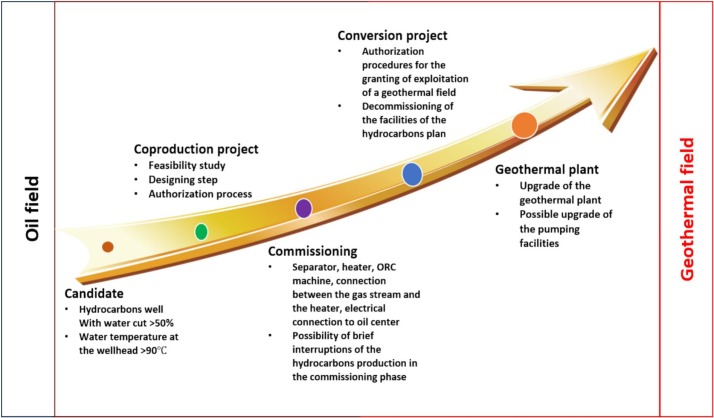
Pathway for Oil Field to Geothermal Conversion
This chart directly illustrates the process of converting oil fields, which is the central topic of the commercial projects discussed in this section.
(Source: ScienceDirect.com)
$331 M Fervo Deal, Electra Therm Investment Calculus Shifts with IRA
The financial viability of deploying ORC systems like those from Electra Therm at oilfields has fundamentally improved, shifting from a pure operational efficiency play to a tax-advantaged investment, primarily due to incentives in the 2022 Inflation Reduction Act (IRA).
- The IRA provides a base Investment Tax Credit (ITC) of 6%, which can increase to 30% for geothermal projects, drastically lowering the net capital expenditure and improving project returns that historically ranged from 6% to 8%.
- This policy support makes the low operational expenditure of ORC systems, estimated at just 0.25% of CAPEX annually, even more compelling compared to the volatile fuel and maintenance costs of diesel generators commonly used at remote sites.
- While direct investments into Electra Therm are not public, growing investor confidence in the broader advanced geothermal sector provides a positive signal. In early 2026, reports showed that Fervo Energy secured $331 million in debt financing, and Eavor received $142 million, indicating that mainstream project financing is becoming accessible for related technologies.
- The combination of federal incentives and proven low OPEX allows operators to frame these projects as strategic tools for cost control, with payback periods now more aligned with the oil and gas industry’s traditional investment horizons.

Global Geothermal Capacity Shows Steady Growth
This chart provides the macro-level market context, showing a steadily growing global capacity that justifies the large-scale investment and deals discussed in the section.
(Source: ScienceDirect.com)
Table: Geothermal Sector Financing Signals
| Partner / Project | Time Frame | Details and Strategic Purpose | Source |
|---|---|---|---|
| Fervo Energy (Cape Station Project) | Early 2026 | Secured $331 million in debt financing. This indicates growing investor confidence and the bankability of advanced geothermal projects, benefiting the entire technology supply chain. | Coyote Gulch |
| Eavor | Early 2026 | Received $142 million in financing. This influx of capital into a closed-loop geothermal developer signals strong market belief in technologies adjacent to Electra Therm’s application space. | Coyote Gulch |
Electra Therm 2 Key Alliances, Rolls-Royce and Hurst Boiler (2025 to 2026)
Electra Therm is advancing its market penetration strategy by forming partnerships with established industrial manufacturers to create pre-engineered, integrated power generation solutions, reducing project complexity and accelerating deployment for clients.
- A technical study published in January 2026 detailed the integration of an Electra Therm Power+ 4400 ORC system with a Rolls-Royce M 250-C 20 B engine. This collaboration validates the technical compatibility of ORC with mainstream industrial engines and provides a blueprint for capturing engine exhaust heat.
- In May 2026, a document outlined a self-contained power unit pairing a Hurst Series 250 boiler with an Electra Therm Power+ generator. This collaboration resulted in a packaged solution capable of producing 125 k We, demonstrating a move toward standardized, off-the-shelf products for industrial clients.
- These collaborations, emerging in the 2025-2026 period, represent a strategic shift from the bespoke, project-by-project integrations of the prior period (2021-2024), where Electra Therm engaged directly with end-users like oil and gas operators on a case-by-case basis.
- By partnering with original equipment manufacturers (OEMs), Electra Therm can embed its technology earlier in the design phase of larger industrial projects, expanding its addressable market beyond retrofits.

Study Assesses Geothermal Potential of Abandoned Wells
The vast market opportunity identified in this study explains the strategic necessity for forming key alliances with major industrial partners like Rolls-Royce and Hurst Boiler to meet future demand.
(Source: ScienceDirect.com)
Table: Electra Therm Strategic Partnerships
| Partner / Project | Time Frame | Details and Strategic Purpose | Source |
|---|---|---|---|
| Hurst Boiler | May 2026 | Collaboration to create a packaged power generation unit combining a Hurst boiler and an Electra Therm ORC generator. The goal is to offer a standardized, 125 k We system for industrial waste heat recovery. | Infinity Turbine |
| Rolls-Royce | Jan 2026 | An integration study paired an Electra Therm Power+ 4400 ORC plant with a Rolls-Royce M 250-C 20 B engine to assess waste heat recovery techniques. This validates the technology with a major industrial OEM. | Research Gate |
US and Canada, Electra Therm Focuses on Mature Oilfield Regions
North America remains the primary geographic focus for oilfield geothermal applications, driven by a combination of extensive legacy oil and gas infrastructure, favorable geology for low-temperature heat, and emerging state and federal policy support.
- Early project deployments, such as the South Swan Hills project in Alberta, Canada (a 3 MW geothermal heat recovery system integrated with a gas plant), highlighted the potential within mature North American fossil fuel basins before 2025.
- Recent policy developments have reinforced this geographic concentration. In 2024, at least 14 US states were considering 42 bills to promote geothermal energy, with states like Texas and Pennsylvania introducing specific legislation to streamline permitting and encourage development.
- Pennsylvania’s Senate Bill 1131, introduced in January 2026, is a model for creating regulatory frameworks that support geothermal development, including co-production from oil and gas wells.
- This state-level policy momentum in the US, combined with the established operational footprint of the oil and gas industry, creates a fertile ground for Electra Therm’s distributed, modular systems, which are well-suited for the decentralized nature of North American oilfields.
ORC at Commercial Scale, Electra Therm Focuses on Application Engineering
The core Organic Rankine Cycle technology used by Electra Therm is fully mature and commercially proven (TRL 9), with the current focus of innovation centered on application-specific engineering, system packaging for harsh environments, and integration with diverse industrial heat sources.
- Unlike emerging next-generation geothermal concepts like Superhot Rock Energy (TRL 3-4), Electra Therm’s binary cycle ORC systems have been operating commercially for years, as evidenced by case studies from 2021 showing units generating power 24/7 from industrial waste heat.
- The technological advancement from 2025 is not in the thermodynamic cycle but in the productization of the system. Electra Therm increased the maximum output of its Power+ Generator to 150 k W and developed the “Active Cooler, ” a product that both displaces cooling system energy consumption and generates net power.
- A key differentiator is the system’s ability to operate with low-temperature water, down to 65°C (150°F). This capability unlocks a vast geothermal resource from co-produced fluids in mature oilfields, which is inaccessible to traditional high-temperature geothermal plants.
- The strategy is not to compete on LCOE with utility-scale renewables like solar or wind but to provide reliable baseload power in remote locations where the alternative is expensive and carbon-intensive diesel generation.

Geothermal Applications Segmented by Temperature
This chart explains the company’s technological focus by showing how geothermal applications are segmented by temperature, highlighting the niche for Electra Therm’s low-temperature ORC systems.
(Source: Utah Geological Survey – Utah.gov)
Strengths and Risks, Electra Therm SWOT Analysis (2021 to 2026)
Electra Therm’s primary strength lies in its proven, modular technology that addresses a clear market need for oilfield decarbonization, while its main challenge is achieving the commercial scale necessary to make a material impact on the industry’s overall emissions footprint.
- Strengths are rooted in the technology’s ability to convert a waste stream into valuable, emission-free electricity using low-temperature heat sources abundant in oil and gas operations.
- Opportunities have expanded significantly with the introduction of federal tax credits under the IRA and growing state-level policy support for geothermal energy.
- Weaknesses include the reliance on favorable site-specific conditions (heat temperature and flow rate) and overcoming the oil and gas industry’s traditional preference for short-term, high-return investments.
- Threats involve competition from other ORC manufacturers and the potential phase-out of critical tax incentives, with some credits scheduled to reduce after 2025.

Chart Outlines Geothermal Technology Alternatives
A SWOT analysis requires a competitive overview. This chart outlines the technological landscape, which is essential for framing the company’s strengths, weaknesses, opportunities, and threats.
(Source: ThinkGeoEnergy)
Table: SWOT Analysis for Electra Therm Oilfield Geothermal
| SWOT Category | 2021 – 2024 | 2025 – 2026 | What Changed / Validated |
|---|---|---|---|
| Strengths | Proven TRL 9 technology with successful case studies (e.g., 45 k We compression heat project). Low OPEX (~0.25% of CAPEX). | Product line enhancements (up to 150 k We output). Established partnerships (Rolls-Royce, Hurst Boiler) for integrated solutions. | The technology’s reliability was validated, and the focus shifted to creating standardized, easier-to-deploy products through OEM partnerships. |
| Weaknesses | Perceived low ROI for O&G operators compared to E&P. Project-by-project sales cycle was long and resource-intensive. | Business case remains dependent on site-specific heat source quality and flow rates. Small modular nature presents a challenge for industry-wide emissions impact. | While the IRA improves ROI, the fundamental hurdle of convincing a conservative industry to adopt new operational models remains a key challenge. |
| Opportunities | Growing pressure on O&G for ESG and decarbonization. Large untapped resource of low-grade waste heat. | 30% federal ITC via the IRA significantly improves project economics. State-level policy momentum (PA, TX) is creating clear regulatory pathways. | The opportunity shifted from a conceptual ESG benefit to a tangible, tax-incentivized investment, making it a financial and operational decision. |
| Threats | Competition from other ORC providers (Ormat, Turboden). Operator inertia and preference for known power sources like diesel generators. | Potential phase-out of federal tax credits after 2025 could create market uncertainty. Permitting delays at the state level could slow adoption. | The primary threat evolved from simple competition to policy and regulatory risk, highlighting the market’s dependence on continued government support. |
Electra Therm 2026 Outlook, State Permitting and O&G Adoption
For 2026, the critical factor for Electra Therm’s growth is the translation of federal incentives and technical validation into widespread commercial adoption by oil and gas operators, a process that hinges on streamlined state-level permitting and clear demonstration of project profitability.
- If states like Texas and Pennsylvania successfully implement clear and efficient permitting frameworks for co-produced geothermal projects in 2026, watch for an acceleration in pilot project announcements from mid-sized and major oil and gas operators.
- The primary signal of traction will be the public announcement of multi-unit deployments by a single operator, moving beyond one-off installations. This would indicate that the economic and operational models have been validated internally.
- Conversely, if permitting reform stalls or O&G operators remain hesitant due to capital allocation priorities, growth could remain limited to niche applications and early adopters, despite the favorable federal policy environment.
- Another emerging signal to watch is the adoption of ORC technology for powering data centers, an opportunity identified in the 2025 U.S. Geothermal Market Report, which could represent a significant new growth vertical for Electra Therm’s modular systems.

Geothermal Installed Base to Grow 10% Annually
This forward-looking chart provides a specific, quantitative forecast for market growth, which is a key data point that directly supports the section’s 2026 outlook.
(Source: Mordor Intelligence)
The questions your competitors are already asking
This report covers one angle of ElectraTherm’s commercial progress in oilfield decarbonization. The questions that matter most depend on your work.
- Is ElectraTherm’s oilfield ORC technology progressing from pilot projects to wider commercial deployment?
- What is the status of the ElectraTherm-Rolls-Royce partnership since the 2026 integration study?
- What is the cost breakdown of an ElectraTherm ORC system for an oilfield application?
- Which oil and gas operators are adopting waste heat to power solutions for decarbonization?
This report does not answer these. Enki Brief Pro does.
Your question, your angle, your framework. SWOT, PESTL, scenario modelling. The same niche depth, built around the decision your work actually depends on.
