

Exxon Mobil Blue Hydrogen, $7.5 B DOE Cuts, 321 Projects Canceled, and ADNOC 35% Stake (2021 to 2026)
Blue Hydrogen Commercial Risks, Exxon Mobil Project Pause, and 266 GW of Canceled Capacity
The 2025-2026 period revealed that political and regulatory risk, not technological or market failure, became the primary driver of project cancellations across the clean energy sector, with the pause of flagship projects like Exxon Mobil‘s Baytown facility serving as the most prominent signal.
- Between 2021 and 2024, the clean energy market was characterized by strong forward momentum, with major companies like Exxon Mobil advancing large-scale projects and securing world-class engineering partners for what was slated to be the world’s largest blue hydrogen plant.
- This momentum reversed sharply in November 2025 when Exxon Mobil indefinitely paused its Baytown project. The decision was officially driven by weak customer demand and economic uncertainty, but it coincided with a significant federal policy shift that undermined the project’s financial structure.
- The Baytown pause was not an isolated incident. In June 2025, BP halted its blue hydrogen and CCS project at its Whiting, Indiana, refinery, citing similar economic headwinds.
- These marquee cancellations were part of a wider industry contraction. In 2025 alone, nearly 1, 900 power projects representing 266 GW of capacity and $400 billion in planned investment were terminated, signaling a systemic response to a deteriorating policy and financing environment.
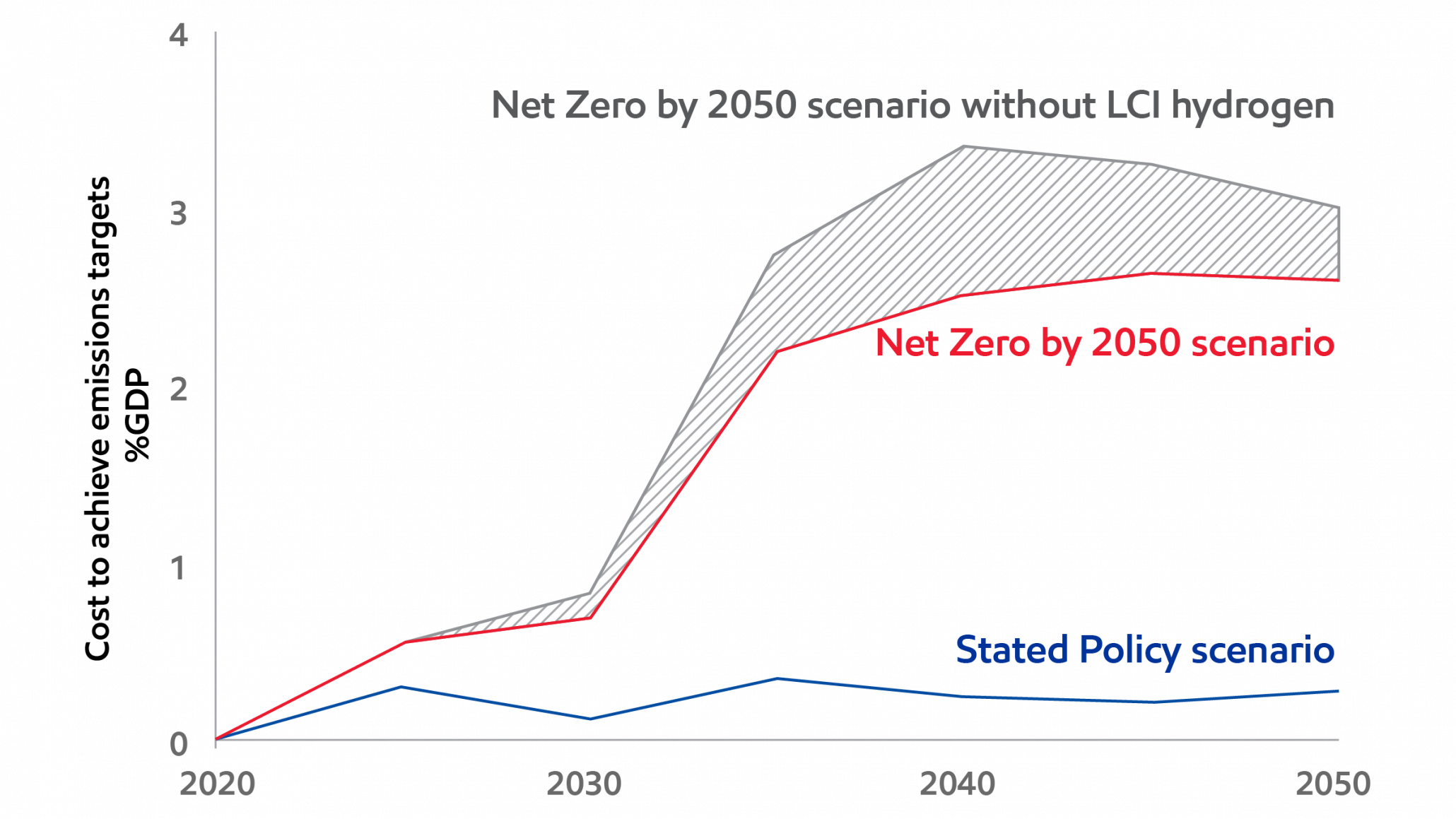
Chart: Low-Carbon Hydrogen Cuts Net Zero Cost
This chart provides high-level context for the section’s discussion on commercial risks and project cancellations by establishing the primary incentive for pursuing low-carbon hydrogen: its potential to significantly reduce the overall cost of achieving net-zero emissions.
(Source: ExxonMobil)
$34.8 B in Cancellations, Exxon Mobil Baytown Pause Amidst Federal Policy Shifts (2025)
The rapid escalation of canceled clean energy investments throughout 2025, culminating in nearly $35 billion by year-end, demonstrates a direct correlation between federal policy reversals and a collapse in investor confidence.
- The year began with a steady stream of project delays and cancellations, totaling $8 billion by the end of Q 1 2025 as developers reacted to rising interest rates and initial signs of policy uncertainty.
- The trend accelerated dramatically following proactive federal actions. By October 2025, the Department of Energy had announced the termination of 321 financial awards for 223 projects, removing approximately $7.56 billion in anticipated support, disproportionately impacting projects in 16 states.
- By the end of 2025, the cumulative value of canceled or abandoned clean energy projects in the U.S. had reached $34.8 billion, accompanied by the loss of an estimated 38, 000 jobs, according to analysis from the environmental business group E 2.
- This capital flight was a direct reaction to executive orders like the “Unleashing American Energy” initiative and freezes on offshore wind permitting, which created a hostile environment for assets heavily reliant on federal tax credits and regulatory approvals.

Exxon Mobil Stock Amidst Project Cancellations
As the section details the significant financial value of project cancellations and the pause of Exxon Mobil’s Baytown facility, this chart provides direct financial context by illustrating the company’s stock performance during this period of uncertainty and shifting federal policy.
(Source: Reuters)
Table: Cumulative Value of Canceled US Clean Energy Projects (2025)
| Date | Cumulative Canceled Value | Source |
|---|---|---|
| Dec 31, 2025 | $34.8 Billion | E 2: Companies Cancelled $34.8 B, 38 K Jobs for Clean Energy … |
| Oct 22, 2025 | $24 Billion | pv magazine USA |
| Jul 24, 2025 | $22 Billion | E 2: $22 Billion in Clean Energy Projects Cancelled in First Half of … |
| May 29, 2025 | $14 Billion | Associated Press |
| Mar 31, 2025 | $8 Billion | E 2: $8 Billion and 16 New Clean Energy Projects Abandoned in … |
US Project Risk, Exxon Mobil Alliances with ADNOC and Technip Energies
The strength of the partnership consortium for the Baytown project, including major international investors and top-tier engineering firms, underscores that its pause was not due to a lack of commercial backing but rather an external shock that undermined its financial foundation.
- Before the pause, Exxon Mobil had de-risked the project by assembling a team of industry leaders. This included a January 2023 contract with Technip Energies for the Front-End Engineering and Design (FEED) and a subsequent December 2024 Engineering, Procurement, and Construction (EPC) contract with Worley.
- The project attracted significant foreign investment, highlighted by a September 2024 agreement for Abu Dhabi National Oil Company (ADNOC) to acquire a 35% equity stake, signaling strong international confidence in the project’s viability.
- Further commercial validation came from a framework agreement with Mitsubishi Corporation to advance project development and an agreement with Air Liquide to transport the low-carbon hydrogen via its extensive U.S. Gulf Coast pipeline network.
- These agreements, secured throughout 2023 and 2024, had positioned the project for a Final Investment Decision (FID) and demonstrated a clear commercial and technical pathway that was ultimately severed by regulatory and political factors.

ExxonMobil Outlines Low-Carbon Sector Strategy
This chart, which outlines Exxon Mobil’s broader low-carbon strategy, directly supports the section’s focus on the company’s specific alliances with ADNOC and Technip Energies. The partnerships can be understood as a direct execution of this overarching strategic plan to manage risk and secure capabilities.
(Source: ExxonMobil)
Table: Exxon Mobil Baytown Project Partnerships
| Partner | Time Frame | Details and Strategic Purpose | Source |
|---|---|---|---|
| Worley | Dec 2024 | Awarded the Engineering, Procurement, and Construction (EPC) contract, moving the project toward the construction phase. | Offshore Energy |
| ADNOC | Sep 2024 | Signed an agreement to acquire a 35% stake, providing significant capital and international validation for the project. | Gasworld |
| Mitsubishi Corp. | Sep 2024 | Signed a framework agreement to advance the development of the low-carbon hydrogen and ammonia production facility. | Mitsubishi Corporation |
| Air Liquide | Jun 2024 | Agreed to transport low-carbon hydrogen via its pipeline network, securing a critical midstream offtake and delivery channel. | Exxon Mobil |
| Technip Energies | Jan 2023 | Awarded the Front-End Engineering and Design (FEED) contract for the integrated complex, a key step in maturing the project design. | Technip Energies |
US Project Cancellations, Exxon Mobil in Texas and BP in Indiana
The clean energy project cancellations of 2025-2026 were geographically concentrated in the United States, with federal actions directly impacting projects across multiple states and technology sectors, reversing the momentum built between 2021 and 2024.
- The 2021-2024 period saw project development across diverse U.S. regions, including the Gulf Coast with Exxon Mobil‘s Baytown project in Texas and the Midwest with BP’s planned facility in Indiana.
- Beginning in 2025, the cancellations became a nationwide phenomenon. The Department of the Interior suspended offshore wind projects from Virginia to New Jersey, including Ørsted‘s Revolution Wind and Equinor‘s Empire Wind. The administration also paid developers like Invenergy and Total Energies over $1.7 billion to terminate their offshore wind leases.
- Onshore projects faced similar fates. The Bureau of Land Management canceled the massive 6.2 GW Esmeralda 7 Solar Project in Nevada, and the Interior Department moved to reverse approval for the Lava Ridge Wind Project in Idaho.
- While the U.S. faced a wave of policy-driven cancellations, commercial viability remained a global challenge. In Australia, the AUD $14 billion Central Queensland Hydrogen Project was canceled in June 2025 after its state-owned proponent, Stanwell, deemed it commercially unfeasible at this stage.
Blue Hydrogen Viability, Exxon Mobil Pause and 45 V Tax Credit Rules
The pause of the Baytown project demonstrates that blue hydrogen technology is commercially ready for large-scale deployment, but its economic viability is entirely dependent on the structure of government subsidies, specifically the interpretation of the 45 V clean hydrogen production tax credit.
- In the 2021-2024 timeframe, the technology was considered mature enough for Exxon Mobil to proceed with FEED and EPC contracts for a facility designed to produce 1 billion cubic feet of hydrogen per day while capturing over 98% of associated CO 2 emissions.
- The project’s economics were predicated on qualifying for the IRA’s top-tier 45 V credit of $3.00/kg. However, the Treasury’s draft guidance released in December 2023 introduced strict lifecycle assessment (LCA) rules that included upstream methane emissions from the natural gas supply chain.
- Under this strict interpretation, the Baytown project would fail to meet the required emissions threshold of less than 0.45 kg of CO 2-equivalent per kg of H 2. It would likely fall into a much lower credit tier of $0.60/kg, a level that Exxon Mobil warned in February 2024 would make the project unlikely to proceed.
- The pause is therefore not a reflection of the technology itself, but a direct consequence of a regulatory framework that renders the project’s financial model unworkable. The project requires the maximum subsidy to bridge the cost gap with conventional grey hydrogen, which costs $1.20/kg to $2.90/kg less to produce.

Chart Forecasts Steady Blue Hydrogen Market Growth
This chart showing a forecast for blue hydrogen market growth directly addresses the section’s central theme of the fuel’s long-term viability. It visualizes the potential market that is at risk or being re-evaluated due to the debate over the 45V tax credit rules.
(Source: Global Market Insights)
$100 B Regional Hub Potential, Exxon Mobil SWOT Analysis and Regulatory Risks
An analysis of the Baytown project reveals immense strengths in its proposed scale and integration, but also a critical weakness in its over-reliance on a specific, favorable interpretation of federal policy, which ultimately materialized as a terminal threat.
- The project’s primary strength was its world-leading scale and its role as an anchor for a potential $100 billion carbon capture and storage hub in the Houston area.
- Its fundamental weakness was a binary economic model that was not resilient to policy shifts. The project was viable with the $3.00/kg 45 V credit but unviable without it.
- The key opportunity was to create a blueprint for large-scale industrial decarbonization, proving the commercial model for blue hydrogen. The materialization of political risk turned this into a lesson on the dangers of subsidy dependence.

Exxon Mobil Leads in Announced Hydrogen Capacity
This chart visually establishes Exxon Mobil’s dominant position in the hydrogen sector, which is a key ‘Strength’ for the SWOT analysis mentioned in the section heading. It provides quantitative backing for the company’s potential to capitalize on the ‘$100 B Regional Hub Potential.’
(Source: Enverus)
Table: SWOT Analysis for Exxon Mobil’s Baytown Project
| SWOT Category | 2021 – 2024 (Development Phase) | 2025 – 2026 (Pause & Reassessment) | What Changed / Validated |
|---|---|---|---|
| Strengths | World’s largest proposed capacity (1 BCFD); 98% CO 2 capture rate; Integration with Houston CCS hub; Strong partnerships (Technip, Worley, ADNOC). | Project design and partnerships remain robust, but are idled. The project’s strategic importance as a large-scale decarbonization lever is highlighted by the scale of investment paused. | The underlying technical and commercial strengths of the project were validated by partner buy-in, but these were insufficient to overcome the external policy threat. |
| Weaknesses | High CAPEX; Economic viability entirely dependent on securing the maximum $3.00/kg 45 V production tax credit. | The dependency on the 45 V credit was exposed as a critical single point of failure. The business case collapsed under unfavorable draft regulatory guidance. | The weakness was validated: over-reliance on a single, yet-to-be-finalized government subsidy created unacceptable financial risk. |
| Opportunities | First-mover advantage in large-scale blue hydrogen; Establish a replicable model for industrial decarbonization; Secure long-term offtake agreements for low-carbon products. | Opportunity to use the project’s pause as leverage to lobby for more favorable final 45 V regulations. Potential to pivot to state-level incentives or corporate PPAs. | The initial market opportunity remains, but the path to capturing it has been blocked. The new opportunity is a strategic negotiation with policymakers. |
| Threats | Regulatory uncertainty around 45 V credit implementation; Unfavorable lifecycle accounting rules for upstream methane emissions; Fluctuations in natural gas prices. | The primary threat materialized: A new administration in 2025 enacted policy reversals, canceled grants, and created a hostile investment climate, leading to the project’s pause. | Political risk, once a theoretical threat, became the primary and decisive factor, validating the need to price in policy instability. |
Exxon Mobil Baytown Restart, Watch for Favorable 45 V Guidance
The restart of the Baytown project is now contingent on a single variable: a revision of the U.S. Treasury’s 45 V guidance to allow blue hydrogen projects to access the top-tier credit or a change in federal administration that reinstates a favorable policy environment.
- If future policy provides a viable pathway for blue hydrogen to qualify for the maximum $3.00/kg tax credit, watch for an immediate announcement from Exxon Mobil and its partners to resume the project, with an FID likely following.
- If the current policy environment persists, these large, subsidy-dependent blue hydrogen projects will remain indefinitely paused. Capital will pivot to regions with more stable incentives, smaller projects with different economic drivers, or other technologies like natural hydrogen exploration being pursued by firms such as Mantle 8 Hydrogen.
- The key market signals to monitor are shifts in federal energy policy, the finalization of the 45 V tax credit rules, and an increase in long-term, binding offtake agreements from corporate buyers, which can provide revenue certainty independent of subsidy fluctuations.
The questions your competitors are already asking
This report covers one angle of blue hydrogen’s commercial risk. The questions that matter most depend on your work.
- US clean hydrogen tax credit final rules
- Natural hydrogen exploration companies
- BP Indiana hydrogen project status
- Companies signing long term hydrogen purchase agreements
This report does not answer these. Enki Brief Pro does.
Your question, your angle, your framework. SWOT, PESTL, scenario modelling. The same niche depth, built around the decision your work actually depends on.
