

Enterprise Products Partners Natural Gas Pipelines, $5.3 B Backlog, Intercontinental Exchange Deal, and $2.6 B CAPEX (2025 to 2026)
Midstream Infrastructure Risks, Enterprise Products Partners Project Pipeline
The strategic value of existing midstream infrastructure is increasing as regulatory and permitting challenges make new large-scale pipeline construction a high-risk, high-cost endeavor. Between 2021 and 2024, the industry focused on post-pandemic recovery and initial capacity expansions, but from 2025 onward, the emphasis shifted to maximizing the value of in-place assets to meet new, specific demand drivers like AI data centers and accelerated LNG exports.
- In 2026, Enterprise Products Partners‘ network of over 50, 000 miles of pipelines is a difficult-to-replicate strategic asset, insulating the company from the lengthy and uncertain approval processes that new projects face.
- The market shift is evident in the company’s ability to capitalize on emerging energy demands, such as the power required for AI data centers, which can be supplied by its extensive natural gas infrastructure without requiring entirely new greenfield projects.
- The industry-wide difficulty in building new pipelines makes existing, interconnected systems like EPD’s more valuable, allowing them to act as essential toll collectors for U.S. energy production and export.
- The U.S. Oil and Gas Midstream market is projected to grow from $17.71 billion in 2026 to $21.08 billion by 2031, and growth will be captured by companies that can expand and optimize existing networks rather than building from scratch.
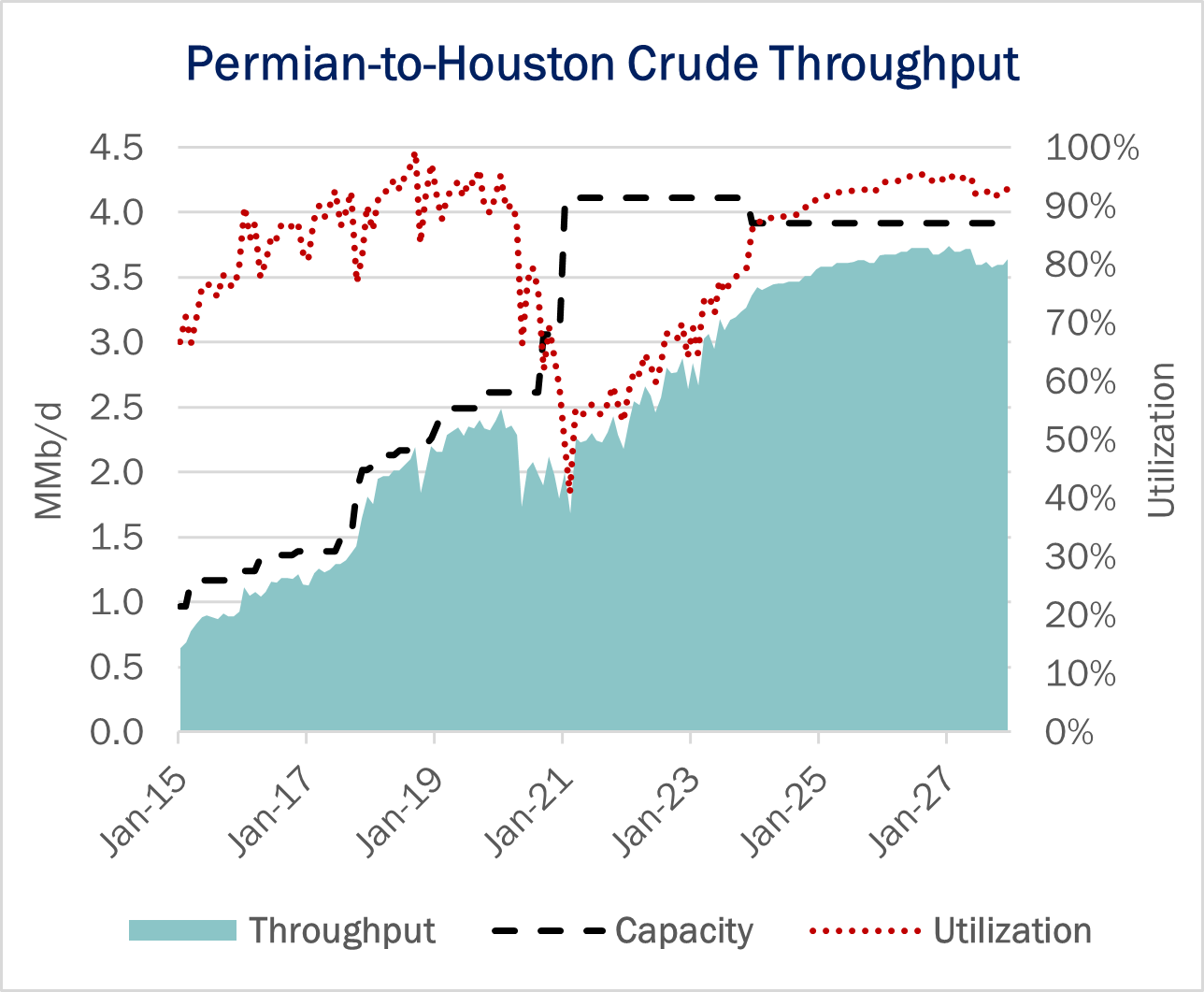
Permian-to-Houston Pipeline Capacity Nears Full Utilization
This chart highlights a specific infrastructure bottleneck and operational risk in a key region, directly relating to the need for the new projects mentioned in the section heading.
(Source: East Daley Analytics)
$2.6 B in 2026 Capex, Enterprise Products Partners Investment Pivot
Enterprise Products Partners is executing a strategic pivot from a heavy investment cycle to a phase of disciplined capital spending, positioning the company for significant free cash flow generation starting in 2026. This follows a period of substantial investment through 2025 aimed at expanding capacity in critical production and export hubs.
- The company’s growth capital expenditure is forecasted to moderate to between $2.3 billion and $2.6 billion for 2026, a marked decrease from the peak investment cycle, signaling a transition to harvesting returns from recently completed projects.
- As of Q 1 2026, the company was executing a $5.3 billion backlog of funded growth projects, primarily focused on natural gas processing and NGL infrastructure to support rising production in the Permian Basin.
- This financial discipline is designed to enhance shareholder returns, supported by a business model where approximately 90% of contracts are fee-based and protected against inflation, ensuring stable cash flow.
- The company’s commitment to shareholder returns was reaffirmed with a quarterly cash distribution of $0.515 per common unit for Q 1 2026, continuing a 28-year trend of annual distribution increases.

Gas Infrastructure to Comprise 13.4% of Energy Capex
This chart provides industry-level context on capital expenditure trends, directly informing the discussion of Enterprise’s specific ‘$2.6 B in 2026 Capex’ and its investment strategy.
(Source: S&P Global)
Table: Enterprise Products Partners Key Investments and Capital Projects (2026)
| Project / Investment | Time Frame | Details and Strategic Purpose | Source |
|---|---|---|---|
| Growth Capital Expenditures | 2026 (Full Year) | $2.3 B – $2.6 B allocated to fund the construction of new midstream assets, primarily expanding the existing network. | Enterprise Products Partners (NYSE:EPD) – Stock Analysis |
| Project Backlog Execution | Q 1 2026 (Ongoing) | Executing a $5.3 Billion portfolio of major growth projects under construction, focused on NGL and natural gas infrastructure. | Enterprise Reports First Quarter 2026 Earnings |
| Permian Gas Processing Plants | 2026 (Ongoing) | Construction of two new gas processing plants in the Permian Basin to handle increasing regional production and higher gas-to-oil ratios. | Permian Gas Production to Increase |
| Quarterly Distribution | Apr 21, 2026 | Declaration of $0.515 per unit cash distribution for Q 1 2026, continuing a multi-decade history of increasing shareholder returns. | How Investors May Respond To Enterprise Products |

EPD Reports Record Volumes in Q1 2026
Record operational volumes demonstrate the need for and viability of the ‘Key Investments and Capital Projects’ detailed in the accompanying table, providing a direct business case.
(Source: Seeking Alpha)
Enterprise Products Partners 3 Key Alliances and Acquisitions (2026)
Enterprise Products Partners utilizes targeted partnerships and acquisitions to enhance specific asset capabilities and expand its footprint in strategic regions, rather than focusing on broad, large-scale joint ventures. In 2026, these moves were centered on strengthening its crude export marketing mechanisms and expanding its gas processing capabilities in the Permian Basin.
- The acquisition of Piñon Midstream for approximately $950 million provides Enterprise with critical sour gas gathering and processing capabilities in the Permian, directly addressing the changing composition of gas production in the basin.
- A collaboration with Intercontinental Exchange (ICE) and Trafigura aims to establish a new physical crude oil futures contract deliverable at EPD’s ECHO terminal, leveraging the terminal’s infrastructure to improve price discovery for U.S. crude exports.
- Ongoing joint ventures on pipeline assets, such as the Old Ocean natural gas pipeline, allow Enterprise to share capital costs and operational risks while enhancing market connectivity and supply reliability in key Texas markets.

EPD Partners with Exxon on Bahia Pipeline Expansion
This chart provides a concrete, high-profile example of one of the ‘3 Key Alliances’ discussed in the section, directly illustrating the company’s partnership strategy.
(Source: Seeking Alpha)
Table: Enterprise Products Partners Strategic Partnerships and Acquisitions (2026)
| Partner / Acquired Company | Time Frame | Details and Strategic Purpose | Source |
|---|---|---|---|
| Piñon Midstream, LLC | Announced by Jul 20, 2026 | Acquired for ~$950 million to add sour gas gathering and processing capabilities, expanding EPD’s service offerings in the Permian Basin. | Enterprise Products Partners (NYSE:EPD) – Stock Analysis |
| Intercontinental Exchange (ICE), Trafigura AG | Announced by Jun 1, 2026 | Collaboration to establish a new physical crude oil futures contract deliverable at EPD’s ECHO terminal, enhancing the terminal’s role in global crude marketing. | Trent Bridges |
| Various Midstream Companies | Ongoing in 2026 | Joint venture to resume service on the Old Ocean natural gas pipeline, improving gas supply reliability and connectivity in the Texas market. | Danielle Mangrum Patterson |

Energy Transfer Outperforms Broader Pipeline Market
This chart shows the performance of a key competitor, illustrating the competitive pressures that necessitate the ‘Strategic Partnerships and Acquisitions’ detailed in the table.
(Source: TradingView)
Permian and Gulf Coast, Enterprise Products Partners Geographic Focus
Enterprise Products Partners‘ capital deployment and strategic focus in the 2025-2026 period are concentrated on the Permian Basin and the U.S. Gulf Coast, the origin and destination points for the majority of U.S. hydrocarbon production and exports. This geographic strategy connects the most prolific supply basin with high-demand domestic and international markets.
- In the Permian Basin, a significant portion of growth capital is directed towards new natural gas processing plants to handle increasing production volumes, a necessary response to the region’s rising gas-to-oil ratio.
- The acquisition of Piñon Midstream and the expansion of the acid gas gathering system in Lee County, Texas, are targeted investments to manage the specific geological characteristics of Permian production.
- Along the U.S. Gulf Coast, investments focus on enhancing export capabilities, as seen in the collaboration to create a futures contract at the ECHO crude terminal in Houston, solidifying its role as a key export hub.
- This dual focus ensures that Enterprise captures value across the entire midstream value chain, from gathering and processing at the wellhead in West Texas to storage and export on the Gulf Coast.

Enterprise’s Key Permian Pipeline Infrastructure
The chart visually represents the company’s assets in the Permian Basin, a core area of operations explicitly mentioned in the section’s ‘Geographic Focus’ heading.
(Source: RBN Energy)
Technology Maturity, Enterprise Products Partners Commercially Deployed Assets
The “technology” of Enterprise Products Partners is its vast, integrated midstream infrastructure, which is a fully mature, commercially scaled system, and its 2026 strategy is focused on optimization and targeted expansion rather than foundational development. The company is leveraging its proven and reliable asset base to meet new market demands with minimal technical risk.
- Between 2021 and 2024, the focus was on debottlenecking and incremental expansions. In 2025-2026, the strategy shifted to deploying commercially proven processing and transportation technology to serve new, large-scale demand sources like data centers and LNG liquefaction plants.
- Projects like the new Permian gas processing plants utilize standard, reliable processing technology that is scaled to meet basin-level demand, demonstrating a mature approach to capacity additions.
- The partnership’s reliance on a fee-based contract structure, which insulates it from commodity price volatility, is a commercial model enabled by the maturity and necessity of its infrastructure.
- Record operational volumes in Q 1 2026, including 7.5 Bcf/d in natural gas processing, validate the technical capability and commercial optimization of the company’s existing and newly added assets.

EPD Details Extensive Midstream Asset Platform
The headline directly corresponds to the section’s focus on EPD’s large-scale, ‘Commercially Deployed Assets’ and its overall infrastructure platform.
(Source: Seeking Alpha)
SWOT Analysis of Enterprise Products Partners Midstream Strategy
Enterprise Products Partners‘ strategic position in 2026 is defined by the immense strength of its existing asset base, creating significant opportunities in export markets while also exposing it to long-term transition risks and immediate regulatory threats. The company has moved from a growth-heavy phase to one focused on operational optimization and shareholder returns.
- Strengths: A vast, integrated, and hard-to-replicate infrastructure network provides a significant competitive moat and enables stable, fee-based cash flows.
- Weaknesses: The business is fundamentally tied to the transportation and processing of fossil fuels, creating long-term risk exposure to the energy transition.
- Opportunities: The infrastructure is perfectly positioned to capitalize on growing demand from LNG exports, petrochemicals, and the power needs of AI data centers.
- Threats: A stringent and unpredictable regulatory and permitting environment for new pipelines remains a major industry-wide threat, alongside potential shifts in global energy demand.

US LNG Export Capacity Set to Double
This chart identifies a significant market growth trend, representing a key ‘Opportunity’ for a midstream player like EPD, which is a core element of a strategic SWOT analysis.
(Source: Deloitte)
Table: SWOT Analysis for Enterprise Products Partners Midstream Position (2021-2025)
| SWOT Category | 2021 – 2023 | 2024 – 2025 | What Changed / Validated |
|---|---|---|---|
| Strengths | Integrated asset base provided resilience during post-pandemic market volatility. Fee-based contracts offered cash flow stability. | Record volumes across all segments. Demonstrated ability to fund growth while increasing distributions. 28 consecutive years of distribution growth. | The value of an integrated, fee-based model was validated as it generated record financial results ($2.7 B adjusted EBITDA in Q 1 2026) despite market fluctuations. |
| Weaknesses | Dependence on North American upstream production levels. Perception as a traditional energy asset in an ESG-focused market. | Ongoing capital requirements for sustaining and growth projects, though moderating into 2026. Long-term business model tied to hydrocarbons. | The company validated it can manage its hydrocarbon-centric model by pivoting to serve growing sectors (LNG, AI) and moderating capex to boost free cash flow. |
| Opportunities | Early signs of growing LNG export demand. Initial recovery in petrochemical demand. | Surging demand for natural gas to power AI data centers becomes a major catalyst. Ethane export demand strengthens. U.S. crude export market solidifies. | The opportunity set expanded significantly with the emergence of the AI data center power demand, adding a major new domestic driver alongside international LNG exports. |
| Threats | Regulatory uncertainty and permitting challenges for new pipelines (e.g., Keystone XL cancellation impacting peers). Commodity price volatility. | Intensified regulatory hurdles for new projects, making existing assets more valuable but growth harder. Competition from other midstream players like Energy Transfer. | The threat of permitting delays was validated as a permanent feature of the market, which ironically strengthened the competitive position of companies with large in-place networks. |

Enterprise Products Ranks Second in Sector Value
The chart provides a quantifiable metric of the company’s market leadership, representing a key ‘Strength’ that would be featured in a SWOT analysis table.
(Source: Global X ETFs)
Scenario: Enterprise Products Partners Executes $5.3 B Project Backlog
The single most critical factor for Enterprise Products Partners‘ performance through 2026 is the successful execution of its $5.3 billion project backlog, which will determine its ability to meet market demand and transition into a period of higher free cash flow generation.
- If this happens: Watch for the on-time and on-budget completion of the new Permian gas processing plants and other key projects. Successful execution will directly translate into higher throughput volumes and fee-based revenue, meeting projections for increased EBITDA.
- Then watch this: Monitor the company’s free cash flow statements and announcements regarding shareholder returns. With capital expenditures scheduled to decrease in late 2026 and 2027, a successful project cycle should unlock significant cash for distribution increases or unit buybacks.
- And these could be happening: Look for announcements of new long-term contracts specifically targeting AI data center clusters or new phases of LNG export facilities. These would be strong signals that the newly built capacity is being absorbed by long-term, high-credit-quality customers, de-risking future cash flows.

US Oil & Gas Infrastructure Market Continues Growth
The chart’s depiction of continued market growth provides the macroeconomic rationale for a large ‘$5.3 B Project Backlog’, setting the stage for the scenario where EPD executes it.
(Source: Global Market Insights)
The questions your competitors are already asking
This report covers one angle of Enterprise Products Partners’ commercial trajectory. The questions that matter most depend on your work.
- Natural gas contracts for new data centers
- New US LNG export terminal approvals
- Energy Transfer vs Enterprise Products Partners Permian projects
- Intercontinental Exchange Houston crude futures contract details
This report does not answer these. Enki Brief Pro does.
Your question, your angle, your framework. SWOT, PESTL, scenario modelling. The same niche depth, built around the decision your work actually depends on.
