

US-Iran War 2026: How a Shattered Supply Chain Exposes Europe’s Energy Security Flaws
Risk Analysis: LNG Dependency Shifts from Supplier Risk to Chokepoint Failure
The 2026 U.S.-Iran conflict exposed a fundamental flaw in Europe’s energy security strategy, demonstrating that the post-2022 pivot from Russian pipeline gas to global Liquefied Natural Gas (LNG) merely swapped a supplier dependency for a catastrophic chokepoint vulnerability. The de facto closure of the Strait of Hormuz, a critical artery for global energy, immediately paralyzed a significant portion of the continent’s new gas supply, triggering a severe and immediate crisis.
- Prior to 2025, Europe’s primary strategic focus was diversifying away from Russian gas, which accounted for nearly 40% of its supply. This led to a rapid build-out of LNG import capacity and new supply agreements, particularly with Qatar and the U.S., which were seen as reliable long-term partners.
- The conflict in early 2026 revealed the fragility of this new system. The Strait of Hormuz, through which approximately 20% of the world’s oil and a substantial volume of LNG from key supplier Qatar passes, became a conflict zone. This single point of failure effectively removed a cornerstone of Europe’s diversified supply from the market overnight.
- The immediate fallout included a production halt by Qatar Energy, a direct catalyst for European natural gas futures surging by over 40%. This event proved that diversifying suppliers is ineffective if their export routes converge on a single, contestable maritime chokepoint, a critical lesson for future LNG supply chains.
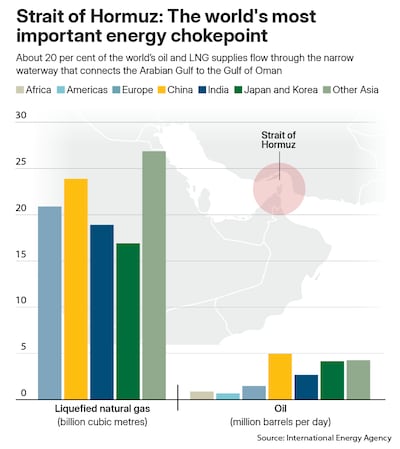
Europe’s LNG Supply Flows Through Hormuz
This chart shows a significant volume of LNG transiting the Strait of Hormuz to Europe, directly visualizing the chokepoint vulnerability that replaced supplier risk.
(Source: The National News)
Financial Impact: Price Shocks Signal Systemic Economic Risk for Europe
The conflict’s immediate financial impact on European energy markets was severe, with unprecedented price surges in natural gas highlighting the continent’s acute sensitivity to global seaborne trade disruptions. The rapid price increases created immediate inflationary pressures and signaled a high risk of a broader economic downturn across the EU, which was identified as the “most exposed major economy” to the conflict’s fallout.

European Gas Prices Surge After Conflict
This chart directly illustrates the massive 2026 price surge in UK natural gas, a key European benchmark, confirming the severe financial impact and price shocks described.
(Source: AOL.com)
- European natural gas prices experienced a dramatic increase, surging by approximately 70-75% within the first week of hostilities. Some reports indicated prices nearly doubled in the immediate aftermath, demonstrating the market’s extreme reaction to the loss of expected supply.
- Crude oil markets reacted with a significant risk premium, with analysts noting an immediate price increase of $10 per barrel. Projections of a potential supply disruption averaging 4 million barrels per day (mbpd) further sustained price volatility.
- The wholesale price hikes translated directly to consumer and industrial pain. In the UK, household energy bills were forecast to jump to £2, 500 a year, while European stock indices slumped amid fears of an energy-driven recession. This shock to the global energy transition underscored the high cost of fossil fuel dependency.
Table: European Energy Price Volatility After the 2026 Conflict
| Metric | Time Frame | Details and Strategic Purpose | Source |
|---|---|---|---|
| European Gas Prices (Weekly) | First week of March 2026 | Prices jumped 75%, reflecting the market’s shock at the disruption of LNG flows from the Persian Gulf and the halt in Qatari production. | Reuters |
| European Natural Gas Prices (Since Attack) | Since Feb 28, 2026 | Prices surged roughly 70% as the conflict escalated, confirming the continent’s high vulnerability to seaborne supply chain disruptions. | Wall Street Journal |
| Natural Gas Futures (April) | March 2, 2026 | Futures surged 42% following initial strikes and the subsequent halt in Qatari production, a key supplier for Europe. | Forbes |
| Crude Oil Price | First days of conflict | An immediate increase of $10 per barrel was added as a risk premium due to the threat to the Strait of Hormuz, a chokepoint for 20% of global oil. | Columbia SIPA |
Partnership Analysis: Diversification Strategy Fails its First Major Stress Test
Europe’s energy partnerships, meticulously crafted between 2022 and 2024 to replace Russian gas, failed to provide resilience during the 2026 conflict. The crisis demonstrated that while partnerships with suppliers like Qatar were strategically sound in a stable geopolitical environment, their value collapsed when the physical supply chain was severed, forcing the EU to confront the limitations of its diversification strategy.

Energy Flows Reveal Partnership Supply Risk
The chart quantifies energy flows from key partners like Qatar through the Strait of Hormuz, visualizing the physical supply chain dependency that caused the diversification strategy to fail its stress test.
(Source: Noahpinion)
- Between 2022 and 2024, Germany and other EU nations signed key energy partnership agreements with Qatar, securing long-term LNG supply contracts intended to form the backbone of a post-Russian energy system.
- The conflict in 2026 immediately nullified the security provided by these agreements, as Qatar was forced to halt production and exports following Iranian attacks. This proved that contract diversification without route diversification offers a false sense of security.
- In the immediate aftermath, the EU publicly praised its gas partnership with Azerbaijan as an alternative. However, the volumes available through this route were insufficient to compensate for the massive disruption in LNG from the Gulf, highlighting a critical scaling mismatch in its contingency planning.
Table: European Strategic Energy Partnerships and Conflict Impact
| Partner / Initiative | Time Frame | Details and Strategic Purpose | Source |
|---|---|---|---|
| EU & Azerbaijan | March 2026 | The EU highlighted its partnership with Azerbaijan to mitigate supply loss, but volumes were insufficient to replace disrupted LNG, exposing a lack of scalable alternatives. | Euronews |
| Germany & Qatar | May 2022 | Germany and Qatar signed an energy partnership focused on LNG to replace Russian gas. The 2026 conflict rendered this supply inaccessible due to the Strait of Hormuz disruption. | Al Jazeera |
| EU Decoupling from Russia | 2022 – 2024 | The EU successfully reduced its reliance on Russian gas from nearly 40% to under 10%, replacing it primarily with LNG from the U.S. and Qatar. This set the stage for the new chokepoint vulnerability. | Foreign Policy |
Geographic Vulnerability: The Strait of Hormuz as Europe’s New Achilles’ Heel
The conflict geographically redefined Europe’s energy risk, shifting it from its eastern border with Russia to the Persian Gulf. The intense focus on securing LNG contracts between 2022 and 2024 overlooked the immense concentration of risk at the Strait of Hormuz, transforming the narrow waterway into the single most critical point of failure for the continent’s economic stability.

Conflict Pinpoints Hormuz as Geographic Flashpoint
This infographic identifies the Strait of Hormuz as a critical energy chokepoint threatened by the conflict, perfectly matching the section’s theme of a new geographic ‘Achilles’ heel’ for Europe.
(Source: Geopolitical Futures)
- From 2021 to 2024, Europe’s geographic risk assessment was dominated by the security of pipeline infrastructure flowing from Russia. The strategic response was to reorient towards global seaborne supply, which was perceived as more flexible and secure.
- The events of 2026 proved this perception wrong. The conflict’s location in the Persian Gulf effectively weaponized the geography of the Strait of Hormuz, halting transit for a fifth of the world’s oil supply and a major share of Europe-bound LNG.
- This crisis exposed that Europe had not achieved true energy independence but had merely outsourced its dependency to a region with inherent geopolitical volatility, making its energy security contingent on the stability of a single maritime chokepoint thousands of miles away.
Strategic Maturity: LNG as a Bridge Fuel Proves to be an Unstable Foundation
The U.S.-Iran conflict served as a brutal stress test that proved Europe’s reliance on LNG as a long-term transition fuel was strategically immature and unsustainable. The belief that a global, fungible gas market could provide stable supply and pricing was shattered, exposing the LNG transition fuel concept as highly vulnerable to geopolitical shocks and validating the argument for a faster pivot to domestic renewable energy.
- Between 2022 and 2024, LNG was positioned as the essential “bridge fuel” that would allow Europe to abandon Russian gas while gradually building out renewables. This strategy was based on the assumption of reliable, unhindered access to global LNG markets.
- The 2026 war invalidated this core assumption. The instant disruption of Qatari supplies and the resulting price explosion demonstrated that LNG is not a secure bridge but a rickety structure exposed to distant conflicts and chokepoint failures, unlike domestic energy sources.
- The crisis forces a re-evaluation of energy strategy, shifting the definition of “mature” energy policy away from diversified fossil fuel procurement and toward the rapid scaling of domestic, geopolitically insulated technologies like wind, solar, and nuclear power.
Scenario Analysis: The Green Transition Becomes a Security Imperative
The primary strategic consequence of the 2026 conflict is the definitive transformation of Europe’s green energy transition from a climate-driven policy into a non-negotiable matter of economic and national security. If geopolitical instability in the Middle East remains a persistent threat, watch for European policymakers to use the crisis as political capital to accelerate the move towards true energy independence, even if it requires significant short-term economic pain.
- If this happens: The crisis has made the economic and security case for renewables undeniable. The price volatility and supply disruptions caused by the war provide a powerful incentive to fast-track investment in domestic wind, solar, and battery storage.
- Watch this: Expect a significant push to streamline permitting for renewable energy projects and grid infrastructure. The debate will shift from the cost of the transition to the “horrendous costs” of continued fossil fuel dependence.
- These could be happening: While the debate over re-engaging with Russian gas may resurface out of desperation, it is unlikely to gain political traction. The primary beneficiary of this conflict will be Europe’s domestic clean energy sector, as the continent is forced to prioritize true energy sovereignty over the illusion of security offered by diversified fossil fuel imports.
Frequently Asked Questions
Why did the 2026 conflict cause an energy crisis in Europe if it had already moved away from Russian gas?
Europe replaced its dependency on Russian pipeline gas with a dependency on global Liquefied Natural Gas (LNG), particularly from Qatar. This new strategy made Europe vulnerable to maritime chokepoints. The 2026 conflict effectively closed the Strait of Hormuz, a critical passage for Qatari LNG, cutting off a cornerstone of Europe’s new supply and revealing that the continent had merely swapped one dependency for another.
What was the immediate financial impact of the supply disruption on European markets?
The financial impact was severe. European natural gas prices surged by approximately 70-75% within the first week, and crude oil prices immediately jumped by $10 per barrel. This translated into projections of sharply higher household energy bills (e.g., to £2,500 a year in the UK) and widespread fears of an energy-driven recession.
Didn’t Europe’s new energy partnerships with countries like Qatar provide security?
No, the partnerships failed their first major stress test. While the contracts with suppliers like Qatar were sound, they became worthless when the physical supply chain was severed. The conflict proved that diversifying supply partners is ineffective if their export routes all pass through a single, contestable chokepoint like the Strait of Hormuz. It highlighted that route diversification is as important as supplier diversification.
What specific geographic vulnerability did the conflict expose?
The conflict shifted Europe’s primary energy vulnerability from its eastern border with Russia to the Persian Gulf, specifically the Strait of Hormuz. This narrow waterway, which carries 20% of the world’s oil and a huge volume of LNG, became Europe’s new ‘Achilles’ heel.’ The crisis showed that Europe had outsourced its energy security to a geopolitically volatile region, making its economy dependent on the stability of a single maritime chokepoint thousands of miles away.
What is the main strategic takeaway for Europe’s future energy policy?
The main takeaway is that the green energy transition is now a non-negotiable matter of economic and national security. The crisis demonstrated that relying on imported LNG as a ‘bridge fuel’ is an unstable foundation. The article concludes that the only path to true energy security and sovereignty is to accelerate the development of domestic, geopolitically insulated energy sources like wind, solar, and nuclear power.
