

Centrus Energy HALEU Production, $900 M DOE Award, Urenco $2 B+ Expansion, and 3 Major Projects (2025 to 2026)
Nuclear Fuel Onshoring, Centrus Energy Secures $900 M for HALEU Production
The U.S. nuclear industry has pivoted from a decades-long reliance on foreign, primarily Russian, enriched uranium to an urgent, federally-backed initiative to onshore the entire fuel cycle, driven by geopolitical risk and rising energy demand. This strategic realignment away from cost-centric global procurement toward a security-focused domestic supply chain was catalyzed by definitive legislative action in 2025 and 2026. The shift immediately triggered significant capital commitments into domestic mining, conversion, and enrichment infrastructure.
- Prior to 2025, the U.S. demonstrated a critical vulnerability, importing approximately 95% of the uranium its reactors consume and sourcing roughly 27% of its enrichment services directly from Russia’s state-owned Rosatom, which controls nearly half the world’s enrichment capacity.
- The passage of the Prohibiting Russian Uranium Imports Act provided the market certainty needed for industrial action. This was immediately followed by the Department of Energy (DOE) announcing a $2.7 billion program to establish secure domestic fuel supplies, directly underwriting new capacity.
- In response, Urenco USA, the nation’s sole commercial enricher, announced a multi-billion-dollar expansion of its New Mexico facility in June 2026. This project aims to increase its capacity by almost 50% to offset the loss of Russian fuel.
- Centrus Energy Corp. secured a cornerstone $900 million DOE award to scale up its commercial operations in Piketon, Ohio, for both conventional Low-Enriched Uranium (LEU) and the advanced High-Assay Low-Enriched Uranium (HALEU) fuel required for next-generation reactors.
- Activity has also resumed at the front-end of the fuel cycle, with Uranium Energy Corp (UEC) activating its Burke Hollow in-situ recovery (ISR) mine in Texas, the largest new domestic uranium mine to begin operations in over a decade.
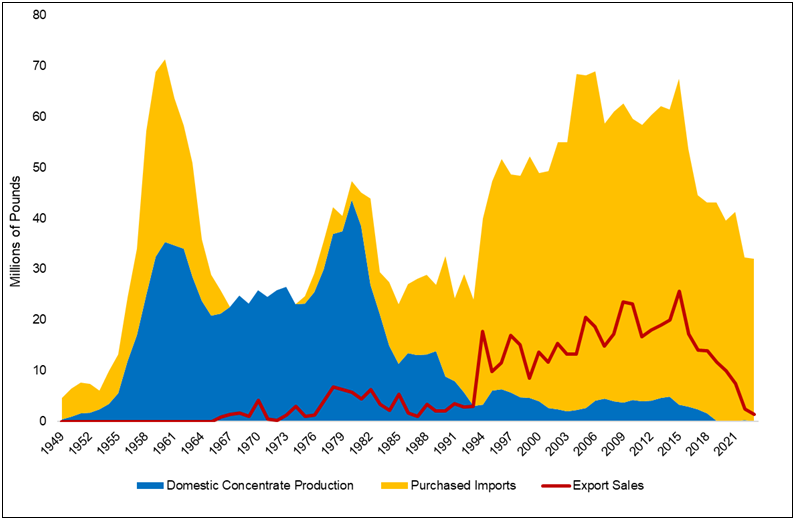
Chart Shows US Reliance on Foreign Uranium
This chart’s depiction of U.S. reliance on foreign uranium directly supports the rationale for ‘onshoring’ nuclear fuel production, which is the central theme of this section’s discussion on Centrus Energy’s new funding for domestic HALEU.
(Source: Sprott)
$2.7 B in Federal Funding, Centrus Energy and Orano Secure Key Awards
Federal investment has been the primary catalyst for rebuilding the domestic nuclear fuel supply chain, de-risking private capital commitments for multi-year, high-cost enrichment and mining projects. The DOE’s funding mechanism, structured as a series of milestone-based contracts and offtake agreements, provides the long-term demand signal necessary for companies to invest in new industrial capacity.
- The DOE’s $2.7 billion commitment, announced in January 2026, serves as a foundational investment to restore American uranium enrichment capabilities. This funding was authorized under the Prohibiting Russian Uranium Imports Act to directly counter Russia’s market influence.
- American Centrifuge Operating, a subsidiary of Centrus Energy, was awarded a $900 million fixed-price task order to pioneer commercial-scale HALEU production at its Piketon, Ohio, facility. This positions the company as the foundational supplier for the U.S. advanced reactor market.
- Orano Federal Services received a parallel $900 million award to expand domestic LEU production, which is essential for fueling the existing fleet of U.S. nuclear reactors and reducing immediate reliance on foreign suppliers.
- General Matter, Inc., a privately funded new entrant, also secured a significant DOE award to develop its proprietary uranium enrichment technology at a planned facility in Paducah, Kentucky, further diversifying the domestic supply base.

Uranium Assets Massively Outperform Broader Markets
The strong financial performance of uranium assets provides the market context for the significant federal funding and investment flowing into the sector, as highlighted by the awards secured by Centrus and Orano.
(Source: Sprott)
Table: U.S. Government Investment in Domestic Nuclear Fuel (2026)
| Recipient Company | Time Frame | Details and Strategic Purpose | Source |
|---|---|---|---|
| American Centrifuge Operating (Centrus) | Jan 2026 | Received a $900 Million DOE award to develop and demonstrate commercial-scale HALEU production, a critical fuel for advanced reactors. | Discovery Alert |
| Orano Federal Services | Jan 2026 | Awarded $900 Million from the DOE to expand domestic production of LEU, aiming to backfill supply for the existing U.S. reactor fleet. | Procurement Magazine |
| General Matter, Inc. | Jan 2026 | Secured a $900 Million DOE award to scale up its proprietary enrichment technology and help reshore U.S. fuel capacity. | Clear Path Action |
Centrus Energy Forms Oklo JV and Other Strategic Nuclear Fuel Alliances (2026)
Strategic partnerships are forming across the supply chain to integrate fuel production with the needs of both existing and advanced reactor developers. These collaborations are essential for aligning the nascent domestic fuel supply with specific reactor designs and commercial deployment timelines, ensuring that fuel availability does not become a bottleneck for the expansion of nuclear energy.
- In March 2026, advanced reactor developer Oklo and Centrus Energy announced a planned joint venture to advance nuclear fuel services in Ohio. The collaboration is expected to focus on securing a HALEU supply chain for Oklo’s advanced reactor designs.
- The DOE’s funding structure itself represents a critical public-private partnership model. By providing milestone-based awards to Centrus, Orano, and General Matter, the government is sharing the financial risk of developing first-of-a-kind commercial facilities.
- Engineering and construction firm Fluor was selected by Centrus Energy as a key contractor to support the expansion of its centrifuge manufacturing and uranium enrichment facilities in Tennessee and Ohio, signaling that the build-out is moving into the execution phase.
Table: Key Partnerships in the U.S. Nuclear Fuel Sector (2026)
| Partner / Project | Time Frame | Details and Strategic Purpose | Source |
|---|---|---|---|
| Oklo & Centrus Energy | Mar 2026 | Announced a planned joint venture to advance nuclear fuel services, likely focusing on securing a HALEU supply for Oklo’s advanced reactors. | PR Newswire |
| Fluor & Centrus Energy | Feb 2026 | Fluor was contracted to support the expansion of the Centrus enrichment plant in Piketon, Ohio, providing engineering and construction expertise for the scale-up. | Engineering News-Record |
Ohio and New Mexico Emerge as Nuclear Fuel Hubs for Centrus and Urenco
U.S. domestic nuclear fuel production is geographically concentrating in states with existing nuclear infrastructure, skilled workforces, and supportive policy environments. Whereas the supply chain was previously defined by international shipping routes from Russia and Europe, the new map is centered on a few key American states poised to become hubs for enrichment and mining.
- Prior to 2025, the geographic focus of the U.S. supply chain was overwhelmingly international, with enrichment services sourced from Russia and European partners like the U.K., Germany, and the Netherlands.
- Ohio is now the central hub for advanced nuclear fuel. Centrus Energy’s HALEU production, backed by its $900 million DOE award, is located at the American Centrifuge Plant in Piketon, a site with a long history in uranium enrichment.
- New Mexico is reinforcing its position as the leader in conventional LEU fuel. Urenco USA’s multi-billion-dollar expansion of its National Enrichment Facility near Eunice will significantly increase domestic capacity for the existing reactor fleet.
- Uranium mining and milling are restarting in Western states. Texas is a key location, with UEC activating the Burke Hollow ISR mine. Energy Fuels Inc. is also ramping up production across its U.S. operations.
- Kentucky is emerging as a future player in the enrichment sector, with startup General Matter, Inc., planning a new HALEU facility in Paducah, another historical enrichment site.
HALEU Production Moves from R&D to Commercial Scale with Centrus Energy
While conventional LEU enrichment is a mature technology, the domestic production of HALEU is rapidly advancing from pilot-scale demonstration to initial commercial capacity, a transition driven almost entirely by federal support. This technological step is critical, as HALEU is the designated fuel for most U.S. advanced reactor designs being developed by companies like X-energy and Terra Power.
- Between 2021 and 2024, domestic HALEU production was effectively nonexistent at a commercial scale, leaving Russia as the only viable global supplier. During this period, Centrus Energy was operating its Piketon facility in a demonstration capacity to prove the viability of its centrifuge technology for higher enrichment levels.
- A major validation point was reached in January 2026, when Centrus announced it had achieved its Phase 2 production target of 900 kg of HALEU under its initial DOE contract. This milestone demonstrated the technical readiness of its centrifuges for sustained HALEU production.
- The subsequent $900 million award is designed to transition this validated pilot into a commercial-scale operation capable of supplying multiple advanced reactors per year, resolving a critical national security vulnerability and a major bottleneck for the advanced nuclear industry.
- In contrast, the technology used by Urenco USA for LEU is already commercially proven at scale. The company’s expansion focuses on manufacturing and deploying additional centrifuge cascades based on an existing, certified design, representing a lower technological risk.
US Nuclear Fuel SWOT, Centrus Energy Dominates HALEU as Urenco Scales LEU
The U.S. nuclear fuel onshoring initiative is propelled by strong government support and clear market demand from the energy transition and new power consumers like data centers, but it faces significant threats from long project timelines and the high capital cost of building new capacity.
- Strengths: The primary strength is robust, bipartisan policy support, codified in the Russian uranium import ban, which creates a protected domestic market. This is coupled with $2.7 billion in direct federal funding that de-risks initial private investment.
- Weaknesses: The most significant weakness is the long lead time required to build and certify new enrichment capacity. For example, Urenco’s new facility is not expected to be fully operational until 2030, creating a potential supply gap in the interim.
- Opportunities: Surging, non-cyclical electricity demand from AI and data centers, as seen in power purchase agreements by Microsoft and Google, creates a powerful new market driver for nuclear energy. The deployment of HALEU-fueled advanced reactors represents a multi-billion dollar market opportunity.
- Threats: The initiative remains vulnerable to construction delays and cost overruns typical of large industrial projects. Furthermore, while the focus is on enrichment, the global supply of raw uranium and conversion services also faces constraints that could impact the entire fuel cycle.

Global Uranium Production Highly Concentrated by Country
This chart illustrates a key ‘Threat’ in a SWOT analysis for the U.S. nuclear fuel market: geopolitical risk stemming from the concentration of uranium production in a few countries, reinforcing the strategic importance of Centrus’s domestic HALEU.
(Source: Sprott)
Scenario Modelling for Centrus Energy and HALEU Supply Readiness
The critical path for the U.S. advanced nuclear sector now depends on Centrus Energy’s ability to execute its HALEU scale-up on schedule and on budget. Any significant delays will have a direct, cascading impact on the deployment timelines for the first wave of next-generation reactors planned for the late 2020 s and early 2030 s.
- If this happens: Centrus Energy successfully meets its production and delivery milestones under the $900 million DOE contract throughout 2026 and 2027, demonstrating a reliable and growing domestic HALEU inventory.
- Watch this: The conversion of existing MOUs into firm, binding offtake agreements for HALEU from advanced reactor developers. A key signal would be a multi-year supply contract from a company like Terra Power or X-energy that is tied to a specific reactor construction schedule.
- This could be happening: With a secure domestic fuel source validated, utilities and project developers will gain the confidence to move forward with site licensing and place firm orders for advanced reactors. This would accelerate the commercialization of technologies from developers like CFS Nuclear and Rolls-Royce SMR, pulling their deployment timelines forward from the early 2030 s into the end of this decade.

Uranium Price Volatility Precedes Nuclear Boom
Price volatility is a critical variable in forecasting and risk assessment, making this chart a key input for the ‘Scenario Modelling’ mentioned in the section heading, which evaluates Centrus Energy’s readiness under various market conditions.
(Source: LinkedIn)
The questions your competitors are already asking
This report covers one angle of the onshoring of the US nuclear fuel supply chain. The questions that matter most depend on your work.
- Which companies are gaining or losing ground in the US nuclear fuel supply chain market?
- What is actually happening with Centrus Energy’s HALEU production since the $900M DOE award?
- Urenco investments and funding. Is its New Mexico facility expansion on track to offset the loss of Russian enriched uranium?
This report does not answer these. Enki Brief Pro does.
Your question, your angle, your framework. SWOT, PESTL, scenario modelling. The same niche depth, built around the decision your work actually depends on.
