

Standard Nuclear TRISO Fuel, $150 M IPO, Oklo Alliance, and 2 New Production Facilities (2026)
TRISO Fuel Adoption Risks, Standard Nuclear Competing with X-energy and BWXT
The immense energy demand from artificial intelligence and data centers has accelerated the push for nuclear micro-reactors, but the adoption of TRISO fuel, a critical enabler, is constrained by a fragile supply chain and intense competition among a few specialized producers. This dynamic shifted in 2026 from a government-led developmental phase to a commercially driven race to scale manufacturing capacity. The core challenge is no longer just proving the technology, but building a resilient supply chain capable of fueling a new fleet of advanced reactors for private industry.
- Prior to 2025, TRISO fuel development was dominated by incumbents like BWX Technologies (BWXT), which produced fuel primarily for U.S. Department of Energy (DOE) programs. The commercial demand signal was weak, and production operated on a small, non-commercial scale focused on research and demonstration projects.
- The market inflection point arrived in 2026 as technology giants began actively pursuing dedicated nuclear power. In January 2026, Meta announced a landmark agreement with Terra Power to evaluate the development of eight 345 MW Natrium reactors, while a March 2026 partnership between Microsoft and Nvidia aimed to accelerate nuclear deployment specifically for data centers.
- This demand signal triggered a race to commercialize fuel production. In 2026, Standard Nuclear advanced its plans for two new production facilities after successful funding rounds. Simultaneously, competitor TRISO-X, a subsidiary of X-energy, secured a historic 40-year Nuclear Regulatory Commission (NRC) license in February 2026 for its commercial fuel fabrication facility in Tennessee.
- In response, micro-reactor developers designing their systems around TRISO fuel began formalizing supply agreements. In June 2026, Oklo and Standard Nuclear formed a strategic alliance to secure fuel for its reactors, demonstrating the emerging need for vertical integration and supply de-risking across the value chain.
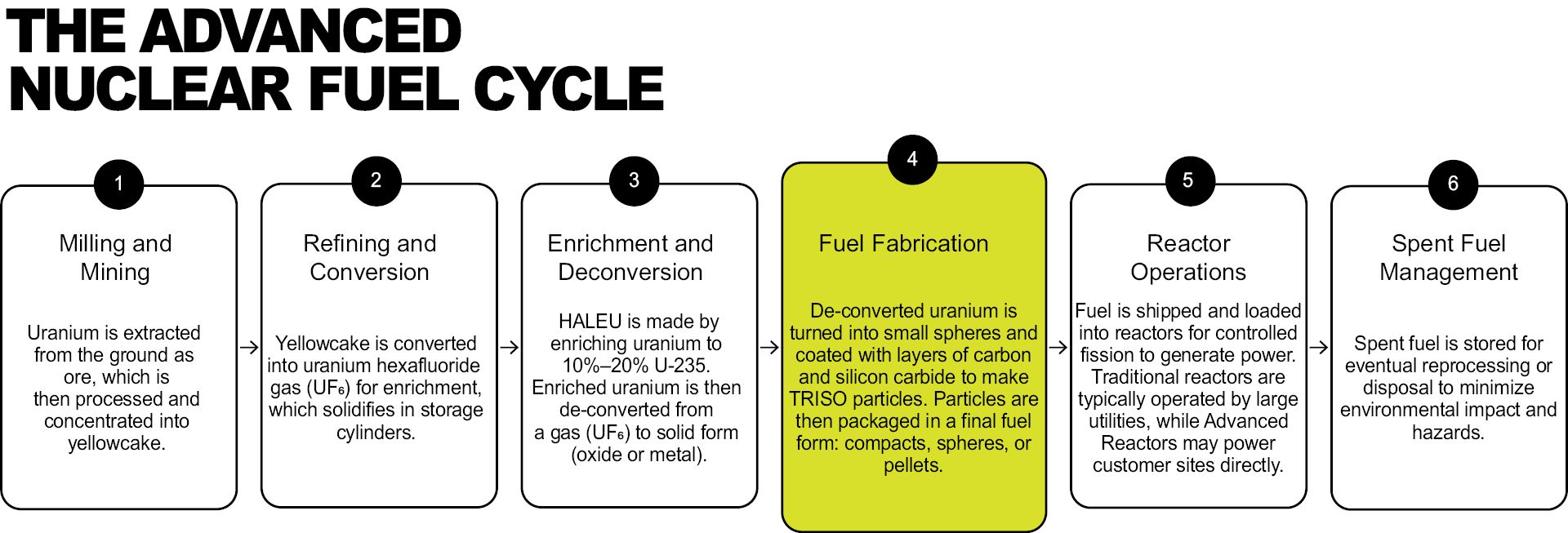
TRISO Fuel Fabrication Central to Advanced Nuclear Reactor Deployment
The Advanced Nuclear Fuel Cycle emphasizes TRISO particle fabrication (Stage 4), where de-converted uranium is coated with carbon and silicon carbide. This process is critical for producing resilient fuel capable of powering Advanced Reactors, which can directly supply customer sites, signaling a move towards decentralized energy solutions.
TRISO Fuel Key to Safe, Decentralized Power for Data Centers
TRISO fuel’s robust, multi-layered design provides inherent safety features and high-temperature tolerance, making it ideal for micro-reactors and SMRs. This enables resilient, localized power generation for energy-intensive applications like data centers, reducing reliance on centralized grids and enhancing energy security.
TRISO Fuel Market Eyes 3.9% CAGR Driven by Microreactor Applications
The global TRISO fuel market, valued at US$387.7 million in 2024, is projected to grow at a 3.9% CAGR from 2025-2034. Microreactors are a significant and expanding application segment for TRISO fuel, alongside High-Temperature Gas-Cooled Reactors (HTGRs). North America is identified as the fastest-growing region for this market.
(Source: Tri-structural Isotropic (TRISO) Fuel Market Latest Report 2025-2034)
$290 M in Funding, Standard Nuclear Series A and IPO in 2026
Capital markets responded decisively in 2026 to the emerging TRISO fuel market, with Standard Nuclear executing two major financing events to fund its production scale-up and compete with heavily capitalized rivals. This infusion of private capital marks a critical transition for the advanced fuel sector, moving it beyond reliance on government grants and toward a commercially viable, self-sustaining model driven by clear market demand from the technology industry.
- Standard Nuclear secured a $140 million Series A funding round in February 2026, with the stated purpose of expanding U.S. advanced nuclear fuel manufacturing capacity. This initial raise provided the foundation for its ambitious construction and operational plans.
- The company quickly followed this with a $150 million initial public offering (IPO) on the NYSE in July 2026. The proceeds are intended to fund the completion of its two planned TRISO fuel facilities and scale its operations to meet future demand.
- This funding is critical for competing against established and well-funded players. X-energy, parent of TRISO fuel producer TRISO-X, raised $1.02 billion in its own IPO in April 2026, supported by backers like Amazon. In July 2026, TRISO-X also received a new grant to fund continued construction.
- The significant investment influx highlights investor confidence in TRISO fuel as a key enabler, even though some estimates project its cost could be 10 to 15 times higher than conventional nuclear fuel. This suggests investors are prioritizing fuel performance and safety characteristics for advanced reactors over immediate cost parity.
Table: Standard Nuclear and Competitor Financing Events (2026)
| Company | Time Frame | Details and Strategic Purpose | Source |
|---|---|---|---|
| TRISO-X (X-energy) | July 2026 | Received a new government grant to fund continued construction of its TRISO-X Fuel Fabrication Facility (TF 3) in Oak Ridge, Tennessee. | ANS.org |
| Standard Nuclear | July 2026 | Priced a $150 million IPO (ticker: STDN) to fund the construction and operation of two planned TRISO fuel production facilities. | Stock Titan |
| X-energy | April 2026 | Raised $1.02 billion in an IPO, valuing the company at over $5 billion. The company develops both SMRs and its own TRISO fuel. | Tech-Insider |
| Standard Nuclear | February 2026 | Raised $140 million in a Series A round to expand U.S. advanced nuclear fuel manufacturing and scale up production of TRISO fuel. | Orrick |
Standard Nuclear Partnership with Oklo Secures Future Fuel Demand
Strategic alliances between fuel producers and reactor developers became a defining feature of the market in 2026, as companies moved to de-risk both fuel supply for reactors and offtake demand for fuel fabricators. These partnerships are essential for creating stable, bankable ecosystems that can attract further investment and provide assurance to end-users like data center operators.
- The most significant partnership for Standard Nuclear in 2026 was the strategic alliance formed with micro-reactor developer Oklo in June. This agreement directly links a fuel producer with a reactor company, aiming to strengthen the advanced nuclear fuel supply chain and secure a foundational customer for Standard Nuclear.
- Competitors are forging similar value chains. X-energy, which is vertically integrated with its TRISO-X fuel subsidiary, joined the $60 million AI-Nuclear Prometheus project in July 2026. Its $10 million commitment aims to integrate AI with reactor design, tightening its links to the data center sector.
- Technology giants are driving demand through their own partnerships. Beyond Amazon‘s backing of X-energy, other major players like Google have pursued large-scale power purchase agreements with nuclear developers, signaling a bankable offtake market for reactor companies and their fuel suppliers.
- Legacy nuclear firms are also entering the TRISO market through collaboration. In July 2026, Framatome and Ultra Safe Nuclear Corporation (USNC) announced a partnership to produce TRISO fuel at a Framatome facility in Washington, adding another competitive force to the supply landscape.
Table: TRISO Fuel and Advanced Reactor Partnerships (2026)
| Partners | Time Frame | Details and Strategic Purpose | Source |
|---|---|---|---|
| Framatome & USNC | July 2026 | Formed a joint venture to produce TRISO particle fuel at Framatome’s specialty fuel facility in Richland, Washington, leveraging existing licensed infrastructure. | ANS.org |
| Standard Nuclear & Oklo | June 2026 | Formed a strategic alliance to strengthen the advanced nuclear fuel supply chain, securing a fuel source for Oklo’s micro-reactors and a key customer for Standard Nuclear. | Oklo |
| Microsoft & Nvidia | March 2026 | Announced a partnership to use AI to accelerate the development and deployment of nuclear power, with a specific focus on powering data centers. | Nuclear News and Views |
| Meta & Terra Power | January 2026 | Entered into an agreement to study the potential deployment of up to eight Natrium advanced reactors (345 MW each) to power Meta’s operations. | Neutron Bytes |
TRISO Fuel Maturity, Production Scaling from Pilot to Commercial
While TRISO particle fuel technology itself is mature and well-demonstrated, the critical challenge shifting from 2024 to 2026 is the transition from government-funded, small-batch production to commercial-scale manufacturing capable of meeting projected demand from dozens of advanced reactors. The primary constraint is not the fuel’s design but the industrial capacity to produce both it and its specialized feedstock at scale.
- Between 2021 and 2024, TRISO fuel was successfully produced and qualified by entities like BWXT for DOE programs, proving its viability and robust safety profile, which allows it to contain fission products under extreme temperatures. The technology was ready, but the commercial infrastructure was not.
- The pivotal shift in 2026 is the industry’s race to build licensed, commercial-scale fabrication plants. The 40-year NRC license awarded to TRISO-X in February 2026 was a landmark achievement, creating the first-ever NRC Category II license for a commercial advanced fuel facility and setting a precedent for others like Standard Nuclear.
- Standard Nuclear marked its own operational milestone in January 2026 when it received its first feedstock of High-Assay Low-Enriched Uranium (HALEU) for a planned reactor fuel demonstration. This step moved the company from the planning phase toward tangible production readiness.
- The primary bottleneck for the entire TRISO fuel industry remains the availability of HALEU, the uranium enriched to between 5% and 20%. The DOE is working to establish a domestic supply to break dependence on Russia, but it remains a persistent “chicken-and-egg problem” where fabricators need guaranteed supply to build plants, and enrichers need guaranteed demand to invest in new nuclear enrichment capacity.

Microreactors Drive TRISO Fuel Market Growth to US$387.7 Mn
The TRISO fuel market, valued at US$387.7 Mn in 2024, is projected to grow at a 3.9% CAGR (2025-2034). Microreactors are a primary growth application, with their share of TRISO fuel consumption increasing significantly from 2024 to 2034, driven by the need for secure, distributed power solutions like data centers.
North America Leads Decentralized Nuclear Power for Critical Infrastructure
The increasing adoption of TRISO fuel in microreactors, particularly in North America (the fastest-growing region), signals a critical shift towards advanced nuclear designs for decentralized energy. This provides unparalleled energy resilience and reduces reliance on traditional grids, crucial for critical infrastructure like data centers.
(Source: Tri-structural Isotropic (TRISO) Fuel Market Latest Report 2025-2034)
Standard Nuclear 2026 SWOT Analysis for TRISO Fuel Production
Standard Nuclear’s progress in 2026 positions it as a key future supplier in the TRISO fuel market, but its success is contingent on navigating significant supply chain vulnerabilities, intense competition from better-capitalized rivals, and the economic viability of its high-cost product.
Table: SWOT Analysis for Standard Nuclear and the TRISO Fuel Market
| SWOT Category | 2021 – 2023 Analysis | 2025 – 2026 Analysis | What Changed and What It Means |
|---|---|---|---|
| Strengths | Focus on a reactor-agnostic fuel supply model, a potential advantage over vertically integrated competitors. Early-stage development with strong technical expertise. | Successfully executed a $140 M Series A and $150 M IPO. Formed a key strategic alliance with reactor developer Oklo. Began receiving HALEU feedstock. | The company successfully transitioned from a development-stage startup to a publicly traded, well-capitalized entity with a clear path to production and a foundational customer. |
| Weaknesses | Lack of commercial-scale production facilities and operating history. Entirely dependent on future HALEU supply chain development. | Post-IPO stock performance showed high volatility, losing 45% in 10 days, indicating investor uncertainty. Still in the construction phase while competitors are more advanced. | Despite successful fundraising, market confidence remains fragile. The company is in a race against competitors like TRISO-X, which already has its NRC license. |
| Opportunities | The theoretical demand from a future fleet of advanced reactors. U.S. government interest in re-establishing domestic nuclear fuel supply chains. | Massive, tangible demand from AI/data centers, confirmed by deals from Meta, Microsoft, and Amazon. The potential market for data center microreactors is projected at $8.2 billion by 2034. | The market opportunity materialized from hypothetical to concrete. This de-risks the demand side of the business case for TRISO fuel production significantly. |
| Threats | Competition from established government contractors like BWXT. High cost of advanced fuels compared to conventional fuel. | Intense competition from X-energy/TRISO-X (which has an NRC license and Amazon backing) and the new Framatome/USNC partnership. The HALEU supply chain remains a critical single point of failure. | The competitive field has become more crowded and formidable. While demand is clear, the path to securing market share is now contested by multiple well-positioned players. |
2027 Outlook, Standard Nuclear HALEU Supply and Facility Commissioning
For 2027, the single most critical factor for Standard Nuclear is its ability to secure a consistent HALEU supply and bring its first production facility online to meet initial customer commitments like the one with Oklo. Success or failure in this endeavor will serve as the primary validation of its business model and its ability to compete in the burgeoning advanced fuel market.
- If this happens: If Standard Nuclear successfully commissions its first facility and begins pilot production in 2027, it will validate its execution capability to investors and strengthen its negotiating position with other micro-reactor developers seeking to secure their fuel supply chains.
- Watch this: Monitor announcements from the DOE regarding the HALEU Availability Program and contracts awarded to domestic enrichers like Centrus. Any acceleration or delay in domestic HALEU production directly impacts Standard Nuclear’s operational timeline and its ability to fulfill its partnership with Oklo.
- These could be happening: We could see more binding offtake agreements between Standard Nuclear and unaligned reactor developers like Radiant or Antares Nuclear. Conversely, construction delays or persistent HALEU shortages could push these potential customers toward competitors like TRISO-X or the Framatome/USNC partnership, solidifying their market positions.
The questions your competitors are already asking
This report covers one angle of Standard Nuclear’s commercial trajectory. The questions that matter most depend on your work.
- US high-assay uranium production status
- Competitors to Standard Nuclear fuel production
- Which small reactor companies have fuel supply contracts
- Cost of nuclear microreactor power for data centers
This report does not answer these. Enki Brief Pro does.
Your question, your angle, your framework. SWOT, PESTL, scenario modelling. The same niche depth, built around the decision your work actually depends on.
