

US Offshore Wind in Crisis: The Top 10 Project Cancellations of 2025
The U.S. offshore wind sector experienced an unprecedented market collapse in 2025, shifting from a period of rapid growth to an existential crisis driven by a severe federal policy reversal. The primary finding is that executive actions systematically dismantled the regulatory and financial certainty required for these long-cycle infrastructure projects. This abrupt change resulted in over 20 GW of planned offshore wind capacity being cancelled or indefinitely halted, putting an estimated $114 billion in investments at risk. The dominant theme of 2025 was not project execution but market paralysis, as a series of federal orders froze new leasing, revoked funding, and suspended active construction, leaving the industry’s future in jeopardy.
The Top 10 Cancelled and Halted Offshore Wind Projects
The following list details the most significant project disruptions of 2025, ranked by their intended generation capacity. These events collectively represent a massive setback for U.S. clean energy goals and a significant retreat of global capital from the market.
1. Attentive Energy
Company: Total Energies
Capacity: 3.0 GW
Applications: Large-scale utility power for the New York / New Jersey region.
Source: Ill wind: Trump 2.0 reverses course on offshore turbines – Work Boat
2. Community Offshore Wind
Company: RWE / National Grid Ventures
Capacity: 3.0 GW
Applications: Utility-scale electricity generation for the New York Bight.
Source: Gigawatts gone? Another major offshore wind developer stops work …
3. Coastal Virginia Offshore Wind (CVOW)
Company: Dominion Energy
Capacity: 2.6 GW
Applications: Powering homes and businesses across Virginia; was one of the largest projects under construction.
Source: Trump administration halts all large-scale offshore wind projects …
4. Leading Light Wind
Company: Invenergy
Capacity: 2.4 GW
Applications: Supplying renewable energy to the New Jersey grid.
Source: Major US offshore wind project scrapped
5. US Wind Project (Mar Win & Momentum Wind)
Company: US Wind (Gruppo Toto)
Capacity: 2.2 GW
Applications: Providing offshore wind power to the state of Maryland.
Source: Trump Administration Moves to Vacate Federal Approval for …
6. Atlantic Shores
Company: Shell / EDF Renewables
Capacity: 1.5 GW
Applications: Supplying clean energy to New Jersey’s power grid.
Source: Atlantic Shores moves to cancel New Jersey plan
7. Excelsior Wind
Company: Vineyard Offshore (CIP)
Capacity: 1.35 GW
Applications: Designed to provide power to Long Island, New York, as part of a state-led procurement.
Source: New York points the finger at the feds for scuttled offshore wind …
8. Sunrise Wind
Company: Ørsted / Eversource
Capacity: 0.924 GW
Applications: Intended to power nearly 600, 000 homes in New York.
Source: Trump administration pauses 5 offshore wind projects on the East …
9. Empire Wind 1
Company: Equinor
Capacity: 0.816 GW
Applications: A $5 billion project to supply renewable power to New York.
Source: Trump admin orders construction stopped on NY offshore wind project
10. Revolution Wind
Company: Ørsted / Eversource
Capacity: 0.704 GW
Applications: Designed to power 350, 000 homes across Rhode Island and Connecticut.
Source: Trump orders Revolution Wind developers to stop offshore project …
Table: Top 10 Halted or Cancelled U.S. Offshore Wind Projects in 2025
| Project Name | Company | Capacity (GW) | Applications | Source |
|---|---|---|---|---|
| Attentive Energy | Total Energies | 3.0 | Utility power for NY/NJ | Work Boat |
| Community Offshore Wind | RWE / National Grid | 3.0 | Utility power for NY Bight | Renewable Energy World |
| Coastal Virginia Offshore Wind | Dominion Energy | 2.6 | Utility power for Virginia | Utility Dive |
| Leading Light Wind | Invenergy | 2.4 | Utility power for New Jersey | Recharge News |
| US Wind Project | US Wind (Gruppo Toto) | 2.2 | Utility power for Maryland | offshorewind.biz |
| Atlantic Shores | Shell / EDF Renewables | 1.5 | Utility power for New Jersey | Work Boat |
| Excelsior Wind | Vineyard Offshore (CIP) | 1.35 | Utility power for New York | Renewable Energy World |
| Sunrise Wind | Ørsted / Eversource | 0.924 | Power for 600 k NY homes | WBUR News |
| Empire Wind 1 | Equinor | 0.816 | Utility power for New York | NBC New York |
| Revolution Wind | Ørsted / Eversource | 0.704 | Power for 350 k RI/CT homes | Rhode Island Current |
From Adoption to Abandonment: A Sector in Retreat
Rather than signaling wider adoption, the events of 2025 document a wholesale abandonment of the U.S. offshore wind market by key global players. The application for all these projects was uniform: large-scale, utility-grade power generation to help states meet ambitious climate goals. The cancellations show that this primary application, despite strong state-level support, is unviable without federal backing. The strategic retreat of major developers like Germany’s RWE, which halted all U.S. offshore development including its 3 GW Community Offshore Wind project, and Shell‘s exit following the cancellation of its 1.5 GW Atlantic Shores project, underscores a catastrophic loss of investor confidence. This is not a story of diversifying applications but of a core business model collapsing under political pressure.
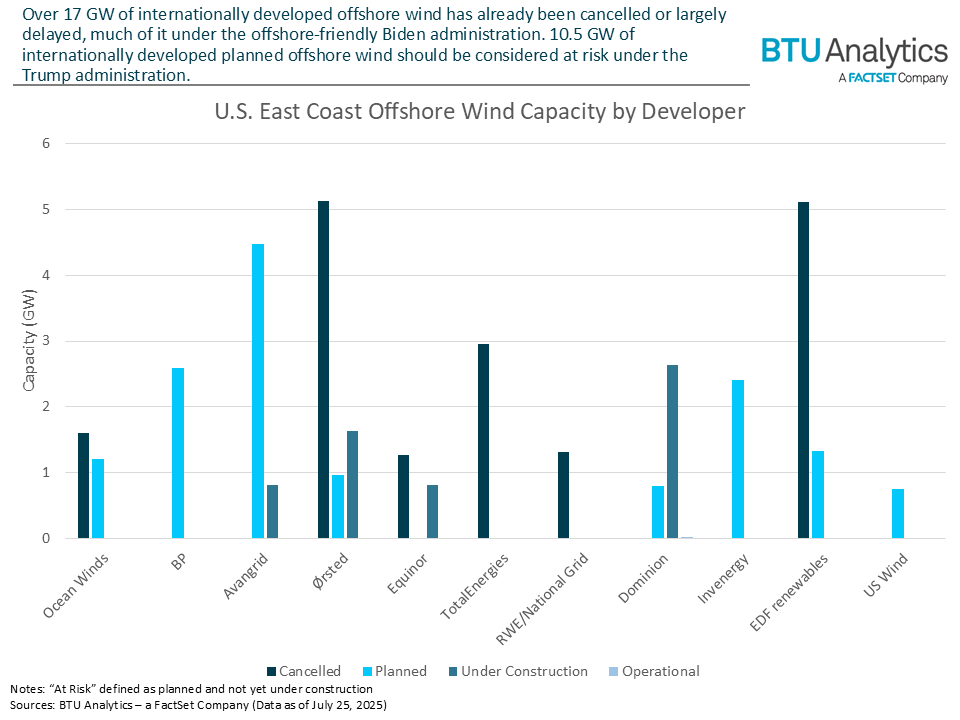
Chart Details Over 17 GW of Cancellations
This chart quantifies the “wholesale abandonment” discussed by showing the massive capacity cancelled by major developers, directly supporting the section’s theme of a sector in retreat.
(Source: FactSet Insight)
East Coast Gridlock: A Regional Dream Deferred
Geographically, the impact of the 2025 market disruption was concentrated entirely on the U.S. East Coast, the nation’s primary hub for offshore wind development. Projects from Virginia (CVOW) to Maryland (US Wind), New Jersey (Atlantic Shores), and New York (Empire Wind 1) were systematically halted. This reveals a critical vulnerability: the industry’s geographic concentration made it highly susceptible to a centralized federal policy reversal. The data shows that no state was immune. Even New York, a climate policy leader, was forced to cancel its fifth offshore wind solicitation in early 2026, explicitly citing a loss of industry confidence due to federal actions. This demonstrates that regional leadership and state-level mandates are insufficient to sustain the industry against adverse federal policy, creating a complete development gridlock along the Eastern Seaboard.

Map Details US East Coast Wind Cancellations
This map perfectly visualizes the section’s focus on geography by showing that the cancelled offshore wind projects are all concentrated along the U.S. East Coast.
(Source: FactSet Insight)
Stranded Assets: When Mature Tech Meets Market Failure
The 2025 cancellations were not a result of technological immaturity. Offshore wind is a globally proven, commercially mature technology. Instead, the data reveals a catastrophic market failure where viable, de-risked assets were stranded. Projects like Revolution Wind, which was reportedly 80% complete, and Coastal Virginia Offshore Wind (CVOW), which was already under construction, were halted mid-stream by stop-work orders from the Department of the Interior. These were not speculative pilot programs; they were multi-billion-dollar infrastructure investments backed by global energy giants like Ørsted and Equinor. The failure occurred not at the R&D stage but at the deployment stage, highlighting that even the most mature clean technologies are powerless against extreme political and regulatory risk.
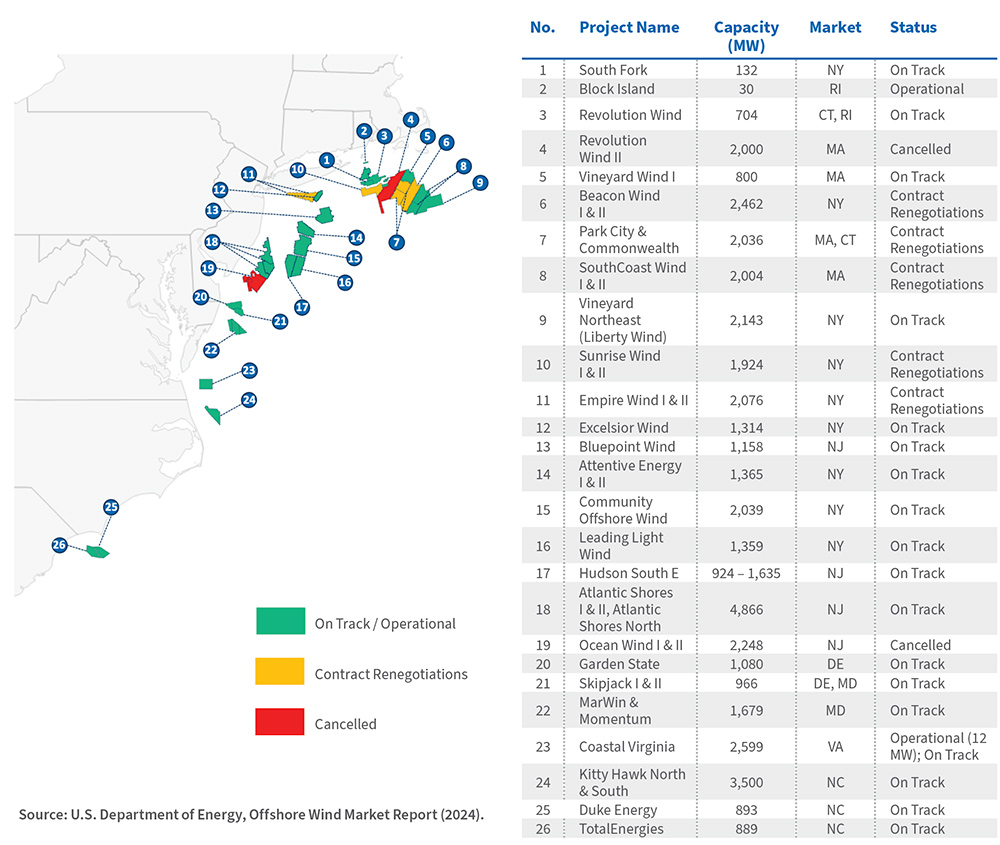
Projects Were ‘On Track’ Before 2025 Halt
This 2024 chart shows projects like Revolution Wind were ‘On Track’, proving the section’s point that viable, mature assets were stranded by market failure, not technological immaturity.
(Source: FTI Consulting)
Forward-Looking Insights: A Chilling Effect on Investment
The events of 2025 signal a bleak near-term future for the U.S. offshore wind industry. The primary takeaway is that sovereign political risk has now eclipsed market and technical risks as the main barrier to investment. The sheer scale of the disruption has prompted drastic forecast revisions, with Bloomberg NEF slashing its 2040 U.S. offshore wind capacity projection from 46 GW to just 6.1 GW. The immediate outlook is one of litigation and investment paralysis, as developers like Ørsted and Equinor shift from construction to legal battles to protect their investments. This “chilling effect” extends beyond offshore wind, sending a warning to investors in all long-duration, capital-intensive clean energy projects that rely on stable federal policy. The competitive landscape has been inverted from a race to build to a struggle to survive.
Frequently Asked Questions
What was the primary cause of the U.S. offshore wind crisis in 2025?
The crisis was caused by a severe federal policy reversal. According to the article, a series of executive actions dismantled regulatory and financial certainty by freezing new leasing, revoking funding, and suspending active construction, which led to a market collapse.
How much planned energy capacity was lost, and what was the financial impact?
The project cancellations and halts in 2025 resulted in the loss of over 20 GW of planned offshore wind capacity. This put an estimated $114 billion in investments at risk.
Were these projects cancelled because the technology wasn’t working?
No. The article explicitly states that the cancellations were due to a “catastrophic market failure” caused by political and regulatory risk, not technological immaturity. It highlights that projects like Revolution Wind (80% complete) and Coastal Virginia Offshore Wind (under construction) were viable, mature assets that were stranded.
Which region of the U.S. was most affected by these cancellations?
The impact was concentrated entirely on the U.S. East Coast. Projects were halted in states from Virginia and Maryland up through New Jersey, New York, Rhode Island, and Connecticut, creating a regional “development gridlock.”
What is the forecast for the U.S. offshore wind industry following these events?
The near-term future is described as bleak. The article points to a “chilling effect” on investment, with political risk becoming the primary barrier. It cites a forecast from Bloomberg NEF that dramatically cut its 2040 U.S. offshore wind capacity projection from 46 GW down to just 6.1 GW.
Want strategic insights like this on your target company or market?
Build clean tech reports in minutes — not days — with real data on partnerships, commercial activities, sustainability strategies, and emerging trends.
