

Offshore Wind Political Risk: 5 Court Injunctions for Ørsted and Dominion Energy Unblock 5.8 GW of Projects After Trump Administration Halt (2025-2026)
Project Resilience, 5 Offshore Wind Farms Overturn Federal Halt
The U.S. renewable energy sector has demonstrated significant legal resilience against political volatility, with federal courts rapidly reversing executive actions that halted 5.8 GW of commercial-scale offshore wind projects in late 2025 and early 2026. This sequence of events marked a sharp pivot from the period between 2021 and 2024, which was characterized by methodical but slow federal regulatory processes. The successful legal challenges validate the strength of existing permits and provide a critical backstop against sudden policy reversals, establishing a new precedent for de-risking major infrastructure investments.
- Between 2021 and 2024, project progression was dictated by standard administrative timelines. For example, the 704 MW Revolution Wind farm received its key federal Record of Decision from the Bureau of Ocean Energy Management (BOEM) on August 21, 2023, a multi-year process. Similarly, reforms like FERC Order No. 2023 were introduced to address systemic, non-political bottlenecks like grid interconnection backlogs.
- The environment shifted dramatically starting in late 2025 when the Trump administration issued a stop-work order on December 22, 2025, for five major offshore wind projects already under construction. The projects, including Revolution Wind, Empire Wind 1, Coastal Virginia Offshore Wind, Vineyard Wind 1, and Sunrise Wind, represented a combined capacity of 5.8 GW.
- In response, developers launched a coordinated legal counteroffensive that resulted in five consecutive preliminary injunctions from federal judges between January 13 and February 2, 2026. These rulings allowed the multi-billion-dollar construction activities to resume, confirming that projects with finalized permits have a strong legal defense against executive interference.
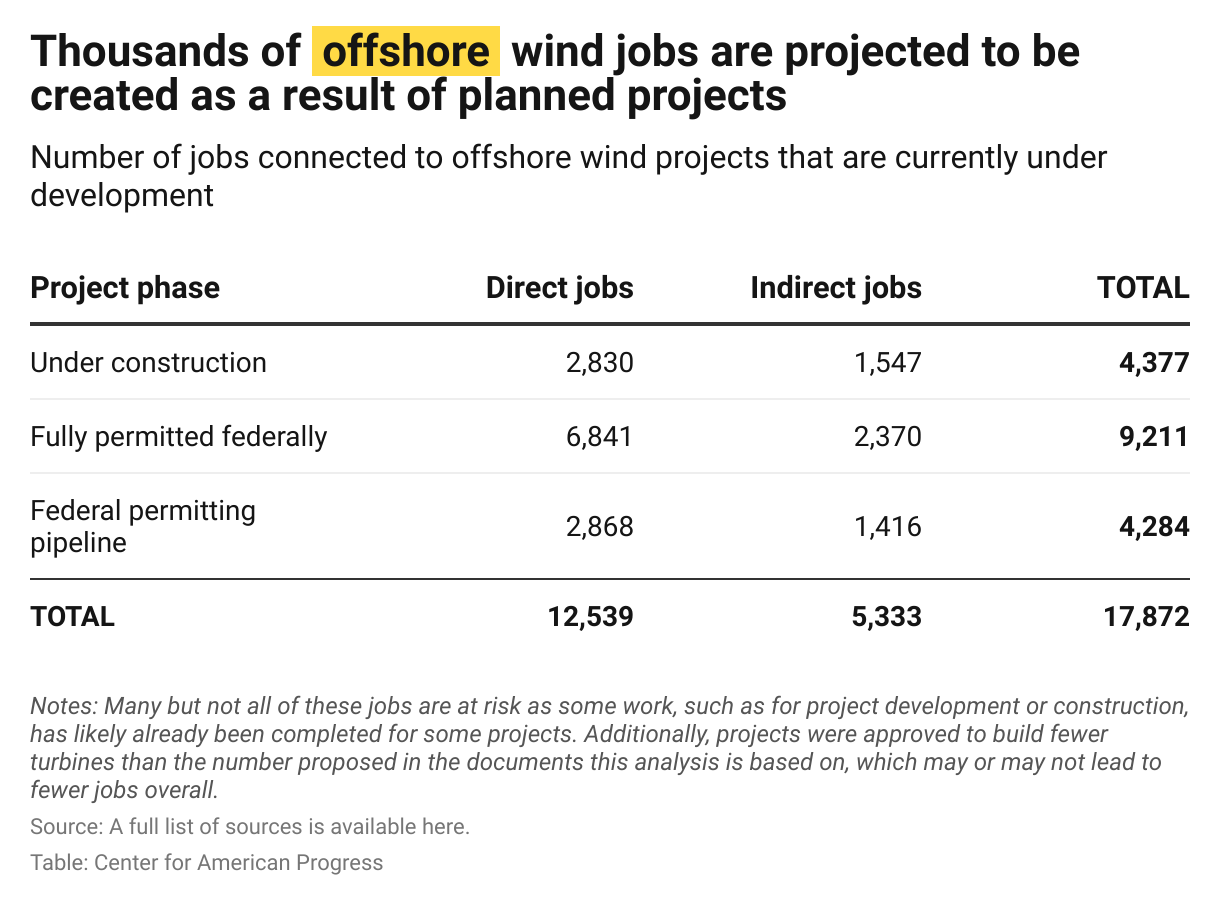
Offshore Wind Jobs Threatened by Halt
This chart shows the significant job creation potential of the offshore wind projects that demonstrated resilience, illustrating the high economic stakes involved in the legal challenges.
(Source: Center for American Progress)
Project Cancellations, Trump Administration Targets 7.7 GW of Solar and 5.8 GW of Wind
The Trump administration’s strategy in late 2025 involved direct intervention to cancel or halt specific large-scale renewable energy projects, totaling over 13 GW of capacity across solar and wind. These actions went beyond typical regulatory reviews and represented a targeted campaign against assets that had, in many cases, already secured federal permits and begun construction. The administration’s moves triggered the subsequent wave of successful legal challenges from the offshore wind industry, but the solar cancellations did not face similar immediate reversals.
Table: Renewable Energy Projects Targeted by Federal Action (2025)
| Project(s) | Time Frame | Details and Strategic Purpose | Source |
|---|---|---|---|
| Empire Wind, Revolution Wind, CVOW, Vineyard Wind 1, Sunrise Wind | Dec 22, 2025 | The Department of the Interior suspended the leases for five offshore wind projects totaling 5.8 GW that were already under construction, citing national security concerns. This action was later reversed by a series of court injunctions. | Georgetown Climate Center |
| Nevada Solar Project | Oct 10, 2025 | The Department of the Interior canceled a 6.2 GW solar project in Nevada. At the time, it would have been the largest solar project in the United States. | PV Magazine |
| Gold Dust Solar Project | Oct 10, 2025 | The administration canceled the 1.5 GW, 17, 000-acre Gold Dust solar project as part of a broader action against large-scale renewable developments. | Politico |
| New England Wind & South Coast Wind | Sep 03, 2025 | The administration initiated court filings to review the permits for two offshore wind projects off the coast of Massachusetts, totaling 5.0 GW of planned capacity. | ENR |
| US Wind Projects (Mar Win & Momentum Wind) | Aug 27, 2025 | The Department of the Interior announced its intent to revoke the approved Construction and Operations Plan (COP) for US Wind’s 2.2 GW projects off the Maryland coast. | Utility Dive |
US East Coast, Offshore Wind Projects Face Targeted Federal Action
The administrative actions in 2025 were geographically concentrated, focusing on the U.S. East Coast’s nascent offshore wind sector and large-scale solar developments in the Southwest. The offshore wind projects targeted were clustered in federal waters off the coasts of Massachusetts, Rhode Island, New York, Virginia, and Maryland, areas critical to achieving state and federal renewable energy goals. This regional focus highlights the vulnerability of capital-intensive, long-duration infrastructure projects to centralized political decisions, even when they have strong state-level support.
- Five major projects along the Atlantic coast became the epicenter of the legal battle: Ørsted’s Revolution Wind (Rhode Island) and Sunrise Wind (New York), Equinor’s Empire Wind 1 (New York), Avangrid/CIP’s Vineyard Wind 1 (Massachusetts), and Dominion Energy’s Coastal Virginia Offshore Wind (Virginia).
- These projects represent the first wave of large-scale offshore wind construction in the U.S. and are foundational to building a domestic supply chain and workforce. The stop-work orders therefore threatened not just individual assets but the momentum of the entire regional industry.
- The broader ruling by a Massachusetts judge on April 23, 2026, addressed the nationwide portfolio of 57.2 GW of renewable projects facing administration-created roadblocks, indicating the impact extended beyond the five named offshore wind farms.
- In contrast, the solar project cancellations were concentrated in Nevada, targeting two developments that alone would have constituted 7.7 GW of capacity, demonstrating a parallel effort to halt significant renewable growth in a different region.
Commercial-Scale Projects, Developers Defend Billions in Assets Under Construction
The federal actions did not target speculative or early-stage ventures but instead focused on commercially mature, fully permitted projects that were already mobilizing billions of dollars in capital and were physically under construction. The targeted assets had successfully navigated the multi-year federal and state permitting processes required between 2021 and 2024, representing de-risked investments. The advanced stage of these projects amplified the financial stakes of the stop-work orders and strengthened the legal argument for irreparable harm, which was a key factor in the courts’ decisions to grant injunctions.
- The 2.6 GW Coastal Virginia Offshore Wind project, operated by Dominion Energy, was reportedly 70% complete when the stop-work order was issued, underscoring the advanced nature of the targeted assets.
- Similarly, Ørsted’s 704 MW Revolution Wind project was described as “nearly complete” at the time of the December 2025 order, showing that the administration was intervening at the final stages of construction.
- The successful legal defense mounted by developers like Ørsted and Dominion Energy solidified their leadership positions by demonstrating an ability to protect advanced-stage, capital-intensive projects against severe political risk.
- This contrasts with the period before 2025, when the primary challenge for mature projects was navigating administrative processes like BOEM environmental reviews and state-level OREC agreement negotiations, not defending their right to exist.
SWOT Analysis, US Renewable Project Political Risk Profile
The events of 2025-2026 fundamentally reshaped the risk profile for large-scale U.S. renewable energy projects, exposing a weakness to executive action while simultaneously validating the strength of the legal system as a countermeasure. Investors and developers must now weigh the demonstrated political risk against the newly established legal precedents that protect permitted projects. The following analysis contrasts the risk environment before and after these pivotal events.
Table: SWOT Analysis for US Renewable Project Political Risk
| SWOT Category | 2021 – 2024 | 2025 – 2026 | What Changed / Validated |
|---|---|---|---|
| Strengths | Robust, multi-stage federal permitting process (BOEM, FERC) provided a clear development pathway. | Court rulings affirmed that finalized permits and construction agreements provide a strong legal defense against executive orders. | The strength of the U.S. judicial system as a bulwark for permitted infrastructure projects was validated under extreme pressure. |
| Weaknesses | Slow and complex permitting and interconnection queues acted as a primary bottleneck for project deployment. | High vulnerability of capital-intensive projects to sudden, targeted political intervention and stop-work orders from the executive branch. | The primary weakness shifted from bureaucratic inefficiency to acute political hostility, exposing a structural vulnerability. |
| Opportunities | Supportive federal policies (e.g., Inflation Reduction Act) and ambitious state-level procurement targets created strong market demand. | The rapid succession of court injunctions created powerful legal precedents that can be used to defend future projects against similar actions. | The opportunity now includes leveraging established legal precedent to de-risk projects, in addition to capitalizing on policy incentives. |
| Threats | Supply chain constraints, trade policy volatility (e.g., solar tariffs), and rising interest rates posed the main financial and logistical risks. | The administration’s stated intent to appeal the injunctions ensures continued legal uncertainty and potential for project financing delays. | The primary threat evolved from market and supply chain issues to sustained, high-level legal and political opposition from the federal government. |
Scenario Modeling, Ørsted and Equinor Face Continued Legal Appeals in 2026
While the series of court injunctions in early 2026 was a decisive victory for developers, the forward-looking outlook is defined by continued legal uncertainty. The administration’s announcement on February 12, 2026, that it will appeal all five injunctions guarantees that political and legal risk will remain a central theme for the U.S. offshore wind sector throughout the year. Developers and investors must now model the potential impacts of a prolonged appellate court battle on project timelines, financing costs, and supply chain commitments.
- If the appeals process proceeds, watch for any preliminary rulings or stays issued by appellate courts. A stay on any of the injunctions would halt construction again, sending a negative signal to the market and potentially chilling investment in other projects that are pre-construction.
- These could be happening now: Developers like Ørsted, Equinor, and Dominion Energy are likely building higher legal and contingency budgets into future project pro-formas. This will increase the levelized cost of energy (LCOE) for the next wave of projects and could make securing financing more difficult for developers without a proven track record of navigating such challenges.
- Watch for statements from financial institutions and equity partners involved in the affected projects. Any signs of wavering commitment or revised financing terms would indicate that the appeals are perceived as a material risk to project completion and profitability.
The questions your competitors are already asking
This report covers one angle of political risk management for US offshore wind projects. The questions that matter most depend on your work.
- What is actually happening with the construction of the 5.8 GW of offshore wind projects, including Revolution Wind and Empire Wind 1, since the federal stop-work order was overturned?
- Which developers, like Ørsted and Dominion Energy, are gaining ground in the US market now that a legal precedent for de-risking projects has been set?
- What is the new outlook for US offshore wind deployment through 2030, considering the legal backstop against sudden policy reversals?
- Are the Coastal Virginia Offshore Wind and Sunrise Wind projects on track for their commissioning targets after the 2025-2026 construction halt?
This report does not answer these. Enki Brief Pro does.
Your question, your angle, your framework. SWOT, PESTL, scenario modelling. The same niche depth, built around the decision your work actually depends on.
