

Energy Security Risk, 11 M BPD Offline, $58 B in Damages, and Qatar Energy LNG Halted (2025 to 2026)
Infrastructure Vulnerability, Qatar Energy 20% Global LNG Supply Halted
The early 2026 military conflict in the Middle East has ended a period of perceived energy market stability by exposing the critical vulnerability of centralized production hubs, a risk that was latent between 2021 and 2024. Direct attacks on core Saudi and Qatari energy infrastructure have demonstrated that these assets are not immune to geopolitical conflict, triggering the largest supply disruption in history and fundamentally repricing global energy security risk.
- Prior to 2025, the global energy system operated on the assumption of secure supply from Gulf producers, with facilities like Qatar’s Ras Laffan LNG complex considered reliable pillars of the market. The primary risks were economic and logistical rather than military.
- In March 2026, this assumption was shattered when direct drone strikes forced Qatar Energy to halt all production at its Ras Laffan and Mesaieed facilities, which collectively represent approximately 20% of the world’s LNG supply. Reports confirmed damage to infrastructure responsible for 17% of the country’s total LNG export capacity.
- Simultaneously, Saudi Arabia shut its largest domestic oil refinery after an attack, and its crude output fell from 10.11 million barrels per day (bpd) to 6.87 million bpd between February and April 2026.
- The regional impact was widespread, with international oil companies like Total Energies reporting that approximately 15% of its global oil and gas output had been shut down due to its exposure in Qatar, Iraq, and the UAE.
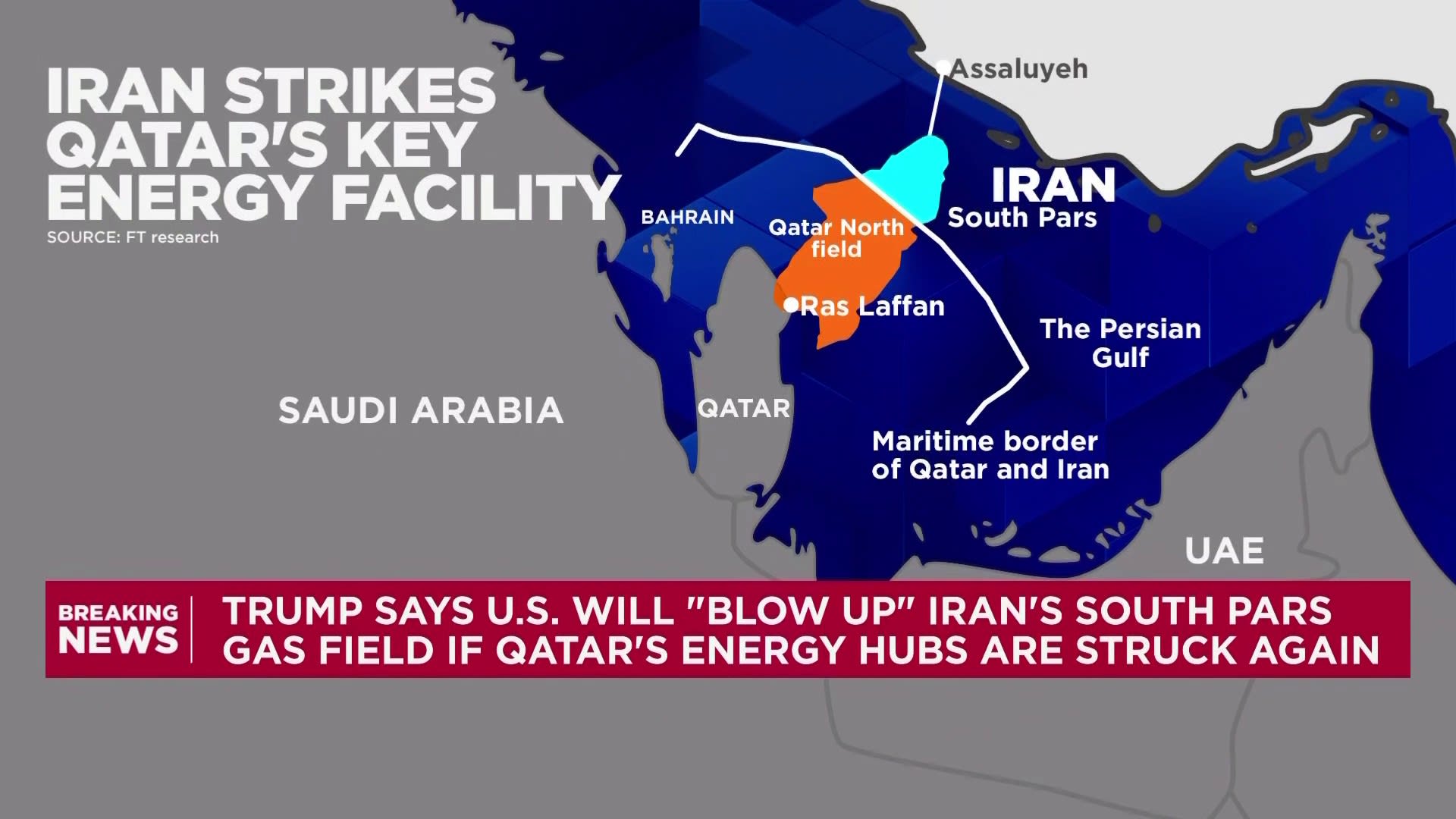
Map Shows Iran Strike on Qatari Energy Facility
The map directly visualizes the attack on Qatar’s energy infrastructure, which is the central event described in the section heading, substantiating the claim of a supply halt due to infrastructure vulnerability.
(Source: CNBC)
$58 B in Repair Costs, Regional Energy Investment Redirected
The conflict has inflicted massive financial damage on regional producers and is forcing a structural redirection of global energy investment away from new upstream projects in the Gulf toward repair and supply diversification. The scale of the physical damage translates into multi-billion-dollar repair bills and significant lost revenue, while the associated risk has triggered a collapse in global oil demand forecasts and a reduction in planned capital expenditures.
- Research firm Rystad Energy estimated in April 2026 that the cost to repair damaged energy assets in the region could reach as high as $58 billion, indicating the severity of the structural harm to refineries, pipelines, and export terminals.
- The production shutdowns have resulted in substantial revenue losses. By mid-March 2026, Wood Mackenzie estimated that Saudi Arabia alone had lost $4.5 billion in oil and gas revenues, with total losses across the Gulf Cooperation Council (GCC) hitting $15.1 billion.
- The supply shock and high prices decimated global oil demand projections. The International Energy Agency (IEA), which had forecast demand growth of 930, 000 bpd for 2026 in January, revised its outlook downward multiple times, projecting a demand contraction of 420, 000 bpd by May 2026.
- This crisis is set to cause global investment in oil projects to fall for a third consecutive year, as capital is reallocated to enhance energy security in importing nations, including accelerated development of domestic energy sources.
Table: Estimated Financial Impact of Middle East Conflict (2026)
| Impact Category | Time Frame | Details and Financial Figures | Source |
|---|---|---|---|
| Infrastructure Repair Costs | Apr 2026 | Estimated cost to repair damaged energy assets could be as high as $58 billion, according to Rystad Energy. An earlier estimate from Wood Mackenzie projected $25 billion in costs for engineering, construction, and equipment. | Reuters |
| Lost Revenue (Qatar) | Apr 2026 | The damage to 17% of Qatar’s LNG export capacity represents an estimated $20 billion loss in annual revenue, severely impacting the national economy. | Consultancy-me.com |
| Lost Revenue (GCC) | Mar 2026 | Wood Mackenzie estimated total lost revenue across the GCC at $15.1 billion by mid-March, with Saudi Arabia accounting for $4.5 billion of that total. | nassersaidi.com |
| Economic Growth Impact | Apr 2026 | Goldman Sachs projected that Gulf economies could shrink by 2% to 5% in 2026 as a result of the production halts, with Qatar and Kuwait being the most vulnerable. | Global Finance Magazine |
Middle East vs. Western Hemisphere, A Geographic Risk Reassessment
The conflict has triggered a fundamental geographic reassessment of energy supply chains, shifting the strategic focus from the concentrated risk of the Middle East to more stable production regions, particularly in the Western Hemisphere. The weaponization of the Strait of Hormuz, a chokepoint for nearly 20 million bpd of oil, has made supply diversification an urgent priority for major importing nations in Asia and Europe.
- Between 2021 and 2024, global energy trade was characterized by a heavy reliance on the Middle East, with major Asian economies like Japan, South Korea, and China sourcing a large share of their oil and LNG from Gulf producers.
- The 2026 conflict has exposed the extreme vulnerability of this model, prompting Asian buyers to urgently seek alternative long-term contracts with suppliers outside the region to mitigate their exposure.
- This creates a strategic opening for producers in the Americas. The United States is positioned to become a more critical supplier of LNG, while Canadian heavy crude delivered via the newly expanded Trans Mountain Pipeline (TMX) offers a secure alternative for Asian refineries.
- The crisis reinforces the need for energy independence and grid stability in importing regions. Efforts by grid operators like ERCOT to ensure reliability become more critical as nations look to electrify and reduce reliance on volatile global fuel markets.

Energy Demand Projected to Shift by 2035
This chart illustrates the long-term outcome of a ‘Geographic Risk Reassessment,’ showing how conflict in the Middle East is projected to shift global energy demand towards other regions, like the Western Hemisphere.
(Source: Wood Mackenzie)
Centralized Hub Model, Energy Infrastructure’s Commercial Viability Tested
The successful attacks on previously secure, large-scale energy infrastructure have fundamentally challenged the technological and commercial model of centralized fossil fuel production and export. The conflict has proven that even the most advanced and capital-intensive facilities are vulnerable, accelerating the strategic pivot toward more distributed, resilient, and domestically controlled energy systems.
- In the period from 2021 to 2024, mega-projects like Qatar’s LNG expansion were viewed as mature, low-risk assets representing the pinnacle of energy engineering and reliability, attracting significant foreign investment.
- The events of 2026 have reclassified these assets as high-risk. The swift and effective neutralization of facilities like Ras Laffan has invalidated the assumption that their scale and strategic importance guaranteed their security.
- This failure of the centralized model provides a powerful catalyst for the energy transition. For importing nations, the crisis has made it clear that energy security is synonymous with energy independence, which is most achievable through domestic renewable generation, energy storage, and nuclear power.
- The strategic imperative to reduce dependence on volatile fossil fuel imports elevates the importance of clean, reliable baseload power, reinforcing the logic behind investments in new grid infrastructure and advanced energy sources by major utilities and corporations like Dominion Energy.
SWOT Analysis, Middle East Energy Production Risks
The conflict has inverted the strategic calculus for Gulf energy producers, transforming their greatest strengths into acute vulnerabilities and accelerating long-term threats to their market position. The SWOT analysis below contrasts the market perception from 2021-2023 with the new reality of 2024-2026.
- Strengths have become weaknesses, as the geographic concentration of vast, low-cost reserves is now a liability.
- Weaknesses, such as the dependence on a single chokepoint, have been fully exposed.
- Opportunities for diversification are now necessities, but they are challenged by immediate security threats.
- Threats have evolved from long-term market shifts to immediate, existential risks to production and economic stability.

Map Shows Vulnerable Middle East Energy Sites
This map visually supports a SWOT analysis by identifying the key ‘Threats’ and ‘Weaknesses’ related to the geographic concentration and vulnerability of the region’s energy production sites.
(Source: RBC Capital Markets)
Table: SWOT Analysis for Gulf Energy Production
| SWOT Category | 2021 – 2023 | 2024 – 2026 | What Changed / Validated |
|---|---|---|---|
| Strengths | Vast, low-cost oil and gas reserves. Large-scale, efficient production and export infrastructure. Established trade relationships with key Asian markets. | Geographic concentration of reserves becomes a critical vulnerability. Centralized infrastructure is proven to be a primary target in conflicts. | The core strength of concentrated, low-cost production was validated as a single point of failure for the global energy system. |
| Weaknesses | High dependence on the Strait of Hormuz chokepoint. Economies are highly reliant on hydrocarbon revenues. | The Strait of Hormuz is effectively closed or made impassable, crippling export capabilities. National economies face recession due to production halts. | The theoretical risk of reliance on a single maritime chokepoint was validated as an acute, actionable military vulnerability. |
| Opportunities | Leverage hydrocarbon wealth to fund economic diversification and investments in renewables (e.g., green hydrogen) as part of a long-term strategy. | Immediate need to secure and rebuild core infrastructure. Crisis accelerates domestic renewable projects as a matter of national security, not just economic strategy. | The energy transition shifted from a long-term economic opportunity to a near-term strategic necessity for domestic energy resilience. |
| Threats | Long-term demand destruction from the global energy transition. Competition from alternative energy sources and suppliers. | Immediate and catastrophic loss of production capacity. Permanent loss of market share to more secure suppliers. Accelerated global pivot to non-fossil fuels for energy security reasons. | The primary threat shifted from gradual market evolution to an abrupt, forced exit from the market due to physical and security constraints. |
Energy Security Outlook, Supply Diversification and Geopolitical Premiums (2026)
The global energy market will operate with a significant and sustained geopolitical risk premium for the foreseeable future, fundamentally altering investment flows and trade patterns. The primary strategic response will be a dual-track approach: an immediate scramble to secure non-Gulf fossil fuel supplies and a long-term acceleration of the energy transition in major importing regions.
- If this happens: The conflict de-escalates and a ceasefire is reached in mid-to-late 2026. Watch this: The timeline and cost for repairing damaged infrastructure. Adnoc’s CEO suggested disruptions may not fully resolve until mid-2027, meaning supply will remain tight. Watch for new long-term LNG and oil contracts signed with US, Canadian, and Australian producers.
- These could be happening: Major energy importers in Europe and Asia will fast-track policy support and subsidies for domestic renewable energy deployment, battery storage, and nuclear power. This includes an aggressive push to secure clean energy supply chains, reducing dependence on foreign sources for both fuel and technology. Watch for major investments in alternative energy sources, such as Blackstone’s natural gas ventures, which may be seen as a bridge fuel in more stable regions.
- If this happens: Tensions remain high, and the security of shipping through the Strait of Hormuz remains uncertain. Watch this: Oil and LNG prices will maintain a high risk premium. Investment will flood into non-Gulf production, while capital expenditure for new Middle East projects will be frozen, pending a dramatic improvement in the regional security framework.

Saudi/UAE Oil Exports Shift to Bypass Routes in 2026
The chart directly illustrates the ‘Supply Diversification’ theme of the energy security outlook by showing a strategic shift to alternative export routes, a key response to heightened geopolitical risk.
(Source: Middle East Institute)
The questions your competitors are already asking
This report covers one angle of the energy security crisis following the 2026 Middle East conflict. The questions that matter most depend on your work.
- Which energy producers are gaining or losing ground in the wake of the Qatar Energy LNG and Saudi oil production shutdowns?
- What is the status of the Qatar Energy LNG restart? Is production at Ras Laffan on track to resume in 2026?
- What is the outlook for global energy security and investment in supply chain diversification by 2030?
This report does not answer these. Enki Brief Pro does.
Your question, your angle, your framework. SWOT, PESTL, scenario modelling. The same niche depth, built around the decision your work actually depends on.
