

Bloom Energy SOFC Deployments, $5 B Brookfield Partnership, 900 MW Wyoming Project, and 11 Commercial Agreements (2021-2026)
Behind-the-Meter Adoption, SOFC Deployments Accelerate on Grid Delays
The strategic rationale for deploying Solid Oxide Fuel Cells (SOFCs) has fundamentally shifted, moving from a secondary role in combined-heat-and-power (CHP) or backup applications to a primary, on-site power source for critical infrastructure. This change is driven by persistent grid interconnection delays, which can take six to ten years, and stalled financing for large-scale grid upgrades. The resulting power bottleneck, exacerbated by surging electricity demand from AI data centers, has made behind-the-meter (BTM) generation a necessity, not an alternative. What was a market driven by green policy incentives between 2021 and 2024 has become a market defined by urgent operational need in 2025 and 2026.
- Between 2021 and 2024, corporate adoption of SOFCs was often centered on smaller-scale deployments aimed at carbon reduction and resiliency. The technology was a component of a broader energy strategy.
- The period from 2025 to 2026 marks a decisive pivot to SOFCs as the central pillar of power strategy for new data center builds. Oracle’s decision in April 2026 to abandon traditional gas turbines and diesel backup for its Project Jupiter campus in favor of a Bloom Energy fuel-cell microgrid is the primary signal of this change.
- This shift is validated by Rystad Energy’s projection that investment in fuel cells for data centers will increase tenfold, from $2.8 billion in 2025 to $30 billion by 2030, driven almost entirely by the need to bypass the grid.
- The application has also narrowed and scaled. While earlier use cases were diverse, the current demand is dominated by providing baseload, primary power to AI-driven data centers, which are expected to account for a 35 GW energy gap by 2030.
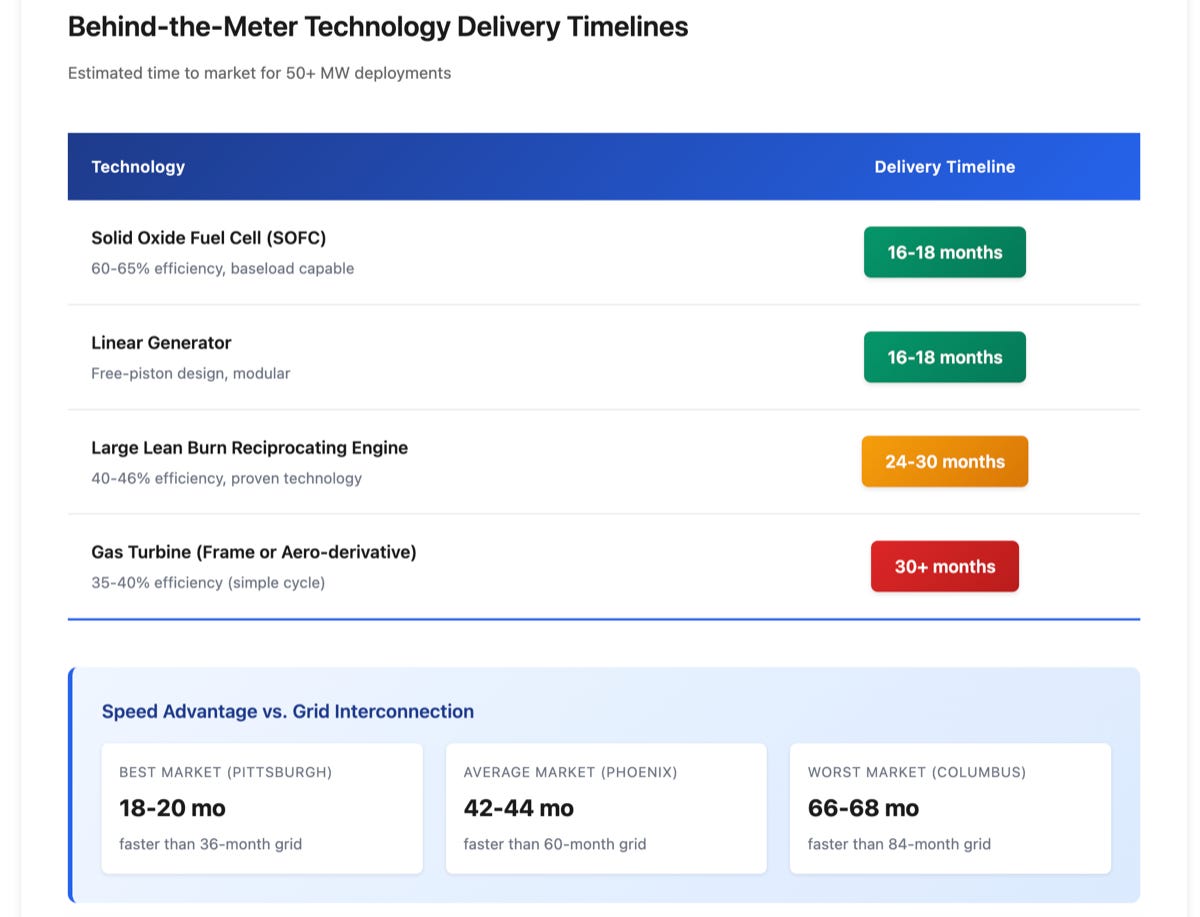
SOFCs Deploy Years Faster Than Grid Upgrades
The section heading’s reference to accelerating deployments due to ‘Grid Delays’ is directly explained by the chart, which shows that SOFCs can be deployed significantly faster than traditional grid upgrades.
(Source: Energy Industry Insights from Avanza Energy – Substack)
$9.35 B in Financing, Bloom Energy and Fuel Cell Energy Secure Capital
A wave of multi-billion-dollar investments and offtake agreements in 2025 and 2026 has validated the bankability of SOFC projects at an unprecedented scale, directly addressing the high capital expenditures that previously limited deployment. These financing structures, often involving infrastructure funds and long-term utility contracts, de-risk projects and create a clear path for gigawatt-scale development independent of traditional utility financing. This contrasts sharply with the venture-style funding and smaller project financing rounds that characterized the 2021-2024 period.
- The scale of capital has increased dramatically. The $5 billion strategic AI infrastructure partnership between Brookfield and Bloom Energy announced in October 2025 provides a dedicated pool of capital specifically for financing and deploying BTM power projects.
- Long-term offtake agreements with utilities have emerged as a key validation point. American Electric Power’s $2.65 billion, 20-year agreement with Bloom Energy for a major SOFC facility, announced in June 2026, signals that utilities are now viewing large-scale SOFCs as reliable, grid-complementary assets.
- Financing is now directly tied to specific data center build-outs. The $1.7 billion investment by IDF and Oaktree Capital in July 2026 is explicitly designed to support Bloom Energy’s fuel cell deployments for Nebius data centers, linking capital directly to the end-user.
Table: Strategic Investments and Offtake Agreements in SOFCs (2025-2026)
| Company / Funder | Time Frame | Details and Strategic Purpose | Source |
|---|---|---|---|
| IDF & Oaktree Capital (for Nebius) | Jul 2026 | $1.7 Billion investment to finance and support Bloom Energy’s fuel cell deployments across Nebius AI data centers in the US. | DCD |
| American Electric Power (AEP) | Jun 2026 | $2.65 Billion, 20-year offtake agreement for power from a major Bloom Energy SOFC facility development. Conditions are expected to be met by Q 2 2026. | Reuters |
| Ceres Power | Jun 2026 | Raised £103 million (~$130 million) to accelerate SOFC production, with a stated focus on meeting demand from data centers. | Proactive Investors |
| Brookfield | Oct 2025 | $5 Billion strategic partnership with Bloom Energy to finance and implement AI infrastructure projects, providing a dedicated capital vehicle for BTM power. | Bloom Energy |
Fuel Cell Energy Data Center Strategy, a 380 MW FIT Energy Deal
Strategic partnerships have evolved from technology validation pilots to multi-megawatt commercial agreements designed to secure power capacity for specific data center projects. In the 2021-2024 timeframe, collaborations often involved testing fuel cell integration. By 2026, these have become large-scale procurement deals where data center operators and their energy partners lock in power supply years in advance. These are among the top two fuel cell companies leading this market.
- The nature of partnerships has shifted from R&D to deployment. The joint development between MODEC and Eld Energy announced in June 2026 to build a 1.2 MW SOFC system with carbon capture for maritime use shows continued diversification in industrial applications.
- However, the largest agreements are squarely focused on data centers. Fuel Cell Energy’s strategic agreement with FIT Energy in June 2026 for up to 380 MW of BTM fuel cell deployments is explicitly targeted at data centers.
- Major technology companies are now direct partners. Oracle’s decision to use Bloom Energy for its Project Jupiter campus in April 2026 marks a major hyperscaler’s public commitment to fuel cells as a primary power source, bypassing conventional utility infrastructure.
- These agreements are creating dedicated supply chains. Elcogen’s expansion into a new 14, 000 m² facility in May 2026 is a direct response to the need to scale up manufacturing to support large-scale offtake agreements from partners.

Power Unit Size Drives Datacenter Redundancy Costs
A company’s ‘Data Center Strategy,’ as mentioned in the heading, would be directly informed by the technical and economic trade-offs shown in this chart, which links power unit size to redundancy costs.
(Source: SemiAnalysis)
Table: Key SOFC Partnerships and Commercial Agreements (2026)
| Partners | Time Frame | Details and Strategic Purpose | Source |
|---|---|---|---|
| Fuel Cell Energy / FIT Energy | Jun 2026 | Strategic agreement for up to 380 MW of behind-the-meter fuel cell deployments specifically for data centers, designed to bypass grid constraints. | Stock Titan |
| MODEC / Eld Energy | Jun 2026 | Joint development of a 1.2 MW SOFC power system with integrated carbon capture for maritime applications (FPSOs), aiming for zero-emission operations. | Carbon Herald |
| Bloom Energy / Nebius | May 2026 | Neocloud provider Nebius signed a deal to deploy Bloom Energy’s SOFC technology to provide primary power for its AI data centers in the US. | DCD |
| Oracle / Bloom Energy | Apr 2026 | Oracle selected a Bloom Energy fuel-cell-based microgrid for its Project Jupiter data center campus, replacing a traditional design with gas turbines and diesel backup. | Data Center Knowledge |
| Bloom Energy / State of Wyoming | Jan 2026 | Selected to provide 900 MW of fuel cell capacity for the first phase of a landmark data center project, showcasing state-level support for BTM power infrastructure. | Wedbush |
US Dominance, SOFC Deployments Center on Data Center Hubs
The geographic focus of SOFC deployment has consolidated heavily within the United States, driven by a combination of surging data center power demand, favorable federal policy, and severe grid congestion in key regions. While Asia, particularly South Korea and Japan, showed strong leadership in fuel cell adoption between 2021 and 2024 for utility and residential use, the period from 2025 to 2026 has seen the US become the epicenter of large-scale commercial deployments tied to the AI build-out.
- The US Inflation Reduction Act (IRA) provides a powerful financial incentive. Its 30% Investment Tax Credit (ITC) for fuel cell property, combined with transferability, significantly lowers the capital barrier for US-based projects, making the economics more attractive than in other regions.
- Deployments are concentrated in US data center alleyways. Regions like Texas, where data center capacity is projected to exceed 40 GW by 2028, and Wyoming, site of a 900 MW fuel cell project, are becoming hotspots due to their combination of high demand and grid limitations.
- While European and Asian manufacturers like Ceres Power and Elcogen are scaling production, their primary market driver is the same US-centric data center demand. Ceres Power raising £103 million in June 2026 was explicitly to target this opportunity.
- Local opposition to data centers in the US, with at least 25 projects cancelled in 2025 due to community resistance, is an emerging geographic risk that could impact permitting for associated BTM power projects.

Diagram Defines ‘Behind-the-Meter’ Data Center Power
As the section focuses on deployments in ‘Data Center Hubs,’ this diagram provides essential context by defining the ‘Behind-the-Meter’ power architecture that is central to the topic.
(Source: Tech Investments)
Commercial Validation, SOFC Technology Reaches TRL 8-9 for Data Centers
Solid Oxide Fuel Cell technology has achieved full commercial maturity (Technology Readiness Level 8-9) for stationary power applications, a status confirmed by its selection for multi-billion-dollar, gigawatt-scale projects. The key shift between 2021-2024 and 2025-2026 is not an advancement in the core technology itself, but its validation as a bankable, reliable primary power source capable of displacing conventional generation. The discussion has moved from technical feasibility to manufacturing scalability.
- The technology’s high electrical efficiency of over 60% is a proven attribute that provides a significant operational advantage over alternatives. A key milestone is the native output of 800 VDC from Bloom Energy’s systems, which directly powers modern servers and eliminates conversion losses.
- Economic viability is now established. BTM fuel cells can deliver power at a levelized cost of $45-$55/MWh, significantly below the all-in grid cost of approximately $123/MWh in major US markets like PJM.
- The remaining technological challenges are related to scale and long-term operation, not fundamental performance. Stack degradation and durability remain key areas of focus for R&D, as they impact lifetime operational costs.
- The primary bottleneck is now manufacturing capacity, not technology risk. Guosen Securities projects new SOFC demand for data centers will reach 16 GW by 2030, while total global fuel cell manufacturing capacity is on track for only 4 GW per year, indicating a severe supply constraint.

SOFCs Show Decisive Cost Advantage Over Grid
The theme of ‘Commercial Validation’ (TRL 8-9) is strongly supported by this chart, which demonstrates the economic viability and cost-competitiveness essential for technology to be considered commercially proven.
(Source: Energy Industry Insights from Avanza Energy – Substack)
SWOT Analysis, SOFC Market Strengths and Supply Headwinds
The SOFC market is positioned at a pivotal moment where its greatest strength, providing grid-independent power, is also the source of its most significant threat, an inability to scale manufacturing fast enough to meet demand. The transition from 2021-2023 to 2024-2025 has seen external market failures (grid constraints) become the technology’s most powerful tailwind, shifting the strategic focus from proving value to capturing it.
- Strengths are now defined by a clear cost and deployment speed advantage over grid-tied solutions for new data centers.
- Weaknesses remain centered on the reliance on natural gas and the high upfront capital cost, though the latter is being mitigated by new financing models.
- Opportunities are immense, driven by the structural power deficit created by AI, which positions SOFCs as a critical enabling technology.
- Threats have shifted from competition with other renewables to internal constraints, primarily manufacturing capacity shortfalls and potential commodity price risk for natural gas.
Table: SWOT Analysis for SOFC Behind-the-Meter Deployment
| SWOT Category | 2021 – 2023 | 2024 – 2026 | What Changed / Validated |
|---|---|---|---|
| Strengths | High efficiency; lower emissions than conventional generators; fuel flexibility. | Deployment speed (bypassing grid queues); lower LCOE ($45-55/MWh) than grid power (~$123/MWh); operational reliability for baseload power. | The value proposition shifted from environmental benefits to speed and cost-certainty, validated by Oracle’s switch from turbines to fuel cells in 2026. |
| Weaknesses | High CAPEX; reliance on natural gas; concerns over long-term stack degradation. | High CAPEX (though mitigated by IRA and financing); continued reliance on natural gas feedstock; long-term durability remains a focus. | The 30% IRA tax credit and large-scale financing partnerships (e.g., Brookfield’s $5 B fund) directly address the CAPEX barrier, making it less of a constraint. |
| Opportunities | Growth in distributed generation; corporate ESG goals; potential use in hydrogen economy. | Massive, urgent power demand from AI data centers (16 GW by 2030); grid interconnection backlogs creating a captive market; utility partnerships (AEP’s $2.65 B deal). | The opportunity transformed from a gradual energy transition role to an immediate solution for a structural power deficit, validated by hyperscaler demand. |
| Threats | Competition from batteries and renewables; policy uncertainty; low natural gas prices making alternatives less attractive. | Inability to scale manufacturing to meet demand (4 GW/yr capacity vs. 16 GW demand); natural gas price volatility; local opposition to data center projects. | The primary threat is now internal (manufacturing) rather than external (competition), confirmed by the massive supply-demand gap projected by analysts. |
Supply Constraints, Manufacturing Capacity vs. 16 GW Demand
The single most critical factor for the SOFC market in the coming years is the race to expand manufacturing capacity to meet the validated, explosive demand from the data center sector. If fuel cell manufacturers can successfully scale production, they are positioned to capture a multi-billion-dollar market as a core infrastructure provider for the AI revolution. If they fail, the opportunity will be ceded to less efficient or less clean BTM alternatives, such as natural gas turbines.
- Watch for formal announcements of new, gigawatt-scale SOFC manufacturing plants. A company like Bloom Energy announcing a second major factory would be a definitive signal of confidence in the long-term demand pipeline.
- Monitor the finalization of the $2.65 billion AEP offtake agreement by its Q 2 2026 target. Its successful closure would be a major de-risking event and a powerful template for future utility-scale partnerships.
- The emergence of a direct, multi-gigawatt BTM power agreement between an SOFC provider and a top-tier hyperscaler (e.g., Google, Amazon, Microsoft) would cement the technology’s role and likely trigger a new wave of investment in the sector.
- Pay close attention to natural gas price trends. A sustained price spike could erode the favorable LCOE of current-generation SOFCs and accelerate the push for green hydrogen readiness, a technology that is still in its early stages.
The questions your competitors are already asking
This report covers one angle of the fuel cell market for data centers. The questions that matter most depend on your work.
- fuel cell manufacturing plant expansion US
- green hydrogen for fuel cell data centers
- fuel cell companies targeting data centers
- utility partnerships for data center power
This report does not answer these. Enki Brief Pro does.
Your question, your angle, your framework. SWOT, PESTL, scenario modelling. The same niche depth, built around the decision your work actually depends on.
