

SOEC Grid Integration, €8 M EU Pilot, 60% RTE Validation, and 15 Projects (2021-2026)
r SOC Commercial Scale: From Lab Validation to MW-Scale Grid Pilots
Reversible Solid Oxide Cell (r SOC) adoption is transitioning from academic validation to strategic, application-specific pilots designed to prove economic viability for grid balancing and industrial decarbonization. The technology’s progression demonstrates a clear focus on moving beyond laboratory efficiency metrics to collecting operational data in real-world environments, a critical step for securing commercial-scale investment.
- Between 2021 and 2024, the market was defined by foundational research and small-scale projects that proved the core technical concepts. The successful validation of the Gr In Hy project, which demonstrated a 150 k W system with 60% round-trip efficiency, was a key milestone during this period, confirming the technology’s high-efficiency potential.
- The period from 2025 to today marks a strategic pivot toward commercialization readiness. This is evidenced by the European Union’s targeted funding for a megawatt-scale r SOC demonstration and pilot projects from innovators like Noon Energy, which demonstrated an ultra-long-duration system capable of 100+ hours of storage in January 2026.
- The current variety of applications, from industrial combined heat and power to long-duration energy storage for grid support, indicates the market is intelligently testing r SOCs in specific, high-value niches. This strategy aims to establish a foothold where the dual-function capability provides a decisive economic advantage over single-purpose technologies.
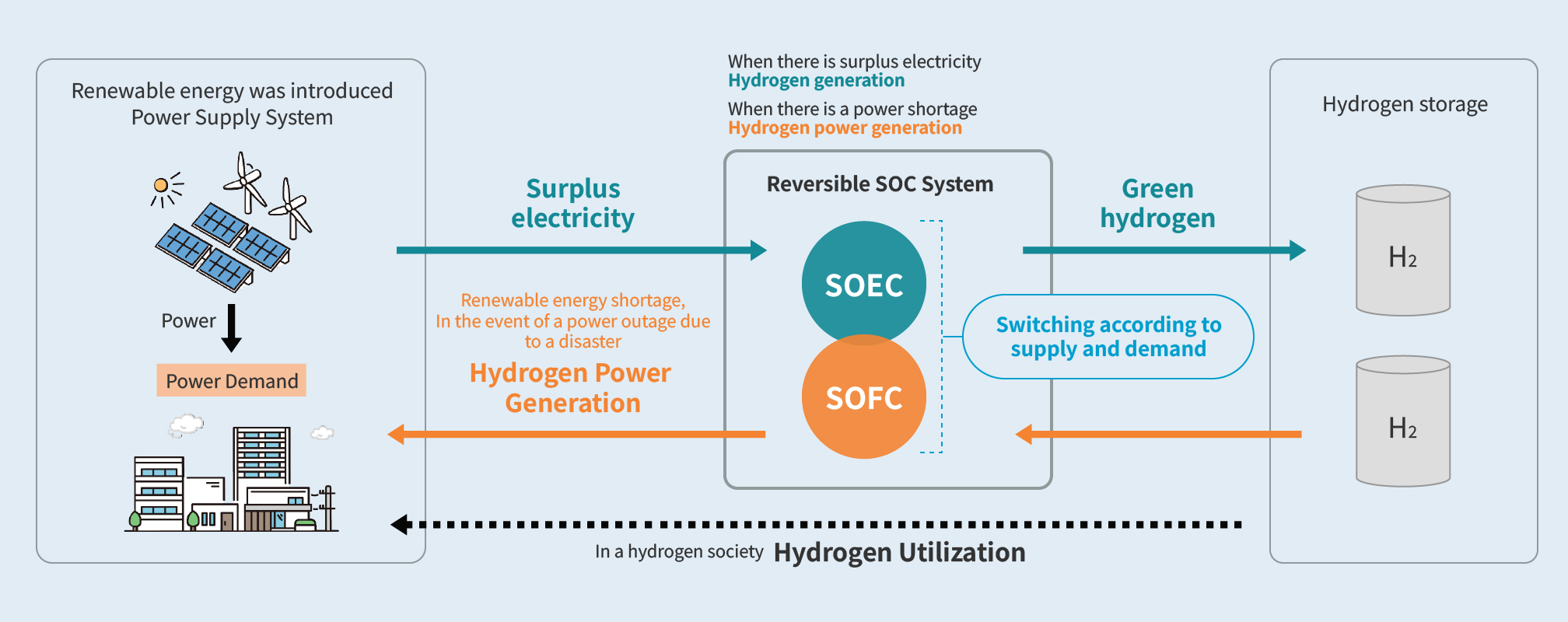
Diagram Shows rSOC Role in Grid Balancing
This diagram perfectly illustrates the grid balancing application discussed in the section, showing how rSOC technology transitions to large-scale pilots that manage power supply and demand.
(Source: www.niterragroup.com)
€105 Million in Public Funding for r SOC and Hydrogen Technologies
Public funding, led by strategic European initiatives, is the primary financial mechanism de-risking r SOC technology and bridging the gap between pilot-scale success and commercial bankability. This government-led investment is designed to absorb the high initial costs of first-of-a-kind, megawatt-scale demonstrations, thereby creating the performance and cost data needed to attract private capital.
- The European Union’s Clean Hydrogen Partnership is the most significant financial driver in the sector, allocating a total budget of €105 million in 2026 to advance cutting-edge hydrogen technologies, including solid oxide cells.
- Within this program, a specific €8 million grant was earmarked for a megawatt-scale r SOC demonstration project. This targeted funding is designed to validate performance, reliability, and economic models in a live, grid-connected environment, a critical step for commercial adoption.
- This direct, large-scale funding for demonstration contrasts with the earlier 2021-2024 period, which was characterized by smaller, research-focused grants. The shift signals a clear strategic priority to prove economic viability and accelerate the technology’s path to market.
Table: r SOC Strategic Funding and Key Demonstrations (2026)
| Partner / Project | Time Frame | Details and Strategic Purpose | Source |
|---|---|---|---|
| Clean Hydrogen Partnership (EU) | Feb 11, 2026 | An €8 million call to fund a megawatt-scale r SOC demonstration project. The objective is to validate performance, reliability, and economic viability for local grid-connected hydrogen production and power generation. | EU Funding Portal |
| Noon Energy | Jan 21, 2026 | Successful demonstration of an ultra-long-duration energy storage system capable of 100+ hours of operation. The pilot validates r SOC technology as a solution for multi-day energy storage, a key grid requirement. | ESS News |
| Gr In Hy Project | Mar 15, 2026 (validation reported) | A landmark EU-funded project that validated the world’s largest r SOC system at 150 k W. It achieved a 60% round-trip efficiency, providing the foundational data for subsequent scale-up efforts. | Science Direct |
Europe Leads r SOC Development with Coordinated Public Funding
Europe has established itself as the global leader in advancing r SOC technology by leveraging coordinated, multi-stage public funding to create an integrated research-to-demonstration pipeline. This programmatic approach ensures that foundational research systematically transitions into large-scale pilots designed to solve real-world integration challenges.
- Between 2021 and 2024, European initiatives laid the groundwork for r SOC leadership. The Gr In Hy project in Germany, a key part of this phase, delivered the critical technical validation needed to justify further investment in scaling the technology.
- From 2025 onward, this regional leadership solidified into a bloc-wide industrial strategy. The Clean Hydrogen Partnership’s 2026 funding calls institutionalized the scale-up process, inviting consortiums from across the EU to compete for funds to build the first MW-scale systems.
- While US-based companies like Noon Energy are pursuing venture-backed innovation in niche applications, the scale, structure, and strategic coordination of European public funding provide the region with a distinct advantage in pushing r SOC technology toward full commercial readiness for broad industrial and grid applications.
r SOC Technology Maturity Hinges on Durability and Cost Reduction
Reversible Solid Oxide Cell technology has successfully proven its performance potential at the pilot scale, but its progression to commercial maturity now depends entirely on solving the challenges of long-term material durability and high capital cost. The focus of the industry has shifted from proving efficiency to proving reliability and economic competitiveness against incumbent solutions.

Chart Shows Optimization for Cost and Efficiency
This chart directly addresses the section’s core topic by visualizing a method to reduce operational cost and improve efficiency, key hurdles for rSOC technology maturity.
(Source: ScienceDirect.com)
- The 2021-2024 period was dedicated to validating performance metrics. The achievement of 60% round-trip efficiency in the Gr In Hy project and lab results demonstrating 66.3% electrical efficiency in fuel cell mode confirmed the technology’s superior thermodynamic potential.
- In 2025-2026, the primary development hurdles have become economic and operational. High capital expenditure remains a significant barrier, and new MW-scale pilots are designed specifically to measure and mitigate material degradation from the thousands of thermal and chemical cycles required in a commercial lifespan.
- The operational data from these large-scale, long-term demonstrations will determine if r SOCs can move from their current pilot stage (Technology Readiness Level 6-7) to initial commercial deployment (TRL 8-9). Success will be defined by achieving cost targets and demonstrating degradation rates acceptable for 20-year project financing.
SWOT Analysis of Reversible Solid Oxide Cell (r SOC) Technology
The strategic position of r SOC technology is defined by a powerful value proposition of dual-function efficiency, which is currently counterbalanced by significant capital cost and material degradation risks. Its market opportunity is directly tied to the success of publicly-funded demonstration projects, while it faces a persistent threat from the falling costs of competing, single-function energy storage and production technologies.

Diagram Explains Reversible Solid Oxide Cell Operation
This schematic illustrates the dual-function technology that forms the basis of the SWOT analysis, providing essential context for the strengths discussed in the section.
(Source: ScienceDirect.com)
Table: SWOT Analysis for Reversible Solid Oxide Cells
| SWOT Category | Strengths | Weaknesses | Opportunities | Threats |
|---|---|---|---|---|
| Technology & Performance | High round-trip efficiency (60% demonstrated); high electrical efficiency in fuel cell mode (66.3%); ability to utilize waste heat for even higher electrolysis efficiency. | Material degradation from high-temperature cycling between oxidizing (SOFC) and reducing (SOEC) modes; high capital cost compared to mature technologies. | Integration with industrial waste heat sources (steel, cement) and nuclear plants to maximize efficiency; long-duration energy storage market (>10 hours) where Li-ion is not cost-effective. | Rapidly falling costs of dedicated PEM electrolyzers and Li-ion batteries; alternative power-to-X-to-power pathways (e.g., PEM electrolyzer + gas turbine) may become more cost-effective. |
| Market & Commercial | Unique ability to generate dual revenue streams from both electricity markets (grid services) and hydrogen sales, improving asset utilization and project economics. | Lack of commercial-scale deployments and bankable performance data for long-term operations creates investment risk; complex system integration compared to single-purpose units. | Targeted government funding (e.g., EU’s €8 M r SOC pilot); growing demand for grid flexibility and long-duration storage to support renewable energy penetration. | Policy or market shifts that favor either dedicated hydrogen production or dedicated energy storage, reducing the value of r SOC’s flexibility; slow development could allow alternative technologies to dominate the market. |
Scenario Modeling for r SOC Grid Integration and Market Adoption
The operational and economic results of the EU’s €8 million megawatt-scale r SOC demonstration project represent the single most critical variable for the technology’s future. The success or failure of this project over the next 18-24 months will directly influence the flow of private capital and determine the pace of commercial adoption.

Diagram Shows Modular Path to Scaling Systems
This schematic illustrates the modular engineering approach required to build the megawatt-scale projects that are central to the future scenario modeling discussed in this section.
(Source: Nature)
- Bull Case: If the demonstration project successfully validates reliability, achieves a round-trip efficiency above 55% at scale, and demonstrates an operational cost structure that projects a levelized cost of energy below $90/MWh, it will trigger a new wave of private investment. In this scenario, expect announcements of the first privately financed, commercial-scale r SOC projects in industrial clusters or data centers by late 2027.
- Signal to Watch: Major SOFC manufacturers, such as Bloom Energy, Ceres Power, and Doosan Fuel Cell, will accelerate their r SOC development programs or move to acquire technology from startups. An increase in patent filings related to redox-stable electrodes would be a leading indicator of progress.
- Bear Case: If the project experiences significant downtime, shows accelerated degradation rates after repeated cycling, or fails to meet its target economic benchmarks, investor confidence will erode. In this outcome, r SOCs risk being relegated to a niche technology, viable only in highly specialized applications with access to consistent, high-grade waste heat, stalling broader grid-scale adoption for another decade.
The questions your competitors are already asking
This report covers one angle of rSOC commercialization and pilot project deployment. The questions that matter most depend on your work.
- What is the status of the European Union’s megawatt-scale rSOC demonstration project since the funding was announced?
- What is the outlook for megawatt-scale rSOC deployment in grid balancing and industrial applications by 2030?
- How does rSOC’s dual-function performance compare to dedicated electrolyzer and fuel cell systems for long-duration energy storage?
- Noon Energy’s activities in long-duration rSOCs. Is its 100-hour system progressing from pilot to commercial deployment?
This report does not answer these. Enki Brief Pro does.
Your question, your angle, your framework. SWOT, PESTL, scenario modelling. The same niche depth, built around the decision your work actually depends on.
