

Doosan SOFC Strategy: 50 MW Factory, 9 MW First Order, Ceres Power Pact (2021-2026)
Doosan Fuel Cell has executed a significant strategic pivot, transitioning from a planning phase between 2021 and 2024 to full-scale commercialization of its Solid Oxide Fuel Cell (SOFC) technology starting in 2025. This shift is defined by the launch of a 50 MW annual capacity factory, a foundational technology license from Ceres Power, and the securing of its first 9 MW commercial order. The company is now actively targeting the high-demand AI data center and marine power markets, moving from R&D initiatives to tangible production and market entry.
Doosan Commercial Scale Projects Target Data Centers and Marine Power
Doosan has rapidly moved its SOFC business from early-stage pilots to commercial production, targeting high-value industrial applications to capitalize on the global demand for clean, reliable power.
- Between 2021 and 2024, Doosan’s activities were centered on foundational pilots and partnerships. This included signing an MOU with Hyundai Heavy Industries for marine systems and collaborating with SK Energy on tri-generation charging stations, which served to explore potential markets and validate technology concepts.
- The strategy shifted decisively to commercial scale in July 2025 with the commencement of mass production at its 50 MW Saemangeum factory. This marked the transition from a development-stage company to a commercial manufacturer capable of addressing industrial-scale demand.
- From 2025, Doosan has explicitly targeted the AI data center market, a sector facing a power crisis. It presented its SOFC solution at CES 2026 as a rapidly deployable and efficient energy source, positioning the technology to solve a critical, emerging infrastructure bottleneck.
- Initial commercial traction was confirmed in late 2025 with a 9 MW SOFC order as part of a larger 234.9 billion KRW domestic project in South Korea. While the order was from a related party, it represents the first deployment of its mass-produced systems.
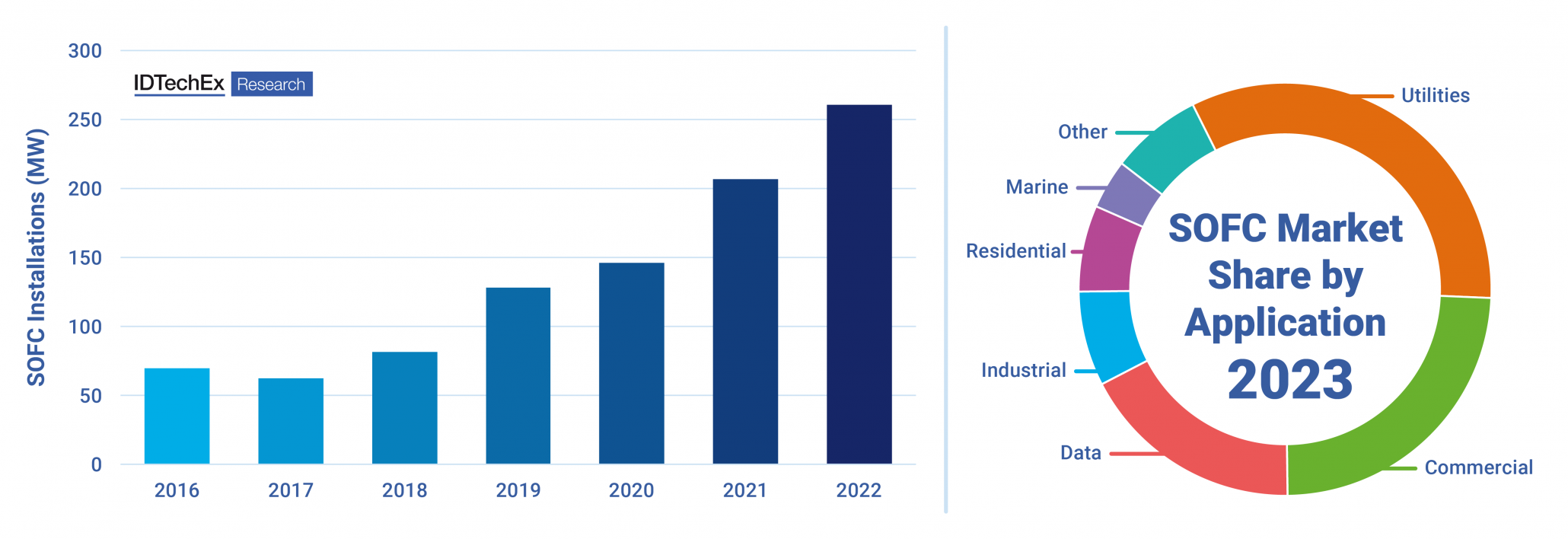
SOFCs Target Key Data and Marine Sectors
This chart highlights the key ‘Data’ and ‘Marine’ applications for SOFCs, which are the primary commercial targets for Doosan as mentioned in the section heading.
(Source: IDTechEx)
$170 Million in Doosan Capital Injections and Project Deployments
Doosan’s financial strategy has transitioned from securing foundational capital for R&D and factory construction to deploying capital through large-scale projects featuring its own SOFC technology.
- The period between 2021 and 2024 was defined by strategic capital raising to build its SOFC capabilities. A key event was the $150 million private placement completed by its U.S. subsidiary, Hy Axiom, in July 2023 to fund critical research and capital expenditures.
- In September 2023, Doosan Mobility Innovation (DMI) secured a separate ₩27 billion (approximately $20 million) investment. This funding was specifically aimed at advancing its development of SOFC technology for smaller-scale mobility applications.
- A significant internal restructuring occurred in December 2024 when DMI acquired the Doosan Fuel Cell Power Business Unit. This move consolidated its PEMFC and SOFC businesses to streamline operations and accelerate a unified market strategy.
- The financial focus shifted in 2025 from raising capital to deploying it. Doosan’s involvement as a key supplier in a domestic project valued at 234.9 billion KRW (approximately $170 million) demonstrates the company’s new role as a commercial technology provider.
Table: Doosan Key Investments and Corporate Actions (2023-2025)
| Partner / Project | Time Frame | Details and Strategic Purpose | Source |
|---|---|---|---|
| Domestic Fuel Cell Project | 2025 | Involvement as a supplier in a 234.9 B KRW (~$170 M) domestic project, deploying 9.0 MW of its new SOFC units. This marks the first commercial application of its mass-produced technology. | FN News |
| Acquisition of Doosan Fuel Cell Power BU | 2024 | Doosan Mobility Innovation acquired the Power BU to consolidate all small and medium-sized fuel cell operations (PEMFC and SOFC) under one roof, creating synergy and accelerating growth. | Fuel Cell Works |
| Doosan Mobility Innovation Investment | 2023 | Secured ₩27 Billion (~$20 M) in venture capital to fund R&D and commercialization of hydrogen mobility solutions, including its SOFC development. | Doosan Mobility Innovation |
| Hy Axiom Private Placement | 2023 | Raised $150 Million to fund capital expenditures and R&D for its U.S.-based fuel cell business, providing a significant capital runway for technology advancement. | Decarbonfuse |
Doosan Partnerships From Technology Licensing to Supply Chain Security
Doosan has methodically constructed a partnership ecosystem, evolving from foundational technology licensing and R&D MOUs between 2021 and 2024 to securing its supply chain and forming market-access consortiums from 2025 onward.
- The entire strategy is built upon the cornerstone technology licensing agreement with UK-based Ceres Power. This partnership provided Doosan with a world-class, market-ready SOFC stack technology, allowing it to bypass years of foundational R&D.
- The 2021-2024 period was characterized by exploratory, R&D-focused agreements. This included a pivotal MOU with Hyundai Heavy Industries Group in March 2021 to co-develop a megawatt-class SOFC system for the marine market.
- A clear strategic shift occurred in early 2025 to de-risk its manufacturing scale-up. The supply agreement with Alleima in January 2025 for a critical SOFC component was essential to ensure a stable supply chain ahead of the factory launch.
- Doosan’s maritime ambitions solidified in March 2026 with the formation of a formal development consortium with industry giants Shell and Korea Shipbuilding & Offshore Engineering (KSOE). This moved the initiative from a preliminary MOU to a concrete project aimed at manufacturing and supplying SOFC systems for marine vessels.
Table: Doosan Strategic SOFC Partnerships (2021-2026)
| Partner / Project | Time Frame | Details and Strategic Purpose | Source |
|---|---|---|---|
| Shell & KSOE | 2026 | Joined a development consortium to develop, manufacture, and supply low-temperature SOFC systems for marine vessels, targeting a key decarbonization market. | Riviera |
| KEPCO | 2025 | Signed a 20-year, ₩96.4 billion power purchase agreement to supply hydrogen power, marking a major entry into long-term, utility-scale contracts. | Fuel Cell Works |
| Alleima | 2025 | Secured a supply agreement for a critical component needed for mass production, stabilizing the supply chain ahead of the 50 MW factory launch. | Alleima |
| Hyundai Heavy Industries Group | 2021 | Signed an MOU for the joint development of a megawatt-class SOFC system for marine propulsion and power, leveraging Ceres Power‘s technology. | Ceres Power |
South Korea as Doosan’s Hub, with Sights on Global Marine and US Markets
Doosan’s SOFC activities are firmly anchored in South Korea, which serves as its hub for manufacturing, R&D, and initial deployments, while its strategic partnerships signal a clear intent to expand into the global maritime sector and the high-value U.S. power market.
- South Korea is the undisputed center of Doosan’s SOFC operations. It is home to the 50 MW Saemangeum factory, the first 9 MW commercial project, and key domestic partners including KSOE, Hyundai, and KEPCO, solidifying its dominant position in the national hydrogen economy.
- The United Kingdom serves as a critical technology link through the foundational partnership with Ceres Power. This collaboration provides Doosan with access to world-leading SOFC stack technology, forming the basis of its product offerings.
- The United States is a primary target for future growth. This is evidenced by the activities of its U.S. subsidiary, Hy Axiom, and a significant stock price increase in February 2026 based on market expectations of Doosan supplying power solutions to U.S. data centers.
- Doosan is pursuing a sector-based global strategy for the international maritime market. The consortium with Netherlands-based Shell to develop marine Auxiliary Power Units (APUs) is designed to create a product for a global industry, independent of any single geographic region.

US SOFC Market Represents Key Expansion Target
This chart quantifies the growing U.S. SOFC market, directly corresponding to the section’s point that Doosan has its sights set on the high-value U.S. power market for expansion.
(Source: Global Market Insights)
Doosan SOFC Technology From R&D Validation to Commercial Production
Doosan’s SOFC technology has matured rapidly from the R&D and pilot validation phase between 2021 and 2024 to commercial-scale manufacturing and initial market deployment from 2025 onwards.
- The 2021-2024 period was focused on technology development and validation. Key achievements included the creation of a low-temperature SOFC operating at 620°C for enhanced durability and a high-efficiency 10 k W SOFC unit by its mobility division.
- A crucial validation milestone was achieved in March 2024, when Doosan’s marine SOFC components passed DNV environmental testing. This was a world-first and significantly de-risked the technology for the demanding maritime sector.
- The official start of mass production in July 2025 marked the technology’s transition from prototype to a commercially available product. This move enables Doosan to compete with established players like Bloom Energy on scale and cost.
- The deployment of 30 SOFC units in a 9 MW domestic project in late 2025 represented the first real-world application of the mass-produced systems. This moved the technology from controlled testbeds to a live commercial environment, proving its readiness for market.

SOFCs Dominate Growing Stationary Power Market
As Doosan’s technology matures from R&D to commercial production, this chart shows that its SOFCs are entering the largest and fastest-growing segment of the stationary fuel cell market.
(Source: Grand View Research)
SWOT Analysis of Doosan’s SOFC Strategy
Doosan’s core strength lies in its newly established manufacturing scale and powerful partnerships, but it faces a critical weakness in its current lack of third-party sales, creating a key challenge as it pursues massive market opportunities against entrenched competitors.
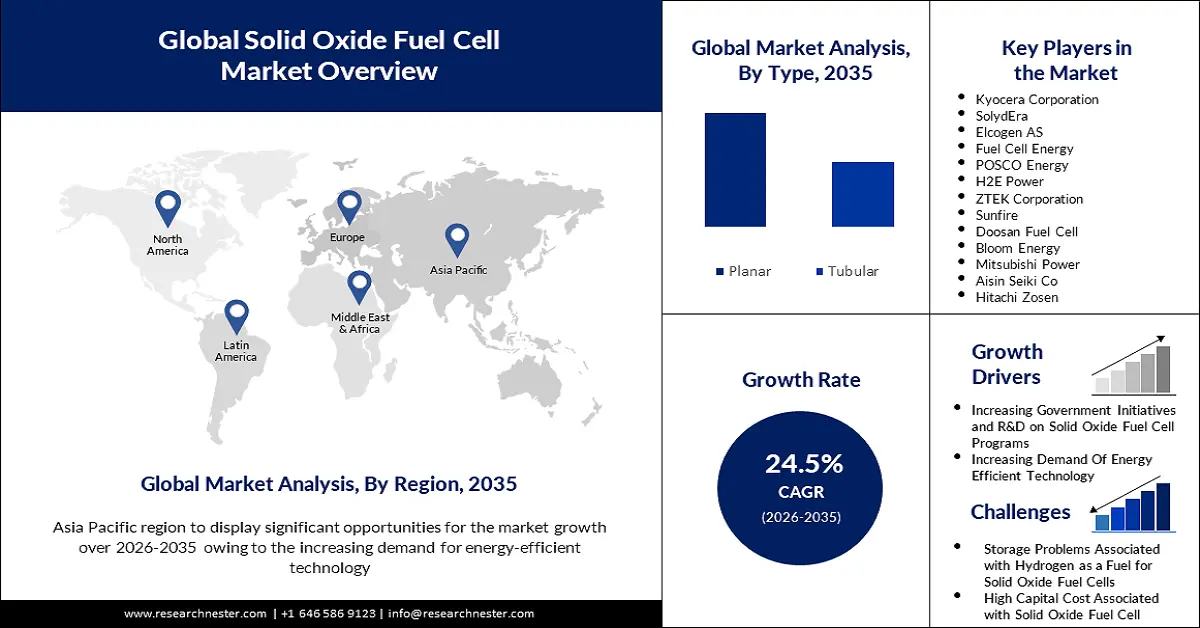
Market Growth Creates Opportunity for Key Players
This chart visualizes the significant market growth (the “Opportunity” in a SWOT analysis) and validates Doosan’s position as a “Key Player” (a core “Strength”).
(Source: Research Nester)
Table: SWOT Analysis for Doosan SOFC Business (2021-2025)
| SWOT Category | 2021 – 2024 | 2025 – 2026 | What Changed / Resolved / Validated |
|---|---|---|---|
| Strengths | Strong industrial brand (Doosan Group), established PAFC business, strategic foresight in partnering with Ceres Power. | Operational 50 MW SOFC factory, $150 M funding secured by Hy Axiom, deep partnerships with market leaders like Shell and KSOE. | The company transitioned from strategic planning to possessing tangible, scaled assets (factory) and a licensed, mature technology ready for market entry. |
| Weaknesses | No commercial SOFC product, limited track record in SOFC technology, heavy reliance on PAFC revenue. | Initial 9 MW order is from a related party, demonstrating limited third-party commercial traction to date. Reliance on a single core technology licensor (Ceres). | The primary weakness shifted from a lack of an SOFC product to a lack of a diversified, external customer base for that new product. |
| Opportunities | Growing global demand for clean hydrogen, emerging maritime regulations (IMO), government support for hydrogen in South Korea. | Explosive growth in energy demand from AI data centers, multi-billion dollar SOFC market forecasts, potential to supply U.S. data centers. | The market opportunity became more specific and urgent (e.g., the AI power crisis), moving from a general decarbonization trend to a pressing, high-value need. |
| Threats | Intense competition from established SOFC players (e.g., Bloom Energy), high material and manufacturing costs for SOFCs. | Competitors are signing large-scale offtake agreements, and increased public market scrutiny, including a short-seller report targeting the Ceres partnership. | The competitive and financial risks have intensified as Doosan enters the commercial market, moving from theoretical competition to direct commercial battles. |
Doosan’s 2026 Outlook: Converting Production into Third-Party Orders
The most critical determinant of Doosan’s success in the year ahead will be its ability to translate its 50 MW manufacturing capacity into a significant and diversified order book from third-party, non-affiliated customers.
- The key metric to watch is the announcement of new commercial orders, particularly from the AI data center sector and international markets. This will be the ultimate validation of market acceptance beyond the initial 9 MW domestic project.
- Tangible progress from the maritime consortium with Shell and KSOE, such as a firm order for a pilot vessel installation, is necessary to unlock what could become a primary revenue stream for Doosan’s SOFC business.
- Future financial reports will provide the clearest measure of commercial traction. Investors will be closely watching for declared revenue from the new SOFC division and the corresponding royalty payments to Ceres.
- Market sentiment, reflected in analyst ratings and stock performance, will serve as a real-time indicator of confidence in Doosan’s strategy. The positive market reaction in early 2026 to potential U.S. data center contracts highlights the high stakes of its execution in this target market.

SOFC Market Opportunity to Skyrocket to $29.6B
This forecast visualizes the massive market potential at stake, providing essential context for the 2026 outlook section, which focuses on Doosan’s need to capture third-party orders.
(Source: Market Research Future)
Frequently Asked Questions
What are the main markets Doosan is targeting with its SOFC technology?
Doosan is primarily targeting two high-demand sectors: the AI data center market, which faces a power crisis, and the global marine power market, for which it has formed a consortium with Shell and KSOE to develop Auxiliary Power Units (APUs).
How did Doosan manage to start mass production of SOFCs so quickly?
Doosan accelerated its entry into the market by licensing world-class, market-ready SOFC stack technology from the UK-based company Ceres Power. This allowed Doosan to bypass years of foundational R&D and move directly to building its 50 MW factory and starting commercial production.
What was Doosan’s first commercial order for its new SOFC factory?
Doosan’s first commercial order was for 9 MW of its mass-produced SOFC units. This order, received in late 2025, was part of a larger 234.9 billion KRW domestic project in South Korea from a related party.
Who are Doosan’s key partners in its SOFC strategy and what are their roles?
Doosan’s key partners include: Ceres Power (the foundational technology licensor for its SOFC stacks), Shell and KSOE (consortium partners for developing marine SOFC systems), and Alleima (a critical component supplier ensuring a stable supply chain for the 50 MW factory).
According to the SWOT analysis, what is the biggest challenge for Doosan’s SOFC business?
The biggest challenge is its limited third-party commercial traction. Although the 50 MW factory is operational, its first 9 MW order was from a related party. The company’s next critical step is to secure significant orders from non-affiliated, external customers to validate its market acceptance and compete against established players.
