

Middle East Green Hydrogen Constraints, $642 B Pipeline, 15 GW Saudi Grid Demand, and Transformer Shortages (2021-2026)
Grid Constraints: Middle East $642 B Clean Energy Pipeline Faces Delays
The Middle East’s multi-hundred-billion-dollar clean energy expansion, driven by sovereign capital, is colliding with physical infrastructure limitations, creating significant execution risks. Despite financial commitments that bypass global interest rate volatility, ambitious timelines for giga-projects are now constrained by insufficient grid capacity, long lead times for critical components like transformers, and supply chain disruptions. This friction between capital deployment and on-the-ground reality defines the primary challenge for the region’s energy transition in 2026.
- Between 2021 and 2024, Gulf Cooperation Council (GCC) nations focused on announcing ambitious national targets and a pipeline of projects valued at $642 billion. The emphasis was on capital allocation and achieving record-low Levelized Costs of Energy (LCOE) for solar.
- From 2025 onward, the focus has shifted to execution, revealing significant bottlenecks. The World Energy Council highlights shortages of transformers and extended lead times for grid infrastructure as primary constraints that threaten project timelines across the region.
- The surge in electricity demand from new industries, particularly AI and data centers, is intensifying pressure on an already strained grid. Global electricity demand is forecast to grow over 3.5% annually, with the Middle East’s data center capacity alone projected to more than double by 2028.
- Geopolitical instability adds another layer of risk, disrupting supply chains for essential materials. The ongoing conflict has impacted the availability of materials like urea, a component in emissions control for conventional power plants and a feedstock for some chemical processes, underscoring the fragility of regional supply lines.
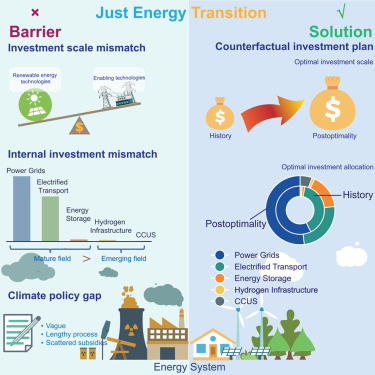
Infographic Details Mismatch in Energy Transition Investment
This infographic aligns with the section’s theme of grid constraints by illustrating the mismatch in energy transition investment, which often manifests as a gap between generation and grid capacity.
(Source: ScienceDirect.com)
Investment Analysis: $43 B in Financed Projects as Sovereign Funds Press Forward
Despite emerging infrastructure bottlenecks, sovereign capital deployment into clean energy remains robust, signaling a long-term strategic commitment that outweighs short-term execution hurdles. As of July 2026, $43 billion worth of projects have secured financing, a fraction of the total $642 billion pipeline but a clear indicator of sustained momentum. This state-led investment insulates the region’s core energy strategy from conventional market pressures and reinforces its goal of becoming a global clean energy hub.
- Saudi Arabia’s $925 billion Public Investment Fund (PIF) approved its 2026-2030 strategy, which formalizes its focus on deploying capital into the domestic economy, with clean energy as a primary pillar of its industrial policy.
- The Middle East is the only global region forecast to increase energy capital expenditure in 2026, with a projected rise of 5.0%, directly contrasting with trends in other markets that are more sensitive to interest rates and economic uncertainty.
- Investment is also flowing into distributed generation. In July 2026, Positive Zero, a decentralized energy company, secured a $375 million financing facility to expand its portfolio of distributed solar, energy efficiency, and clean mobility projects across the GCC.
- Financing is extending beyond solar and wind to include critical grid-stabilizing assets. The World Bank approved a $265 million loan for a pumped hydropower storage project in Morocco, highlighting the growing recognition of the need for energy storage to support variable renewables.

Financing Costs Dominate Renewable Energy Economics
This chart supports the section’s focus on investment analysis by detailing the significant role of financing costs in the economics of financed projects.
(Source: Nature)
Table: Major Clean Energy Investments in the Middle East (2026)
| Entity / Project | Time Frame | Details and Strategic Purpose | Source |
|---|---|---|---|
| Positive Zero | Jul 2026 | Secured a $375 million financing facility to expand distributed solar and energy efficiency projects across the GCC, bypassing utility-scale grid constraints. | Bizscoop MENA |
| Saudi Arabia (NREP) | Jul 2026 | Signed agreements for seven large-scale projects under the National Renewable Energy Programme, targeting 15 GW of new solar and wind capacity. | Megaproject |
| World Bank / Morocco | Jul 2026 | The World Bank approved $265 million in financing for a pumped hydropower storage facility in Morocco to enhance grid stability and integrate more renewables. | Zawya |
| Public Investment Fund (PIF) | Apr 2026 | Saudi Arabia’s $925 billion sovereign fund approved its 2026-2030 strategy, prioritizing domestic investment in key sectors including clean energy. | Reuters |
Geography: Saudi Arabia vs. UAE National Ambitions
Saudi Arabia and the UAE are the clear epicenters of the region’s clean energy push, but analysis of their 2026 progress reveals a growing divergence between stated national ambitions and the practical pace of implementation. While both nations leverage sovereign wealth to drive development, Saudi Arabia faces a steeper climb to meet its aggressive 2030 targets, underscoring the severity of its execution and infrastructure challenges compared to the UAE’s more incremental expansion.
- In the 2021-2024 period, Saudi Arabia established one of the world’s most ambitious goals: generating 50% of its electricity from renewables by 2030, which requires developing 130 GW of capacity.
- However, a February 2026 analysis from Wood Mackenzie highlights a significant execution gap, projecting the kingdom will only reach 20% clean power by 2030 under its base-case scenario, falling far short of the 50% target.
- The UAE has demonstrated more consistent progress, reporting an installed renewable capacity of over 7.7 GW as of April 2026. Its state-backed entity, Masdar, continues to expand its project portfolio both domestically and internationally.
- In a bid to accelerate its timeline, Saudi Arabia signed deals in July 2026 for 15 GW of new solar and wind projects, a move designed to close the gap between its ambitious targets and its current trajectory.

UAE & Saudi Arabia Lead GCC Investment into Africa
This chart directly compares the investment activities of Saudi Arabia and the UAE, aligning with the section’s geographical and competitive focus.
(Source: Clean Air Task Force)
Technology Maturity: Solar and Wind Foundation With Nascent Bets
The Middle East’s transition strategy is built on a foundation of commercially mature solar and wind technologies, but its long-term vision for global energy leadership rests on scaling more nascent sectors like green hydrogen and Carbon Capture, Utilization, and Storage (CCUS). While mature technologies like solar PV (photovoltaics) and the HEFA process for Sustainable Aviation Fuel (SAF) provide immediate, bankable pathways for decarbonization, the region’s sovereign funds are simultaneously channeling capital into less mature technologies to build future competitive advantages.
- From 2021 to 2024, the primary technological focus was on leveraging mature utility-scale solar PV to achieve world-record low costs, with LCOE figures dropping as low as $0.02/k Wh in the region.
- In 2025-2026, the strategy has broadened. PEM electrolyzers for green hydrogen production are commercially ready at a Technology Readiness Level (TRL) of 8–9. However, scaling production is dependent on the massive build-out of renewable generation, which is subject to the grid bottlenecks previously identified.
- Investment is also targeting the decarbonization of hard-to-abate sectors. The region’s CCUS capacity is projected to grow at a CAGR of 32% between 2026 and 2030. This is crucial for industries like steel and cement, but the underlying technologies, such as Direct Air Capture (DAC), are less mature at a TRL of 6–7.
- The Hydroprocessed Esters and Fatty Acids (HEFA) pathway for SAF production is at a TRL of 8–9, representing the most commercially viable route for aviation decarbonization today and a key area for future export-oriented production.

Global Energy Capital Costs Compared
This chart supports the section’s theme of technology maturity by providing a comparison of capital costs across different energy sources, including foundational solar and wind.
(Source: Nature)
SWOT Analysis: Middle East Sovereign Capital vs. Execution Risks
The Middle East’s clean energy strategy is defined by a powerful combination of financial strength and natural resources, creating a clear opportunity for global leadership. However, this potential is tempered by significant internal weaknesses related to infrastructure and external threats from geopolitical instability. The core tension is whether the region’s immense sovereign wealth can overcome the physical and political barriers to execution.

Chart Details Risks Inflating Clean Energy Costs
This chart illustrates the execution risks mentioned in the SWOT analysis by detailing various factors that can inflate clean energy project costs.
(Source: IEA)
Table: SWOT Analysis for Middle East Clean Energy Execution
| SWOT Category | 2021 – 2024 | 2025 – 2026 | What Changed / Validated |
|---|---|---|---|
| Strengths | Massive sovereign wealth funds (e.g., PIF, Mubadala) and ambitious national visions (e.g., Saudi Vision 2030) were announced, signaling intent. | SWFs are actively deploying capital ($43 B financed) and achieving record-low LCOE ($0.02/k Wh for solar), confirming financial power. The PIF’s 2026-2030 strategy solidifies clean energy as a core focus. | The strength shifted from stated ambition to demonstrated financial commitment, proving the model is insulated from external interest rate pressures. |
| Weaknesses | The scale of announced projects and targets appeared difficult to achieve, but physical constraints were not yet the primary focus. | An execution gap is now evident (KSA projected to hit 20% renewables vs. 50% target). Grid limitations and transformer shortages are identified as critical bottlenecks. | The weakness has been validated as a physical constraint, moving from a theoretical planning challenge to a real-world project delay risk. |
| Opportunities | The goal was to diversify economies away from oil and capture a share of the future clean energy market. | Surging electricity demand from AI and data centers creates a massive, guaranteed domestic offtake market. Leadership in green hydrogen production for export becomes more viable. | The opportunity has become more specific and urgent, driven by the unexpected acceleration of domestic power demand from the technology sector. |
| Threats | Geopolitical tensions were a persistent background risk. Supply chain issues were seen as a global, post-pandemic problem. | Regional conflict directly threatens key trade routes (Strait of Hormuz) and disrupts supply chains for specific materials. Infrastructure bottlenecks are now a primary threat to project timelines. | Threats have intensified and become more localized. Geopolitical risk is no longer abstract but a direct factor reshaping investment and supply chain logistics. |
Scenario Modelling: Saudi PIF Grid Investment vs. Project Delays
The most critical variable for the Middle East’s clean energy success in the next 12 to 18 months is its ability to accelerate grid modernization and resolve supply chain bottlenecks for key electrical components. The pace of investment in transmission infrastructure, substations, and transformers will directly determine whether the region’s giga-project pipeline can move from financial commitment to commercial operation without significant delays.
- If this happens: Watch for major announcements from entities like the Saudi PIF or the UAE’s investment arms (Mubadala, ADQ) earmarking multi-billion dollar funds specifically for grid modernization, domestic manufacturing of transformers, or strategic partnerships with global equipment suppliers.
- Watch this: A key signal will be a shift in public tender documents for renewable projects to include integrated grid connection solutions or direct investment stipulations for transmission upgrades. The financial close of new projects will be a lagging indicator of confidence in grid readiness.
- These could be happening: If grid investment lags, expect a slowdown in new utility-scale project announcements and a strategic pivot toward smaller, distributed energy projects that are less dependent on high-voltage transmission. The $375 million financing for Positive Zero could be an early indicator of this trend, as capital seeks to bypass systemic bottlenecks.

Global Interest Rates Shift to ‘Higher-for-Longer’ Era
This chart provides crucial macroeconomic context for the scenario modelling by highlighting the ‘higher-for-longer’ interest rate environment, which impacts investment decisions and project delay costs.
(Source: Wood Mackenzie)
The questions your competitors are already asking
This report covers one angle of clean energy project execution risk in the Middle East. The questions that matter most depend on your work.
- Companies manufacturing transformers for the Middle East
- Saudi Arabia grid modernization investment plans
- Distributed solar projects in the GCC
- UAE grid capacity expansion projects
This report does not answer these. Enki Brief Pro does.
Your question, your angle, your framework. SWOT, PESTL, scenario modelling. The same niche depth, built around the decision your work actually depends on.
