

Total Energies Offshore Wind Cancellations, ~$1 B US Deal, $2.2 B Masdar JV, and 5 Project Pivots (2025 to 2026)
Offshore Wind Risk, Total Energies Cancels 4 GW US Projects
Total Energies has executed a significant strategic shift in its clean energy portfolio, de-risking its investments by exiting the politically sensitive U.S. offshore wind market and reallocating capital toward more predictable, faster-return projects like utility-scale solar and battery storage. This move signals a pivot from pursuing growth in capital-intensive, high-risk sectors to a more disciplined financial strategy focused on proven technologies and stable regulatory environments.
- In March 2026, Total Energies finalized a deal with the U.S. government to cancel its offshore wind leases for nearly $1 billion, a stark reversal from its earlier strategy of acquiring these leases to build a significant U.S. presence. This decision was driven by political uncertainty and unfavorable market conditions that materialized after 2024.
- Capital freed from the U.S. wind exit is being redeployed. The company is advancing projects like a 440 MWp solar facility in the Philippines, which secured $300 million in financing in May 2026, and is heavily investing in battery storage, including a 789 MW portfolio in France and an 800 MW portfolio in Germany.
- The company further streamlined its portfolio by divesting smaller, less scalable assets. In July 2026, it sold its 170 MW distributed solar portfolio in Europe to refocus on utility-scale projects that offer better economies of scale.
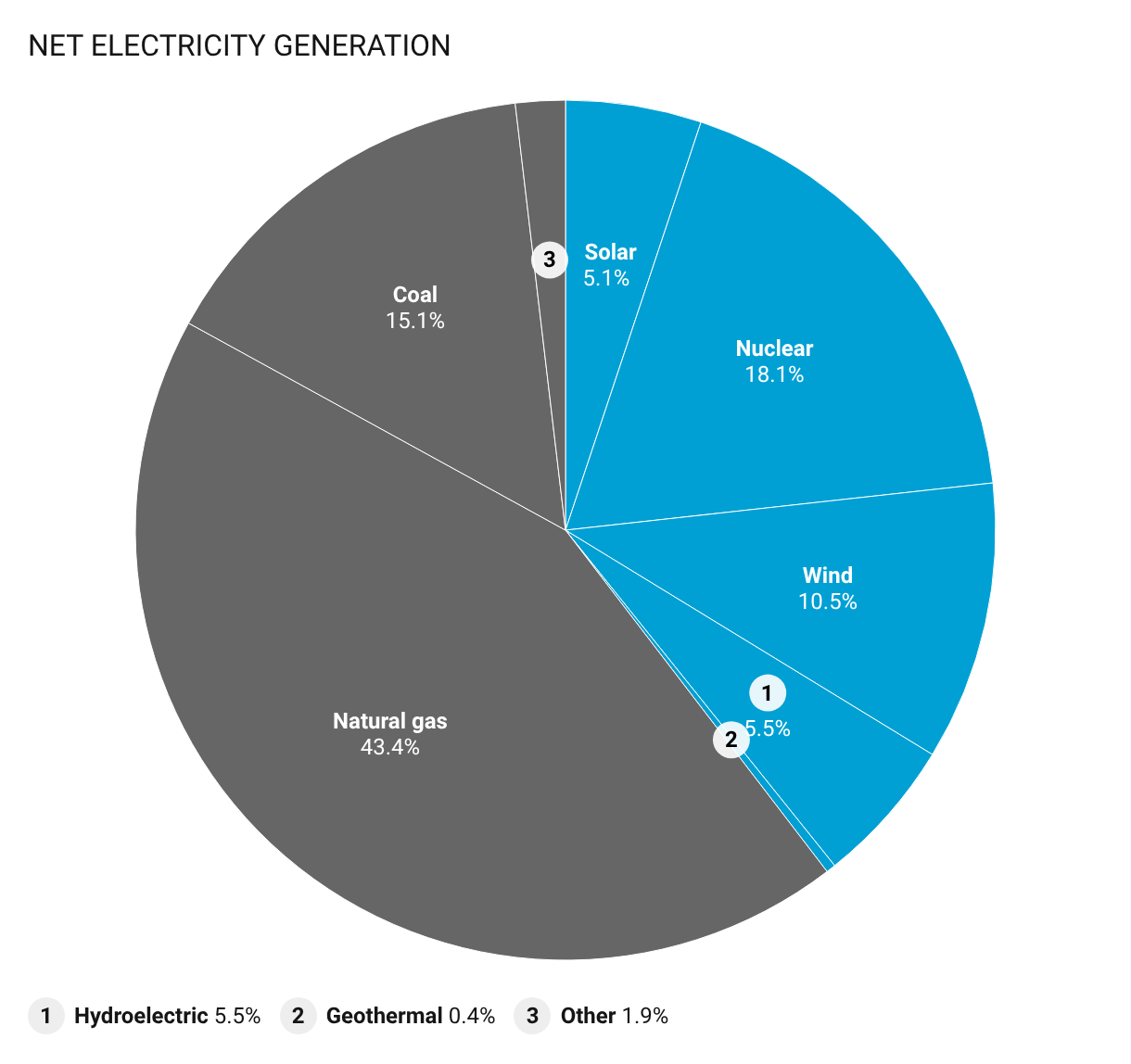
Natural Gas Dominates US Electricity Generation
This chart offers crucial context for the section, which details the cancellation of US offshore wind projects. The dominance of natural gas in the US electricity market illustrates the competitive headwinds and inherent risks for renewable energy projects, justifying the ‘risk’ mentioned in the section heading.
(Source: Center for American Progress)
$1 B Cancellation, Total Energies Reallocates US Offshore Wind Capital
The most defining financial action from Total Energies between 2025 and 2026 was not a new investment but a strategic cancellation that unlocked nearly $1 billion in capital, demonstrating a pragmatic approach to portfolio management over ideological commitment to specific renewable technologies. This disciplined reallocation contrasts with a broader trend of divestments aimed at optimizing the company’s asset base for higher returns.
- The cornerstone event was the March 2026 agreement with the U.S. Department of the Interior to terminate its 4 GW offshore wind projects. The deal allowed Total Energies to recover its lease fees, which were then mandated for reinvestment into its U.S. Gas & Power activities, effectively transforming a project stall into a strategic capital pivot.
- This was part of a larger pattern of de-risking. In May 2026, the company announced it would cease development of offshore wind in Germany, citing unfavorable conditions.
- Portfolio optimization also involved strategic sales to raise capital. In December 2025, Total Energies sold a 50% stake in its 424 MW Greek renewables portfolio, and in May 2026, it revealed plans to sell a stake in a 1.2 GW portfolio of solar and wind farms across Europe.

Global Energy Investment to Reach $3.3T in 2025
The chart provides macro-level context for the capital reallocation discussed in the section. Total Energies’ specific $1B reallocation is framed against the massive $3.3T global energy investment, underscoring the scale of capital movement within the transitioning energy sector.
(Source: bne IntelliNews)
Table: Total Energies Strategic Divestments and Cancellations
| Asset / Project | Time Frame | Details and Strategic Purpose | Source |
|---|---|---|---|
| European Distributed Solar Portfolio | Jul 2026 | Sold a 170 MW portfolio to Amarenco and AMPYR to refocus capital and operational efforts on larger, utility-scale projects with stronger returns. | Energy News.pro |
| U.S. Offshore Wind Leases | Mar 2026 | Canceled leases for 4 GW of projects in New York and the Carolinas. Recovered nearly $1 billion in a settlement with the U.S. government, with funds to be reinvested into U.S. Gas & Power. | Business Wire |
| German Offshore Wind Development | May 2026 | Ceased development activities as part of a strategic pullback from high-risk offshore wind markets in Europe facing unfavorable conditions. | Business Chief |
| Greek Renewables Portfolio | Dec 2025 | Sold a 50% stake in a 424 MW portfolio of wind and solar assets to Asterion Industrial Partners as part of a global savings and portfolio management strategy. | WFW |
Total Energies $2.2 B Masdar JV, RWE Hydrogen Deal (2025 to 2026)
To reduce capital expenditure and mitigate market entry risks, Total Energies has intensified its use of large-scale joint ventures and long-term offtake agreements. This partnership-led strategy allows the company to scale its presence in key growth markets and emerging technologies without bearing the full financial burden, as demonstrated by major deals in Asia and with European energy partners.
- In April 2026, Total Energies and Masdar signed a landmark agreement to form a $2.2 billion, 50/50 joint venture. This entity will merge their onshore renewable activities in Asia, targeting a portfolio of 3 GW of operational assets and 6 GW in development.
- To de-risk its green hydrogen strategy, the company signed a long-term offtake agreement with RWE in March 2025. This deal secures 30, 000 metric tons of green hydrogen per year for its Leuna refinery, allowing it to decarbonize operations without direct investment in high-capex production facilities.
- The company is also using partnerships to scale its battery storage business. In April 2026, it sold a 50% stake in an 800 MW German BESS portfolio to Allianz Global Investors, forming a joint venture to finance and construct the projects.
- Corporate Power Purchase Agreements (PPAs) remain a key tool for securing long-term revenue. In February 2026, Total Energies announced an agreement to provide Google with 1 GW of solar capacity to power its data centers.
Table: Total Energies Strategic Partnerships
| Partner / Project | Time Frame | Details and Strategic Purpose | Source |
|---|---|---|---|
| Masdar | Apr 2026 | Formation of a $2.2 billion joint venture to merge and accelerate onshore wind and solar development in nine Asian countries, leveraging regional expertise and shared capital. | Business Wire |
| Allianz Global Investors | Apr 2026 | Sold a 50% stake in an 800 MW German BESS portfolio to form a joint venture, sharing the financial and operational load for developing critical grid stability assets. | POWER Magazine |
| Nextnorth | May 2026 | Reached financial close on a 440 MW solar project in the Philippines, demonstrating a successful partnership model for developing large-scale renewables in Southeast Asia. | ESG News |
| RWE | Mar 2025 | Signed a long-term offtake agreement for 30, 000 metric tons/year of green hydrogen, securing supply for refinery decarbonization without direct production investment. | RWE |
US vs. Asia, Total Energies Pivots Renewables Investment
The geographic focus of Total Energies’ clean energy investments has markedly shifted between 2025 and 2026, with a deliberate withdrawal from the politically volatile U.S. offshore wind market and a concurrent acceleration of investment in Asia and select European nations with more stable regulatory frameworks. This pivot prioritizes regions where utility-scale solar and storage projects can be developed with greater certainty.
- The most significant geographic retreat was from the United States. After acquiring offshore wind leases in New York and the Carolinas prior to 2025, the company completely exited this market in 2026, citing political headwinds and unfavorable market conditions.
- Conversely, Asia has emerged as a primary growth engine, underscored by the $2.2 billion joint venture with Masdar in April 2026. This partnership serves as the exclusive vehicle for developing onshore wind and solar projects across nine countries, consolidating the company’s regional ambitions.
- Europe remains a core market but with a more selective focus. The company is advancing projects in countries with strong fundamentals, such as the inauguration of its largest European solar cluster in Spain in May 2025 and significant BESS investments in Germany and France in 2026.
BESS Commercialization, Total Energies Finances 1.6 GW
Total Energies’ recent financing activities confirm the commercial maturity and scalability of utility-scale solar and battery energy storage systems (BESS), which now form the core of its progressing clean energy projects. In contrast, the company’s pullback from direct investment in U.S. offshore wind and its offtake-focused hydrogen strategy suggest these technologies are still considered to carry higher financial and execution risks.
- From 2025 to 2026, the company shifted from a broad portfolio strategy that included early-stage, capital-intensive technologies to focusing on commercially proven ones. Solar projects are consistently reaching financial close and commissioning, including a major cluster in Spain (515 GWh/year) and a 440 MW project in the Philippines.
- BESS has transitioned from a niche technology to a central pillar of the company’s Integrated Power strategy. In 2026 alone, Total Energies secured financing for or partnered on nearly 1.6 GW of battery projects in France (789 MW) and Germany (800 MW).
- The company’s approach to green hydrogen remains cautious and commercially driven. Instead of large-scale production investments, it is securing supply via offtake agreements, as seen in the RWE deal, to decarbonize its own industrial processes first.
SWOT Analysis, Total Energies Clean Energy De-risking Strategy
The strategic actions of Total Energies between 2025 and 2026 reveal a company leveraging its financial strength to execute a disciplined pivot toward lower-risk, integrated power projects. However, this pragmatic de-risking strategy creates an opportunity cost by reducing exposure to potentially high-growth sectors like offshore wind and exposes the company’s transition plan to the reliability of its chosen partners and markets.
Table: SWOT Analysis for Total Energies Clean Energy Financing
| SWOT Category | 2021 – 2024 | 2025 – 2026 | What Changed / Validated |
|---|---|---|---|
| Strength | Diversified portfolio across multiple renewable technologies, including capital-intensive offshore wind. | Demonstrated financial discipline by cutting losses on high-risk projects and reallocating capital to assets with faster, more certain returns (solar, BESS, LNG). | The company validated its ability to make difficult capital allocation decisions, prioritizing shareholder returns and its integrated model over growth at any cost. |
| Weakness | Increasing exposure to long-cycle, high-capex projects like U.S. offshore wind, which were vulnerable to policy shifts. | Reduced exposure to the offshore wind sector, a major long-term growth driver for the energy transition, ceding ground to competitors. | The strategy’s reliance on political stability was proven to be a weakness, forcing a costly and high-profile exit from the U.S. offshore wind market. |
| Opportunity | Expansion into new geographic markets and technologies to build a 100 GW renewable portfolio by 2030. | Forging large-scale JVs (Masdar) to enter growth markets with shared risk. Focusing on high-demand, mature technologies like BESS and solar. | The company validated that partnerships and a focus on commercially mature technologies provide a more resilient path to profitable growth than speculative, unilateral investments. |
| Threat | Political and regulatory risk was a known but abstract factor in investment models. | Political risk became a tangible, multi-billion-dollar threat, directly causing the cancellation of the U.S. offshore wind portfolio and a strategic reassessment. | The threat of sudden, adverse policy changes in key markets was validated, forcing the company to pivot its geographic and technological focus toward more stable environments. |
Scenario Modelling, Total Energies BESS and Solar Growth
The primary signal for 2026-2027 is that Total Energies will continue to prioritize and accelerate investments in utility-scale solar and BESS projects, particularly through joint ventures, while avoiding large, unilateral commitments to capital-intensive technologies in politically unstable regions. Its progress toward the 100 GW by 2030 target will increasingly depend on the success of its partnership-led model.
- If geopolitical tensions ease and U.S. federal policy for offshore wind becomes more favorable and stable, watch for Total Energies to potentially re-enter the market, but likely through strategic partnerships rather than direct lease ownership to mitigate risk.
- The performance of the Masdar joint venture will be the central indicator of the company’s growth in Asia. Watch for announcements of new final investment decisions (FIDs) for large-scale solar or wind projects under this vehicle.
- Expect further portfolio optimization through the divestment of smaller or non-core renewable assets in Europe, with the proceeds recycled into larger, more strategic solar and BESS developments that align with the company’s integrated power model.

Renewables’ Net Income Growth to Dwarf Oil Majors
The chart provides the financial incentive and primary driver for the topic of the section. The projection that renewables’ net income will grow significantly justifies why a company like Total Energies would be conducting scenario modeling for BESS and solar growth.
(Source: LinkedIn)
The questions your competitors are already asking
This report covers one angle of Total Energies’ strategic de-risking in renewables. The questions that matter most depend on your work.
- Who is building US offshore wind projects now
- Total Energies Masdar joint venture projects Asia
- Shell BP renewable energy strategy comparison
- European utility scale battery storage market size
This report does not answer these. Enki Brief Pro does.
Your question, your angle, your framework. SWOT, PESTL, scenario modelling. The same niche depth, built around the decision your work actually depends on.
