

Space X IPO, $75 B Raised, $1.75 T Valuation, and 3 Mega-Listings Reshaping Markets (2025-2026)
Market Absorption Risks, Space X and Mega-IPOs Test Liquidity with $4 T in New Stock
The primary risk for capital markets is not the quality of the new companies entering, but the system’s capacity to absorb nearly $4 trillion of new equity from Space X, Open AI, and Anthropic. This influx of stock fundamentally tests market liquidity and ends the “stock scarcity” environment that defined the investment landscape for the previous decade.
- Before 2025, investment capital seeking high-growth technology exposure was concentrated in a small number of mega-cap stocks, namely the FAANG cohort. The 2026 market structure forces a massive reallocation, as investors must sell existing assets to fund purchases of the new, multi-trillion-dollar entities.
- This wave of listings creates a “liquidity drain” effect, with analysts warning that the combined capital demand could surpass $240 billion by the end of 2026. This level of capital absorption will likely pressure valuations of incumbent technology companies and draw investment away from other asset classes.
- The IPOs introduce significant structural risks, exemplified by Space X’s sub-5% public float. This model, designed to maintain insider control, creates extreme volatility and poses a challenge for index funds, which are forced to build large positions from a very limited supply of available shares.
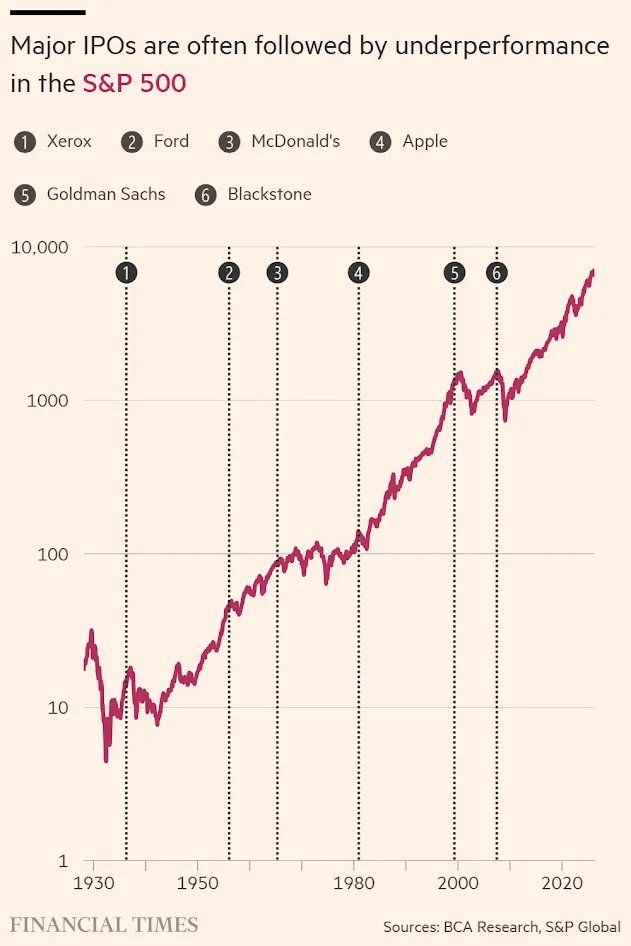
Major IPOs Historically Precede S&P 500 Underperformance
The section discusses market absorption risks from mega-IPOs. The chart provides historical evidence that large IPO waves are often followed by broader market underperformance, directly illustrating the systemic risk mentioned in the section.
(Source: LinkedIn)
$75 B Raised, Space X IPO Sets New Record for Capital Markets
The Space X IPO was the single largest capital raise in history, anchoring a wave of mega-listings that marks a definitive shift of value from private secondary markets to the public domain. This event solidifies a new valuation paradigm for foundational, capital-intensive technology companies.
- On June 12, 2026, Space X raised $75 billion at a $1.75 trillion valuation in its public debut, an amount that exceeds the previous $29.4 billion record set by Saudi Aramco and establishes a new benchmark for capital formation.
- This public valuation was validated by a frenetic private secondary market, where demand for Space X shares drove its valuation from $800 billion in December 2025 to nearly $1.8 trillion in a pre-IPO sale in June 2026, confirming immense pent-up investor appetite.
- The market’s capacity will be further tested by upcoming listings from Open AI, which is targeting an $852 billion valuation after a $122 billion funding round, and Anthropic, which is expected to debut at around $1 trillion. The scale of these offerings reflects the massive capital required to build out AI infrastructure, a challenge also being addressed by companies like Microsoft through novel energy procurement strategies.

Private Valuations Dwarf Historical IPO Records
The section highlights the record-breaking capital raised by the SpaceX IPO. The chart explains the underlying driver for such records: the unprecedented scale of private market valuations that precede these public offerings.
(Source: LinkedIn)
Table: 2026 Mega-IPO Capital and Valuation
| Company | IPO Date | Valuation at IPO (USD) | Capital Raised (USD) | Source |
|---|---|---|---|---|
| Space X | Jun 12, 2026 | $1.75 Trillion | $75 Billion | Ketodietapp |
| Open AI | 2026 (Target) | $852 Billion (Target) | Not specified | IPO Club |
| Anthropic | Oct 2026 (Target) | $1 Trillion (Target) | Not specified | Blo Fin |
| Saudi Aramco (for comparison) | Dec 2019 | $1.7 Trillion | $29.4 Billion | Big Go Finance |

Chart Highlights SpaceX IPO with $4B Revenue
The section is a table on mega-IPO capital and valuation. This chart provides a specific visual example for the table’s subject, SpaceX, by linking its IPO to a key fundamental metric (revenue) used in valuation.
(Source: TradingView)
US Markets, Space X and AI Giants Concentrate Value Before Global Distribution
The 2026 mega-IPOs represent a massive concentration of capital within U.S. public markets, reinforcing the Nasdaq’s position as the primary venue for foundational technology companies and creating new structural complexities for global investors and index providers.
- Before 2025, global institutional investors gained exposure to these unicorns through U.S.-centric and opaque private secondary markets. The 2026 listings on Nasdaq formalize this concentration, establishing U.S. exchanges as the definitive gateway for direct public investment in this new class of technology leader.
- The unique structure of these IPOs creates a significant challenge for global index providers. The S&P 500’s decision to reject Space X for inclusion due to its low float and other governance factors signals a growing divergence between the realities of U.S. capital markets and the established rules of global indexing.
- This trend is supported by a favorable U.S. regulatory environment. The Securities and Exchange Commission’s proposed reforms in May 2026, aimed at reducing the disclosure and compliance burdens for public companies, are designed to make domestic listings more attractive and retain high-growth companies within U.S. markets.

Valuation Concerns Trigger 2026 Tech Selloff
The section describes how value is concentrated in a few US tech giants. The chart shows a direct consequence of this concentration: a tech sector selloff triggered by concerns over high valuations, a risk amplified by market concentration.
(Source: Bloomberg.com)
Space X & Open AI Valuation Model, A Shift to Capital-Intensive Infrastructure (2026)
The valuation models underpinning the Space X and Open AI IPOs signal a market maturation, moving from a preference for capital-light software businesses to an acceptance of capital-intensive, infrastructure-first platforms. This forces a fundamental re-evaluation of how investors price long-term technological advantage.
- Between 2010 and 2024, the market’s highest valuations were awarded to capital-light business models, such as online advertising and software-as-a-service, which were prized for their high gross margins and minimal physical overhead.
- The 2026 class of IPOs is fundamentally different. Space X requires billions in ongoing investment for manufacturing and launch infrastructure, while Open AI and Anthropic face immense and growing costs for AI-specific data centers and the computational power they consume. This capital intensity is a sector-wide issue, with companies like Akamai raising billions just to expand their distributed cloud networks.
- Public market investors are now being asked to price these entities based on their potential for long-term dominance of foundational economic sectors, such as the space economy and artificial general intelligence, rather than on near-term profitability metrics. This represents a significant shift in the market’s risk appetite and valuation calculus.
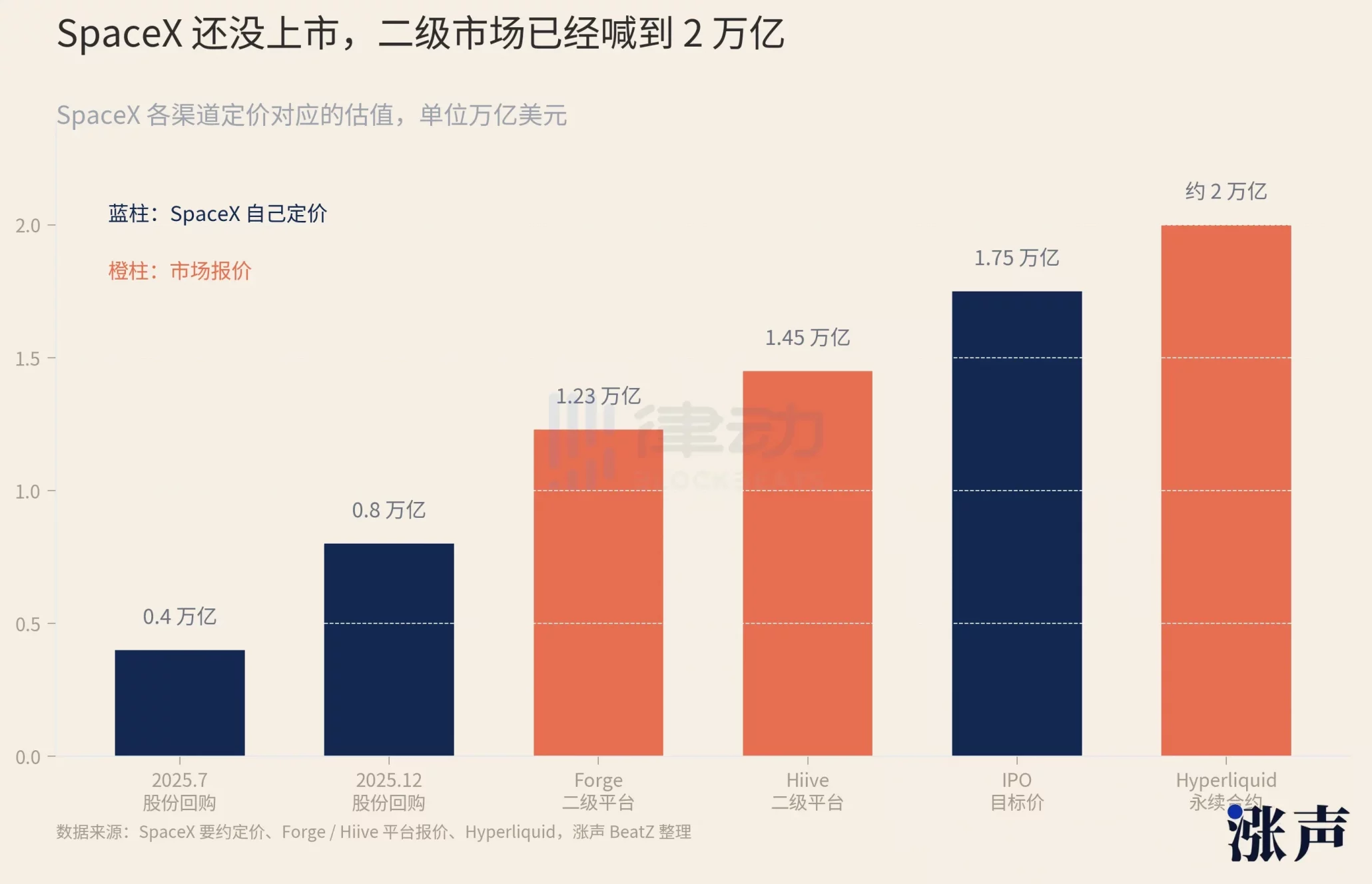
Chart Shows SpaceX Valuation Path to IPO
The section analyzes the new valuation model for capital-intensive companies like SpaceX. The chart visually represents the result of this model by plotting the steep growth of SpaceX’s valuation on its path to the IPO.
(Source: KuCoin)
SWOT Analysis, Space X and the New IPO Market Structure
The new market structure inaugurated by the Space X IPO is defined by the strength of its underlying technology and immense pent-up demand. However, this is counterbalanced by threats of extreme valuation, low-float volatility, and the systemic risk that comes with such a high concentration of capital.
- The primary strengths are rooted in the companies’ clear technological advantages and the decade-long build-up of investor demand that was previously confined to private markets.
- Weaknesses include unproven public market governance structures and financial models that prioritize long-term growth over near-term profitability, presenting a risk profile that public investors are unaccustomed to at this scale.
- The opportunity is to finally give all investors access to a new generation of foundational growth companies, but the primary threat is the potential for an asset bubble and valuation compression across the entire technology sector as capital is reallocated.

Figma Stock Plummets Over 80% Post-IPO
The section provides a SWOT analysis for SpaceX’s IPO. This chart illustrates a significant ‘Threat’ by showing the catastrophic post-IPO collapse of another hyped tech company, serving as a powerful cautionary tale.
(Source: MarketWise)
Table: SWOT Analysis of the Mega-IPO Market Shift
| SWOT Category | Pre-2025 Market Environment | 2025–2026 Market Environment | What Changed / Validated |
|---|---|---|---|
| Strengths | Public investors had access to mature, capital-light tech giants with proven profitability (FAANGs). | Public investors gain access to a new class of foundational, high-growth infrastructure companies (Space X, Open AI). | The investment universe expands, ending the era of stock scarcity and offering direct exposure to next-generation technology platforms. |
| Weaknesses | Hyper-growth companies remained private, limiting public market growth opportunities and concentrating value. | New public companies have massive valuations but lack profitability and operate with risky, low-float structures. | Public markets are now exposed to early-stage growth risks at an unprecedented scale, introducing new volatility. |
| Opportunities | Private secondary markets offered limited, opaque access to top-tier private companies. | A $4 trillion wave of new equity provides new avenues for capital allocation and potential for high returns. | The formal listing of these companies democratizes access and provides a transparent mechanism for price discovery. |
| Threats | A scarcity of high-growth public stocks led to inflated valuations among a few incumbent tech companies. | A flood of new equity could drain liquidity from the broader market, causing valuation compression for existing stocks. | The sheer scale and untested models of the new listings create the potential for a market-wide bubble and subsequent correction. |
$2 T Market Cap, Space X Signals a New Valuation Paradigm
If Space X sustains its market capitalization near $2 trillion through the end of 2026, watch for incumbent technology giants to pursue large-scale M&A or strategic spin-offs to unlock similar infrastructure-based valuations and compete for investor capital.
- A stable or rising Space X stock price serves as a powerful market signal, validating investor appetite for capital-intensive, long-horizon infrastructure projects and setting a new precedent for how such companies are valued.
- In this scenario, expect legacy tech companies to accelerate their narrative shift from software and services to foundational infrastructure. This could manifest as acquisitions in sectors like energy, communications, or logistics to build tangible, defensible asset bases.
- Conversely, if Space X’s stock exhibits high volatility or a significant, sustained decline, it would signal that public markets lack the patience for its low-float, growth-over-profit model. Such an outcome would likely force Open AI and Anthropic to reconsider the timing, valuation, or structure of their own IPOs to avoid a similar fate.

SpaceX Valued at $2.6T, Among Top Megacaps
The section title announces SpaceX’s ‘$2 T Market Cap’ as a new paradigm. The chart directly supports this by showing a comparable valuation ($2.6T) and placing SpaceX in the context of other top megacap companies.
(Source: Reddit)
The questions your competitors are already asking
This report covers one angle of how mega-IPOs from SpaceX and OpenAI are reshaping technology valuations and market structure. The questions that matter most depend on your work.
- Which mega-cap tech incumbents are most at risk of losing ground as investment shifts to the new listings from SpaceX, OpenAI, and Anthropic?
- What is the outlook for the market’s capacity to absorb nearly $4 trillion in new equity by 2026, and what are the primary liquidity risks?
- Is SpaceX a good investment at a $1.75T valuation, given the structural risks and extreme volatility created by its sub-5% public float?
This report does not answer these. Enki Brief Pro does.
Your question, your angle, your framework. SWOT, PESTL, scenario modelling. The same niche depth, built around the decision your work actually depends on.
