

UK Grid Connection Delays, 700 GW Project Queue, 70% Wait Time Increase, and BESS as the Key Solution (2021-2026)
The increasing frequency of negative power prices in the United Kingdom is a direct market signal that grid infrastructure has failed to keep pace with renewable energy deployment. This phenomenon creates a financial crisis for inflexible power generators but unlocks a significant economic opportunity for grid flexibility solutions, with Battery Energy Storage Systems (BESS) emerging as the primary beneficiary. While presenting a revenue risk to an older grid model, the volatility is fundamentally a powerful catalyst for investment in the modern, flexible system required for a decarbonized future. The core issue is not an oversupply of clean energy but a systemic failure to connect and manage it, a problem highlighted by a 700 GW queue of projects awaiting grid access.
UK Grid Connection Crisis, National Grid’s 700 GW Queue and 80% Project Withdrawal Rate
The UK’s grid connection bottleneck has become the single most critical risk to its renewable energy targets, with a queue exceeding 700 GW and project withdrawal rates indicating systemic delays that threaten national decarbonization goals.
- The period from 2021 to 2024 saw the grid connection queue swell, but the issue remained a developer-level concern, with project withdrawal rates just beginning to climb as a signal of underlying friction.
- By 2025, the problem escalated to a systemic crisis, with the active queue for new connections surpassing 700 GW of projects. This logjam is a direct result of average connection wait times increasing by 70% over the last decade, severely stalling the deployment of new clean power.
- The historical ‘first come, first served’ policy was identified in 2025 as a primary cause of the backlog. This approach allowed non-viable or speculative projects to occupy queue positions, effectively blocking shovel-ready assets from connecting to the grid, as analyzed by Fuse Energy.
- In response, the National Grid ESO initiated significant reforms in early 2026 to transition to a ‘first ready, first connected’ model. While these reforms aim to clear the queue by prioritizing viable projects, the required physical transmission and distribution networks upgrades will demand billions in capital and years to complete.
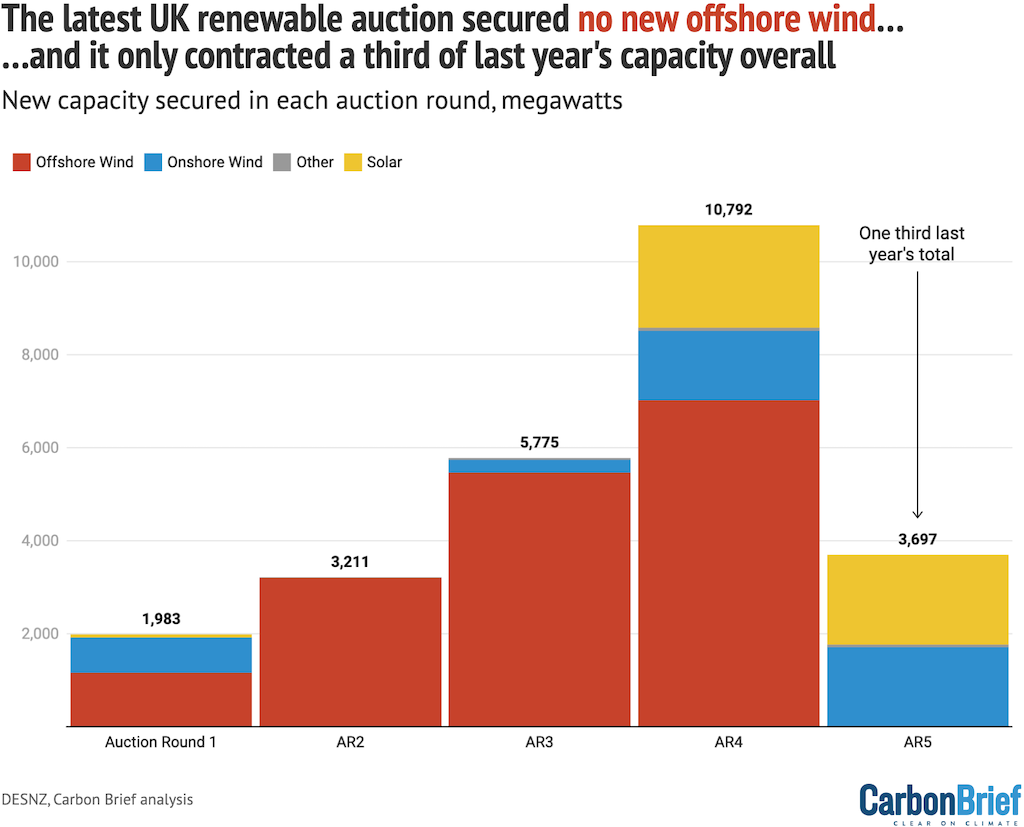
UK Renewable Capacity Auction Shows Drastic Decline
This chart’s depiction of a drastic decline in renewable capacity auctions directly illustrates the consequences of the ‘Grid Connection Crisis’ and high ‘Project Withdrawal Rate’ discussed in this section.
(Source: Carbon Brief)
UK BESS Investment Surge, 13 GW LDES Target, and Technology Cost Projections to 2030
The UK government’s projection of needing up to 13 GW of Long-Duration Energy Storage (LDES) by 2030 has directly catalyzed a surge in private investment into BESS projects, which are seen as the principal solution to monetize grid volatility and mitigate renewable curtailment.
- Investment in BESS accelerated sharply in 2025, with over 100 planning applications filed between April and June alone. These applications represent a combined 8.4 GW of potential capacity designed to capitalize on arbitrage opportunities created by extreme price swings.
- The business case for energy storage systems is strengthened by falling costs. The Levelized Cost of Storage (LCOS) for grid-scale batteries saw a projected 11% drop from $104/MWh in 2024 to $93/MWh in 2025, making projects more financially viable.
- The government’s ‘Clean Power 2030 Action Plan’ provides a clear policy signal by defining the need for 6 GW to 13 GW of LDES and other flexible power. This target offers investors the long-term certainty required for capital-intensive projects.
- While lithium-ion BESS dominates current investments, innovative LDES projects are emerging. A Dutch project announced in January 2026 by AQUABATTERY and Elestor, targeting disruptive sub-€50/k Wh costs, indicates a future pipeline of lower-cost, longer-duration technologies.

Batteries Significantly Lower Peak Evening Power Prices
This chart demonstrates the tangible financial benefit and grid-stabilizing effect of batteries, providing a clear rationale for the ‘UK BESS Investment Surge’ detailed in this section.
(Source: LinkedIn)
Data Centers and PPAs, UK AI Growth Zones, and Corporate Offtake Agreements (2025-2026)
The exponential power demand from data centers and AI is creating a new class of corporate offtakers who are forming symbiotic partnerships with renewable generators through long-term Power Purchase Agreements (PPAs) to secure green energy and de-risk generation projects.
- In 2025, as negative price volatility intensified, renewable generators increasingly turned to long-term PPAs as a critical tool to secure project financing and insulate themselves from wholesale market exposure.
- The UK government’s launch of “AI Growth Zones” in 2026 signaled a strategic alignment between technology and energy policy. This initiative fast-tracks planning and grid connections for data centers that are explicitly linked to the clean energy transition, creating a powerful demand signal for new renewable capacity.
- This model provides a dual benefit: data centers gain access to stable, low-cost green power, while renewable projects secure the revenue certainty needed for investment, bypassing the financial risk of price cannibalization and curtailment. Some data centers are also exploring on-site generation from sources like nuclear SMRs.
- In Q 3 2025, European solar PPA prices showed a decline while wind prices held steady. According to Level Ten Energy, this activity indicates a dynamic and maturing corporate PPA market where buyers and sellers actively negotiate risk in response to evolving market conditions.
UK vs Europe, National Grid Price Volatility and Renewable Cannibalization
While negative pricing is a pan-European phenomenon driven by renewable expansion, the UK’s islanded grid and severe connection bottlenecks create uniquely acute challenges and, consequently, a more urgent investment case for flexibility solutions compared to more interconnected continental markets.
- Between 2021 and 2024, negative pricing events in the UK were sporadic anomalies. In contrast, markets with higher renewable penetration, such as Germany, already demonstrated more frequent occurrences, signaling the future direction for the UK grid.
- By 2025–2026, the UK market rapidly converged with its European counterparts. Negative price hours are now projected to quadruple by 2027, mirroring the extreme volatility seen in markets like Poland, which experienced daily price swings over €350/MWh in April 2025.
- The UK’s primary differentiator is its physical grid constraints. The 700 GW connection queue represents a far more significant barrier to deploying both new generation and the necessary flexibility assets compared to mainland Europe, which benefits from greater interconnection capacity.
- As a result, the market opportunity for flexibility assets like BESS is arguably more concentrated and immediate in the UK. Investors are directly targeting the severe price volatility and constraints that are specific to the British grid.

UK Industrial Electricity Prices Exceed European Rivals
This chart provides a direct visual comparison that is central to the section’s theme of ‘UK vs Europe’ competitiveness regarding energy costs.
(Source: Carbon Brief)
Grid Flexibility Technologies, BESS at Commercial Scale, and LDES at Demonstration Phase
While short-duration Lithium-ion BESS (1-4 hours) have reached full commercial maturity and are being deployed at scale to address intraday volatility, longer-duration technologies needed for multi-day or seasonal balancing remain at the demonstration and pilot stages.
- From 2021 to 2024, the UK BESS market was nascent, with deployments focused primarily on ancillary services. By 2025–2026, the business model shifted decisively to include wholesale arbitrage, a move driven by recurring negative pricing events, with Lithium-ion (TRL 9) being the dominant, bankable technology.
- The UK’s position as the world’s third-largest deployer of BESS validates the commercial readiness of the technology. Current projects have a CAPEX ranging from $250–$400/k Wh, with costs continuing to decline.
- Emerging technologies for medium-to-long duration storage are gaining traction but are less mature. Flow Batteries (TRL 7-8) offer a longer cycle life and greater scalability but currently come at a higher CAPEX of $300–$700/k Wh.
- Innovative Long-Duration Energy Storage (LDES) concepts, such as those targeting sub-€50/k Wh costs, are still at the prototype or pilot stage (TRL 5-6). This indicates that commercially viable solutions for tackling seasonal intermittency are not yet available and remain a critical gap in the technology stack.

UK Grid Balancing and Network Costs Surge
The surge in grid balancing and network costs shown in this chart highlights the core problem that ‘Grid Flexibility Technologies’ like BESS are designed to solve.
(Source: Carbon Brief)
SWOT Analysis, UK Grid Flexibility Market and BESS Investment Case
The primary strength of the UK’s grid flexibility market is the powerful, undeniable price signal from negative pricing, which creates a strong business case for BESS. However, this is threatened by the severe weakness of grid connection delays, which risk stifling the deployment of both generation and storage assets.

UK Power Prices Show Extreme Volatility
This chart’s illustration of extreme price volatility is a foundational element for the ‘SWOT Analysis’, representing both a weakness of the current grid and a key opportunity for the ‘UK Grid Flexibility Market’.
(Source: Carbon Brief)
Table: SWOT Analysis for the UK Grid Flexibility Market
| SWOT Category | 2021 – 2024 | 2025 – 2026 | What Changed / Validated |
|---|---|---|---|
| Strengths | Growing renewable capacity and early government support for decarbonization. A nascent BESS market focused on ancillary services. | Mature, bankable Lithium-ion BESS technology with declining costs. A clear and powerful price signal for arbitrage from extreme wholesale market volatility. | The business case for BESS shifted from niche grid services to mainstream, profitable energy trading, validating its role in a renewables-heavy grid. |
| Weaknesses | Grid connection queues were growing but not yet a systemic crisis. Revenue cannibalization was a theoretical risk for future projects. | A 700 GW connection queue is actively blocking projects. Frequent negative prices are eroding the revenue of existing, unsubsidized renewable generators. | The grid’s physical and administrative limitations were validated as the single biggest constraint on the energy transition, moving from a developer issue to a national-level crisis. |
| Opportunities | Early-stage investment in BESS for grid balancing. Development of corporate PPA market. | A multi-billion-pound market for BESS arbitrage. New flexible demand from data centers and green hydrogen. Co-location of storage with generation. | Negative prices created a clear, bankable opportunity. The growth of AI and data centers provides a new, massive source of flexible demand to absorb surplus generation. |
| Threats | Uncertainty over the future revenue streams for flexibility assets. Policy and regulatory lag. | Slow permitting for critical grid upgrades could prolong bottlenecks. Unpredictable revenue streams deter investment in generation without PPAs or storage. | The risk shifted from technology readiness to infrastructure and regulatory failure. The inability to execute grid upgrades is now the primary threat to meeting 2030 targets. |
UK Grid Flexibility in 2027: National Grid Connection Reforms, BESS Deployment, and Price Volatility
If the National Grid ESO’s new ‘first ready, first connected’ reforms fail to clear a significant portion of the 700 GW project queue by 2027, negative price hours will likely exceed the projected 1, 000 hours annually. This outcome would accelerate the financial failure of unsubsidized renewable projects and concentrate investment almost exclusively on short-duration BESS that profits from volatility.
- Watch This: Monitor the quarterly project withdrawal and connection rates published by the National Grid ESO under its new reforms. A failure to reduce the queue size quarter-over-quarter throughout 2026 is the primary negative signal, indicating the reforms are not working as intended.
- If This Happens: If the queue remains congested, expect a surge in announcements of co-located BESS projects. This would signal that developers are being forced to self-integrate storage to protect their generation assets’ revenue by capturing value from volatility on-site.
- These Could Be Happening: A slowdown in final investment decisions (FIDs) for standalone solar and wind farms without a secured PPA or co-located storage would confirm that investors are pricing in the high risk of continued grid delays and revenue cannibalization from wholesale price exposure.

UK 2026 Energy Mix Relies on Wind and Gas
This chart’s projection of the 2026 energy mix sets the stage for the section’s forward-looking discussion on ‘UK Grid Flexibility in 2027’, highlighting the future need for ‘BESS Deployment’ to manage ‘Price Volatility’ from intermittent renewables.
(Source: Bionic)
The questions your competitors are already asking
This report covers one angle of the UK’s grid connection crisis and the resulting BESS investment opportunity. The questions that matter most depend on your work.
- What is actually happening with National Grid’s queue reform since the ‘first come, first served’ policy was abandoned?
- What is the outlook for BESS deployment in the UK grid services market by 2030?
- What are the revenue opportunities for Battery Energy Storage Systems from negative power price events in the UK?
- Which renewable project developers are co-locating BESS to bypass UK grid connection delays?
This report does not answer these. Enki Brief Pro does.
Your question, your angle, your framework. SWOT, PESTL, scenario modelling. The same niche depth, built around the decision your work actually depends on.
