

Doosan SOFC Manufacturing Capacity, 50 MW Ceres Power Plant, and 73 B KRW Deal (2025 to 2026)
SOFC Manufacturing Scale, Doosan Fuel Cell Faces Capacity Constraints
The global pivot to Solid Oxide Fuel Cells (SOFCs) to meet the extreme power demands of AI data centers has created a manufacturing capacity race, with new entrants facing significant scaling challenges against established players. While the demand signal is clear, the ability to produce SOFC systems at the speed and scale required by hyperscalers is the primary constraint. This dynamic defines the market entry risk for companies like Doosan Fuel Cell and its strategic pivot away from its legacy Phosphoric Acid Fuel Cell (PAFC) business.
- From 2021 to 2024, Doosan’s business was centered on its established PAFC technology, a mature market with limited growth. The company had not yet entered the SOFC manufacturing space.
- In July 2025, Doosan Fuel Cell commissioned its new 50 MW annual capacity SOFC mass production facility in Gunsan, South Korea, marking its formal entry into the high-growth data center market.
- This initial 50 MW capacity is a fraction of the scale operated by market incumbent Bloom Energy, which commands an annual manufacturing capacity of over 1 GW.
- The capacity disparity presents a major execution risk for Doosan, as large-scale data center deployments require hundreds of megawatts, potentially straining the new factory’s output and ability to compete on large contracts.
- In a strategic move to focus resources, Doosan terminated three legacy PAFC supply contracts in early 2026, signaling a complete operational commitment to the SOFC ramp-up despite the initial capacity limitations.
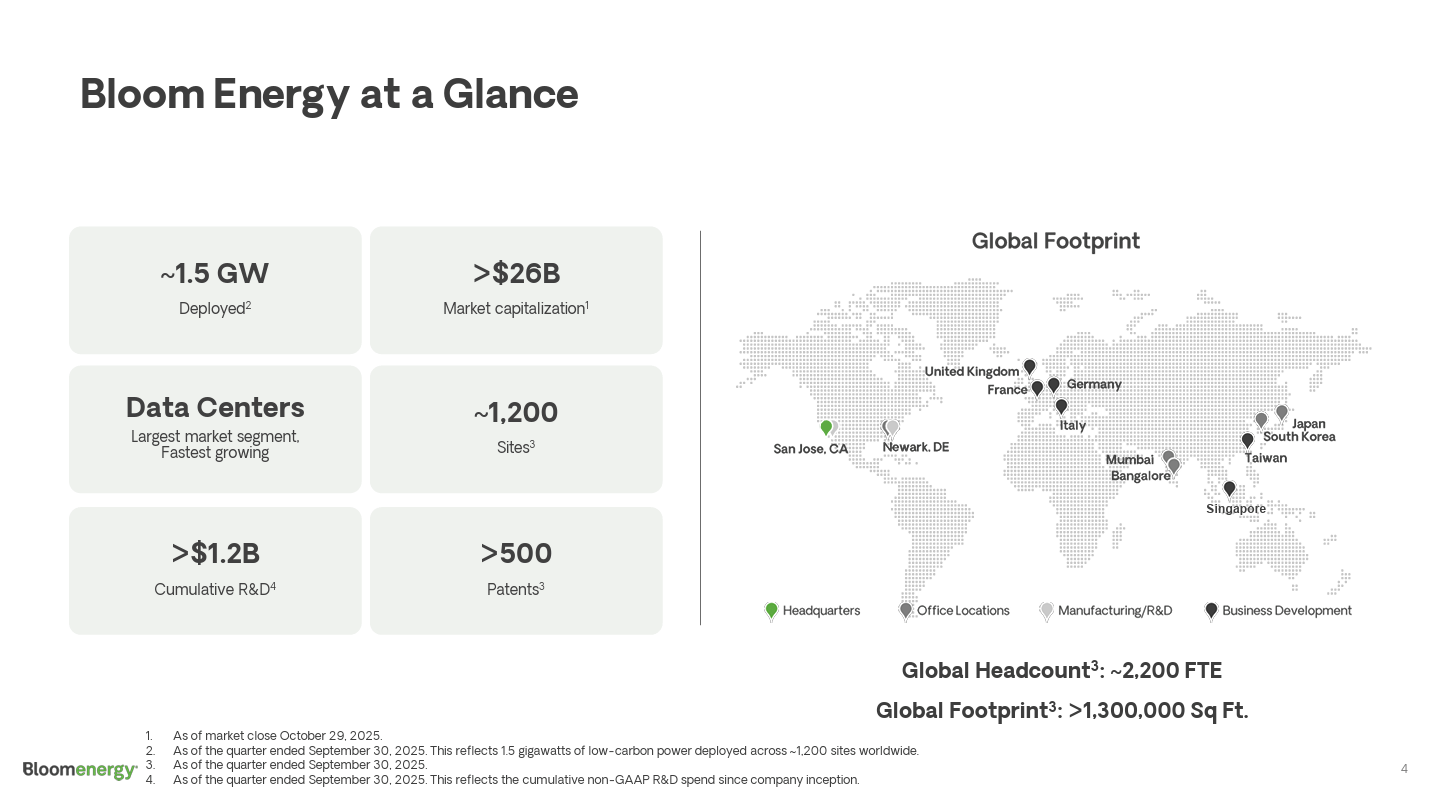
Bloom Energy Metrics Highlight Competitive Scale
This section discusses Doosan’s manufacturing scale and capacity constraints. The chart showing competitor Bloom Energy’s scale provides a direct, quantitative benchmark to illustrate the competitive landscape and contextualize Doosan’s own position and challenges regarding scale.
(Source: Arya’s Substack)
Doosan Fuel Cell 3 Strategic Alliances for SOFC Push (2025 to 2026)
Doosan Fuel Cell has assembled a foundational network of strategic partnerships to secure its core technology, de-risk its supply chain, and build market access for its data center push. These alliances are critical for a new market entrant attempting to challenge an established competitor. The partnerships span technology licensing, critical component supply, and go-to-market collaboration, forming the strategic backbone of the company’s 2026 North American expansion plan.

Bloom Energy Projects Major Profitability Shift
This section outlines Doosan’s strategic alliances for a future push from 2025 to 2026. The chart showing a competitor’s projected major profitability shift illustrates the high-stakes, forward-looking competitive environment, providing the strategic rationale for why Doosan needs to form alliances to compete effectively in the coming years.
(Source: Long-term Investing – Substack)
Table: Doosan Fuel Cell Strategic SOFC Partnerships
| Partner | Time Frame | Details and Strategic Purpose | Source |
|---|---|---|---|
| SK Ecoplant & Hyosung Heavy Industries | Nov 10, 2025 | Signed a Memorandum of Understanding (MOU) to collaborate on providing stable power supplies for data centers. This alliance combines Doosan’s fuel cell technology with the partners’ infrastructure and engineering capabilities to create a more comprehensive market offering. | Doosan Fuel Cell Co., Ltd |
| Alleima | Jan 24, 2025 | Secured a commercial supply agreement for coated steel strips, a critical component for the mass production of Doosan’s SOFC stacks. This move was essential for securing the supply chain ahead of the Gunsan factory launch. | Alleima receives an order for mass production of fuel cells … |
| Ceres Power | Established prior to 2025 | The core technology partnership where Ceres Power licensed its metal-supported SOFC stack technology to Doosan. This agreement is the technological foundation for Doosan’s entire SOFC business and its entry into the stationary power market. | Ceres Power Fuels Investors’ Illusions With Misleading … |

Bloom Energy Shows Strong Profitability Trend
This section is a table listing Doosan’s strategic partnerships. The chart, showing the strong existing profitability trend of a key competitor, provides the justification for these alliances. It demonstrates the strength of the competition, making it clear why Doosan needs partners to effectively challenge the market incumbent.
(Source: Long-term Investing – Substack)
South Korea vs. North America, Doosan SOFC Geographic Focus
Doosan Fuel Cell’s market strategy represents a decisive geographic shift from a historically domestic focus to a high-stakes, export-oriented push targeting the lucrative North American data center market. While initial commercialization began in its home market of South Korea to validate the new technology, the company’s public statements and strategic activities in 2026 confirm that its primary growth objective is securing contracts with U.S. technology giants.
- Between 2021 and 2024, Doosan’s fuel cell business was almost entirely concentrated in South Korea, driven by domestic energy policies and its PAFC product line.
- In September 2025, the company’s first commercial SOFC deployments were domestic, including an initial 9 MW supply and a 73 billion KRW agreement for a 39.8 MW power plant, providing crucial early references.
- By May 2026, Doosan confirmed it was in “detailed talks with multiple big tech customers” in North America, signaling that the export strategy was moving from planning to active negotiation.
- The North American push is a direct attempt to capture a share of the market for on-site data center power, which is growing fastest in the U.S. due to the concentration of AI development and grid capacity shortfalls.

Texas Power Grid Faces Massive Load Deficit
This section compares Doosan’s geographic focus between South Korea and North America. The chart, highlighting a massive power load deficit in Texas, provides a powerful and specific example of the market opportunity in North America, justifying the strategic decision to focus on this region.
(Source: SemiAnalysis)
SWOT Analysis, Doosan SOFC Strengths and Execution Risks
Doosan’s strategic pivot to SOFCs is well-timed to intersect with the AI-driven energy demand surge, but it is accompanied by significant financial and operational risks. The company’s strengths lie in its licensed technology and clear strategic focus. However, its weaknesses are tied to its nascent manufacturing scale and initial financial performance, creating a critical window where it must convert opportunities into firm orders to fend off competitive threats.

Competitor Bloom Energy Stock Value Soars
This section covers a general SWOT analysis for Doosan’s SOFC business. A competitor’s soaring stock value is a critical external factor, representing both a threat (strong competition) and an opportunity (market validation). This chart is a perfect illustration for the ‘Threats’ or ‘Opportunities’ quadrant of the SWOT analysis.
(Source: Long-term Investing – Substack)
Table: SWOT Analysis for Doosan’s SOFC Data Center Pivot
| SWOT Category | 2021 – 2024 (Pre-Pivot) | 2025 – 2026 (Post-Pivot) | What Changed / Validated |
|---|---|---|---|
| Strengths | Established presence in the Korean PAFC market with a known brand. | Licensed advanced, high-efficiency (up to 70%) metal-supported SOFC technology from Ceres Power. Established first-mover advantage in the Korean SOFC market. | The launch of the Gunsan factory and the high-efficiency rating of its SOFC product validate a strong technical foundation for competing in the data center market. |
| Weaknesses | Dependence on a maturing, lower-margin PAFC technology with limited international growth prospects. | Posted a substantial operating loss of KRW 105.7 billion in 2025, its worst since inception. Initial manufacturing capacity is limited to 50 MW. | The financial strain highlights the high cost of the technology transition. The small factory capacity remains a key weakness against competitors like Bloom Energy. |
| Opportunities | Growing domestic demand for distributed power generation in South Korea. | Exponential growth in power demand from AI data centers creating a need for grid-independent power. Grid infrastructure build-out takes 5 to 15 years, creating an opening for on-site solutions. | The “detailed talks” with North American big tech firms in May 2026 validate that the data center opportunity is real and that Doosan is being considered as a potential supplier. |
| Threats | Increasing competition in the global fuel cell market and maturing PAFC technology. | Incumbent market leader Bloom Energy has 1 GW of manufacturing capacity and established relationships with data center clients. A December 2025 report alleged slow initial SOFC order intake. | The competitive threat from Bloom Energy is now a direct and immediate challenge. Failure to secure large orders quickly could allow the incumbent to solidify its market dominance. |

Datacenter Onsite Gas Power Market Surges
This section is a SWOT analysis table specifically for Doosan’s pivot to data centers. The chart showing that the datacenter onsite power market is surging directly visualizes the primary ‘Opportunity’ that is driving this strategic pivot. It provides the core market rationale for the move.
(Source: 富途资讯)
A Major US Order, Doosan Fuel Cell 2026 Validation Signal
The single most important event to watch for Doosan Fuel Cell through late 2026 and early 2027 is the conversion of its pipeline of discussions into a firm, multi-megawatt SOFC supply agreement with a major North American data center operator. Such an announcement would serve as the definitive validation of its strategic pivot, its manufacturing capability, and its technology’s competitiveness on the global stage. Without it, the significant capital expenditure on the new factory and the pivot away from profitable legacy contracts will face intensified scrutiny.
- If Doosan secures a flagship U.S. data center contract, it will confirm that customers are seeking alternatives to incumbent suppliers and that Doosan’s technology meets the rigorous standards of hyperscale operators.
- Watch for press releases or regulatory filings that name a specific North American “big tech” customer and detail a firm order size in megawatts, moving beyond the “detailed talks” reported in May 2026.
- This could be happening now, as the urgency for data center power is acute. A successful contract would justify the KRW 105.7 billion operating loss in 2025 as a necessary investment for future growth.
- Conversely, a continued absence of a major export order into 2027 would suggest that the company is struggling to penetrate the market, potentially leaving its 50 MW factory underutilized and its financial recovery delayed.

Larger Datacenter Power Units Require More Redundancy
This section discusses a major US order that validates Doosan’s technology. The chart explains a key technical requirement—redundancy—for large datacenter power units. Its inclusion here implies that the major order is for such a facility, and that Doosan’s technology meets this critical technical standard, thus validating its suitability for this demanding market.
(Source: SemiAnalysis)
The questions your competitors are already asking
This report covers one angle of Doosan Fuel Cell’s pivot into the data center power market. The questions that matter most depend on your work.
- Bloom Energy data center contracts
- Ceres Power technology licensing deals
- Other fuel cell companies for data centers
- South Korea fuel cell power market
This report does not answer these. Enki Brief Pro does.
Your question, your angle, your framework. SWOT, PESTL, scenario modelling. The same niche depth, built around the decision your work actually depends on.
