

Shell CCUS Strategy, $714 M Equinor JV, $17 M Avnos Investment, and 4 Key Projects (2024 to 2026)
$714 M FID vs $17 M Venture Bets, Shell’s CCUS Adoption Model
The carbon capture industry is defined by a dual-track adoption model, where energy majors commit massive capital to de-risk existing industrial assets with proven technology while placing smaller, strategic venture bets on nascent technologies like Direct Air Capture (DAC). This approach balances near-term emissions mitigation for core operations with long-term optionality on potentially disruptive carbon removal solutions. The period from 2025 to today marks a significant acceleration of this dual strategy, shifting from earlier-stage pilots to large-scale final investment decisions (FIDs) and targeted funding for next-generation technology.
- From 2021 to 2024, industry activity was characterized by advancing existing projects like Shell’s Quest CCS facility and forming foundational partnerships for future hubs. The focus was on demonstrating the viability of point-source capture at an operational scale.
- The period from January 2025 to present shows a clear split. On one hand, Shell and its partners committed NOK 7.5 billion (approximately $714 million) to the Phase 2 expansion of the Northern Lights project in March 2025, a large-scale infrastructure play using mature technology.
- Simultaneously, Shell Ventures participated in a $17 million funding round for Avnos, a hybrid DAC startup, in November 2025. This represents a calculated, low-cost investment to gain exposure to novel technology with the potential for lower operational costs.
- This dual approach allows supermajors to address immediate decarbonization needs in hard-to-abate sectors while cultivating a portfolio of innovative technologies that could become commercially viable if costs decline and supportive policies like the U.S. Section 45 Q tax credit remain in place.
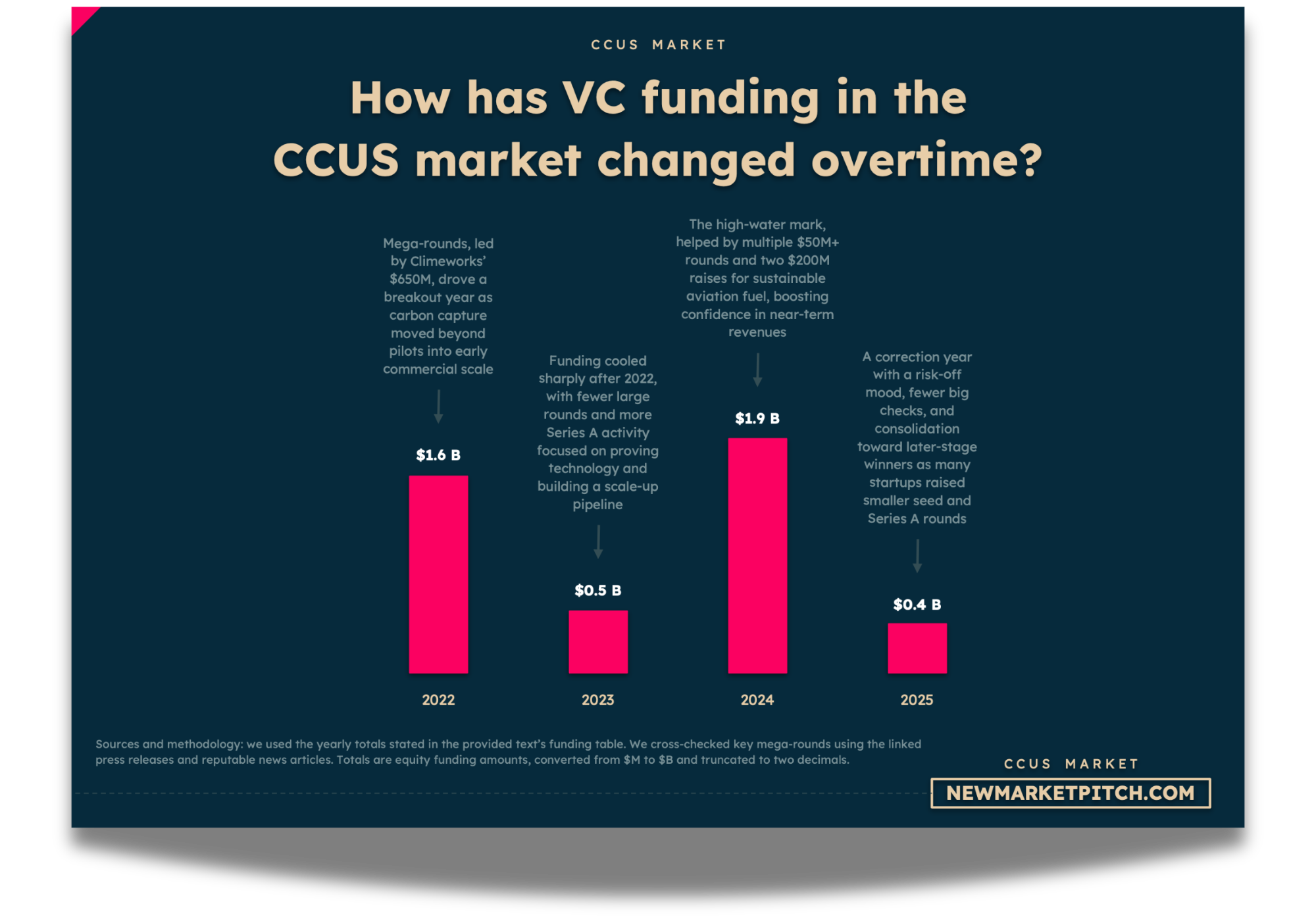
VC Funding for CCUS Startups Declines Sharply
This chart illustrates the challenging environment for ‘Venture Bets’ mentioned in the section heading. The sharp decline in VC funding provides a stark contrast to large, committed Final Investment Decisions (FIDs), highlighting the dual nature of Shell’s adoption model: investing in both proven, large-scale projects and navigating the volatile early-stage technology landscape.
(Source: New Market Pitch)
Shell Investment Strategy, $714 M Northern Lights vs Aramis Exit (2025-2026)
Shell’s capital allocation reveals a highly selective and risk-averse investment strategy, prioritizing large, multi-partner joint ventures for proven projects while exiting or minimizing exposure to developments with higher perceived risk or less certain returns. This cautious deployment of capital is underscored by the company’s planned allocation of approximately 60% of its total capital expenditure to fossil fuels between 2025 and 2030, positioning its CCUS investments as a mitigation tool rather than a primary business pivot.
- The decision to co-invest $714 million with Equinor and Total Energies in the Northern Lights Phase 2 expansion demonstrates a commitment to large-scale projects that are de-risked through shared financial burden and strong government backing in a favorable regulatory environment.
- In contrast, Shell’s withdrawal from the Aramis CCS pipeline project in the Netherlands in April 2025 signals a clear risk threshold. The project, which required a subsequent €639 million ($726 million) government commitment to proceed, was deemed insufficiently attractive for Shell’s capital.
- Venture investments into DAC represent a different form of risk management. By investing smaller sums, such as up to $3 million in Rep Air Carbon and participating in a $17 million round for Avnos, Shell secures access to technological innovation without the multi-billion-dollar exposure of a full-scale project. This shows a clear strategy in Carbon Capture financing, separating infrastructure from venture capital.

CCUS Project Pipeline Swells With Development-Stage Assets
This chart provides the industry context for Shell’s strategic investment decisions, such as backing Northern Lights while exiting Aramis. The swelling pipeline of development-stage projects indicates increased competition for capital and resources, forcing companies like Shell to be highly selective in their project portfolio management.
(Source: New Market Pitch)
Table: Shell’s Key CCUS and Related Investments (2025-2030)
| Project / Investment | Time Frame | Details and Strategic Purpose | Source |
|---|---|---|---|
| Overall Company CAPEX Plan | 2025 – 2030 | Allocation of approx. 60% of total CAPEX to fossil fuel business, providing context for the scale of low-carbon investments. | Reclaim Finance |
| Northern Lights Phase 2 | March 2025 | Joint investment of NOK 7.5 billion ($714 million) with Equinor and Total Energies to expand CO 2 storage infrastructure in Norway. | OE Digital |
| Investment in Avnos | November 2025 | Participated in a $17 million project finance round to fund a commercial demonstration facility for Avnos’s hybrid DAC technology. | ESG Dive |
| Investment in Rep Air Carbon | January 2025 | Committed up to $3 million with Mitsubishi to accelerate the development of Rep Air’s electrochemical DAC technology. | Upstream |
Partnership Models in CCUS, Shell’s JVs with Equinor and Mitsubishi
Shell’s CCUS strategy is structurally dependent on two distinct partnership models: large-scale joint ventures with peer energy supermajors to fund and execute capital-intensive infrastructure, and smaller, technology-focused collaborations with corporate partners to scout and nurture early-stage innovation. This bifurcated approach effectively outsources different forms of risk, separating infrastructure development from technology discovery.
- The Northern Lights project exemplifies the supermajor JV model, where Shell, Equinor, and Total Energies pool capital and operational expertise to build infrastructure that no single company would likely undertake alone. This model is replicated in exploration activities, such as the JV with Chevron and Exxon Mobil to assess storage potential in Australia.
- The collaboration with Mitsubishi on DAC investments showcases the technology-scouting model. By jointly funding startups like Rep Air Carbon and Avnos, both companies share the financial risk and benefit from combined due diligence in the highly speculative DAC market.
- The withdrawal from the Aramis project highlights the limits of this partnership model. When the perceived risk-reward profile becomes unfavorable, even established JVs can dissolve, demonstrating that partner alignment is critical but not guaranteed throughout a project’s long lifecycle.

CCUS Conference Draws Senior Energy and Finance Leaders
This chart visualizes the ecosystem in which Shell’s partnerships and JVs are formed. The gathering of senior leaders from energy and finance underscores the high-level, cross-industry collaboration required for capital-intensive CCUS projects, directly supporting the section’s focus on partnership models.
(Source: Wood Mackenzie)
Table: Shell’s Key CCUS Partnerships (2024-2026)
| Partner / Project | Time Frame | Details and Strategic Purpose | Source |
|---|---|---|---|
| Equinor, Total Energies (Northern Lights JV) | March 2025 | Reached FID for Phase 2 expansion, committing $714 million to build out Europe’s first open-access CO 2 storage network. | ESG Today |
| Gasunie, EBN, Total Energies (Aramis) | April 2025 | Shell withdrew from the partnership to develop a major CO 2 pipeline in the Netherlands, citing strategic reprioritization. | ESG News |
| Mitsubishi | 2025 | Ongoing collaboration to co-invest in DAC startups, including a $3 million commitment to Rep Air Carbon and participation in a $17 million round for Avnos. | Upstream |
| Chevron, Exxon Mobil | December 2024 | Secured a permit as part of a JV to explore the potential for large-scale geological carbon storage in the Carnarvon Basin, Australia. | Carbon Herald |
Europe vs North America, Shell’s Geographic CCUS Focus
Shell’s CCUS activities are geographically concentrated in regions with a combination of favorable geology, established industrial clusters, and robust government policy support, primarily Europe and North America. This focus reflects a strategy of developing hub-based projects where policy mechanisms like carbon pricing or tax credits create a viable business case for the high capital costs of CCUS infrastructure.
- In Europe, Norway stands out as a strategic hub due to the government-backed Northern Lights project. The project’s open-access model is designed to serve industrial emitters across the continent, making it a cornerstone of European decarbonization strategy. Shell’s withdrawal from the Dutch Aramis project, however, indicates that not all European jurisdictions offer the same level of investment security.
- In North America, Canada is a key focus area, particularly Alberta, where supportive provincial policies and existing infrastructure create a favorable environment. The announcement of the Polaris CCS project in March 2025, aiming to capture 650, 000 tonnes of CO 2 per year at the Scotford complex, builds on the operational experience of the nearby Quest facility.
- Exploratory activities are extending to other regions with geological potential. The joint venture with Chevron and Exxon Mobil to assess storage sites in Australia’s Carnarvon Basin signals an effort to identify future growth opportunities beyond the current core regions.

CCUS Market Segmented by Capture Type and Region
This chart directly supports the section’s topic by providing a market-level breakdown by region. It allows for a quantitative comparison between the North American and European CCUS markets, which is central to the discussion of Shell’s geographic focus.
(Source: IDTechEx)
TRL-9 vs TRL-5, Shell’s Technology Maturity Spectrum
Shell’s technology strategy clearly differentiates between commercially mature solutions for immediate deployment and early-stage technologies for future development. The company leverages its proprietary, high-TRL post-combustion capture systems for its large-scale projects while using its venture arm to nurture lower-TRL DAC technologies that promise lower energy penalties and operating costs.
- The deployment of Shell’s CANSOLV® CO₂ Capture System (TRL 8-9) in projects like Polaris represents the core of its current strategy. This proven amine-based technology offers high capture efficiency (85-95%) but comes with a significant energy cost, forming the baseline for current project economics.
- Investments in DAC startups target technologies at a much earlier stage of development. Avnos’s hybrid geochemical technology (TRL 5-6) is moving toward its first commercial-scale demonstration, while Rep Air Carbon’s electrochemical approach (TRL 4-5) is still in the pilot phase.
- This technological dualism is a hedge. While mature technologies allow Shell to act on decarbonization now, the high energy and cost profiles limit their widespread application. The lower-TRL DAC investments are options on a future where a technological breakthrough could make atmospheric carbon removal economically viable at scale.

Carbon Capture Technologies Mapped by Scale
This chart, mapping technologies by scale, serves as a visual proxy for the Technology Readiness Level (TRL) spectrum discussed in the section. It helps illustrate how technologies at different maturity stages (e.g., TRL-5 vs. TRL-9) correspond to different deployment scales, contextualizing Shell’s portfolio of technologies.
(Source: IDTechEx)
SWOT Analysis, Shell’s CCUS Strengths and Market Risks
Shell’s CCUS strategy leverages its core competencies in large-scale project execution and financial capacity, but it faces significant external threats from policy uncertainty and is internally constrained by its continued heavy investment in fossil fuels. The shift from 2021-2024 to the 2025-2026 period has validated its ability to advance major projects to FID while also highlighting its risk aversion in less certain regulatory environments.
- Strengths: Shell‘s ability to execute complex, multi-billion-dollar energy projects and its strong balance sheet are key enablers.
- Weaknesses: The allocation of a majority of CAPEX to fossil fuels creates strategic tension and raises questions about the scale of its commitment to the energy transition.
- Opportunities: Growing policy support like the U.S. 45 Q tax credit (up to $180/tonne for DAC) and the global push for industrial decarbonization create a large potential market.
- Threats: High costs, regulatory delays, and reliance on sustained government subsidies make CCUS projects vulnerable to political and economic shifts.

CCUS Market to Reach $30.7B by 2035
This market forecast chart quantifies the significant ‘Opportunity’ aspect of a SWOT analysis. The projection of a $30.7B market by 2035 highlights the substantial commercial potential and long-term growth prospects in the CCUS sector, which is a key external factor influencing Shell’s strategy.
(Source: Market.us)
Table: SWOT Analysis for Shell’s CCUS Strategy
| SWOT Category | 2021 – 2024 | 2025 – 2026 | What Changed / Validated |
|---|---|---|---|
| Strengths | Operational experience from projects like Quest. Established JVs for future projects. | Advanced Northern Lights to Phase 2 FID (March 2025). Leveraged proprietary CANSOLV® technology for the new Polaris project. | Validated ability to move complex, capital-intensive projects from planning to final investment decision with partners. |
| Weaknesses | High capital dependency for CCUS projects. Strategic ambiguity regarding the pace of transition away from fossil fuels. | Confirmed plan to allocate ~60% of CAPEX to fossil fuels through 2030. CCUS investments remain a fraction of total spending. | The scale of low-carbon investment remains modest relative to the core business, defining CCUS as a mitigation tool, not a primary growth engine. |
| Opportunities | Emerging policy support (e.g., initial versions of 45 Q). Growing corporate demand for decarbonization solutions. | Enhanced 45 Q tax credits (up to $180/t for DAC) create a strong business case. Made venture investments in DAC (Avnos, Rep Air) to capture this upside. | Actively positioning to capitalize on specific, high-value policy incentives, particularly in the nascent but potentially lucrative DAC market. |
| Threats | Uncertainty over long-term carbon pricing and regulatory frameworks. High project costs and long lead times. | Withdrew from the Aramis project (April 2025) due to perceived risks, highlighting sensitivity to project economics and partner alignment. | Demonstrated willingness to cancel or exit from large projects if the risk-reward balance is not sufficiently favorable, even with government support. |
Future Scenarios, Shell’s DAC Bets vs Infrastructure Scale-Up
The most critical strategic question for the year ahead is whether the parallel tracks of massive infrastructure investment and small-scale technology bets will converge into a cohesive, scalable business model. The success of this dual strategy hinges on near-term validation points for both its large-scale hubs and its nascent technology investments.
- If this happens: The Aramis project reaches a final investment decision in 2026 without Shell’s involvement. Watch this: This would signal that government funding and partnerships with non-supermajors are sufficient to advance major European CCUS infrastructure, potentially reducing the leverage of players like Shell in future projects.
- If this happens: Initial performance data from Avnos’s demonstration plant, funded in late 2025, shows a significant reduction in energy and water use compared to existing DAC technologies. Watch this: This would validate Shell’s venture strategy and likely trigger follow-on funding and a broader industry pivot toward hybrid or electrochemical DAC methods.
- If this happens: Shell’s annual capital allocation plans for 2026 and beyond show a meaningful shift away from the previously stated 60% allocation to fossil fuels. These could be happening: This would be the strongest signal that CCUS and other low-carbon technologies are transitioning from a defensive, license-to-operate function to a central pillar of the company’s long-term growth strategy.

Net-Zero 2050 Requires Massive CCUS Scale-Up
This chart frames the discussion on ‘Future Scenarios’ by highlighting the immense scale-up challenge required to meet Net-Zero 2050 goals. It establishes the critical importance of infrastructure scale-up, providing a macro-level context for evaluating Shell’s specific technology bets, such as DAC.
(Source: Clean Air Task Force)
The questions your competitors are already asking
This report covers one angle of Shell’s carbon capture strategy. The questions that matter most depend on your work.
- Major carbon capture projects in Canada
- New direct air capture technologies getting funding
- US vs Europe carbon capture government incentives
- Aramis carbon capture project partners after Shell exit
This report does not answer these. Enki Brief Pro does.
Your question, your angle, your framework. SWOT, PESTL, scenario modelling. The same niche depth, built around the decision your work actually depends on.
