

BHP CCUS Hubs, $69 M Funding for 5 Steel Decarbonization Sites with POSCO (2021 to 2026)
CCUS Hub Adoption, BHP Industrial Decarbonization Models
The strategic approach to industrial decarbonization is consolidating around shared, multi-user infrastructure, a departure from earlier, fragmented single-project efforts. This shift is driven by the need to manage prohibitive capital costs and logistical complexity associated with Carbon Capture, Utilization, and Storage (CCUS) for hard-to-abate sectors like steel. By creating industrial clusters, lead entities like BHP can aggregate CO 2 supply from multiple emitters, enabling the economies of scale required for common pipeline and storage facilities.
- Between 2021 and 2024, CCUS development was characterized by individual companies exploring standalone projects, facing high capital hurdles and project-specific risks, as seen with early-stage initiatives across Europe and North America.
- The period from 2025 to 2026 marks a decisive pivot toward the consortium-led hub model, exemplified by BHP’s initiative with global steelmakers to develop shared CCUS hubs across Asia. This strategy was validated in April 2026 when a study identified five promising hub sites in the Asia-Pacific region, providing a tangible roadmap for collective investment and risk-sharing.
- The hub model directly addresses the prohibitive cost of standalone carbon capture, which ranges from $32.53 to over $204 per tonne of CO 2, by socializing the cost of transport and storage infrastructure across multiple partners.
- This commercial model is not unique to steel; other hard-to-abate industries are following suit. For example, Holcim is developing a large-scale onshore carbon capture project in Eastern Europe with Carmeuse, signaling cross-industry acceptance of the shared infrastructure approach.
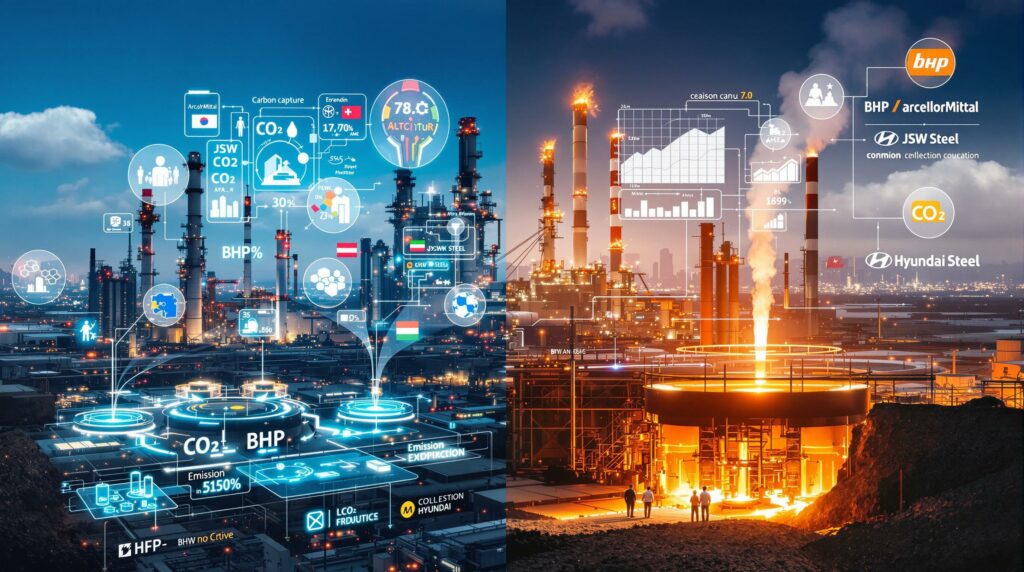
BHP Leads Steelmaker Carbon Capture Alliance
The chart visualizes the CCUS hub model led by BHP in partnership with steelmakers, directly aligning with the section’s focus on this strategic approach.
(Source: Discovery Alert)
$7.6 B in Incentives, BHP Project Viability Analysis
The financial viability of capital-intensive CCUS hubs is fundamentally dependent on government incentives that de-risk private investment and shorten payback periods. Recent policy actions between 2025 and 2026, particularly in Canada and the UK, have created powerful financial models that are now being emulated to attract the trillions in private capital needed for climate action in regions like Asia. Without these policy backstops, large-scale industrial decarbonization projects would remain economically unfeasible.

Government Incentives Underpin CCUS Hub Viability
This chart is matched because its $7.6B value and 2026 timeframe directly correspond to the $7.6B in government incentives discussed in the section.
(Source: Discovery Alert)
- In January 2026, the Canadian government formalized its CCUS Investment Tax Credit, a policy valued at $7.6 billion by 2030, offering refundable credits of up to 60% on capture equipment. This provides a clear financial pathway that significantly lowers the barrier for Final Investment Decisions (FIDs).
- The UK government’s commitment of up to £20 billion ($25.4 billion) in December 2023 to foster a competitive CCUS market provides the long-term policy certainty required to unlock private sector investment in shared infrastructure projects like the Viking CCS and East Coast Cluster.
- These large-scale government commitments create a stable framework that informs the commercial strategy of consortiums led by companies like BHP, which can leverage these policy models when negotiating with host governments in Asia to secure similar incentives for their planned hubs.
- Even smaller, targeted investments have a catalytic effect. The $69.2 million in funding awarded by the Australian Government in October 2024 to the Central Queensland Hydrogen Hub, where BHP is a partner, de-risks the development of essential precursor infrastructure for both hydrogen and CCUS.
Table: Global CCUS and Hydrogen Hub Investments (2021-2026)
| Partner / Project | Time Frame | Details and Strategic Purpose | Source |
|---|---|---|---|
| Government of Canada (CCUS ITC) | Jan 2026 | A $7.6 billion refundable Investment Tax Credit to de-risk private capital investment in CCUS projects. | Natural Resources Canada |
| Occidental / ADNOC’s XRG | May 2025 | A potential $500 million joint venture to support a Direct Air Capture (DAC) facility in Texas capable of capturing 500, 000 tonnes of CO 2 annually. | Ghana Upstream |
| Australian Government (CQ-H 2) | Oct 2024 | $69.2 million in funding for the Central Queensland Hydrogen Hub, a project where BHP is a key partner, to develop shared infrastructure for low-carbon industries. | [PDF] National Hydrogen Strategy 2024 |
| UK Government (CCUS Sector) | Dec 2023 | Commitment of up to £20 billion ($25.4 billion) to establish a domestic CCUS market, providing a stable policy blueprint for industrial clusters. | GOV.UK |
BHP 5 Steelmaker Pacts, POSCO and Arcelor Mittal (2022 to 2026)
BHP‘s strategy has evolved from broad decarbonization dialogues to forming a structured consortium aimed at building specific, shared assets. This transition from general Memorandums of Understanding (Mo Us) to concrete project proposals with key customers like POSCO underscores a deliberate move to embed itself within the future carbon management infrastructure of the steel industry. These partnerships are designed to create a captive market for shared CCUS services, securing long-term demand for BHP‘s core commodities by ensuring its customers have a viable path to decarbonization.

POSCO’s Hydrogen-Based Steelmaking Plan
As POSCO is a key partner named in the section, this chart illustrates the hydrogen-based technology central to the decarbonization pacts BHP is forming.
(Source: Ignacio Ibarrondo – Iron and Steelmaking)
- A pivotal development occurred in April 2026 with the announcement that a BHP-involved consortium had identified five potential sites for shared CCUS hubs in the Asia-Pacific, moving the initiative from a concept to a tangible, site-specific plan.
- The Port Hedland Green Steel (PHGS) proposal with POSCO, formalized in late 2024, represents a key anchor project. This initiative for a hot briquetted iron (HBI) plant in Western Australia provides the initial industrial demand necessary to justify a regional CCUS network.
- Prior to these specific projects, BHP’s activities from 2022 centered on building a broad coalition, signing agreements with global steelmakers like Arcelor Mittal and voestalpine to study decarbonization pathways, which laid the commercial groundwork for the current hub strategy.
- BHP’s participation in the Central Queensland Hydrogen Hub alongside Stanwell Corporation demonstrates a strategy of developing parallel and synergistic infrastructures, recognizing that future industrial parks will require integrated solutions for both hydrogen and carbon management.
Table: BHP Strategic Partnerships for Decarbonization
| Partner / Project | Time Frame | Details and Strategic Purpose | Source |
|---|---|---|---|
| Asia-Pacific CCUS Hub Consortium | Apr 2026 | A study identified five potential sites for shared CCUS infrastructure, providing a tangible roadmap for developing common transport and storage facilities for steelmakers and other industries. | Globe Newswire |
| POSCO (Port Hedland Green Steel) | Nov 2024 | A joint proposal for a downstream HBI plant in Western Australia, serving as a potential anchor tenant for a future industrial and CCUS hub. | [PDF] Climate Energy Finance |
| Stanwell Corporation & Australian Government | Oct 2024 | Participation in the Central Queensland Hydrogen Hub (CQ-H 2), which was awarded $69.2 million to develop foundational infrastructure for low-carbon industries. | [PDF] National Hydrogen Strategy 2024 |
| Global Steelmakers (incl. Arcelor Mittal) | Sep 2022 | Formation of a consortium to explore and develop shared CCUS infrastructure, aiming to decarbonize existing BF-BOF steelmaking assets in key markets. | [PDF] BHP Annual Report 2022 |
Asia-Pacific vs. North America, BHP Geographic Focus
The geographic focus for large-scale CCUS hub development has sharpened, with Asia-Pacific emerging as the strategic priority for industry-led consortia. While North America and Europe led initial development with policy-driven projects, the commercial imperative to decarbonize Asia’s massive and relatively young industrial base, particularly its steel sector, has made it the new center of gravity for shared infrastructure initiatives.

JFE Steel’s Asian Decarbonization Strategy
The chart provides a concrete example of a major Asian steelmaker’s strategy, supporting the section’s point about the strategic focus shifting to Asia-Pacific.
(Source: Ignacio Ibarrondo – Iron and Steelmaking)
- From 2025 to 2026, activity has converged on the Asia-Pacific region, led by BHP‘s consortium identifying five potential hub sites. This is driven by the concentration of steel production and the strategic need to provide a decarbonization solution for key customers in Japan, South Korea, and China.
- Australia is positioned as a key enabler for this strategy, not just as an emitter but as a potential location for both downstream processing (e.g., Port Hedland) and large-scale geological CO 2 storage, creating a symbiotic relationship with carbon-importing nations.
- This contrasts with the 2021-2024 period, where flagship projects were predominantly located in North America (like the Pathways Alliance in Canada) and Europe (the UK’s East Coast Cluster), driven primarily by domestic climate policies and established regulatory frameworks.
- The success of Asian hubs will depend on replicating the policy and regulatory certainty seen in the West, including the critical development of transboundary agreements to allow for the transport and storage of CO 2 between countries.
Technology Maturity, BHP Focus on TRL 8-9 Solutions
The consortium’s strategy is built on a foundation of technologically mature and commercially proven components, de-risking deployment by focusing innovation on business models and scale rather than on novel technology. This pragmatic approach leverages existing solutions with high Technology Readiness Levels (TRL) to offer a near-term decarbonization pathway for existing industrial assets. The core challenge is not invention but system integration and cost reduction through massive scale.

Integrating Mature Tech for Decarbonization
This process diagram shows the integration of proven technologies into existing steelmaking, perfectly illustrating the section’s focus on high-TRL, commercially ready solutions.
(Source: Ignacio Ibarrondo – Iron and Steelmaking)
- The primary capture technology for the proposed hubs, post-combustion amine scrubbing for blast furnaces, is a mature solution at TRL 8-9. It is a known quantity that can be retrofitted onto existing steel plants, which is essential for decarbonizing the current fleet in Asia.
- Shared CO 2 transport via pipelines (TRL 9) and permanent geological storage in saline aquifers or depleted fields (TRL 9) are both fully proven technologies with decades of operational history, primarily from the enhanced oil recovery industry.
- The period from 2025 to 2026 saw the consortium actively evaluating next-generation technologies like Capsol’s Hy Caps (TRL 6) to improve future cost-effectiveness, but the initial deployment relies on established methods to ensure project bankability.
- From 2021 to 2024, the narrative often included a wider range of emerging technologies. The recent strategic shift focuses squarely on deploying what works now, while keeping an eye on future improvements, signaling a move from R&D exploration to commercial execution.
SWOT Analysis, BHP CCUS Hubs Strategy
The strategic position of BHP‘s consortium-led hub model has been clarified and strengthened between 2024 and 2025 as government policy and industry commitment have aligned. While fundamental challenges like capital cost and reliance on carbon pricing remain, the shift from conceptual exploration to tangible, site-specific planning has validated the core strengths of the collaborative, infrastructure-led approach.
- Strengths: The consortium’s primary strength is its ability to de-risk massive capital investments and create economies of scale by sharing infrastructure costs, a model now actively supported by emerging government policies.
- Weaknesses: The strategy remains highly dependent on the future implementation of robust carbon pricing in Asia and the successful, timely development of vast geological storage sites, which carry their own technical and social license risks.
- Opportunities: BHP has a first-mover opportunity to establish itself as the central operator of carbon management infrastructure for the Asian steel industry, creating a powerful competitive moat and securing demand for its iron ore.
- Threats: The primary long-term threat is the maturation of competing decarbonization pathways, specifically green hydrogen-based Direct Reduced Iron (DRI), which could eventually render the BF-BOF with CCUS route obsolete if it becomes economically superior.
Table: SWOT Analysis for BHP’s Shared CCUS Hub Strategy
| SWOT Category | 2021 – 2024 | 2025 – 2026 | What Changed / Validated |
|---|---|---|---|
| Strengths | Conceptual advantage of cost-sharing and risk mitigation through a hub model. Strong market position as a leading iron ore supplier. | Demonstrated ability to form a high-power consortium (POSCO, etc.) and secure government support (e.g., CQ-H 2 funding). Use of proven, high-TRL technologies. | The theoretical strength of the hub model was validated by the formation of the consortium and the identification of five specific potential sites in Asia-Pacific. |
| Weaknesses | High theoretical CAPEX for CCUS. Uncertainty around long-term CO 2 storage liability. Dependence on nascent carbon policies in Asia. | Continued reliance on external factors: requires carbon prices of $100+ per tonne for viability. Public and regulatory acceptance of large-scale storage is still being tested. | The financial weakness was partially addressed by new government incentives (Canada, UK), but the core need for a high carbon price in Asia remains an unresolved variable. |
| Opportunities | Potential to secure long-term demand for iron ore and metallurgical coal by offering a decarbonization solution to steelmakers. | The global CCUS market is forecast to grow significantly, with some estimates projecting a market size of over $51 billion by 2030. Leadership role in a high-growth sector. | The opportunity moved from a general market trend to a specific, addressable market as the consortium solidified its plans and market growth forecasts became more aggressive. |
| Threats | Competition from alternative ‘green steel’ pathways like hydrogen-based Direct Reduced Iron (DRI). Risk of stranded assets if CCUS is seen only as a temporary bridge. | Continued acceleration of H 2-DRI projects globally. The “transitional” nature of CCUS is more widely acknowledged, creating a timeline for its relevance. | The threat from hydrogen has become more defined, forcing the CCUS strategy to be positioned explicitly as a near-to-mid-term solution for existing assets, not a permanent one. |
5 Hub FIDs, BHP Signals for 2026-2027
The critical action for the next 18-24 months is the transition from feasibility studies to Final Investment Decisions (FIDs) for the first of the five identified Asia-Pacific CCUS hubs. An FID would represent the most important signal of commercial validation, unlocking billions in capital and triggering the physical build-out of pipelines and storage facilities. The success of this entire strategy now rests on converting plans into committed projects.
- If this happens: The BHP-led consortium announces an FID for at least one of the five hub sites with anchor tenants like POSCO.
- Watch this: The establishment of bilateral agreements for transboundary CO 2 transport between Australia and key partners like Japan or South Korea. These legal frameworks are a prerequisite for a regional carbon market.
- These could be happening: Other industrial sectors in the region (e.g., cement, chemicals) begin signing Mo Us to join the hubs, further strengthening the business case through increased CO 2 volume. Conversely, a lack of new members could signal insufficient economic pull.
The questions your competitors are already asking
This report covers one angle of BHP’s strategy for building cross-industry carbon infrastructure. The questions that matter most depend on your work.
- BHP’s activities in CCUS. Is the steelmaker consortium progressing from feasibility studies to deployment at its five proposed Asian hubs?
- BHP investments and funding in steel decarbonization. Is the $69M partnership with POSCO on track for its 2026 targets?
- Which global steelmakers are gaining or losing ground in the race to deploy shared CCUS infrastructure?
- Which hard-to-abate sectors beyond steel are adopting the consortium-led CCUS hub model?
This report does not answer these. Enki Brief Pro does.
Your question, your angle, your framework. SWOT, PESTL, scenario modelling. The same niche depth, built around the decision your work actually depends on.
