

Microsoft BECCS Strategy, 650 K Tonne Bio Circ Deal, 626 K Tonne Canadian Offtake, and 5 Agreements (2026)
Market Dependency Risk, Microsoft’s 80% Share of CDR Purchases
The durable carbon dioxide removal (CDR) market’s growth is almost entirely dependent on Microsoft, creating a systemic risk where the sector’s viability is tied to the strategic decisions of a single buyer. This dependency became clear in 2026 as the company’s urgent need to offset a 25% emissions increase, driven by AI data center expansion, forced a strategic pivot toward immediately scalable CDR solutions. The market’s heavy reliance on one customer, which accounts for an estimated 80% to 93% of all durable CDR credits purchased globally, means its trajectory is shaped more by one company’s balance sheet than by diversified industrial demand.
- Between 2021 and 2024, Microsoft pursued a diversified portfolio approach, investing in a wide range of emerging CDR technologies to stimulate market development. This included early-stage offtakes in Direct Air Capture, bio-oil, and other novel methods, aimed at fostering a broad technology ecosystem.
- The period from 2025 to 2026 marks a significant strategic shift from portfolio diversification to securing volume at scale. Faced with surging internal emissions, Microsoft focused its purchasing power on the most commercially mature technology, Bioenergy with Carbon Capture and Storage (BECCS), which now constitutes 76% of its contracted CDR volume.
- The market’s fragility was exposed in April 2026 when reports of a temporary pause in Microsoft‘s purchasing activity caused industry-wide concern. This event validated that the entire sector’s financial stability and project bankability are currently contingent on the procurement strategy of one corporation.
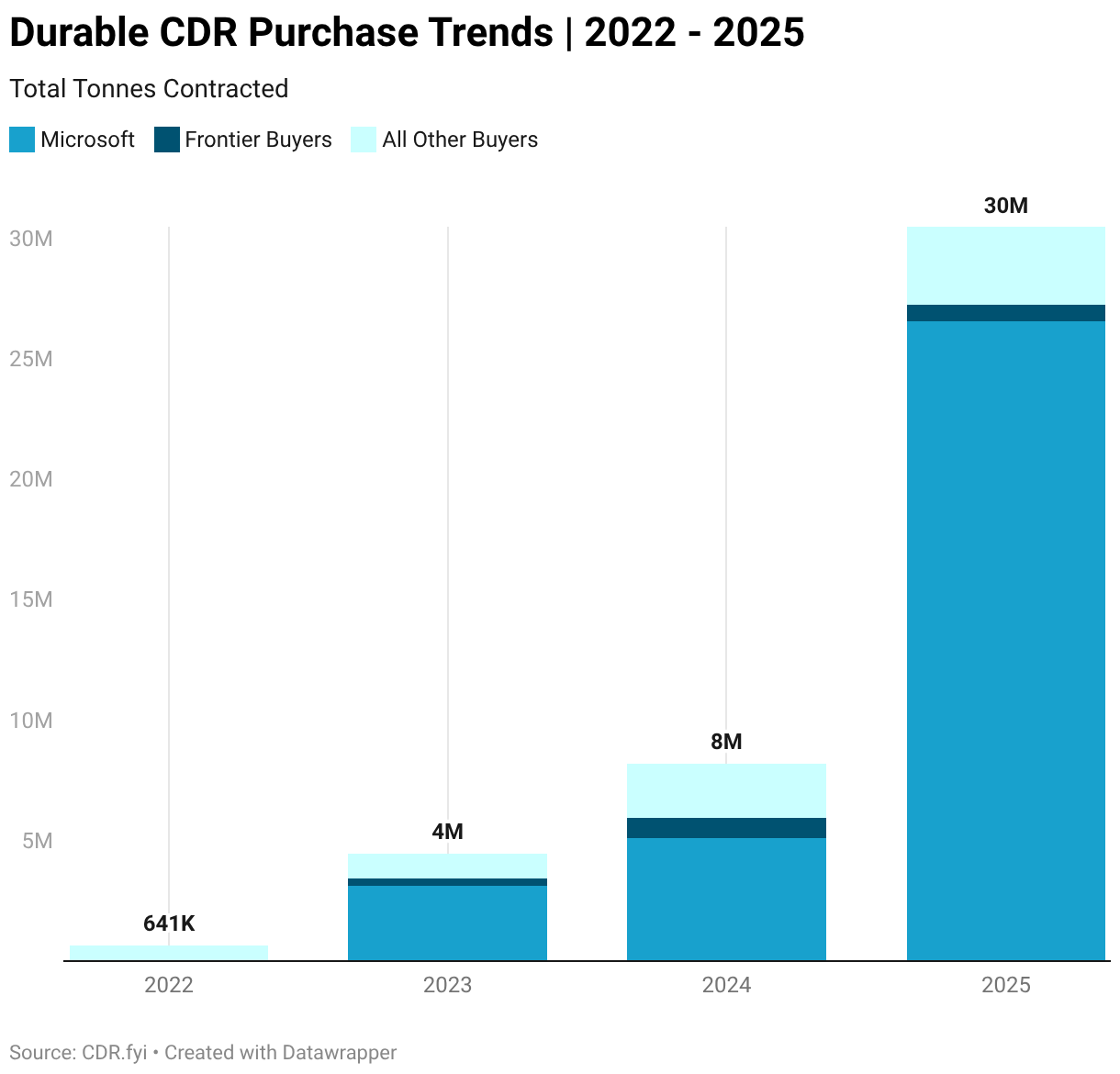
Microsoft’s CDR Portfolio Rockets to 27M Tonnes by 2025
Microsoft’s durable Carbon Dioxide Removal (CDR) purchases are set to explode, growing from 641K tonnes in 2022 to an estimated 27M tonnes by 2025. This meteoric rise positions Microsoft as the overwhelming leader, commanding over 90% of the 30M total tonnes contracted by 2025.
Microsoft’s Investment De-Risks CDR, Catalyzing Market Growth
Microsoft’s aggressive procurement strategy is not just about its own net-zero goals; it’s a massive market signal. This early, large-scale investment de-risks nascent CDR technologies, attracting further capital and accelerating critical infrastructure development required for broader industrial adoption, paving the way for diverse carbon removal solutions.
BECCS Market Set for 400%+ Growth to $18.61B by 2035
The Bioenergy with Carbon Capture and Storage (BECCS) market is projected for substantial growth, expanding from $3.74 billion in 2025 to $18.61 billion by 2035. This indicates a strong upward trend in demand and investment for BECCS solutions, signaling a critical role in future carbon removal strategies.
(Source: Microsoft Carbon Capture 2025, $1.4B Stockholm Exergi Deal)
Microsoft BECCS Offtakes, 1.2 M Tonnes from Bio Circ and Svante (2026)
In 2026, Microsoft solidified its commitment to BECCS through a series of large-scale, long-term offtake agreements that provide the financial certainty required for capital-intensive projects to secure funding. These partnerships, signed after a brief recalibration of its purchasing strategy in April 2026, signal a clear preference for BECCS projects that can deliver high volumes of durable carbon removal credits in the near term. The agreements serve as a critical de-risking mechanism, making multi-million-dollar carbon capture facilities bankable.
- The landmark agreement with Bio Circ in May 2026 commits Microsoft to purchasing up to 650, 000 tonnes of carbon removal over seven years from the company’s Danish BECCS platform, demonstrating confidence in European bioenergy infrastructure.
- An offtake agreement with the North Star project, a partnership between Svante and the Meadow Lake Tribal Council (MLTC) in Canada, secures 626, 000 tonnes of CDR credits for Microsoft over a 15-year term, highlighting a focus on projects with strong community and indigenous engagement.
- Beyond BECCS, Microsoft has continued to sign high-volume agreements for other forms of durable removal, including a ten-year deal for one million tonnes of carbon removal units from Liferaft, which specializes in biomass geological sequestration.
- The company also diversifies with nature-based solutions, seen in a deal for 100, 000 tonnes of biochar-based removal from India’s Varaha and a separate agreement to buy 2 million credits from a forestry project in Uganda.
Table: Microsoft Carbon Removal Partnerships in 2026
| Partner / Project | Time Frame | Details and Strategic Purpose | Source |
|---|---|---|---|
| Bio Circ | May 20, 2026 | Seven-year agreement to purchase up to 650, 000 tonnes of CDR from a Danish BECCS platform. This deal signaled Microsoft‘s re-entry into the market with a focus on scalable European projects. | ESG Today |
| Svante & Meadow Lake Tribal Council | Apr 6, 2026 | A 15-year offtake for 626, 000 tonnes of CDR from the majority Indigenous-owned North Star BECCS project in Canada. This secures long-term supply from a North American facility. | Business Wire |
| Liferaft (via Supercritical) | Mar 24, 2026 | Ten-year agreement for 1 million tonnes of CDR units based on biomass geological sequestration. This diversifies the portfolio with another high-durability removal pathway. | Supercritical |
| Rubicon Carbon | Jan 14, 2026 | Agreement for Microsoft to purchase 2 million carbon removal credits from the Kijani Forestry Project in Northern Uganda, adding large-scale afforestation to the portfolio. | Carbon Credits.com |
| Varaha | Jan 15, 2026 | Offtake agreement for 100, 000 tonnes of biochar removal credits over several years from the India-based specialist, expanding the portfolio’s geographic and technological diversity. | Real Economy Progress |
North America vs. Global South, Microsoft’s CDR Sourcing Strategy
Microsoft‘s sourcing strategy reveals a bifurcated approach, prioritizing high-cost, high-durability engineered removals like BECCS in North America and Europe while sourcing lower-cost, nature-based solutions from the Global South. This geographic segmentation reflects a pragmatic calculation based on infrastructure availability, regulatory certainty, and project bankability. The concentration of capital-intensive BECCS projects in developed nations is a direct result of established bioenergy supply chains and supportive policy environments.
- From 2021 to 2024, Microsoft‘s geographic sourcing was more experimental, with investments spread across various regions to test the viability of different CDR pathways and stimulate a global market.
- In 2025 and 2026, the strategy crystallized. Major BECCS offtakes were signed for projects in Denmark (Bio Circ) and Canada (Svante/MLTC), regions with mature industries and clear carbon storage regulations that reduce project risk.
- Simultaneously, the company secured large volumes of credits from projects in Uganda (2 million tonnes from Rubicon Carbon‘s forestry project) and India (100, 000 tonnes of biochar from Varaha), leveraging the scalability of nature-based solutions in these regions.
TRL 7-8, Microsoft’s Pragmatic Choice of BECCS over DAC
The dominance of BECCS in Microsoft‘s portfolio is a pragmatic decision driven by technology readiness and the urgent need for scalable removal, rather than a verdict on the long-term potential of other technologies. BECCS, which leverages existing biomass and power generation infrastructure, is at a higher Technology Readiness Level (TRL 7-8) compared to many Direct Air Capture (DAC) projects that are still in earlier commercial stages. This maturity provides a more predictable path to generating the mega-tonne volumes of CDR credits Microsoft requires to meet its 2030 carbon-negative goal.
- Between 2021 and 2024, Microsoft made foundational investments in DAC companies, helping to catalyze that market segment, but the technology did not scale fast enough to meet the company’s escalating removal needs.
- The market reality in 2026 shows DAC costs remaining high, at $200 to over $600 per tonne, with significant development timelines. In contrast, BECCS offers a more immediate and commercially viable pathway for large-scale removals.
- The “bankability” of BECCS projects is enhanced by their ability to generate revenue from both electricity sales and carbon credit offtakes, a dual-revenue stream that is more attractive to project financiers compared to pure-play CDR models like DAC.

BioCCS Dominates Carbon Removal Market with 71% Share as Demand Surges 7x by 2025
BioCCS accounts for 71% of the 29,187 ktCO2 total publicly disclosed carbon removal purchases, dwarfing other methods like Terrestrial Biomass (17%) and Biochar (6%). The total volume of removals is projected to surge from 4.1 ktCO2 in 2023 to 29.2 ktCO2 by 2025, a 7x increase, indicating rapid market expansion.
Scaling Carbon Removal: BioCCS Leads as Corporate Demand Accelerates, Outpacing Nascent Technologies
The dramatic 7x scale-up in carbon removal purchases by 2025 underscores intense corporate demand for verifiable solutions, driven by net-zero commitments. BioCCS’s overwhelming lead suggests its current scalability and cost-effectiveness make it the preferred choice for large-volume purchasers, indicating a maturity advantage over nascent technologies like Direct Air Capture (DAC) which holds only a 1% share.
BECCS Offers 2.5X Cost Efficiency Over DACCS in CDR Market
Bioenergy with Carbon Capture and Storage (BECCS) credits are priced at $300/ton of CO2 equivalent, offering a significant cost advantage over Direct Air Capture with Carbon Storage (DACCS) at $773/ton. This positions BECCS as a highly attractive, economical option for scaling carbon removal efforts.
SWOT Analysis, Microsoft’s BECCS Strategy Execution Risks
Microsoft‘s strategic pivot to BECCS leverages its market power to build a scalable carbon removal portfolio, but this concentration creates significant execution risks and market vulnerabilities. The analysis below details the strengths, weaknesses, opportunities, and threats inherent in this approach, contrasting the initial portfolio-building phase with the current high-volume procurement strategy.
Table: SWOT Analysis for Microsoft’s BECCS-Centric CDR Strategy
| SWOT Category | 2021 – 2024 | 2025 – 2026 | What Changed / Validated |
|---|---|---|---|
| Strengths | Market catalyst through diversified investments across multiple CDR pathways. Established reputation as a credible first-mover. | Market-making purchasing power used to underwrite and de-risk large, capital-intensive BECCS projects (e.g., Bio Circ, Svante). Securing high-volume, durable supply. | The 2026 offtake agreements validated that Microsoft‘s primary strength is its ability to make nascent markets bankable through long-term purchase commitments. |
| Weaknesses | Portfolio spread too thin across unproven technologies, with limited near-term volume to offset growing emissions. | Over-reliance on a single CDR technology (BECCS) and a single buyer (Microsoft), creating systemic market risk. The April 2026 “pause” highlighted this vulnerability. | The emissions surge of 25% revealed that the prior diversified strategy was insufficient, forcing a pivot that introduced concentration risk as a new primary weakness. |
| Opportunities | Cultivate a diverse global ecosystem of CDR suppliers and technologies. | Scale the BECCS industry rapidly to meet 2030 climate goals. Set a precedent for corporate CDR procurement that other companies can follow. | The opportunity shifted from nurturing a broad market to proving that at least one durable CDR pathway can be scaled to the mega-tonne level required for corporate net-zero targets. |
| Threats | Reputational damage from investing in low-quality or failed CDR projects. Slow pace of technology development. | Emissions growth from AI outpaces the supply of available CDR credits. BECCS projects face public opposition or fail to deliver on promised volumes, impacting Microsoft‘s carbon-negative pledge. | The primary threat was validated: internal emissions growth is the biggest challenge to the climate strategy, creating a race between emissions and removals that Microsoft may not win. |
Scenario Modelling, Microsoft’s Future CDR Portfolio Diversification
If Microsoft‘s emissions continue to grow at a significant rate, the company will be forced to secure even larger volumes of carbon removal, placing immense pressure on the nascent BECCS supply chain and potentially driving up prices for all buyers. Watch for signals of portfolio diversification away from BECCS and into other engineered pathways, such as DAC, as those technologies mature and their costs decline. The company’s next wave of purchases will indicate whether it is doubling down on BECCS or re-investing in a broader technology base to mitigate supply risk.
- If BECCS projects successfully come online and deliver credits as promised, watch for Microsoft to sign additional mega-deals that further entrench the technology as the market standard for durable CDR through 2030.
- If other large corporations enter the durable CDR market at scale, possibly through consortiums like Frontier, this could create competition for a limited supply of high-quality credits. This would reduce the market’s dependency on Microsoft but increase procurement costs.
- A key indicator of a strategic shift would be Microsoft signing a DAC offtake agreement in the multi-hundred-thousand-tonne range, which would signal that DAC technology has reached a level of commercial maturity and cost-effectiveness sufficient to contribute meaningfully to its portfolio.
The questions your competitors are already asking
This report covers one angle of Microsoft’s carbon removal strategy. The questions that matter most depend on your work.
- Financing details for new bioenergy carbon capture projects
- Who else is buying durable carbon removal credits
- Direct air capture project costs and timelines 2027
- Bioenergy supply chain risks for carbon capture
This report does not answer these. Enki Brief Pro does.
Your question, your angle, your framework. SWOT, PESTL, scenario modelling. The same niche depth, built around the decision your work actually depends on.
