

CMA CGM Green Methanol Strategy, $1.5 B Fund, Shanghai Electric Deal, 24 Ships, and 5 Key Agreements (2021-2025)
CMA CGM 24 Methanol Ships and 5 Supply Deals Signal Market Creation (2021-2025)
In 2025, CMA CGM transitioned from a participant in the energy transition to an active market-maker, systematically solving the supply-demand deadlock for green maritime fuels. The company pivoted from a primary focus on LNG to aggressively building dedicated value chains for green methanol and its derivatives, using its financial scale and vessel order book to de-risk investment for fuel producers and secure its own future supply.
- Before 2025, CMA CGM‘s strategy centered on LNG-powered dual-fuel vessels as the primary transitional pathway. While forward-looking, this approach relied on an existing, albeit fossil-based, fuel infrastructure.
- The strategic shift in 2025 is defined by tangible actions to create a new fuel ecosystem. The landmark long-term supply agreement with Shanghai Electric and SIPG Energy on March 20, 2025, established a hydrogen-based green methanol value chain, directly connecting production to CMA CGM‘s fleet.
- This market-creation strategy is further evidenced by the collaboration with Masdar and AD Ports Group to explore a major e-methanol bunkering hub in the UAE. This move is designed to establish downstream infrastructure in parallel with upstream supply, a critical step that solves the “chicken-and-egg” dilemma paralyzing competitors.
- The deployment of the methanol-fueled CMA CGM ANTIGONE on a major Asia-Mediterranean trade route in December 2025 serves as a commercial proof-of-concept, demonstrating the operational viability of its strategy on key global shipping lanes.
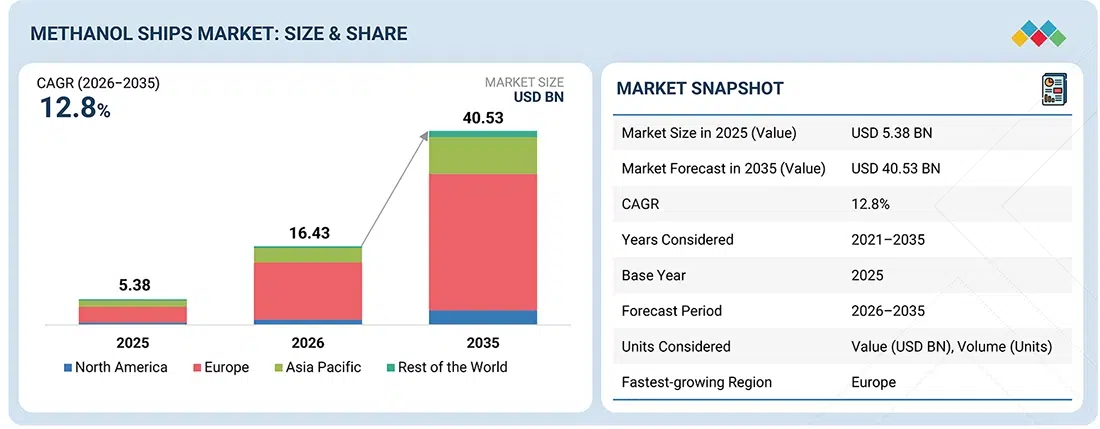
Methanol Ships Market to Reach $40.5B by 2035
The chart quantifies the overall market opportunity for methanol-powered vessels, providing context for the section’s focus on CMA CGM’s specific investment in 24 such ships and its role as a market creator.
(Source: MarketsandMarkets)
$1.5 B Fund for Energies, CMA CGM Accelerates Methanol and Bio-LNG Projects
CMA CGM is backing its decarbonization strategy with significant and targeted capital, using its dedicated $1.5 billion “Fund for Energies” to catalyze the production of low-carbon fuels. This financial commitment serves a dual purpose: it provides the necessary capital to stimulate nascent production projects while justifying the company’s own multi-billion dollar investments in a next-generation, dual-fuel fleet.
- The $1.5 billion fund, established to accelerate the energy transition over five years, is the primary financial engine behind CMA CGM‘s pursuit of green methanol and bio-LNG. In 2025, it enabled key investments in partnerships and supply agreements.
- This fund directly supports the company’s massive fleet modernization. A $2.6 billion order for twelve 18, 000-TEU ships, likely dual-fuel compatible, was placed in 2025, adding to its confirmed pipeline of at least 24 methanol-powered vessels by 2029.
- Beyond large-scale projects, the fund facilitates strategic equity stakes. As an existing shareholder in Hy 2 gen, CMA CGM supported a new funding round in April 2025, accelerating the development of renewable hydrogen production facilities.
- The company is also diversifying its fuel portfolio by investing in bio-LNG. An August 2025 investment in Vanguard Renewables secures a long-term supply of renewable natural gas (RNG), providing an immediate pathway to reduce emissions while the green methanol infrastructure matures. This strategy complements its work in direct air capture and other forms of carbon capture.

Analysis Compares Methanol and LNG Shipping Fuels
As the section highlights CMA CGM’s dual investment in both methanol and bio-LNG projects, this chart provides a direct comparative analysis of these two key fuel options, helping to explain the strategic rationale behind the investment.
(Source: Nature)
Table: CMA CGM Strategic Investments and Fleet Modernization (2025)
| Investment Focus | Time Frame | Details and Strategic Purpose | Source |
|---|---|---|---|
| Fleet Expansion | Sep 30, 2025 | $2.6 Billion order for twelve 18, 000-TEU dual-fuel capable container ships to modernize the fleet and ensure readiness for new fuels. | Apollo Global Experts |
| Fund for Energies | Sep 28, 2025 | Deployment of a $1.5 billion fund dedicated to investing in and sourcing alternative fuels, including green methanol and bio-LNG. | [PDF] UNCTAD |
| Bio-LNG Supply Chain | Aug 21, 2025 | Strategic investment in Vanguard Renewables to secure a supply of bio-LNG, diversifying its low-carbon fuel portfolio as a complement to methanol. | Offshore Energy |
| Green Hydrogen Production | Apr 29, 2025 | Participation in a EUR 47 Million funding round for Hy 2 gen to accelerate its pipeline of renewable hydrogen production projects. | Hy 2 gen |
| US Maritime Infrastructure | Mar 6, 2025 | A $20 billion, four-year investment commitment to enhance US maritime and logistics capabilities, including infrastructure to support new-fuel vessels. | CMA CGM |

CMA CGM Shipping Performance Trends Through 2025
This chart illustrates the operational outcomes directly related to the fleet modernization and strategic investments detailed in the section’s table. Modernization impacts performance, and this chart visualizes those trends.
(Source: Maritime Analytica)
China to UAE, CMA CGM Builds Global Green Methanol Bunkering Network
CMA CGM‘s 2025 partnership strategy constructs an end-to-end green methanol value chain, strategically spanning key global regions from production hubs in Asia to bunkering centers in the Middle East. This network approach is designed to secure fuel not just at a single point, but across the world’s most critical trade arteries, ensuring operational flexibility for its future fleet.
- The most critical partnership is the long-term supply agreement with SIPG Energy and Shanghai Electric in China. This collaboration, signed in March 2025, focuses on the upstream production of hydrogen-based green methanol, creating a stable source of supply near major manufacturing and shipping hubs.
- To secure downstream distribution, CMA CGM signed a collaboration agreement in June 2025 with AD Ports Group, Masdar, and Advario. This project explores a major e-methanol production and bunkering facility in the UAE, creating a vital refueling station on the critical Asia-Europe trade route.
- Complementing its methanol strategy, CMA CGM formed a partnership with US-based Vanguard Renewables in August 2025. This deal secures a supply of bio-LNG, offering a diversified, low-carbon fuel option that leverages its existing LNG-capable fleet.
- The company also reinforced its transitional fuel supply by launching a joint venture with Total Energies in July 2025 for LNG bunkering services in Rotterdam, a key European port, securing up to 360, 000 tons of LNG annually.

Methanol Market to Reach 143M Tons by 2031
The chart provides the demand-side context for building a global bunkering network. The projected growth of the methanol fuel market in tonnage justifies the large-scale infrastructure investment described in the section.
(Source: Mordor Intelligence)
Table: CMA CGM Green Fuel Partnerships (2025)
| Partner(s) | Time Frame | Details and Strategic Purpose | Source |
|---|---|---|---|
| Vanguard Renewables | Aug 20, 2025 | Strategic partnership to secure long-term supply of renewable natural gas (RNG/bio-LNG) for decarbonizing shipping operations. | Vanguard Renewables |
| Total Energies | Aug 5, 2025 | Joint venture for LNG bunkering in Rotterdam, securing up to 360, 000 tons of LNG per year until 2040 to fuel its transitional fleet. | Maritime Analytica |
| AD Ports Group, Masdar, Advario | Jun 4, 2025 | Collaboration agreement to explore developing an e-methanol bunkering and export facility in the UAE, creating a key bunkering hub. | Fuel Cells Works |
| SIPG Energy, Shanghai Electric | Mar 20, 2025 | Long-term supply cooperation agreement to establish a hydrogen-based green methanol value chain, securing upstream production for its dual-fuel vessels. | Safety 4 Sea |

Chart Shows 2024 Revenues of Green Hydrogen Leaders
Since green hydrogen is a primary feedstock for e-methanol, this chart highlights the financial scale of the types of companies CMA CGM would partner with, providing essential context for the partnerships listed in the table.
(Source: Report Prime)
Green Methanol Viability, CMA CGM Moves from Pilots to Commercial Deployment
The technological readiness of green methanol for maritime use advanced from pilot-scale validation to initial commercial deployment in 2025, with CMA CGM leading the charge. The company’s strategy of ordering methanol-ready vessels and securing fuel in parallel has proven that the technology is viable for major trade routes, shifting the industry challenge from technical feasibility to scaling production and reducing cost.
- Between 2021 and 2024, the primary focus was on dual-fuel engine technology and placing orders for vessels that could run on LNG with future compatibility for methanol. The technology was mature in theory but lacked at-scale operational deployment and a secure fuel supply chain.
- In 2025, CMA CGM bridged this gap by deploying the CMA CGM ANTIGONE, a purpose-built methanol-fueled container ship. Its operation on the Asia-Mediterranean route provides critical real-world data on engine performance, fuel consumption, and bunkering logistics.
- This deployment validates the dual-fuel vessel strategy. The ability of these ships to operate on LNG, bio-LNG, or green methanol provides crucial operational flexibility, allowing the company to adapt to fuel availability and price fluctuations during the transition.
- The supply agreements signed in 2025 represent the most significant validation point. By securing offtake, CMA CGM has confirmed that green methanol production can be scaled to meet the demands of a global shipping line, moving the technology from a niche alternative to a central pillar of its decarbonization roadmap.

Green Methanol Drastically Cuts Marine Emissions
This chart directly demonstrates the core ‘viability’ of green methanol by quantifying its primary benefit: emissions reduction. This data justifies the strategic shift from pilot programs to full commercial deployment.
(Source: Green Fuel Journal)
SWOT Analysis, CMA CGM’s First-Mover Advantage in Green Fuels
CMA CGM‘s aggressive 2025 strategy has established a significant first-mover advantage in the race to secure green fuels, but it also creates exposure to the nascent and volatile green methanol market. The company has effectively swapped long-term regulatory risk for near-term execution and market development risk.

Chart Outlines Shipping’s Phased Energy Transition
The chart visualizes the industry-wide timeline for the energy transition, providing the strategic backdrop for the section’s discussion of CMA CGM’s ‘first-mover advantage’ by showing the phases the company aims to lead.
(Source: ScienceDirect.com)
Table: SWOT Analysis for CMA CGM’s Green Fuel Strategy
| SWOT Category | 2021 – 2024 | 2025 – Today | What Changed / Validated |
|---|---|---|---|
| Strengths | Financial strength and large LNG dual-fuel order book. Strategic vision for decarbonization. | $1.5 B Fund for Energies actively deployed. Secured green methanol offtake (Shanghai Electric). Tangible infrastructure projects (UAE hub). | The company converted financial strength into market-shaping power, moving from a buyer of transition technology to a co-creator of the green fuel market. |
| Weaknesses | Heavy reliance on LNG as a transitional fuel, exposing it to methane slip regulations and price volatility. Lack of a clear post-LNG strategy. | High dependency on a few key partnerships for methanol supply. Fleet is still predominantly fossil-fueled. | The weakness shifted from strategic ambiguity to execution dependency. Success is now tied to the performance of its new fuel production partners. |
| Opportunities | Potential to lead in alternative fuels. Leverage purchasing power to influence fuel development. | Shaping industry standards for methanol bunkering. Securing preferential access and pricing for limited green fuel supply. Capitalizing on tightening regulations (EU ETS). | The opportunity moved from theoretical to tangible. By building the supply chain, CMA CGM is now in a position to define how the market operates. |
| Threats | Regulatory uncertainty. High cost of alternative fuels. “Chicken-and-egg” problem of fuel availability vs. vessel orders. | Competing fuel pathways (e.g., green ammonia) gaining traction. Slow cost reduction in green methanol production. Potential for supply disruptions from geopolitical factors. | The primary threat is no longer inaction, but that its chosen technological pathway (methanol) could be outmaneuvered by a more scalable or cost-effective alternative like ammonia. |

CMA CGM Revenue Performance Through Q2 2025
Strong revenue is a critical internal ‘Strength’ in a SWOT analysis. This chart provides the key financial data that underpins the company’s ability to fund its green fuel strategy, making it a perfect supplement to the SWOT table.
(Source: Maritime Analytica)
CMA CGM 2026 Outlook: Watch UAE Hub FID and Sino-French Supply Volumes
The critical factor for CMA CGM‘s strategy in the year ahead is the successful execution of its foundational 2025 partnerships. The transition from agreements to physical molecules and reliable bunkering operations will determine whether its first-mover advantage solidifies into a sustainable competitive edge.
- If a positive Final Investment Decision (FID) is announced for the UAE e-methanol hub with Masdar and AD Ports Group, watch for a new wave of vessel orders specifically for methanol-powered ships, as this would secure a critical bunkering point on a major trade lane.
- The operational start of the green methanol value chain with Shanghai Electric and SIPG Energy will be the most important signal. The first bunkering operations at scale in China will validate the entire upstream strategy and provide a template for future supply hubs.
- Any new investments from the $1.5 billion “Fund for Energies” into green ammonia production or bunkering would indicate a strategic hedging or diversification beyond methanol, acknowledging the ongoing competition between future fuels.
- Conversely, delays in the UAE project or lower-than-expected production volumes from the Chinese partnership could signal that scaling green fuel production is more challenging than anticipated, potentially forcing a greater reliance on bio-LNG and conventional LNG for its dual-fuel fleet in the medium term.

CMA CGM Details Biomethane Shipping Initiative
The section provides a forward-looking outlook. As CMA CGM is also investing in bio-LNG (biomethane), this chart offers a concrete example of the type of supply initiatives that are central to the company’s 2026 strategic goals.
(Source: Offshore-Energy.biz)
The questions your competitors are already asking
This report covers one angle of CMA CGM’s role as a market-maker for green maritime fuels. The questions that matter most depend on your work.
- Which shipping lines are gaining or losing ground in the race to secure green methanol supply?
- CMA CGM’s $1.5 B Fund for Energies. Is the Shanghai Electric and SIPG Energy green methanol value chain on track to supply the company’s 24-ship fleet?
- CMA CGM’s activities with Masdar and AD Ports Group. Is the partnership progressing from exploration to a major e-methanol bunkering hub in the UAE?
- What are the opportunities for fuel producers and technology firms in the green methanol-for-shipping market that CMA CGM is creating?
This report does not answer these. Enki Brief Pro does.
Your question, your angle, your framework. SWOT, PESTL, scenario modelling. The same niche depth, built around the decision your work actually depends on.
