

Data Center Risk 2026: How the US-Iran War Made Digital Infrastructure a Battlefield
From Theoretical Risk to Kinetic Reality: The New Threat to Data Centers
The recent escalation of the US-Iran conflict has fundamentally altered the risk calculus for digital infrastructure, transforming data centers from neutral commercial assets into direct military targets. Before 2025, the primary threats to data centers were theoretical, centering on energy price volatility from disruptions in the Strait of Hormuz and the rising sophistication of state-sponsored cyberattacks. The current conflict has made the physical destruction of these facilities a realized threat, forcing a complete strategic re-evaluation across the industry focused on surviving the US-Iran Conflict.
- In the period between 2021 and 2024, risk management focused on mitigating cyber threats from groups like Iran’s Oil Rig/APT 34 and managing soaring operational costs from the enormous energy appetite of the AI boom. The concern was digital disruption and economic strain, not physical annihilation.
- The paradigm shifted in March 2026 when Iranian drone strikes successfully damaged three separate Amazon Web Services (AWS) data centers in the United Arab Emirates and Bahrain. This marked the first known direct military attack on a major US cloud provider’s core infrastructure.
- The nature of the attacks, which caused structural damage, power failures, and fires, took the facilities offline and disrupted essential services like banking and computing across the region. Iran’s state media confirmed the strikes were deliberate, signaling that US technology infrastructure is now considered a legitimate target in hybrid warfare.
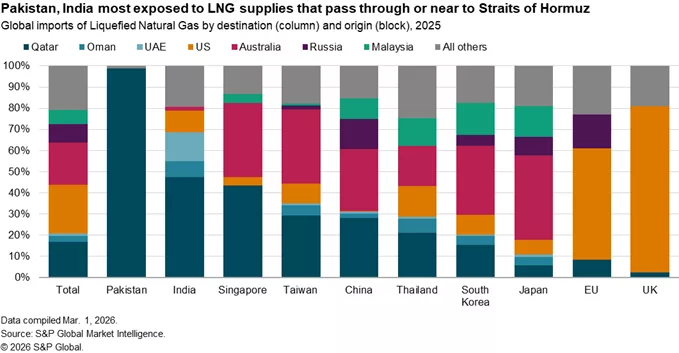
Energy Chokepoint Was a Pre-Conflict Threat
This chart illustrates the pre-conflict theoretical energy risk from the Strait of Hormuz, which the section identifies as a primary threat before kinetic attacks began.
(Source: S&P Global)
Investment at Risk: How the 2026 Conflict Derailed Data Center Finance
The physical attacks on data centers have triggered severe economic consequences, jeopardizing hundreds of billions in planned technology and infrastructure investments and forcing a capital shift from expansion to defense. The massive pre-conflict investments, driven by the AI boom, now face an unprecedented geopolitical risk premium that threatens project viability and reallocates capital towards hardening existing assets. This conflict reshapes ME investment strategies for the foreseeable future.

AI-Driven Investment Boom Faces Geopolitical Risk
This chart quantifies the massive scale of AI infrastructure investment, directly showing the value at risk that the section describes as being derailed by conflict.
(Source: Semafor)
- Over $300 billion in planned spending by Gulf nations on data centers, chips, and AI-related infrastructure is now under review due to the demonstrated physical risks to assets in the region. This capital was intended to establish the Gulf as a global AI hub.
- The global IT spending outlook for 2026 has been revised downwards by market intelligence firm IDC. A conflict lasting up to three months is projected to reduce global growth from a baseline of 10% to approximately 9%, with discretionary projects and device sales most affected.
- The conflict has also driven crude oil prices above $100 per barrel, directly increasing the operational expenditure for power-intensive data centers globally and straining the economic stability required for large-scale capital projects.
- Supply chain paralysis caused by disruptions to global shipping routes threatens the delivery of critical components, including servers and cooling systems. This could worsen the existing 2026 memory crisis, leading to significant project delays and cost overruns for data center construction worldwide.
Table: Major Infrastructure Investments Facing Heightened Geopolitical Risk in 2026
| Entity / Investor | Time Frame | Details and Strategic Purpose | Source |
|---|---|---|---|
| Gulf Nations | March 2026 | $300 Billion in planned spending on data centers and AI infrastructure is now at risk following direct attacks on regional facilities, imperiling the region’s goal of becoming an AI superpower. | The Information |
| Blackstone | January 2024 | A $25 billion investment initiative to build an AI data center empire now faces a riskier environment with higher capital costs, energy price volatility, and supply chain disruptions threatening returns. | Bloomberg |
| Microsoft | April 2024 | A strategic $1.5 billion investment in G 42, a UAE-based AI company, is now directly exposed to regional instability and heightened physical and cyber threats to assets located in a conflict zone. | The New York Times |
| Government of Canada | December 2024 | A proposed $15 billion incentive plan to attract pension fund investment in green AI data centers could be shelved as national budgets are redirected toward defense and security priorities in a war scenario. | The Globe and Mail |
Geography of Risk: The Middle East’s Retreat from Tech Hub to Conflict Zone
The US-Iran conflict has effectively stalled the Middle East’s rapid ascent as a global data hub, transforming a region of strategic growth into one of strategic retreat. Before the conflict, hyperscalers and investors flocked to the Gulf, drawn by government support and its central location. The recent attacks have exposed this geographic concentration as a critical vulnerability, forcing a rapid and costly reconsideration of where to place vital digital infrastructure.

Middle East Data Center Density Becomes Vulnerability
This map visualizes the high concentration of data centers across the Middle East, perfectly illustrating the geographic vulnerability and risk concentration discussed in the section.
(Source: Bloomberg.com)
- Between 2021 and 2024, the Gulf nations, particularly the UAE and Saudi Arabia, attracted billions in investments from companies like Microsoft and Blackstone, aiming to leverage their location and capital to build a world-class AI and data ecosystem.
- The March 2026 attacks reversed this trend. In a direct admission that it cannot guarantee physical security, AWS has urged its customers in the Middle East to migrate workloads and restore data to alternative facilities in the US and Europe.
- The conflict has also exposed the fragility of the region’s connectivity. The only two routes for submarine fiber-optic data cables in and out of the Gulf are now trapped behind war zones, effectively stranding trillions of dollars in planned investment and highlighting the danger of geographic chokepoints.
Technology Maturity: Data Center Security Evolves from Cyber Defense to Kinetic Warfare
The conflict has forced an immediate and dramatic evolution in data center security technology, shifting the focus from software-based cyber defense to hardware-based kinetic defense. Before 2025, technology roadmaps focused on improving energy efficiency and defending against digital intrusions. Now, the baseline for security in any contested region includes systems designed to defeat physical military attacks, fundamentally changing the design, cost, and architecture of future data centers.
- From 2021-2024, the primary technological security challenge was defending against sophisticated cyber actors like Iran-backed hacking groups. The focus was on network intrusion detection, data encryption, and preventing ransomware attacks.
- The drone strikes of 2026 rendered this focus insufficient. The conversation has now shifted to the practical necessity of “missile defence on datacentres, ” a concept that has moved from a theoretical contingency to a mandatory design requirement for critical infrastructure in high-risk zones.
- This shift will catalyze architectural changes, favoring smaller, hardened, and geographically dispersed facilities over the large, visible campuses that are easy targets. Long-term, speculative concepts like orbital data centers may gain traction as a solution for ultimate physical security.
SWOT Analysis: The Data Center Industry in a New Era of Conflict
The US-Iran conflict has exposed the vulnerabilities of a globalized digital infrastructure model built on economic optimization rather than geopolitical resilience. The industry’s strengths in attracting capital have been counteracted by weaknesses in physical security, while opportunities for regional growth have been eclipsed by the threat of direct military confrontation.
Table: SWOT Analysis for the Data Center Industry Amid Geopolitical Conflict
| SWOT Category | 2021 – 2024 (Pre-Conflict) | 2025 – Today (Conflict Era) | What Changed / Validated |
|---|---|---|---|
| Strengths | Massive capital influx for AI-driven growth; strong government support in emerging hubs (e.g., UAE, Saudi Arabia); economies of scale from large campus builds. | Demonstrated resilience in workload migration (AWS); established global footprint allows for geographic diversification away from conflict zones. | The strength of a global footprint was validated as a key resilience mechanism, while the strength of centralized campuses became a liability. |
| Weaknesses | Extreme energy consumption straining power grids; geographic concentration in geopolitically complex regions; reliance on vulnerable subsea cable chokepoints. | Proven physical vulnerability to military attack (drones, missiles); high operational costs due to energy price spikes; inability to guarantee physical security in certain regions. | Theoretical weaknesses (geographic concentration, chokepoints) were validated as critical, mission-ending vulnerabilities in a real-world conflict scenario. |
| Opportunities | Establish new global AI and data hubs in the Middle East; leverage green energy transitions for sustainable operations; build interconnected global infrastructure corridors (e.g., IMEC). | Accelerate investment in hardened and distributed data center designs; drive innovation in kinetic defense systems (anti-drone, missile defense); capture demand for “friend-shored” data infrastructure. | The opportunity shifted from geographic expansion to technological and architectural innovation focused on survival and resilience. |
| Threats | State-sponsored cyberattacks (e.g., ransomware, data theft); energy price shocks from regional instability; supply chain disruptions for critical components. | Direct kinetic attacks on commercial data centers; complete loss of investment in conflict zones ($300 B at risk); indefinite project delays and crippling cost overruns. | The primary threat was validated and escalated from digital and economic disruption to outright physical destruction of core assets. |
Scenario Modelling: Resilience Over Growth is the New Mandate
If the direct targeting of commercial digital infrastructure becomes a new norm in modern warfare, the data center industry must fundamentally prioritize defensive resilience and geographic diversification over pure cost-optimization and scalability. The illusion of infrastructure neutrality is gone, and future development must account for survival in a contested world.

Capital Flees to US Data Center Havens
This chart’s data on the US data center boom exemplifies the ‘geographic diversification’ and shift to resilient locations that the section posits as the new mandate.
(Source: Wood Mackenzie)
- If this happens: Other state or non-state actors adopt Iran’s playbook of targeting commercial data centers in future conflicts.
- Watch this: An accelerated push by hyperscalers like Microsoft and Google to shift planned investments from the Middle East to more secure, albeit higher-cost, locations in North America and Europe. Watch for announcements of new, smaller, and hardened data center builds.
- This could be happening: A significant portion of the $300 billion earmarked for Gulf AI projects is re-scoped. Capital is redirected from pure compute capacity towards advanced physical security, including anti-drone systems and redundant power infrastructure. Defense-tech stocks continue to see increased investor interest as the convergence of digital and defense industries solidifies.
Frequently Asked Questions
What specific event transformed data centers into military targets?
The turning point occurred in March 2026, when Iranian drone strikes successfully damaged three Amazon Web Services (AWS) data centers in the UAE and Bahrain. This marked the first known direct military attack on a major cloud provider’s core infrastructure, shifting the threat from theoretical to kinetic reality.
How has the US-Iran conflict impacted data center investment in the Middle East?
The conflict has jeopardized over $300 billion in planned spending by Gulf nations on data centers and AI. The physical attacks have stalled the region’s growth as a tech hub, forcing investors and companies like Microsoft and Blackstone to re-evaluate the viability of their projects due to the unprecedented geopolitical risk.
What were the primary risks to data centers before 2025?
Before the conflict escalated, the main risks were cyber threats from state-sponsored groups like Iran’s Oil Rig/APT 34, and economic challenges like soaring energy costs due to the AI boom and potential supply chain disruptions. The focus was on digital and economic security, not physical destruction.
How is data center security technology evolving in response to these new threats?
Data center security is shifting dramatically from a focus on cyber defense to kinetic defense. The industry is now planning for physical protection, with concepts like “missile defence on datacentres” becoming a mandatory design requirement in high-risk zones. This is also driving a move toward smaller, hardened, and geographically dispersed facilities instead of large, centralized campuses.
What advice is AWS giving its customers in the Middle East following the attacks?
Acknowledging it cannot guarantee physical security in the region, AWS has urged its customers in the Middle East to migrate their workloads and restore data to alternative facilities in the US and Europe. This signals a strategic retreat from the conflict zone to protect customer data and services.
