

US-Iran War 2026: The New Risk Calculus for Data Center Investment and Infrastructure
Geopolitical Risk Adoption: Data Centers as Strategic Military Targets in 2026
The US-Iran conflict has fundamentally redefined the risk landscape for global digital infrastructure, catapulting data centers from seemingly neutral commercial facilities into the realm of strategic, high-risk assets. Before 2025, the primary threat from state actors like Iran was confined to the cyber domain, with a focus on disrupting industrial control systems. The recent conflict has established a new and dangerous precedent, demonstrating that the physical infrastructure of the cloud is now considered a viable military target, forcing a complete reassessment of site selection, security protocols, and investment strategies.
- Prior to 2025, risk assessments for data centers centered on cyber warfare. Iranian-affiliated actors focused on exploiting vulnerabilities in operational technology, such as the November 2023 attacks by “Cyber Av 3 ngers” on Unitronics PLCs in U.S. water systems, aiming for disruption rather than physical destruction.
- In March 2026, this paradigm shifted to direct kinetic attacks. Retaliatory drone strikes by Iran damaged three separate Amazon Web Services (AWS) facilities in the United Arab Emirates and Bahrain, causing structural damage, power disruption, and service outages. This marked the first time a major U.S. technology company’s data centers were directly impacted by military action.
- The attacks exposed the physical fragility of a digital world heavily concentrated in geopolitical hotspots. This reality now forces operators to factor military-grade physical security and regional instability into the total cost of ownership, a variable previously considered negligible for commercial cloud facilities.
- This new threat environment is accelerating the demand for sovereign cloud capabilities and a more decentralized, resilient infrastructure model, as governments and corporations can no longer assume the physical immunity of assets located in politically volatile regions.
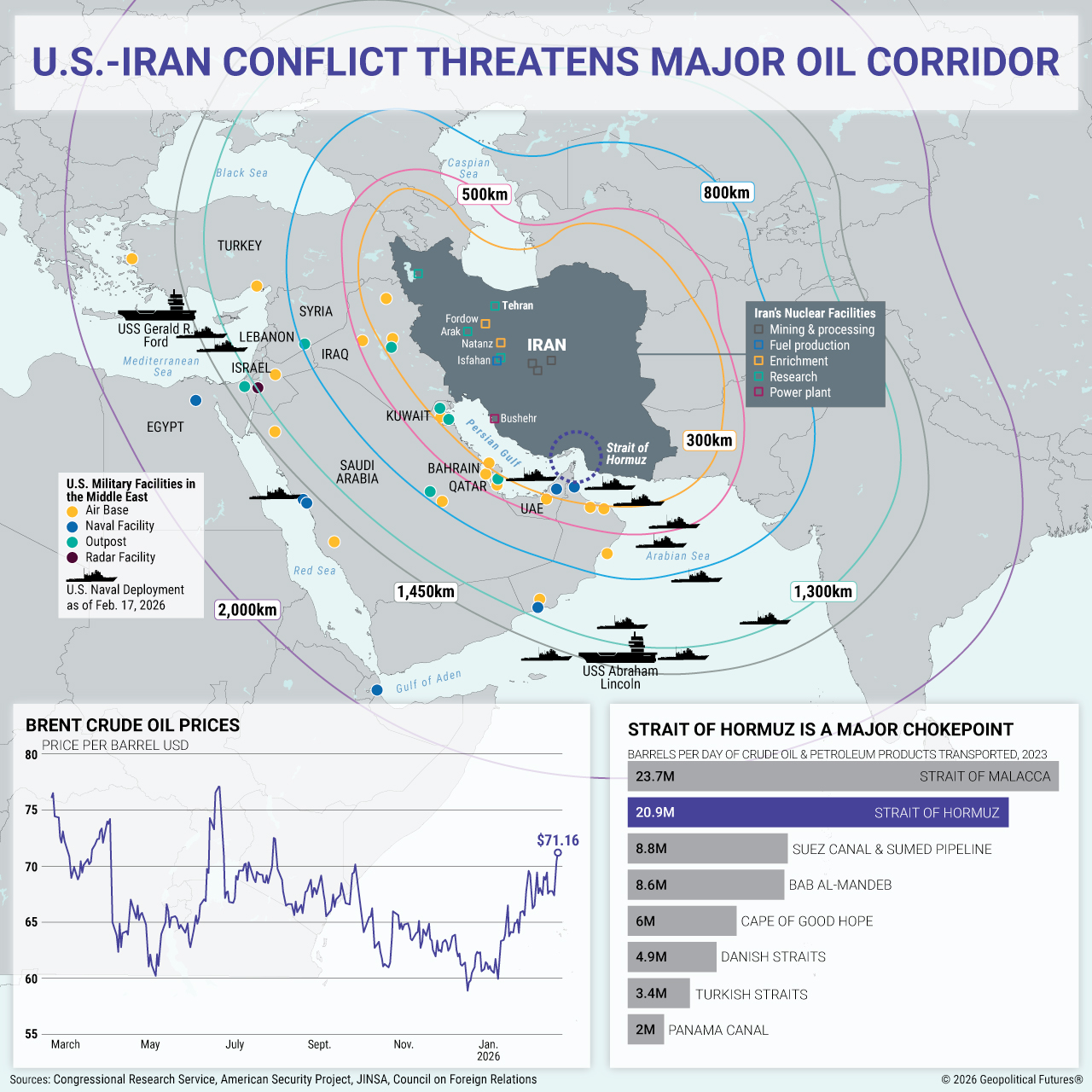
US-Iran Military Standoff in Gulf
This map illustrates the geopolitical risk context described in the section, showing the military deployments and strategic chokepoints central to the US-Iran conflict.
(Source: Geopolitical Futures)
Investment Re-evaluation: Gulf AI Ambitions Tested by New Military Realities
The direct attacks on Gulf data centers have sent immediate shockwaves through financial markets and are forcing a re-evaluation of the multi-billion dollar technology and AI investments flowing into the region. While some long-term strategic capital remains committed, the heightened risk profile is causing a pause and reassessment of new large-scale projects, with investors now pricing in the potential for military-related disruptions and demanding higher returns or enhanced security guarantees. The conflict directly jeopardizes the Gulf’s ambition to become a global AI hub, which is contingent on massive, secure data center capacity.

Massive Scale of Global AI Projects
This chart quantifies the large-scale AI ambitions and investments involving Gulf nations, which the section states are being re-evaluated due to new military realities.
(Source: Yahoo)
- News of the AWS data center strikes in March 2026 contributed to a significant market downturn, with the Dow and Nasdaq plunging by 2% as investors reacted to the direct impact on major U.S. technology assets.
- The conflict directly threatens the Gulf’s “trillion-dollar AI dream” and casts a shadow over major planned investments. A $5.3 billion commitment from AWS to build a new data center region in Saudi Arabia by 2026 now faces significant uncertainty and a mandatory security reassessment.
- Despite the heightened risk, some strategic investors are holding course. Brookfield Asset Management confirmed its $20 billion data center partnership with the Qatar Investment Authority will proceed, signaling that long-term institutional capital may tolerate the new risk environment, albeit with revised calculations.
- Compounding the issue, the conflict is exacerbating an already tight market for high-performance components. The escalating 2026 memory crisis is expected to intensify as supply chain friction and geopolitical uncertainty drive costs for advanced semiconductors and memory chips even higher.
Table: Major Technology and Infrastructure Investments in the Gulf: Pre- and Post-Conflict Status
| Company / Investor | Time Frame | Details and Strategic Purpose | Source |
|---|---|---|---|
| Brookfield Asset Management & Qatar Investment Authority | Ongoing | $20 Billion data center development partnership in Qatar. The project signals continued institutional investor appetite for digital infrastructure in the region despite heightened geopolitical risk. | Bloomberg |
| Amazon Web Services (AWS) | By 2026 | Planned $5.3 Billion new data center region in Saudi Arabia. This investment is now under high-risk scrutiny following direct attacks on existing AWS regional assets in March 2026. | The Economic Times |
| Various (G 7 Initiative) | Long-term | The India-Middle East-Europe Economic Corridor (IMEC), a transport and data corridor project. The war casts a significant shadow over the corridor’s viability, as it relies on regional stability. | Geopolitical Monitor |
Geographic Risk Exposure: The Squeeze Between Foreign Conflict and Domestic Opposition
The US-Iran conflict creates a critical geographic dilemma for data center operators, forcing a strategic re-evaluation of site selection that is complicated by growing domestic challenges. While the attacks in the Gulf highlight the acute risks of concentrating digital infrastructure in geopolitical hotspots, the presumed “safe harbor” of the United States is becoming increasingly difficult and expensive for new projects. This dual pressure is forcing a move away from simple geographic concentration and toward a more distributed and resilient global footprint.

Iran’s Strategic Infrastructure Sites Detailed
This map visually represents the ‘Geographic Risk Exposure’ in a key geopolitical hotspot by pinpointing Iran’s critical military and nuclear sites mentioned in the conflict.
(Source: Institute for the Study of War)
- Between 2021-2024, the Middle East, particularly the UAE and Saudi Arabia, was a primary target for hyperscale data center expansion, driven by sovereign AI ambitions and massive capital availability.
- The 2026 attacks on AWS facilities in the UAE and Bahrain have permanently altered the risk assessment for the entire Gulf region, proving that proximity to Iran makes these assets vulnerable to direct military action.
- Simultaneously, a push to reshore or expand infrastructure in the U.S. is met with significant headwinds. A surge in grassroots protests against data centers, focused on power grid and water strain, is causing major delays and cancellations.
- This domestic opposition is having a measurable impact. In 2025 alone, at least 25 data center projects were canceled in the U.S., a four-fold increase from the prior year, with one report identifying 16 major projects worth a combined $64 billion blocked or delayed.
Technology Maturity: A Forced Evolution from Cyber Defense to Physical Resilience
The conflict has triggered a forced maturation of data center design and security philosophy, shifting the focus from an almost exclusive emphasis on cybersecurity to a new paradigm that integrates military-grade physical hardening and operational resilience. Before 2025, the pinnacle of infrastructure security was defending against remote network intrusions. The reality of drone strikes has now made physical survivability and supply chain integrity primary technical requirements, exposing a significant maturity gap in the industry.

US Data Center Construction Spending Surges
This chart’s data on surging construction spending underscores the section’s point about the growing importance of physical infrastructure, which now requires a new focus on resilience.
(Source: Council on Foreign Relations)
- From 2021-2024, technology maturity was measured by the sophistication of cyber defenses. Government advisories, like CISA’s warning about Iranian actors targeting PLCs, defined the threat landscape, and solutions focused on network security and intrusion detection.
- The March 2026 drone attacks on AWS facilities served as a harsh validation that cyber defenses are insufficient. The strikes caused structural damage, disrupted power, and triggered fire suppression systems, highlighting vulnerabilities in physical plant design that were previously theoretical.
- In response, the definition of a mature, resilient data center is rapidly evolving to include capabilities like drone defense systems, reinforced physical structures, and supply chain independence for critical components like power distribution units and advanced liquid cooling systems.
- This shift also puts a premium on energy independence. The conflict’s impact on global energy prices underscores the need for on-site power generation to ensure operational continuity, accelerating interest in technologies like co-located small modular reactors.
SWOT Analysis: Data Center Infrastructure in an Era of Geopolitical Conflict
The US-Iran conflict has exposed both deep vulnerabilities and new strategic opportunities for the data center industry. While the immediate threats to physical assets and supply chains are severe, the crisis is also forcing a necessary evolution toward more resilient and defensible infrastructure models, which could create new markets for security technologies and sovereign cloud services.
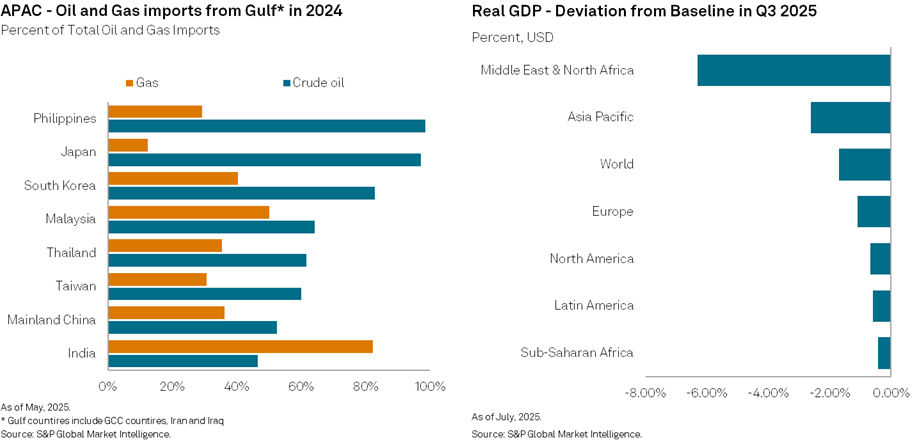
Conflict Forecasts Major GDP Shock
This forecast quantifies a major economic threat from a Gulf conflict, a core ‘Threat’ component of the SWOT analysis being introduced in this section.
(Source: S&P Global)
Table: SWOT Analysis for Data Center Infrastructure Post-Conflict
| SWOT Category | 2021 – 2024 | 2025 – 2026 | What Changed / Validated |
|---|---|---|---|
| Strengths | Massive capital investment in hyperscale buildouts driven by the AI boom; strong demand for cloud services. | Continued access to large-scale strategic capital for long-term projects (e.g., Brookfield‘s $20 B Qatar deal); established global footprint. | The fundamental demand for AI and data processing remains a powerful driver, attracting capital that is willing to price in higher geopolitical risk. |
| Weaknesses | Heavy reliance on vulnerable power grids; concentrated geographic presence in politically stable but resource-intensive areas. | Demonstrated physical vulnerability to military strikes (AWS drone attacks); extreme energy dependency; fragile global supply chains for critical components. | The theoretical weakness of physical vulnerability was validated by direct kinetic attacks, revealing a critical gap in industry resilience planning. |
| Opportunities | Expansion into new emerging markets; focus on energy efficiency to lower OPEX. | Accelerated demand for sovereign cloud and locally-owned infrastructure; growth market for physical security (anti-drone tech); push for energy independence (SMRs). | The conflict created a powerful new market driver for sovereign and highly-secure infrastructure, shifting focus from pure cost efficiency to national security and resilience. |
| Threats | Escalating state-sponsored cyberattacks (e.g., Iranian intrusions); supply chain bottlenecks for semiconductors. | Direct military action against commercial assets; extreme energy price volatility; disruption of key shipping lanes (Strait of Hormuz); growing local opposition to data centers in “safe” regions. | The primary threat evolved from cyber disruption to physical destruction, compounded by a new domestic threat in the form of local opposition blocking necessary geographic diversification. |
Scenario Modelling: Navigating the New Era of Militarized Digital Infrastructure
If the US-Iran conflict continues to involve direct or proxy attacks on commercial infrastructure, watch for a rapid bifurcation of the data center market into high-risk, high-reward frontier zones and fortified, high-cost safe havens. The key signal to monitor is not just government policy but the pricing of risk by insurers and institutional investors, which will ultimately dictate where the next generation of digital infrastructure can be built. The era of building for pure efficiency is over; the new imperative is building for survival.

AI Data Center Power Demand Forecast
This global forecast models the quadrupling of power demand for AI, illustrating the massive scale of the ‘new era’ of digital infrastructure whose future is being modeled in the section.
(Source: Council on Foreign Relations)
- If attacks on Gulf infrastructure persist, watch for a spike in insurance premiums for facilities in the region and the inclusion of explicit “war risk” clauses in data center service contracts. This will directly increase the operating cost for cloud providers.
- A key signal of strategic adjustment will be accelerated investment in alternative data and transport corridors that bypass the Middle East entirely, alongside a renewed push by companies like Digital Realty to secure power-advantaged sites in politically stable regions.
- The most significant downstream effect could be an accelerated AI manufacturing constraint, as the combination of physical risk, supply chain disruption for components like HBM, and capital market volatility stalls the massive infrastructure build-out required to support AI development.
- Expect a surge in R&D and pilot projects for physically hardened, autonomous data centers with independent power sources, such as those being explored by Google, as the industry races to develop a new class of infrastructure resilient to both cyber and kinetic threats.
Frequently Asked Questions
What is the biggest change in the threat to data centers according to the analysis?
The biggest change is the shift from exclusively cyber threats to direct physical, or kinetic, attacks. Prior to 2025, the primary concern from state actors like Iran was cyber warfare aimed at disruption. However, the hypothetical 2026 conflict established a new precedent where Iranian drone strikes physically damaged AWS data centers, proving that digital infrastructure is now considered a viable military target.
Are all investors pulling out of the Middle East’s tech sector because of this new risk?
No, not all of them. The attacks have caused a significant re-evaluation and pause in new large-scale projects, and an AWS investment in Saudi Arabia now faces major uncertainty. However, the article notes that some long-term strategic capital is holding firm. For example, Brookfield Asset Management confirmed its $20 billion data center partnership in Qatar will proceed, signaling that institutional investors may be willing to tolerate the heightened risk, though with new calculations.
Why can’t companies just build more data centers in ‘safe’ countries like the U.S. to avoid this conflict?
While moving to the U.S. seems like a logical alternative, it faces significant domestic headwinds. The article highlights a surge in grassroots protests against new data centers due to concerns over their immense power and water consumption. In 2025 alone, this local opposition reportedly caused the cancellation or delay of at least 25 projects, creating a ‘dual pressure’ where it’s both dangerous to build in geopolitical hotspots and increasingly difficult to build in supposedly safe regions.
How is data center technology and design expected to change in response to these military threats?
Data center design is being forced to evolve from a focus on cyber defense to one that includes physical resilience. The new paradigm requires military-grade hardening, such as reinforced structures and anti-drone defense systems. Furthermore, there is an accelerated push for energy independence through on-site generation, like small modular reactors, to ensure operational continuity even if regional power grids are disrupted by conflict.
What are the potential downstream effects of this conflict on the AI industry?
The conflict could create a significant bottleneck for the AI industry. The development of advanced AI is contingent on a massive build-out of secure data center capacity. The combination of direct physical risks to facilities, supply chain disruptions for critical components like memory chips (exacerbating the ‘2026 memory crisis’), and investor hesitation could stall this necessary infrastructure growth, thereby constraining AI development and manufacturing.
