

Power Transformer Shortages Delay 7 GW of AI Projects and 2, 500 GW of Renewables (2025 to 2026)
Project Cancellations, Grid Operators Face Delays from Transformer Shortages
The physical inability to source critical grid hardware, particularly large power transformers (LPTs) and switchgear, has transitioned from a manageable supply chain risk into a primary barrier for project execution. This structural crisis is now actively delaying and canceling multi-billion dollar technology and energy projects, with lead times for essential components extending to multiple years. The result is a hard cap on growth for sectors reliant on massive electricity consumption, including artificial intelligence and renewable energy.
- Prior to 2025, the transformer shortage was identified as a growing concern. In the 2025 to 2026 period, this risk has materialized into direct commercial consequences, with an estimated 7 GW of planned U.S. AI data center capacity either delayed or canceled specifically due to power infrastructure constraints.
- The integration of renewable energy is severely impacted, with over 2, 500 GW of solar, wind, and storage projects stalled in global interconnection queues. This backlog is directly exacerbated by the lack of available transformers needed to connect new generation sources to the grid.
- This “demand supercycle” is forcing hyperscalers to seek alternatives. Major technology companies like Microsoft and Google are now actively pursuing behind-the-meter power solutions, including on-site nuclear reactors and fuel cells, to bypass the constrained public grid for future data center developments.
- The strain is also evident in the pivot of former cryptocurrency miners. Firms such as Core Scientific and Cipher Mining are converting their power-intensive facilities to support AI workloads, further concentrating immense electrical demand in specific regions and stressing local grid capacity.
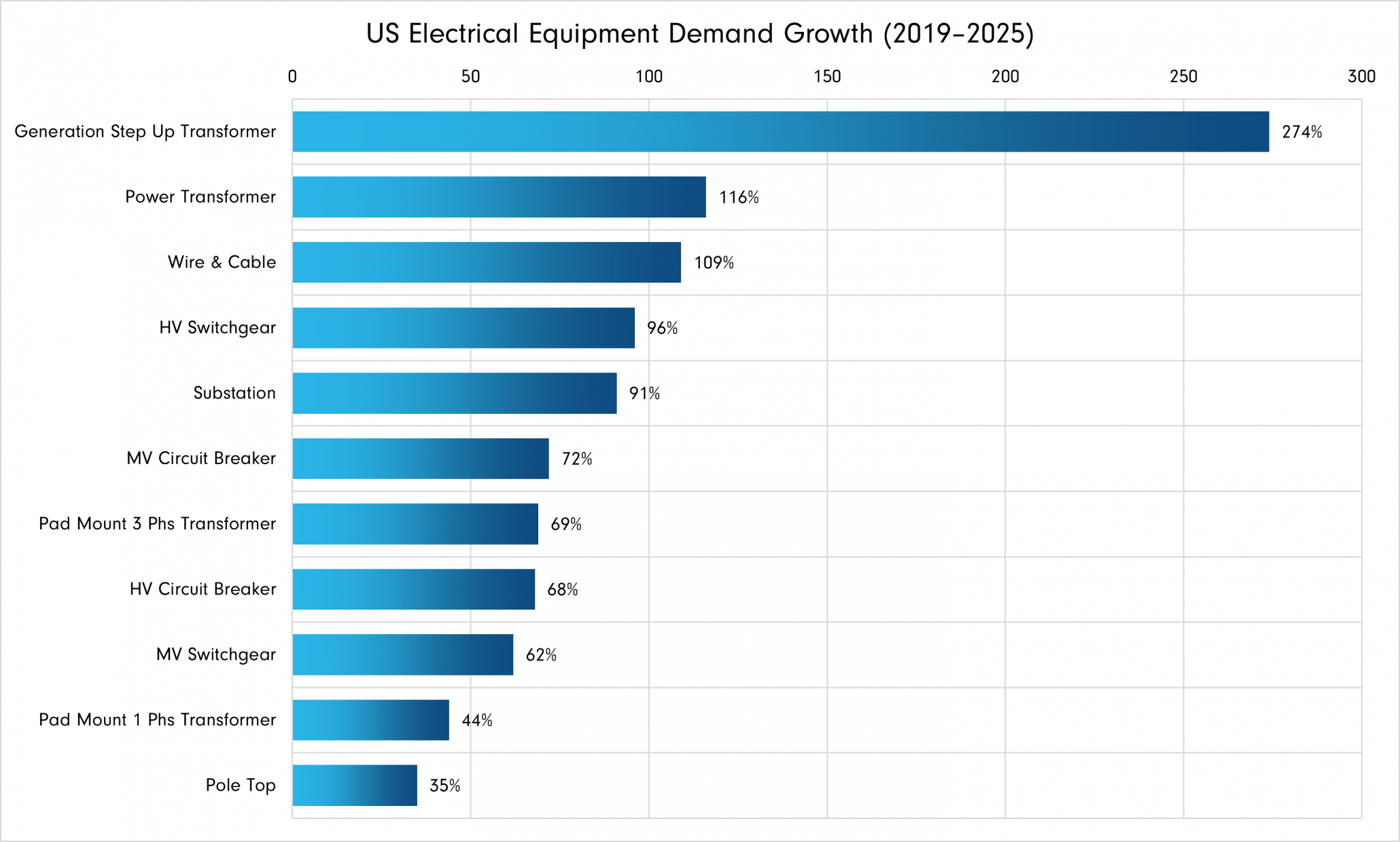
Explosive Demand for Critical Grid Equipment Signals Imminent Supply Bottleneck
Demand for ‘Generation Step Up Transformers’ is skyrocketing, up 274% between 2019-2025, far outstripping all other electrical equipment. ‘Power Transformers’ and ‘Wire & Cable’ also show critical double-digit growth at 116% and 109%, respectively. ‘HV Switchgear” demand increased 96%. This explosive demand indicates an imminent supply chain bottleneck for essential grid components, exacerbating lead times and threatening grid expansion.
Demand Surge Threatens Renewable Integration & Grid Resilience
The unprecedented demand surge for transformers and switchgear directly reflects accelerating renewable energy integration and grid modernization efforts. These components are foundational to connecting new generation and strengthening an aging infrastructure. Without adequate supply, projected growth in clean energy projects and grid resilience will be severely capped, directly leading to the ‘Grid Infrastructure Shortage 2026″ and hindering decarbonization goals.
Critical Grid Equipment Lead Times Soar by Up to 400%
Lead times for critical grid equipment like Power Transformers have skyrocketed from a maximum of ~50 weeks pre-2021 to over 250 weeks by 2025—a 400% increase. Generator Step-Up Transformers also show a substantial jump from ~60 to ~200 weeks, indicating widespread supply chain strain across essential grid components.
$8.6 B in Grid Upgrades, U.S. Utilities Plan Investments to Combat Load Growth
In response to escalating project delays and the threat of widespread power shortages, U.S. grid operators and utilities are allocating billions toward infrastructure upgrades. However, these ambitious investment plans are themselves constrained by the very equipment shortages they aim to solve. The capital is available, but the physical hardware is not, creating a paradoxical loop where the solution is blocked by the problem.
- The Southwest Power Pool (SPP) has proposed a significant $8.6 billion investment in its 2025 regional transmission plan, with a primary focus on addressing explosive load growth from data centers and other new industrial facilities.
- Federal initiatives are also attempting to address the shortfall. The U.S. Department of Energy announced a $1.9 billion investment program aimed at modernizing critical grid infrastructure and reducing electricity costs, though the impact of this funding depends on the manufacturing sector’s ability to deliver equipment.
- Despite these planned investments, the immediate impact on the ground is one of contraction. The cancellation or delay of 7 GW of AI data center capacity in 2026 is a direct result of utilities being unable to procure transformers and secure power connections in time for project timelines.
Table: Documented Project Delays & Cancellations Due to Grid Constraints
| Impacted Sector / Project | Time Frame | Details and Strategic Purpose | Source |
|---|---|---|---|
| AI Data Centers | 2026 | An estimated 7 GW of computing capacity, representing nearly half of planned U.S. AI data centers for 2026, has been delayed or canceled due to power infrastructure and equipment shortages. | tech-insider.org |
| Renewable Energy Projects | 2026 | Over 2, 500 GW of generation and storage projects are stuck in global interconnection queues. The distributed nature of renewables requires more transformers, exacerbating delays. | greenfueljournal.com |
| U.S. Hydropower Upgrades | 2026 | Upgrades to U.S. hydropower facilities are facing delays of up to 5 years and costs exceeding $10 million per project, primarily due to the difficulty in sourcing large power transformers. | interestingengineering.com |
U.S. Grid Strain, PJM and ERCOT Face Acute Transformer Demand from Data Centers
While the transformer shortage is a global phenomenon, its effects are disproportionately concentrated in specific U.S. electricity markets where unprecedented data center growth is colliding with an aging and under-invested grid. These regions serve as a leading indicator of the broader economic risks posed by the equipment bottleneck.
- The PJM Interconnection and ERCOT in Texas have become hotspots of grid strain. Both operators are seeing demand forecasts revised sharply upwards, driven almost entirely by the power requirements of new data centers planned in their territories.
- This regional strain highlights a national vulnerability. The U.S. currently relies on imports for approximately 80% of its large power transformers, creating significant geopolitical and logistical risks. This dependency is compounded by the age of domestic infrastructure, with 31% of transmission lines and 46% of distribution lines at or near the end of their operational lifetimes.
- The buildout of new, massive data centers, such as the planned 340 MW Neocloud facility in Michigan and the $2 billion Clean Core joint venture in West Texas, exemplifies the scale of new load being added to already stressed regional grids.
Structural Crisis, Transformer Manufacturing Lags Demand Growth by 4-5% Annually
The grid equipment shortage has matured from a temporary, post-pandemic supply chain disruption into a long-term structural crisis. This is defined by a persistent and widening gap between a stagnant global manufacturing capacity and the exponential growth in electricity demand, a problem that cannot be solved by capital investment alone in the short term.
- In the 2021-2024 period, equipment delays were often attributed to transient logistics issues. By 2026, the issue is understood as a fundamental manufacturing deficit. Global demand for transformers is growing at 7-9% annually, while the expansion of manufacturing capacity is lagging at only 3-4% per year.
- The practical effect of this deficit is a dramatic increase in lead times. Procuring large power transformers, which once took months, now routinely requires 2 to 5 years from order to delivery, making long-range project planning exceptionally difficult.
- This manufacturing bottleneck is rooted in decades of underinvestment and is further complicated by chokepoints in sub-component supply chains, most notably the limited global production capacity for grain-oriented electrical steel (GOES), a critical material for transformer cores.

Critical Grid Equipment Faces Massive Deficits by 2025
Electrical equipment demand, particularly for Generation Step Up Transformers, has surged by 274% from 2019-2025, resulting in a 100% market deficit by 2025. Power Transformers show 116% demand growth with a 39% deficit, and HV Switchgear has 95% demand growth with a 36% deficit, indicating severe supply chain bottlenecks with 2-3 year lead times driving project delays and cancellations.
Supply Crunch Stalls Renewable Integration & Grid Modernization
The demand-supply gap, especially for transformers and switchgear, directly impedes renewable energy integration and grid modernization in the US. Renewables heavily rely on Generation Step Up Units (GSUs) which face the largest deficits, threatening decarbonization goals and forcing developers to secure production slots years in advance. This systemic underinvestment in manufacturing capacity relative to surging demand creates a costly bottleneck for grid expansion.
Grid Equipment Lead Times Soar 5x, Stalling Modernization
Lead times for critical grid equipment like Power Transformers have surged from a maximum of 50 weeks pre-2021 to up to 250 weeks by 2025, a 5x increase. Generator Step-Up Transformers also jumped from 75 weeks to 200 weeks, indicating severe supply chain constraints crippling grid expansion and renewable energy projects.
Grid Operator SWOT Analysis, Strengths and Threats in the Transformer Shortage
The current grid equipment crisis presents a complex mix of systemic weaknesses and external threats that are actively constraining economic growth. However, this same pressure is creating significant opportunities for new technologies, domestic manufacturing initiatives, and decisive policy interventions that could reshape the energy infrastructure landscape.
- The primary Weakness is the severe deficit in domestic manufacturing, which exposes the U.S. grid to geopolitical risks and long, fragile supply chains.
- The most significant Threat is the demand supercycle from AI and electrification, which continues to outpace all supply-side responses and could lead to more widespread project cancellations.
- A key Opportunity has emerged for Grid-Enhancing Technologies (GETs) and new hardware like solid-state transformers, which can optimize existing infrastructure and reduce the need for new LPTs. It also creates a powerful incentive for energy-intensive users to partner with alternative power providers like Cameco and its partner Brookfield to develop on-site nuclear solutions.
Table: SWOT Analysis for Grid Equipment Supply Chain
| SWOT Category | 2021 – 2024 | 2025 – 2026 | What Changed / Validated |
|---|---|---|---|
| Strength | Early discussions around reshoring manufacturing and grid modernization funding in legislative proposals. | Activation of the Defense Production Act (DPA) for transformers and federal incentives from the IRA and DOE to spur domestic production. FERC begins exploring incentives for Grid-Enhancing Technologies. | The crisis has moved from a discussion point to a trigger for federal policy action and regulatory intervention, validating the severity of the supply chain risk. |
| Weakness | Recognized high import dependency for LPTs and aging grid infrastructure. | U.S. import dependency for LPTs remains at 80%. Lead times extend to 4-5 years, confirming the lack of domestic surge capacity. Decades of underinvestment are now a primary constraint. | The weakness was validated as a structural, not cyclical, problem. The lack of domestic manufacturing is now directly canceling economic development projects. |
| Opportunity | Theoretical potential for new technologies (GETs, solid-state transformers) to alleviate grid strain. | Data center operators like Microsoft actively pursue on-site power generation (nuclear, fuel cells) to bypass the grid. New domestic factory announcements begin to emerge. | The opportunity shifted from theoretical to practical. The grid bottleneck is now a primary business driver for behind-the-meter generation and new domestic manufacturing investments. |
| Threat | Forecasts of rising electricity demand from data centers and EVs were seen as a future challenge. | The “demand supercycle” from AI is a present reality, overwhelming grid operator forecasts. Geopolitical tensions add risk to a supply chain heavily reliant on specific countries. | The threat materialized faster than anticipated. The scale and speed of AI-driven demand were significantly underestimated, turning a future challenge into an immediate crisis. |
Scenario Modeling, Watch for Policy Shifts on Domestic Transformer Production
Looking ahead, the critical variable determining the severity and duration of the grid equipment bottleneck will be the effectiveness of government and private sector initiatives to onshore and expand transformer manufacturing capacity. The market is now at an inflection point where policy, investment, and technological innovation will either alleviate the constraint or allow it to become a long-term drag on economic growth.
- If policy tools like the Defense Production Act and IRA tax credits successfully spur the construction of new domestic transformer factories by late 2026, watch for equipment lead times to begin stabilizing and potentially decreasing in the 2028-2030 timeframe.
- If this new manufacturing capacity fails to materialize at scale, watch for a broadening of project cancellations beyond data centers to include industrial facilities and a significant slowdown in the pace of the energy transition as renewable projects remain stalled in queues.
- A key leading indicator is the adoption of grid bypass strategies. The progress of hyperscalers like Microsoft in developing on-site power solutions, whether nuclear or other technologies, will signal a potential long-term fragmentation of the traditional utility model for large industrial customers.
The questions your competitors are already asking
This report covers one angle of the grid equipment supply chain crisis. The questions that matter most depend on your work.
- New US transformer factory announcements
- Data centers building on-site nuclear power
- Grid enhancing technology deployments US
- US electrical steel production increase
This report does not answer these. Enki Brief Pro does.
Your question, your angle, your framework. SWOT, PESTL, scenario modelling. The same niche depth, built around the decision your work actually depends on.
