

Next Era Grid Infrastructure, $400 B Dominion Merger for 37% AI Demand Growth and 3.1 GW in PPAs (2025-2026)
Grid Infrastructure Risks, Next Era $400 B Merger Signals Massive Consolidation to Meet AI Demand
The May 2026 agreement for Next Era Energy to merge with Dominion Energy signals a strategic pivot in the U.S. utility sector, where large-scale consolidation is now seen as the primary tool to manage the systemic risk of grid capacity failing to meet the exponential growth in electricity demand from artificial intelligence. This move away from incremental upgrades toward creating a “mega-utility” is a direct response to forecasts showing existing infrastructure is inadequate for the coming demand surge, reframing M&A as an essential strategy for execution and market capture.
Pre-2025: Fragmented Utility Responses
Prior to 2025, the utility industry’s response to growing electricity needs was characterized by fragmented, smaller-scale actions. Utilities typically pursued individual power plant developments, incremental transmission upgrades, and one-off Power Purchase Agreements (PPAs) with corporate offtakers. This approach was sufficient for a predictable, low-growth demand environment but proved inadequate to address the concentrated, gigawatt-scale needs emerging from the AI and data center sectors.
2025-2026: Consolidation as a Strategic Imperative
The period between 2025 and 2026 marks a definitive shift toward consolidation as a strategic necessity.
- The definitive all-stock merger agreement between Next Era Energy and Dominion Energy, announced in May 2026, creates a combined entity with an enterprise value of approximately $400 billion. This scale is explicitly intended to finance and build generation and transmission infrastructure at a pace and size that smaller, individual utilities cannot attempt.
- This strategic consolidation is driven by the core risk of a projected 37% surge in peak load demand, from 59 GW in 2026 to 81 GW by 2032, within the combined service territories. This growth is overwhelmingly attributed to the expansion of data centers, particularly in Virginia.
- The deal represents an Execution-focused M&A strategy, aiming for market capture and vertical integration. The goal is to dominate the energy supply chain for the Eastern U.S. data center alley by creating a single entity capable of delivering massive, integrated infrastructure programs.
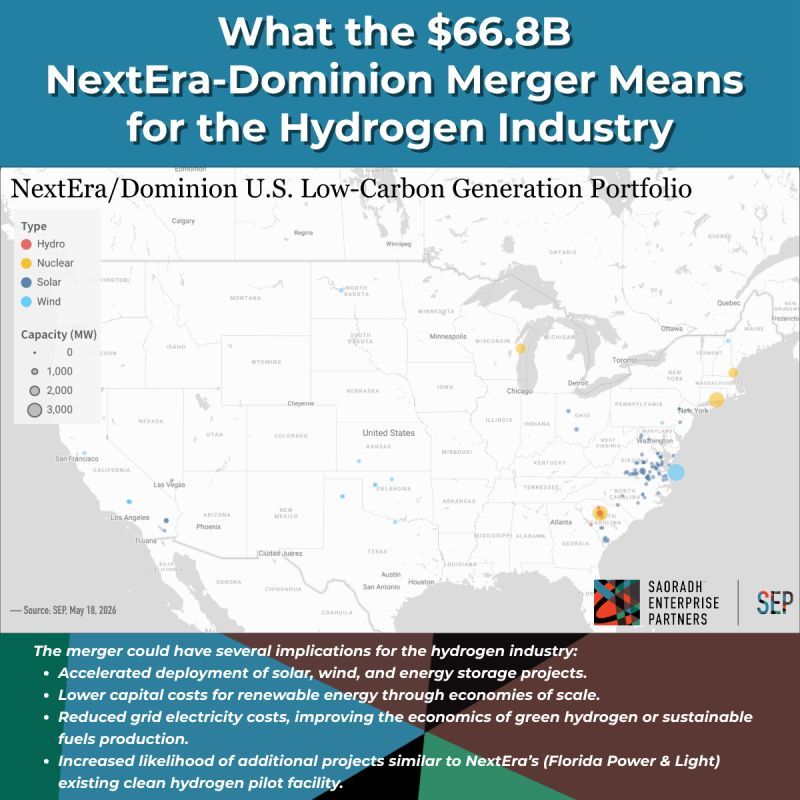
NextEra-Dominion Merger Fuels Low-Carbon Grid Growth
The $66.8B NextEra-Dominion merger consolidates a massive U.S. low-carbon generation portfolio, accelerating the deployment of solar, wind, and energy storage. This integration is poised to significantly reduce grid electricity costs, making green hydrogen production more economically viable.
Merger Accelerates Green Hydrogen Economic Viability
This strategic consolidation is a game-changer for the hydrogen industry, enabling lower capital costs for renewable energy and improving the economics of green hydrogen. NextEra’s existing clean hydrogen pilot facility signals the direct pathway for large-scale, vertically integrated clean fuel production.
(Source: SAORADH ENTERPRISE PARTNERS — via Next Era Grid Infrastructure 2026, 110 GW Dominion Merger – EnkiAI)
Next Era Energy $1.1 T Market Context, Funding Grid Expansion for AI Data Centers (2025-2029)
The all-stock structure of the Next Era–Dominion merger is a deliberate financial strategy to preserve capital for an immense infrastructure spending cycle. This move is set against a backdrop of an estimated $1.1 trillion in capital expenditures required by U.S. investor-owned utilities between 2025 and 2029 just to modernize and expand the nation’s power grid, positioning the combined company to lead this investment wave.
The $400 B Enterprise Value Merger
The combination of Next Era Energy and Dominion Energy creates a utility powerhouse with an enterprise value between $400 billion and $420 billion. This financial scale provides the balance sheet capacity required to underwrite the multi-billion dollar transmission, generation, and storage projects needed to service the AI-driven demand. The sheer size of the new entity is designed to absorb the financial and execution risks associated with projects that are too large for stand-alone utilities.
All-Stock Transaction and CAPEX
The decision to structure the deal as an all-stock transaction, formally filed on May 15, 2026, is a critical defensive maneuver. It avoids draining cash reserves, which will be immediately funneled into funding a massive capital expenditure pipeline. This financial strategy directly addresses the findings from a Pew Charitable Trusts report, which projects that investor-owned utilities will need to spend $1.1 trillion through 2029 to maintain and expand the grid. The merger positions the new Next Era to deploy a significant portion of that capital efficiently.
Table: Strategic Capital and Investment Context
| Partner / Project | Time Frame | Details and Strategic Purpose | Source |
|---|---|---|---|
| Next Era Energy / Dominion Energy Merger | May 2026 | All-stock transaction creating a combined entity with a ~$400 B enterprise value. The primary purpose is to achieve the scale necessary to fund and execute a large-scale grid and generation build-out for AI data center demand. | Reuters |
| U.S. Investor-Owned Utility CAPEX | 2025 – 2029 | Projected $1.1 trillion in spending on grid upgrades and modernization. The merger provides Next Era with the scale to capture a significant share of this required investment. | Pew Charitable Trusts |
| Forecast Provider / Entity⇅ | Market Segment⇅ | Metric⇅ | Base Year⇅ | Base Value⇅ | Forecast Year⇅ | Forecast Value⇅ | CAGR (%)⇅ | Source⇅ |
|---|---|---|---|---|---|---|---|---|
| NextEra/Dominion Combined | Utility Peak Load | Peak Load Demand (GW) | 2026 | 59 | 2032 | 81 | 5.40 * | Nextera and Dominion Deal – Saadiyat Capital – Substack ↗ |
| Grid Strategies | US Electricity Demand | 5-Year Peak Demand Growth (GW) | 2025 | 2030 | 166 | 3.70 | Power Demand Forecasts Revised Up ↗ | |
| MarkNtel Advisors | Global Renewable Energy | Market Size ($ Trillion) | 2026 | 2.78 | 2032 | 5.78 | Renewable Energy Market Trends & Outlook by 2032 ↗ | |
| Grand View Research | Global Renewable Energy | Market Size ($ Billion) | 2026 | 1900 | 2033 | 4900 | 14.70 | Renewable Energy Market Size, Share Report, 2026-2033 ↗ |
| Grand View Research | Energy Storage Systems | Installed Capacity (GW) | 2026 | 931.70 | 2033 | 3735.30 | 21.90 | Energy Storage Systems Market Size Report, 2026-2033 ↗ |
Next Era Energy 3.1 GW in PPAs, Securing Hyperscaler Demand with Google and Meta
Even before the merger, Next Era Energy solidified its position as a key energy supplier for hyperscale data center operators, securing over 3.1 GW in Power Purchase Agreements (PPAs) with tech giants. These agreements validate the immense power demand thesis that underpins the strategic rationale for acquiring Dominion Energy and its extensive regulated infrastructure.
Next Era’s Meta and Google Agreements
In the year leading up to the merger announcement, Next Era executed several landmark deals that demonstrated its ability to meet the clean energy needs of major technology companies. In December 2025, the company announced agreements with Meta to supply 2.5 GW of power from new renewable energy projects. That same month, Next Era expanded its existing collaboration with Google Cloud to provide additional clean energy capacity for its U.S. data centers, building on a partnership focused on accelerating nuclear energy deployment announced in October 2025.
Post-Merger End-to-End Service
The merger with Dominion vertically integrates Next Era‘s world-class renewable development arm with a vast, regulated transmission and distribution network. This combination transforms the company’s value proposition, enabling it to offer a complete, end-to-end solution for hyperscalers. The new entity can manage everything from financing and building a new solar or wind farm to delivering that power reliably through its own grid infrastructure. This integrated model is designed to be the go-to solution for companies that need to build out the grid infrastructure for data center power at an unprecedented speed and scale.
Table: Key Hyperscaler Power Agreements
| Partner / Project | Time Frame | Details and Strategic Purpose | Source |
|---|---|---|---|
| Meta | Dec 2025 | Next Era signed agreements to supply 2.5 GW of renewable energy for Meta’s U.S. projects, showcasing its ability to deliver clean power at the scale required by data centers. | Energy Storage News |
| Google Cloud | Dec 2025 | Expanded an existing deal to add clean energy capacity for Google’s U.S. data center build-out, strengthening a long-term strategic energy partnership. | Reuters |
| Oct 2025 | Announced a new collaboration to accelerate nuclear energy deployment in the U.S., signaling a push into firm, carbon-free power sources to complement renewables. | PR Newswire |
| Date⇅ | Partner⇅ | Agreement Type⇅ | Capacity / Value⇅ | Source⇅ |
|---|---|---|---|---|
| Feb 5, 2026 | GE Vernova & Xcel Energy | Alliance | To support 6 GW data center outlook | Xcel Energy Inks Dual Alliances with GE Vernova, NextEra … ↗ |
| Dec 10, 2025 | Meta | PPAs and ESAs | 2.5 GW | NextEra signs 2.5GW of agreements with Meta for US … ↗ |
| Dec 8, 2025 | Google Cloud | Power Purchase Agreements | 600 MW | NextEra Energy and Google Cloud Announce Landmark … ↗ |
| Oct 27, 2025 | Collaboration / PPA | Restart of Duane Arnold nuclear plant | NextEra Energy and Google Announce New Collaboration … ↗ |
Virginia Data Center Alley, Next Era Merger Focuses on High-Growth Eastern U.S. Markets
The strategic geography of the Next Era–Dominion merger is explicitly designed to consolidate control over power infrastructure in the highest-growth electricity markets in the Eastern U.S. The epicenter of this strategy is Virginia’s data center alley, the world’s largest data center market, where acute and accelerating demand for power makes grid ownership a critical strategic asset.
Dominion’s Strategic Footprint
Dominion Energy‘s core asset base provides the geographic anchor for the merger. Its regulated utility business serves approximately 10 million customers across key growth states, including Florida, the Carolinas, and most importantly, Virginia. Owning the transmission and distribution network in the heart of the data center boom gives the combined entity direct control over connecting new power generation to the largest source of new demand.
Projected Load Growth in the Region
The compelling logic of this geographic focus is reinforced by load growth projections. The combined service territory is forecast to experience a peak load increase from 59 GW in 2026 to 81 GW by 2032, a stunning 37% surge driven almost entirely by data center expansion. By concentrating assets in this region, the new Next Era can focus its vast capital resources on a specific, high-return area. This includes targeted investments in the PJM grid infrastructure to support the localized and intense power needs of the technology sector.
| Metric⇅ | Value⇅ | Source⇅ |
|---|---|---|
| Acquirer | NextEra Energy, Inc. | 425 ↗ |
| Target | Dominion Energy, Inc. | 425 ↗ |
| Announced Date | May 18, 2026 | NextEra Energy and Dominion Energy to Combine … ↗ |
| Enterprise Value (Approx.) | $400 Billion | NextEra-Dominion Energy: Scaling Up The Eastern U.S. To … ↗ |
| Deal Structure | All-Stock Merger | NextEra Energy, Dominion Energy Declare Business … ↗ |
| Combined Generation Capacity | 110 GW | NextEra Energy and Dominion Energy to Combine … ↗ |
| Combined Customer Base (Approx.) | 10 Million | Nextera and Dominion Deal – Saadiyat Capital – Substack ↗ |
| Regulated Business Mix | >80% | NextEra Energy and Dominion Energy to Combine … ↗ |
SWOT Analysis, Next Era Energy and Dominion Merger Execution Risks and Scale Advantages
The merger of Next Era Energy and Dominion Energy creates an entity with unparalleled scale and a complementary portfolio perfectly positioned to capture AI-driven electricity demand. However, this strategic advantage is balanced by significant regulatory hurdles and immense execution risks associated with a capital program of this magnitude. The success of the merger will depend on navigating these challenges while leveraging its dominant market position.
Table: SWOT Analysis for the Next Era and Dominion Merger
| SWOT Category | Key Factors and Evidence |
|---|---|
| Strengths |
|
| Weaknesses |
|
| Opportunities |
|
| Threats |
|
| Year⇅ | Projected Peak Load (GW)⇅ | Source⇅ |
|---|---|---|
| 2026 | 59 | Nextera and Dominion Deal – Saadiyat Capital – Substack ↗ |
| 2032 | 81 | Nextera and Dominion Deal – Saadiyat Capital – Substack ↗ |
Next Era 2027 Outlook: Will Regulatory Approval Unlock the $400 B Dominion Merger?
For 2027, the single most critical factor is securing timely federal and state regulatory approvals for the merger. If the transaction is approved, watch for immediate announcements of large-scale, multi-billion-dollar transmission and generation projects in Virginia and the Carolinas. If it is blocked or delayed, both companies will be forced to pursue less efficient, independent strategies to meet the undeniable demand growth.
Regulatory Approval as the Key Milestone
The primary signal to monitor will be filings and decisions from the Federal Energy Regulatory Commission (FERC) and state public utility commissions through late 2026 and early 2027. Approval would validate the “scale for stability” argument put forth by the companies and officially sanction the creation of the super-utility. This would be the green light for deploying the massive capital pool assembled for the grid build-out.
Post-Approval Project Announcements
A positive outcome would quickly be followed by concrete project announcements. Watch for new filings for high-voltage transmission lines to de-constrain the grid in data center regions and plans for new generation sources. These could include renewables as well as firm power sources like advanced nuclear, building on Dominion Energy’s 2025 SMR pivot to service data center load. Conversely, significant regulatory resistance or a rejection would fragment the response to the AI power demand, likely slowing the pace of the necessary infrastructure expansion and forcing hyperscalers to find alternative, piecemeal solutions.
| Metric⇅ | Value⇅ | Source⇅ |
|---|---|---|
| Acquiring Company | NextEra Energy, Inc. | McGuireWoods Advises Dominion Energy in Historic Combination … ↗ |
| Target Company | Dominion Energy, Inc. | McGuireWoods Advises Dominion Energy in Historic Combination … ↗ |
| Transaction Value (Deal Size) | $66.8 Billion | NextEra-Dominion deal extends US utility M&A wave into 2026 ↗ |
| Enterprise Value (Combined) | Approximately $420 Billion | McGuireWoods Advises Dominion Energy in Historic Combination … ↗ |
| Transaction Structure | All-stock | McGuireWoods Advises Dominion Energy in Historic Combination … ↗ |
| Combined Generation Capacity | 110 Gigawatts (GW) | NextEra Energy and Dominion Energy to Combine … ↗ |
| Combined Customer Accounts | Approximately 10 million | NextEra Energy, Dominion Energy announce merger … ↗ |
| Key Service Areas | Florida, Virginia, North Carolina, South Carolina | NextEra Energy, Dominion Energy announce merger … ↗ |
The questions your competitors are already asking
This report covers one angle of the utility sector’s response to AI data center power demand. The questions that matter most depend on your work.
- Utility merger regulatory hurdles
- Other utilities serving data center power demand
- New transmission projects for Virginia data centers
- Data centers building their own power supply
This report does not answer these. Enki Brief Pro does.
Your question, your angle, your framework. SWOT, PESTL, scenario modelling. The same niche depth, built around the decision your work actually depends on.
