

PJM Grid Infrastructure, 9.3 GW FERC Fast-Track Approval, 51 Projects Cleared, and 30 GW Data Center Demand Forecast (2025-2026)
PJM Grid Risks, Soaring Demand Adds 30 GW, Threatening System Reliability
The PJM Interconnection is confronting a structural reliability risk as unprecedented electricity demand, driven almost entirely by data centers, outpaces the grid’s ability to connect new generation. After two decades of flat load growth, PJM now forecasts an additional 30 GW of data center demand by 2030, creating a projected capacity shortfall as early as summer 2027. This has forced emergency regulatory actions and a fundamental re-prioritization of generation projects to prevent system-wide failures.
Data Center Demand Surge
The primary catalyst for this risk is the explosive growth of high-density computing and AI power demand. The trend represents a fundamental shift from the prior two decades of stable, predictable energy consumption.
- Prior to this surge, U.S. electricity consumption grew at an average of less than 0.6% annually. Forecasts now project a 15% rise by 2030, with PJM at the epicenter.
- Within the PJM region, new large-load growth is 97% attributable to data centers. These facilities added over 5, 000 MW of demand to the 2027/2028 capacity auction alone.
- This AI data center grid strain is most acute in specific zones like Northern Virginia, but its effects are causing region-wide price spikes and reliability concerns.
Projected Capacity Shortfall
The rapid increase in demand is creating a significant gap between available generation and required capacity, prompting warnings of potential shortfalls from grid officials.
- PJM officials warned in January 2026 of a potential energy shortfall by summer 2027, citing the combination of retiring power plants and surging demand from new facilities.
- By the 2027-2028 delivery year, PJM anticipates a 5.2% capacity shortfall. Closing this gap is estimated to require approximately $15 billion in new power plant investments to maintain grid reliability.
- PJM’s 20-year forecast from January 2026 projects a 10-year load increase of nearly 66, 000 MW, a substantial increase over the current generating capacity of approximately 182, 000 MW.
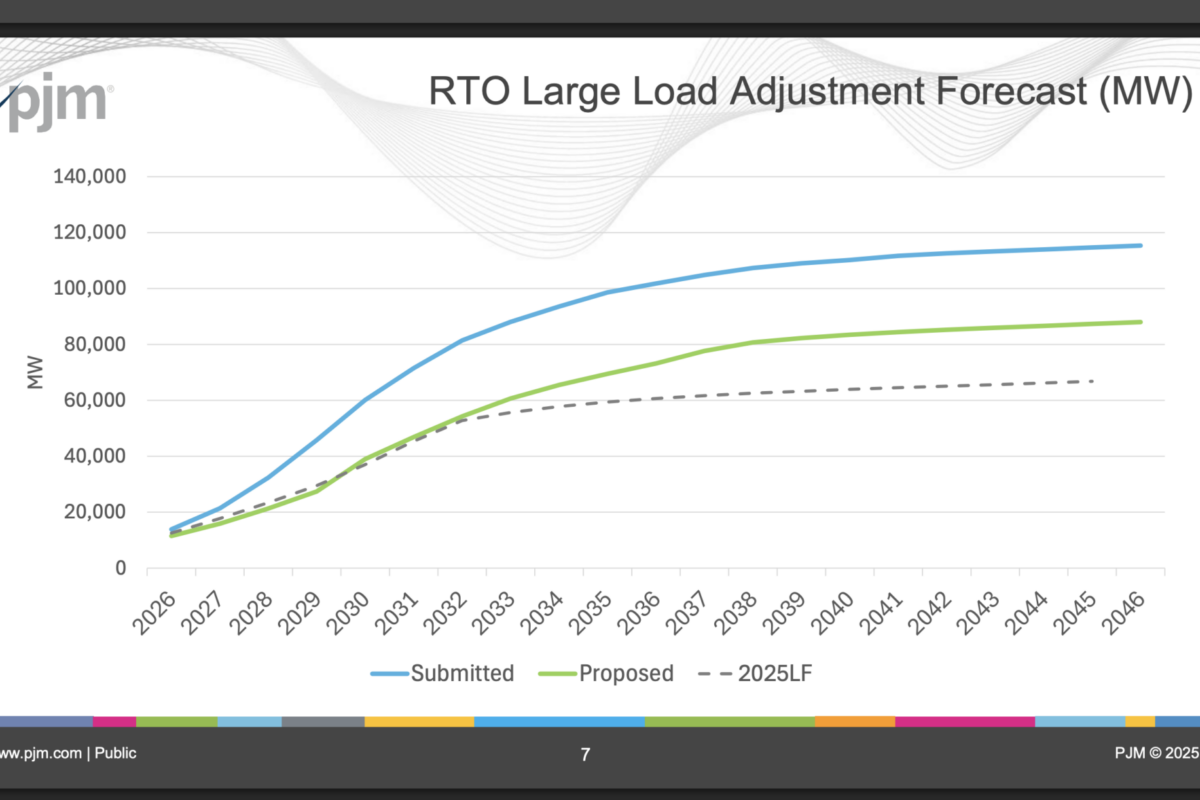
PJM “Submitted” Load Forecast Exceeds “Proposed” by 28 GW by 2046
PJM’s RTO Large Load Adjustment forecast shows “Submitted” requests reaching ~115 GW by 2046, a substantial 28 GW higher than the “Proposed” 87 GW. All forecasts indicate significant growth starting from ~14 GW (“Submitted”) in 2026, peaking in 2030-2032 with a sharp increase.
(Source: PJM — via The 60-Day Clock: FERC Just Forced Six Grid Operators to Rewrite the Rules for Every Data Center Over 20 MW)
9.3 GW Fast-Tracked, PJM Regulatory Approvals and Project Investments
In response to the impending capacity deficit and a massive project backlog, federal regulators approved PJM’s plan to fast-track mature generation projects, signaling a clear prioritization of speed-to-market for new capacity. This regulatory action, combined with soaring auction prices, is driving significant new investment, particularly in dispatchable gas-fired generation.
FERC’s July 2026 Approval
The Federal Energy Regulatory Commission’s (FERC) decision in July 2026 was a critical enabler, allowing PJM to expedite projects that were furthest along in the development process.
- FERC approved PJM’s fast-track review process, which resulted in the immediate approval of 51 generation projects totaling 9.3 GW of new capacity.
- In a related decision, FERC denied a waiver request from Chestnut Run Energy (an entity of Advanced Power) for its $2 billion gas-fired plant. The ruling upheld the new queue rules, reinforcing the integrity of the reformed interconnection process.
Capacity Auction Price Signals
PJM’s capacity auctions provide a direct financial signal of the grid’s health. Recent results show a market under extreme stress, with prices hitting the regulatory cap and creating powerful incentives for new construction.
- The PJM 2028/2029 capacity auction, held in July 2026, cleared at the established price cap for the third consecutive time. This reflects a severe shortage of cleared capacity relative to demand.
- These high clearing prices are a direct result of the projected AI power crisis and are intended to spur investment in new generation by guaranteeing higher future revenues for plant operators. For example, Talen Energy executed a deal in January 2026 to acquire 2.6 GW of gas plants in PJM for $3.5 billion.
Table: PJM Grid Infrastructure Investments and Regulatory Milestones (2026)
| Partner / Project | Time Frame | Details and Strategic Purpose | Source |
|---|---|---|---|
| PJM Interconnection | Aug 2026 | Filed a backstop capacity auction plan at FERC to secure additional resources and address reliability concerns driven by data center load growth. | Utility Dive |
| PJM Interconnection / FERC | Jul 2026 | FERC approved PJM’s fast-track review, clearing 51 projects totaling 9.3 GW to help alleviate the interconnection queue backlog and address impending shortfalls. | Utility Dive |
| PJM Interconnection | Jul 2026 | The 2028/2029 Base Residual Auction cleared at the price cap for the third time, indicating a severe capacity shortage and creating strong financial incentives for new generation. | OPIS |
| PJM Interconnection / DOE | May 2026 | Received emergency approval from the Department of Energy to curtail power to data centers and other large customers during grid emergencies to maintain reliability. | Utility Dive |
| Talen Energy | Jan 2026 | Announced a deal to acquire 2.6 GW of natural gas-fired power plants within PJM for $3.5 billion, a strategic investment to capitalize on high capacity prices. | Utility Dive |
| Delivery Year⇅ | Market Segment⇅ | Clearing Price ($/MW-day)⇅ | Source⇅ |
|---|---|---|---|
| 2028/2029 | Grid Capacity Market | 325 | PJM’s 2028/2029 Capacity Auction Clears at Price Cap for … ↗ |
| 2027/2028 | Grid Capacity Market | 333.44 | PJM Capacity Auction Results: Higher Prices & Volatility ↗ |
| 2026/2027 | Grid Capacity Market | 329.17 | Projected data center growth spurs PJM capacity prices by … ↗ |
| 2025/2026 | Grid Capacity Market | 269.92 | PJM’s New Capacity Cap and Collar for 2026/27 and 2027 … ↗ |
| 2024/2025 | Grid Capacity Market | 28.92 | Projected data center growth spurs PJM capacity prices by … ↗ |
PJM Region Epicenter, Data Center Alley Drives National Demand
While the demand surge is a national issue impacting multiple grid operators, the PJM territory, and specifically Northern Virginia’s “Data Center Alley, ” has become the undisputed epicenter of the challenge. The concentration of data center development in this area has created localized grid infrastructure constraints that require region-wide solutions, making PJM a test case for how the U.S. will manage the energy needs of the AI economy.
Northern Virginia’s Demand Concentration
The concentration of digital infrastructure in a single geographic corridor is the primary source of PJM’s acute reliability risk. For years, utilities in the area have warned that their systems cannot support the requested load growth.
- The massive data center cluster in Loudoun, Prince William, and Fairfax counties in Virginia is the single largest driver of PJM’s load growth, forcing urgent and costly transmission and generation upgrades.
- This concentration creates a significant point of failure. The inability to build adequate transmission into the area is forcing PJM to rely on bringing new generation online faster than ever before to serve this pocket of demand.
State-Level Policy and Cost Allocation
The financial burden of accommodating this industrial-scale load growth has become a contentious issue, prompting state regulators to determine how the multi-billion-dollar costs will be allocated between data center operators and the general public.
- As of June 2026, at least 23 states have made regulatory or legislative decisions regarding who pays for the grid buildout required to support new data centers.
- These policy decisions will directly influence the financial viability of data center projects and the pace of grid expansion, creating a complex patchwork of investment incentives across the PJM footprint and the rest of the nation.
Generation Mix Shift, PJM Prioritizes Natural Gas for 9.3 GW Fast-Track
The immediate need for reliable, dispatchable power to avert shortfalls has forced a pragmatic shift in the generation mix, with natural gas emerging as the dominant near-term solution. While battery storage and renewables feature heavily in the long-term queue, gas-fired plants are being prioritized for their ability to come online quickly and provide firm capacity to backstop both the data center load and intermittent renewable resources.
Natural Gas as the Near-Term Solution
The results of PJM’s first reformed interconnection queue cycle underscore the critical role natural gas will play in meeting demand through the end of the decade.
- Natural gas plants dominated the first batch of projects to clear PJM’s reformed queue process, as reported in August 2026. Developers are prioritizing gas due to its reliability and the strong economic signals from high capacity prices.
- The urgency of the situation favors technologies with established supply chains and faster construction timelines. This dynamic benefits gas turbines over large-scale renewable projects that face greater siting and supply chain challenges.
Expanding Role of Battery Storage
While gas provides a bridge, energy storage is a significant and growing component of the interconnection queue, positioned to address short-duration reliability needs and complement the renewable buildout.
- In December 2025, PJM awarded interconnection agreements to 23 standalone battery energy storage system (BESS) resources, signaling a pathway for storage to contribute to capacity.
- PJM’s total accepted interconnection queue includes 349 standalone storage projects and another 45 solar-plus-storage hybrid projects, representing a massive long-term pipeline. However, these projects face their own interconnection and financing hurdles.
| Fuel Type⇅ | Market Segment⇅ | Proposed Capacity (GW)⇅ | Number of Projects⇅ | Source⇅ |
|---|---|---|---|---|
| Natural Gas | New Generation Capacity | 99.80 | 147 | Natural gas dominates PJM’s first reformed grid queue, … ↗ |
| Battery Storage | New Generation Capacity | 60 | Natural gas dominates PJM’s first reformed grid queue, … ↗ | |
| Nuclear | New Generation Capacity | 17.30 | Natural gas dominates PJM’s first reformed grid queue, … ↗ | |
| Solar | New Generation Capacity | 11.80 | Natural gas dominates PJM’s first reformed grid queue, … ↗ |
SWOT Analysis, PJM Grid Reliability and Expansion Strategy
PJM’s strategy is currently defined by a reactive response to an acute demand-driven crisis. Its core strength as the nation’s largest grid operator is being tested by weaknesses in its legacy planning processes, creating both significant opportunities for investors in new generation and severe threats to regional economic stability if reliability is compromised.
Table: SWOT Analysis for PJM Grid Infrastructure and Capacity Expansion
| SWOT Category | 2021 – 2023 | 2024 – 2026 | What Changed / Validated |
|---|---|---|---|
| Strengths | Largest U.S. grid operator; serves 65 million people; mature capacity market structure. | Maintains its critical role; market structure is actively sending strong price signals for new builds; proven ability to enact major regulatory reform. | The crisis validated the market’s ability to signal a severe need for new capacity through record-high auction prices, confirming the mechanism works under stress. |
| Weaknesses | Growing interconnection queue backlog; aging generation fleet; load growth was flat, discouraging new investment. | Massive queue persists despite reforms; significant projected capacity shortfall (5.2% by 2027); over-reliance on a single demand driver (data centers). | The theoretical weakness of the queue backlog became an active threat to reliability, forcing emergency reforms like the 9.3 GW fast-track approval. |
| Opportunities | Potential for renewable energy growth; early-stage interest from data centers. | Massive, urgent demand for new generation creates a prime market for developers; high capacity prices guarantee revenue; regulatory support for fast-tracking projects. | The opportunity shifted from incremental growth to a multi-billion dollar rush to build, driven by the data center boom and validated by the $15 B investment need. |
| Threats | Policy uncertainty; retirements of coal and nuclear plants. | Imminent reliability failures and potential for blackouts by 2027; extreme price volatility for consumers; project delays due to supply chain and labor shortages. | The threat of plant retirements was amplified by the simultaneous demand shock, turning a manageable transition into a potential system-wide power constraint. |
| Company⇅ | Market Segment⇅ | Time Period⇅ | Total Investment ($B)⇅ | PJM-Specific Investment ($B)⇅ | Key Focus⇅ | Source⇅ |
|---|---|---|---|---|---|---|
| Xcel Energy | Grid Infrastructure Investment | 2026-2030 | 60 | Base Capital Plan, Transmission | Xcel Energy on track for 3% retail sales growth this year, … ↗ | |
| American Electric Power (AEP) | Grid Infrastructure Investment | Ongoing | 3.50 | Transmission, Gas-fired Generation | American Electric Power Q1 2026 Earnings Call Transcript ↗ | |
| Constellation Energy (Divestment) | Generation Asset M&A | 2026 | 5 | 5 | Sale of 4.4 GW of PJM plants to LS Power | Constellation Energy posts $2.1B H1 2026 profit | CEG … ↗ |
PJM Future Outlook, 9.3 GW Approval and Next Steps (2026-2027)
If the 9.3 GW of fast-tracked projects and other queued generation fail to achieve commercial operation on schedule, watch for PJM and federal regulators to deploy more forceful market interventions to preserve grid reliability. The focus will shift from incentivizing supply to actively managing demand, a significant development for both data center operators and industrial power consumers.
Signal: Emergency Curtailment Orders
The most direct signal of system stress is the use of emergency powers to force load reduction. This is no longer a theoretical possibility but an approved tool in PJM’s arsenal.
- In May 2026, the Department of Energy granted PJM an emergency order allowing it to curtail power to large customers, including data centers, during grid emergencies. A similar approval was granted in June 2026 for heat wave conditions.
- Further use of these orders in 2026 or 2027 would indicate that the supply-side solutions are not materializing fast enough and that demand-side restrictions are becoming the primary tool for maintaining reliability.
Signal: Backstop Capacity Auctions
Should regular capacity auctions fail to procure sufficient resources, PJM has already prepared a secondary mechanism to secure power at potentially higher costs.
- In August 2026, PJM filed a plan with FERC to implement a “backstop” capacity auction. This is designed as a last-resort measure to address reliability needs not met by the primary auction.
- The activation of this backstop mechanism would be a definitive signal that the market is failing to provide adequate capacity through normal channels, likely leading to higher costs for consumers and increased scrutiny of AI’s impact on the grid.
| Metric⇅ | Market Segment⇅ | Capacity (GW)⇅ | Time Period⇅ | Source⇅ |
|---|---|---|---|---|
| New Interconnection Queue Cycle | Generation & Storage Queue | 220 | June 2026 | In PJM, power developers are ready to build but need data … ↗ |
| Cleared Interconnection Queue | Generation & Storage Queue | 55 | June 2026 | In PJM, power developers are ready to build but need data … ↗ |
| FERC Fast-Track Approval | Generation & Storage Queue | 9.30 | July 2026 | FERC denies waiver for $2B gas-fired plant in PJM’s fast- … ↗ |
| Proposed Gas Power Complex (SB Energy) | Proposed Generation | 9.20 | Feb 2026 | SB Energy Tapped for Proposed 9.2‑GW Ohio Gas … ↗ |
| Capacity Shortfall | Grid Reliability | 6.62 | 2027/2028 Delivery Year | PJM’s 6GW Capacity Shortfall | Introl Blog ↗ |
| NRG & GE Vernova Gas Venture | New Generation Development | 5 | Aug 2026 | EnergyChoiceMatters.com — News on Retail Energy Choice … ↗ |
| Talen Energy Gas Plant Acquisition | Asset Acquisition | 2.60 | Jan 2026 | Talen in deal to buy 2.6 GW of gas plants in PJM for $3.5B ↗ |
The questions your competitors are already asking
This report covers one angle of the power grid’s response to AI-driven data center demand. The questions that matter most depend on your work.
- Data center power demand in other US grid regions
- New natural gas power plants planned in Virginia
- Who pays for grid upgrades for new data centers
- Financing hurdles for large battery storage projects
This report does not answer these. Enki Brief Pro does.
Your question, your angle, your framework. SWOT, PESTL, scenario modelling. The same niche depth, built around the decision your work actually depends on.
