

Corporate Electrification, Quanta Services Grid Buildout, $22 B in Canceled Projects, and 67 GW Data Center Demand (2021 to 2026)
Corporate Electrification Projects and the Post-Crisis Market Bifurcation
Corporate electrification has fundamentally split into two distinct tracks following the global energy crisis and major U.S. policy shifts. The first is a necessity-driven, non-negotiable demand-pull from the artificial intelligence sector, which is forcing the development of new power generation regardless of policy. The second is a more cautious, incentive-sensitive path for the broader industrial and commercial sectors, which now face a re-evaluated and less certain investment case following the rollback of federal subsidies in 2025.
- Between 2021 and 2024, the U.S. Inflation Reduction Act (IRA) fueled a broad electrification push, with predictable tax credits creating a strong business case for transitioning fleets and industrial processes to electric power, supported by corporate sustainability goals.
- The landscape shifted in 2025 as two forces emerged. First, the voracious electricity demand from AI became the single largest driver of new load growth, with projections showing data centers will require an additional 29 GW of power by 2027 and another 67 GW by 2030. Technology leaders like Microsoft and Oracle are now at the forefront, creating their own markets for power.
- Second, the passage of the “One Big Beautiful Bill Act” (OBBBA) in July 2025 significantly altered or repealed many IRA incentives. This had an immediate chilling effect on the incentive-sensitive industrial and commercial sectors, which are now more exposed to high upfront capital costs and market volatility.
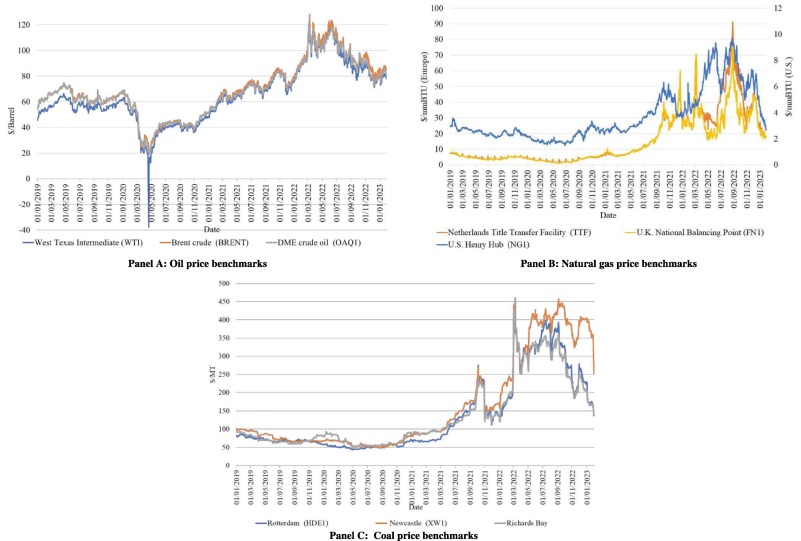
Global Energy Prices Show Extreme Volatility
The chart, showing extreme volatility in global energy prices, provides the context for the “post-crisis” environment and resulting “market bifurcation” discussed in the section.
(Source: ScienceDirect.com)
$22 B in Canceled Investments After the 2025 OBBBA Policy Shift
The dramatic U.S. policy reversal in mid-2025 with the OBBBA directly triggered the cancellation of $22 billion in planned electrification investments, demonstrating the acute sensitivity of capital-intensive projects to policy uncertainty. This contrasts sharply with the pre-2025 environment, where the IRA’s long-term incentives unlocked significant capital commitments for domestic manufacturing and supply chain development.
- The impact was most visible in 2025, when 19 separate U.S. EV supply chain manufacturing projects were canceled, according to the Clean Investment Monitor. This effectively stalled a significant portion of the domestic battery and vehicle component pipeline that had been announced following the IRA.
- The policy change went beyond just the EV sector. The formal end of key federal tax credits like 25 D and 25 C for solar and HVAC equipment at the end of 2025 further cooled investment appetite for commercial and residential building electrification, shifting the financial burden back to corporate and consumer balance sheets.
- While the IRA’s technology-neutral Clean Electricity Investment Credit became available in 2025, the OBBBA’s new restrictions narrowed its applicability and reduced its value for many project developers, complicating the financial models for new renewable energy projects intended to supply the electrification push.

Policy Uncertainty and Oil Volatility Correlations
This chart directly links “Policy Uncertainty” to market volatility, explaining the investment climate that would lead to the “$22 B in Canceled Investments” following the policy shift mentioned in the section.
(Source: ScienceDirect.com)
Table: U.S. Electrification Project Cancellations
| Affected Sector | Time Frame | Details and Strategic Purpose | Source |
|---|---|---|---|
| EV Supply Chain Manufacturing | 2025 | A total of 19 announced U.S. manufacturing projects were canceled following the policy disruption of the OBBBA. This represented a planned investment of $22 billion aimed at onshoring battery and component production. | Tracking Global Clean Technology Investment |
| Solar and HVAC | 2025 | Federal tax credits 25 D (residential clean energy) and 25 C (energy efficient home improvements) expired. This removed a key financial incentive for commercial and residential building electrification projects. | AC Direct |
Corporate Electrification Partnerships and Akaysha Energy’s 12-Year VTA
In the face of market volatility and shifting policies, corporations are increasingly using sophisticated, long-term commercial agreements to de-risk investments and secure both stable energy supply and predictable revenue streams. The market has evolved from simple Corporate Power Purchase Agreements (CPPAs) to more complex structures designed to manage the financial and operational risks of new energy assets in a post-subsidy environment.
- The period from 2025 onward is defined by more advanced deal structures that ensure project bankability. A key example is the 12-year Virtual Tolling Agreement (VTA) between Akaysha Energy and Energy Australia for a large-scale Battery Energy Storage System (BESS) project, a model that provides revenue certainty for the asset owner while giving the offtaker control over the battery’s market participation.
- The insatiable demand from data centers is driving mega-deals for clean energy. Large technology companies like Open AI are actively seeking power solutions, and energy service companies like Ameresco are developing storage and generation projects to meet this demand.
- These long-term offtake agreements are now the primary mechanism for financing new energy projects. They provide the revenue certainty required by lenders, replacing the role previously played by direct government subsidies for many projects.
Table: Key Electrification Partnerships
| Partner / Project | Time Frame | Details and Strategic Purpose | Source |
|---|---|---|---|
| Akaysha Energy and Energy Australia | Nov 2025 | A 12-year Virtual Tolling Agreement for a BESS project. This structure de-risks the investment by providing a guaranteed capacity payment, enabling the financing of critical grid-stabilizing assets. | Dentons |
| Corporate Power Purchase Agreements (CPPAs) | May 2025 | CPPAs have become a standard tool for corporations to secure long-term, fixed-price renewable electricity, hedging against price volatility while providing revenue certainty for developers to build new wind and solar farms. | Nordic Energy Research |
U.S. vs. Global Demand, Corporate Electrification Hotspots
The United States has become the global epicenter of both explosive electricity demand growth and significant policy-driven disruption, creating a highly dynamic market. Concurrently, other developed economies are experiencing their own demand surges from data centers and industrial decarbonization, but with different policy landscapes and constraints.
- The U.S. is ground zero for the AI-driven demand shock. Projections from the Electric Power Research Institute (EPRI) show data centers could consume up to 9% of total U.S. electricity generation by 2030, a development that is straining grid planning in states like Virginia, Georgia, and Texas.
- While leading in demand, the U.S. also experienced the most severe policy whiplash with the 2025 OBBBA, which created a bifurcated market. This policy shift has made state-level incentives and regulatory environments more critical than ever for project viability.
- In Canada, data center load growth is a primary driver of new electricity demand, projected to account for approximately 100 TWh, or about a quarter of the total end-use electricity demand growth, according to the Canada Energy Regulator.
- A 2023 survey of European companies revealed that 60% cited high energy prices as a major barrier to investment. This experience during the energy crisis has accelerated corporate efforts in Europe to electrify processes and secure power from renewables to gain insulation from fossil fuel volatility.

US Electricity Intensity Trend Poised for Reversal
The chart illustrates the main subject of the section—the reversal of a long-term trend in U.S. electricity demand, a key topic when analyzing “U.S. vs. Global Demand” patterns.
(Source: CSIS)
Technology Maturity for Industrial Electrification After the Energy Crisis
While some industrial electrification technologies are commercially mature and ready for wide-scale deployment, more advanced applications needed for full decarbonization of heavy industry remain at earlier stages of development. The primary barrier has shifted from technology validation to the high capital cost and physical infrastructure constraints, particularly in the wake of reduced federal incentives.
- Technologies like industrial heat pumps are considered mature, with Technology Readiness Levels (TRL) of 6-8. During the 2021-2024 period, their value proposition was proven. Post-2025, the challenge is financing their deployment at scale, as the high upfront CAPEX is now a greater hurdle for the incentive-sensitive industrial sector.
- For hard-to-abate sectors, the technology remains a bottleneck. Advanced applications like electric kilns for cement production are still at lower readiness levels (TRL 5), meaning a scalable, purely electric solution is not yet available.
- The entire electrification push is threatened by a critical and persistent bottleneck in the supply chain for essential grid equipment. U.S. domestic manufacturing meets only 20% of the demand for large power transformers, leading to long lead times that delay both generation projects and industrial facility upgrades. This issue has persisted and worsened from 2021 through 2026.
SWOT Analysis for Corporate Electrification
Corporate electrification is propelled by powerful economic tailwinds from the AI boom and the strategic need for cost stability, but it faces formidable threats from policy instability and severe physical infrastructure constraints. The strategic landscape has fundamentally changed between the pre-2025 IRA-driven era and the post-2025 period defined by demand shocks and policy reversals.
- Strengths: The core strength is the powerful economic case driven by hedging against volatile fossil fuel costs and, more recently, the non-negotiable demand from the technology sector.
- Weaknesses: The high upfront capital expenditure for electric equipment and the deep reliance on strained global supply chains for components like transformers remain significant weaknesses.
- Opportunities: The massive, inelastic demand from AI data centers creates a premium market for energy developers. Advanced commercial structures like VTAs are creating new revenue streams for storage and generation assets.
- Threats: Policy reversals like the OBBBA have proven to be the most significant threat to investment certainty. This is compounded by physical constraints like years-long grid interconnection queues and rising electricity capacity prices in strained markets.

Data Centers, EVs Drive Electricity Demand Growth
The chart quantifies major demand drivers (Data Centers, EVs), which represent key “Opportunities” and “Threats” that would be central to the SWOT analysis discussed in this section.
(Source: CSIS)
Table: SWOT Analysis for Corporate Electrification
| SWOT Category | 2021 – 2024 | 2025 – 2026 | What Changed / Validated |
|---|---|---|---|
| Strengths | Driven by sustainability goals and long-term OPEX savings supported by IRA incentives. | Driven by raw economic necessity: cost volatility hedging and massive, inelastic demand from AI data centers. | The primary driver shifted from a “nice-to-have” sustainability goal to a “must-have” for economic resilience and to power the AI boom. |
| Weaknesses | High CAPEX was a known hurdle, but mitigated by generous tax credits. Supply chain issues for transformers were emerging. | High CAPEX becomes a major barrier for non-data center sectors without subsidies. Transformer and grid equipment shortages are now a critical path constraint. | Financial weaknesses were amplified by policy changes, while physical supply chain weaknesses became acute and systemic. |
| Opportunities | Broad opportunity across industrial and commercial sectors to leverage IRA credits for decarbonization. | A hyper-focused, premium opportunity to supply power to data centers. Growing market for sophisticated offtake agreements (VTAs) for storage. | The opportunity narrowed and intensified, moving from a broad market to a highly lucrative niche (data centers) requiring speed and execution. |
| Threats | Grid interconnection queues and NIMBYism delaying project construction. | Sudden policy reversals (OBBBA) destroying investment cases overnight. Soaring electricity capacity prices in key markets. | Policy risk, previously seen as low under the IRA, was validated as the single largest threat to capital-intensive projects. |
Data Centers, EVs Drive Electricity Demand Growth
The chart quantifies major demand drivers (Data Centers, EVs), which represent key “Opportunities” and “Threats” that would be central to the SWOT analysis discussed in this section.
(Source: CSIS)
2026 Electrification Outlook for Quanta Services and 67 GW AI Demand
The defining theme for corporate electrification in 2026 will be the physical race to build generation and transmission capacity for the non-negotiable power demand from the AI sector. This race will create a premium market for energy providers and infrastructure developers who can execute projects quickly, navigating grid queues and supply chain delays to deliver large blocks of power.
- If AI demand continues at this pace, watch for: An increase in unconventional energy partnerships for data centers. This includes direct investments in novel sources like enhanced geothermal from firms such as Fervo Energy and advanced nuclear, or joint ventures between tech giants and utilities to build dedicated power plants.
- This could be happening: Utilities will accelerate and expand rate case filings to fund the massive capital expenditures required for grid modernization and expansion. This will likely lead to higher electricity prices for all industrial and commercial customers, further strengthening the business case for on-site generation and energy efficiency.
- Watch this: The Power Purchase Agreement market will become increasingly competitive, with a clear price premium for projects that have already secured interconnection rights and have a clear path to commercial operation. Infrastructure builders like Quanta Services and equipment manufacturers such as Eaton are positioned to benefit directly from this urgent buildout.
- This could be happening: A further geographic divergence between U.S. states. States with supportive clean energy policies, streamlined permitting processes, and available grid capacity will attract a disproportionate share of new industrial and data center investment, creating “electrification havens.”

AI Boom Fuels Major Electricity Demand Surge
The chart directly visualizes the “AI Boom” and its impact on electricity demand, which is the specific subject of the section, referencing “67 GW AI Demand”.
(Source: CSIS)
The questions your competitors are already asking
This report covers one angle of the bifurcation in the U.S. corporate electrification market. The questions that matter most depend on your work.
- Which companies are gaining or losing ground in the corporate electrification market following the IRA incentive rollback?
- What is the outlook for new power generation deployment to meet the projected 67 GW demand from AI data centers by 2030?
- What is actually happening with industrial electrification projects following the passage of the One Big Beautiful Bill Act (OBBBA)?
- What are the opportunities for grid service providers like Quanta Services amid the AI-driven electricity boom?
This report does not answer these. Enki Brief Pro does.
Your question, your angle, your framework. SWOT, PESTL, scenario modelling. The same niche depth, built around the decision your work actually depends on.
