

Top 10 Space-Based AI Data Center Projects and Initiatives to Monitor in 2025
The convergence of artificial intelligence’s insatiable energy demand and the falling cost of space access is catalyzing a new infrastructure frontier: the orbital data center. Analysis of developments from 2025 and early 2026 reveals that space-based AI computing is rapidly transitioning from a conceptual idea to a strategic imperative backed by major tech and aerospace players. Key data points underscore this shift, including the successful launch of initial prototypes by Starcloud and the deployment of a testbed on the International Space Station (ISS). Furthermore, ambitious, large-scale plans have been announced by industry giants like Space X and Google, alongside well-funded startups such as Aetherflux. The dominant theme for 2025 is the move from theory to tangible, in-orbit hardware validation, establishing the foundational technology and business models for what is now a $500 million emerging market.
1. Lone Star Data Holdings AI Test Mission
Companies/Organizations: Lone Star Data Holdings
Application: Testing and validating the feasibility of operating AI data centers in space. This is a critical early-stage validation step for orbital data storage and processing.
Status/Timeline: A key test launch is scheduled for early 2026.
Source: Data centers in outer space emerge as solution to AI’s …
2. Starcloud’s Inaugural Satellite Deployment
Companies/Organizations: Starcloud (an NVIDIA Inception startup)
Application: To establish an operational orbital data center prototype. This project marks one of the first tangible hardware deployments in the sector.
Status/Timeline: The first prototype satellite was successfully launched in November 2025 and is now operational in orbit.
Source: As AI Grows, Should We Move Data Centers to Space?
3. Aetherflux “Galactic Brain” Project
Companies/Organizations: Aetherflux (founded by Robinhood co-founder Baiju Bhatt)
Application: To launch a constellation of satellites equipped with AI chips, forming a “Galactic Brain” for orbital data processing.
Status/Timeline: The first satellite prototype is planned for launch by 2027.
Source: Startup announces ‘Galactic Brain’ project to put AI data …
4. Space X Orbital Data Center Initiative
Companies/Organizations: Space X
Installation Capacity: Ambition to put a “megaton/year of AI hardware to orbit.”
Application: Building large-scale, space-based data centers by integrating terabit-class data processing capabilities into its Starlink satellite infrastructure.
Status/Timeline: The strategic initiative was confirmed in December 2025.
Source: Tech Billionaires Race to Build AI Data Centers in Space
5. Google “Project Suncatcher”
Companies/Organizations: Google (Alphabet)
Application: To develop a scalable, space-based AI infrastructure using solar-powered satellites with custom Tensor Processing Units (TPUs) and optical communication links.
Status/Timeline: Announced in November 2025, with two prototype satellites planned for launch by early 2027.
Source: Exploring a space-based, scalable AI infrastructure system …
6. Starcloud 5 GW Orbital AI Cluster
Companies/Organizations: Starcloud
Installation Capacity: A target capacity of 5 gigawatts (5, 000 MW).
Application: To construct a massive, multi-gigawatt AI training cluster in space, powered entirely by orbital solar energy.
Status/Timeline: This long-term conceptual design was detailed in October 2025.
Source: How Starcloud Is Bringing Data Centers to Outer Space
7. Axiom Space & Red Hat ISS Data Center Prototype
Companies/Organizations: Axiom Space, Red Hat
Application: Testing the functionality of terrestrial computing hardware and software on the International Space Station to validate the use of commercial off-the-shelf components.
Status/Timeline: The prototype reached the ISS in September 2025 and is now an operational testbed.
Source: ISS Data Center Launch Tests Edge Computing in Space
8. Relativity Space Orbital Compute Initiative
Companies/Organizations: Relativity Space
Application: To leverage its 3 D-printed rocket launch capabilities to deploy data centers in space, a strategic pivot reportedly driven by an acquisition by former Google CEO Eric Schmidt.
Status/Timeline: Strategic direction highlighted in reports during 2025 and early 2026.
Source: The biggest data center stories of 2025
9. Blue Origin Space-Based Data Center Plan
Companies/Organizations: Blue Origin
Application: To enter the space-based data center market by utilizing its heavy-lift launch vehicle capabilities to deploy the required infrastructure.
Status/Timeline: The company’s interest was noted in industry reports in early 2026.
Source: The biggest data center stories of 2025
10. Modular Orbital Platforms Development
Companies/Organizations: Various emerging startups and research initiatives.
Installation Capacity: The market is valued at approximately $500 million as of 2025.
Application: An industry-wide trend toward developing modular, containerized systems for the first operational AI data centers in low Earth orbit, rather than single monolithic structures.
Status/Timeline: This emerging market segment represents the foundational layer for future, larger projects.
Source: AI Data Centers in Space: The Next Infrastructure Frontier
Table: Key Space-Based AI Data Center Projects Announced in 2025-2026
| Company/Organization | Installation Capacity/Scale | Application | Source |
|---|---|---|---|
| Starcloud | 5 GW target | Large-scale orbital AI training cluster | How Starcloud Is Bringing Data Centers to Outer Space |
| Space X | “Megaton/year of AI hardware” | Integrated compute in Starlink constellation | Tech Billionaires Race to Build AI Data Centers in Space |
| Two prototype satellites by 2027 | Scalable AI infrastructure with custom TPUs | Exploring a space-based, scalable AI infrastructure system … | |
| Axiom Space & Red Hat | Prototype on the ISS | Testing commercial hardware in space | ISS Data Center Launch Tests Edge Computing in Space |
| Lone Star Data Holdings | Prototype test mission | Feasibility validation for orbital data centers | Data centers in outer space emerge as solution to AI’s … |
From Testbeds to “Galactic Brains”: A Widening Application Scope
The diversity of projects announced in 2025 signals a multi-pronged approach to establishing an orbital compute ecosystem. The applications range from foundational, risk-reducing tests to hyper-ambitious commercial visions. At one end, projects like the Axiom Space and Red Hat collaboration on the ISS and Lone Star’s planned test mission focus on the immediate challenge: proving that data center hardware can operate reliably in the harsh environment of space. In contrast, ventures like Aetherflux’s “Galactic Brain” and Starcloud’s 5 GW cluster are already designing for massive-scale AI processing. This parallel development—validating basic viability while simultaneously designing for scale—indicates that investors and innovators are confident that the initial technical hurdles will be overcome, justifying long-term planning for commercial deployment.
A New Space Race Fueled by US Tech and Aerospace
The geographic landscape of space-based data centers is, for now, overwhelmingly centered in the United States. This concentration is a direct result of the nation’s unique combination of a dominant private aerospace industry and a world-leading technology sector. Companies like Space X and Blue Origin provide the launch capabilities essential for deploying any orbital infrastructure, while tech giants like Google and capital from figures like Baiju Bhatt and Eric Schmidt provide the AI expertise and financial backing. This synergy has created a powerful innovation hub, effectively kickstarting a new, commercially driven space race. The strategic acquisition of Relativity Space, reportedly for this purpose, further solidifies the trend of vertical integration, where launch providers become key players in the data infrastructure they deploy.

USA Leads Global Data Center Infrastructure
The chart shows the US’s dominant position in the terrestrial data center market. This established infrastructure and expertise provides context for its leadership in the new race to build data centers in space.
(Source: Brightlio)
From Prototypes to Strategic Pivots: A Maturing Technology Pipeline
The announced projects reveal a clear technology maturation pipeline. The sector is progressing through distinct phases, each building on the last.
1. In-Orbit Validation: The successful launch of Starcloud’s first satellite in November 2025 and the operational ISS testbed represent the first critical phase: proving hardware can work in space. These projects provide invaluable data on radiation hardening, thermal management, and software performance.
2. Advanced Prototyping: Google’s “Project Suncatcher” and Lone Star’s upcoming launch signify the next stage. These missions aim to test more complex, integrated systems, including custom silicon like Google’s TPUs and sophisticated optical communication links.
3. Strategic Scaling Initiatives: At the top of the maturity curve are the strategic announcements from Space X, Blue Origin, and the long-term vision for Starcloud’s 5 GW cluster. These are not just technical projects but market-shaping ambitions that presuppose the success of earlier phases and rely on heavy-lift launch capacity to achieve their “megaton” scale.
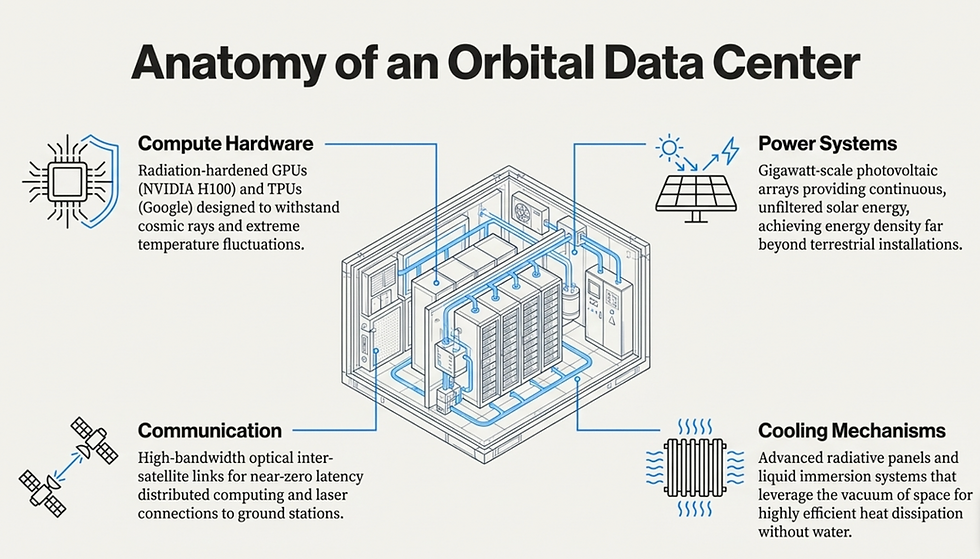
Core Components of an Orbital Datacenter
This diagram breaks down the essential technologies being prototyped for space, as discussed in the section. It highlights the specific hardware, like radiation-hardened chips and optical links, that define the maturing technology pipeline.
(Source: AI News Hub)
The Future is Modular and Orbital
The developments of 2025 and early 2026 signal that space-based AI data centers are no longer a futuristic novelty but a funded and rapidly advancing technological solution to a terrestrial problem. The primary driver is the unsustainability of AI’s energy and land footprint on Earth. By moving compute to orbit, companies can access unlimited solar power and a near-perfect vacuum for cooling. The trend towards modular, containerized platforms suggests the industry is prioritizing scalability and iterative deployment over monolithic, high-risk structures. As launch costs continue to fall, the economic case will only strengthen, positioning this nascent $500 million market for exponential growth. The key takeaway is that the race to build the next generation of data infrastructure is no longer bound by geography—it is now looking to the stars.

A Blueprint for Modular Orbital Platforms
This technical schematic directly illustrates the modular design trend mentioned in the section. It details key specifications that enable a scalable, containerized approach to building data centers in orbit.
(Source: Hackaday)
Frequently Asked Questions
Why are companies building AI data centers in space?
Companies are moving AI data centers to space to solve major terrestrial problems. The primary drivers are to escape AI’s insatiable energy demand and large land footprint on Earth. Orbit provides unlimited solar power and a natural vacuum for efficient cooling, which are ideal for high-performance computing.
Which major companies are involved in this new industry?
The field is led by a mix of major US-based tech and aerospace companies. Key players include SpaceX, Google (with its “Project Suncatcher”), Blue Origin, and Red Hat. The sector also features well-funded startups like Starcloud, Aetherflux (founded by Robinhood’s co-founder), and Lone Star Data Holdings.
Are there any data centers actually operating in space right now?
Yes, the first prototypes are already operational. As of late 2025, Starcloud successfully launched its inaugural prototype satellite, and a testbed collaboration between Axiom Space and Red Hat is running on the International Space Station (ISS) to validate commercial hardware in a space environment.
What is the current market size for this emerging sector?
As of 2025, the market for space-based AI data centers is valued at approximately $500 million. This figure represents the initial phase of development, which is focused on tangible, in-orbit hardware validation and foundational business models.
What is the timeline for some of these ambitious projects?
Timelines vary. Initial prototypes from Starcloud and the Axiom/Red Hat collaboration became operational in 2025. Lone Star Data Holdings is planning a key test mission for early 2026. More advanced projects, such as Google’s “Project Suncatcher” and Aetherflux’s “Galactic Brain,” are targeting their first prototype launches by 2027.
Want strategic insights like this on your target company or market?
Build clean tech reports in minutes — not days — with real data on partnerships, commercial activities, sustainability strategies, and emerging trends.
Experience In-Depth, Real-Time Analysis
For just $200/year (not $200/hour). Stop wasting time with alternatives:
- Consultancies take weeks and cost thousands.
- ChatGPT and Perplexity lack depth.
- Googling wastes hours with scattered results.
Enki delivers fresh, evidence-based insights covering your market, your customers, and your competitors.
Trusted by Fortune 500 teams. Market-specific intelligence.
Explore Your Market →One-week free trial. Cancel anytime.
