

US LNG Export Policy, 17 Bcf/d Capacity, Sempra’s Tokyo Gas Deal, and 2 Key Political Risks (2025-2026)
US LNG Export Volatility: Europe’s New Dependency on American Domestic Policy
Europe has successfully replaced Russian pipeline gas with U.S. Liquefied Natural Gas (LNG), but this strategic pivot has created a new, concentrated dependency. The continent’s energy security is now directly exposed to the volatility of U.S. domestic energy policy, transforming what was a commercial energy flow into a significant geopolitical lever for Washington.
- Between 2022 and 2024, Europe’s primary objective was securing alternative gas supplies at any cost to replace Russian volumes. U.S. LNG was the only source available at the scale required, and flows surged to meet this crisis-driven demand.
- The dynamic shifted in 2025-2026 from simple procurement to risk management. Europe’s reliance became stark, with U.S. LNG accounting for 57% of the EU’s total LNG imports and 25% of its overall gas consumption by 2025. This concentration of supply introduced a new single point of failure.
- This vulnerability was highlighted by the U.S. political landscape. The Biden administration’s 2024 pause on new LNG export permit approvals, driven by domestic climate concerns, was reversed by the subsequent administration in January 2025. This policy whiplash demonstrated how quickly Europe’s energy supply could be impacted by American politics.
- The U.S. is now the marginal supplier for the entire global market, having provided 93% of the world’s LNG export growth in 2025. This central role means any disruption to U.S. exports, whether from policy, weather, or infrastructure issues, has immediate and amplified effects on European and global gas prices.
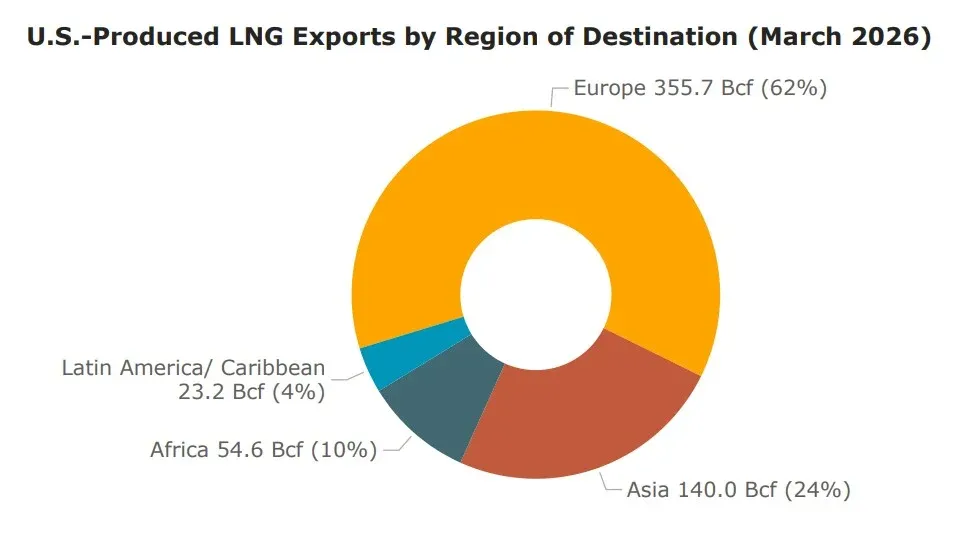
Europe Dominates U.S. LNG Exports, Securing 62% Share by March 2026
In March 2026, Europe will receive a dominant 62% (355.7 Bcf) of all U.S.-produced LNG exports, clearly positioning the U.S. as Europe’s primary external gas supplier and a pivotal player in its energy security strategy. Asia accounts for the second-largest share at 24% (140.0 Bcf).
Transatlantic Energy Axis Solidified, Yet New Market Risks Emerge for Europe
This heavy reliance on U.S. LNG transforms Europe’s energy security, shifting from historical geopolitical vulnerabilities to a transatlantic energy axis. While reducing dependence on certain volatile regions, it introduces new risks related to global LNG price fluctuations, shipping logistics, and the need for robust regasification infrastructure. For the US, this translates into significant geopolitical leverage.
US LNG Dominates EU Imports, Reshaping Energy Mix
As of January 2026, US LNG constitutes 30.2% of the EU’s total natural gas and LNG imports, making it the single largest LNG source. Overall, LNG now accounts for 49.1% of EU imports, nearing parity with traditional pipeline gas (50.9%).
(Source: Trump threatens US LNG supplies to Europe | European Gas Hub)
$5.3 B Cancellation at Lake Charles, Energy Transfer Signals Policy Friction
Investment in the next wave of U.S. LNG export capacity has been defined by significant friction, as regulatory uncertainty and political reversals create a difficult environment for developers to secure the long-term contracts needed for financing. This has resulted in high-profile project delays and cancellations, signaling a potential cap on future supply growth.
- In December 2025, Energy Transfer announced the suspension of development for its Lake Charles LNG project. The decision was a direct result of the unstable regulatory environment and an inability to secure offtake agreements, illustrating the real-world impact of policy uncertainty on infrastructure development.
- This contrasts with projects that achieved final investment decision (FID) before the period of heightened political friction. For example, the Golden Pass LNG project, which secured financing earlier, successfully began production in June 2026, adding 18.1 million tonnes per annum (MTPA) of capacity.
- European buyers have contributed to this financing challenge. Citing their own climate targets and wary of over-reliance on a single source, many European utilities have avoided the 20-year contracts that U.S. developers require, further complicating the investment outlook for new projects.
US Gulf Coast Dominance, Supplying 68% of LNG Exports to Europe
The U.S. Gulf Coast has cemented its role as the critical energy artery for Europe, with its vast liquefaction and export infrastructure forming a highly concentrated and strategically vital supply corridor. This geographic concentration, while efficient, also represents a significant risk point for European energy security.
- During the 2022-2024 period, Gulf Coast terminals operated at maximum capacity to meet Europe’s emergency demand, establishing the transatlantic route as the world’s most important LNG trade flow.
- By 2025, this ad-hoc response had become a structural feature of the global energy market. Fully 68% of all U.S. LNG exports were directed to Europe, with the vast majority originating from terminals in Texas and Louisiana.
- Massive new projects, including Sempra‘s Port Arthur LNG and the Golden Pass LNG facility, are located along the Gulf Coast. Their ramp-up through 2026 further solidifies the region’s central role in supplying Europe.
- While Europe is the primary destination, U.S. cargoes remain flexible and can be diverted to Asia to capture price arbitrage opportunities. This creates a constant source of potential competition for volumes, meaning European buyers must consistently pay a premium to ensure cargoes are delivered.
SWOT Analysis for US LNG Exports and European Energy Security
While U.S. LNG’s strength is its immense scale and cost-competitive feedstock, its primary weakness and most potent threat is the politicization of its export policy. This dynamic creates significant strategic uncertainty for its most important customer, Europe, which has traded dependency on an adversary for a complex reliance on an ally.
Table: SWOT Analysis of U.S. LNG as a Geopolitical Lever
| SWOT Category | 2021 – 2024 | 2025 – 2026 | What Changed / Validated |
|---|---|---|---|
| Strengths | Vast, low-cost shale gas reserves (Henry Hub benchmark). Rapidly expanding liquefaction capacity in response to European crisis demand. | Confirmed status as the world’s largest LNG exporter (111 million tons in 2025). New projects like Golden Pass LNG coming online, boosting capacity to over 17 Bcf/d. | The U.S. proved it could scale production and exports faster than any other nation, solidifying its role as the world’s marginal supplier. |
| Weaknesses | Growing domestic opposition to LNG exports from environmental groups. Infrastructure bottlenecks in pipeline capacity to feed terminals. | Exposure to domestic political shifts, demonstrated by the 2024 permit pause and 2025 reversal. High domestic gas demand can limit export availability during extreme weather. | The weakness shifted from a theoretical political risk to a demonstrated reality, making U.S. domestic policy a primary concern for European buyers. |
| Opportunities | Displace Russian gas entirely from the European market. Secure long-term contracts as Europe rebuilt its energy strategy. | Use LNG exports as a powerful diplomatic tool to solidify alliances in Europe and Asia. Lock in market share before the next wave of Qatari supply arrives post-2027. | The opportunity to achieve energy dominance was validated, with the U.S. now accounting for 85% of all new global LNG investment decisions. |
| Threats | A sudden drop in European demand due to economic recession or a faster-than-expected green transition. Competition from Qatar. | A future U.S. administration imposing export restrictions, creating a supply shock. EU regulations on methane intensity (e.g., CBAM) potentially penalizing U.S. gas. | The threat of politically-motivated supply restrictions became the single largest risk factor for European energy security, replacing the previous threat of Russian weaponization of energy. |
Scenario Modelling: Next Decade and the Impact of a US Export Policy Shift
The most critical variable for European energy security and global gas markets through 2027 is the stability and predictability of U.S. LNG export policy. Any substantive move to restrict or slow the approval of future export volumes would immediately tighten global supply, spike prices, and create significant diplomatic friction between Washington and its allies.
- If this happens: A future U.S. administration, citing domestic price inflation or climate commitments, re-imposes a strict and lengthy review process for all new non-FTA LNG export permits, effectively halting the “second wave” of projects.
- Watch this: The Final Investment Decisions (FIDs) for major proposed projects that have not yet begun construction, such as Phase 2 of Next Decade‘s Rio Grande LNG. Further delays or cancellations of these FIDs would be the primary signal that new U.S. capacity growth is stalling.
- These could be happening: European utilities and governments would be forced to compete aggressively for volumes from Qatar and other producers, likely driving the European TTF gas benchmark significantly higher. This would also trigger urgent diplomatic talks as Europe pushes back against U.S. policy that it views as undermining its energy security.
The questions your competitors are already asking
This report covers one angle of the politicization of US gas exports. The questions that matter most depend on your work.
- Qatar new gas projects timeline
- European utility long term gas contracts
- EU methane rules impact on US gas imports
- Rio Grande gas project status
This report does not answer these. Enki Brief Pro does.
Your question, your angle, your framework. SWOT, PESTL, scenario modelling. The same niche depth, built around the decision your work actually depends on.
