

Marathon Petroleum Distributed Energy Hubs, 1, 055 MW Capacity, Marathon Digital Deal, and $5.5 B MPLX Investment (2025-2026)
DER Hub Adoption, Marathon Petroleum’s Industrial Co-location Projects
In 2025, Marathon Petroleum Corporation shifted its energy strategy from incremental efficiency gains to pioneering a new model for distributed energy resources by integrating its industrial operations with large-scale, flexible electrical loads. This approach moves beyond typical corporate renewable procurements by creating industrial energy hubs that monetize underutilized energy and provide grid-stabilizing services. The strategy leverages the company’s extensive midstream and refining footprint as a foundation for this new class of distributed energy asset.
- Prior to late 2025, Marathon Petroleum’s clean energy efforts were characterized by cautious, venture-style investments, such as its $33 million stake in decarbonization firm Comstock Inc. This approach outsourced R&D and minimized direct capital risk while providing access to emerging biofuel technologies.
- A strategic pivot occurred in November 2025 with the collaboration between its MLP, MPLX, and Marathon Digital Holdings (MARA). This initiative co-locates power generation with data centers in the Delaware Basin, transforming stranded or flared gas from processing plants into a valuable, dispatchable energy source.
- This co-location model positions industrial sites as distributed energy hubs, creating a new revenue stream while using the data centers as a flexible load to enhance local grid stability. This initiative is set against a backdrop of a global Distributed Energy Generation market valued at nearly $500 billion in 2025.
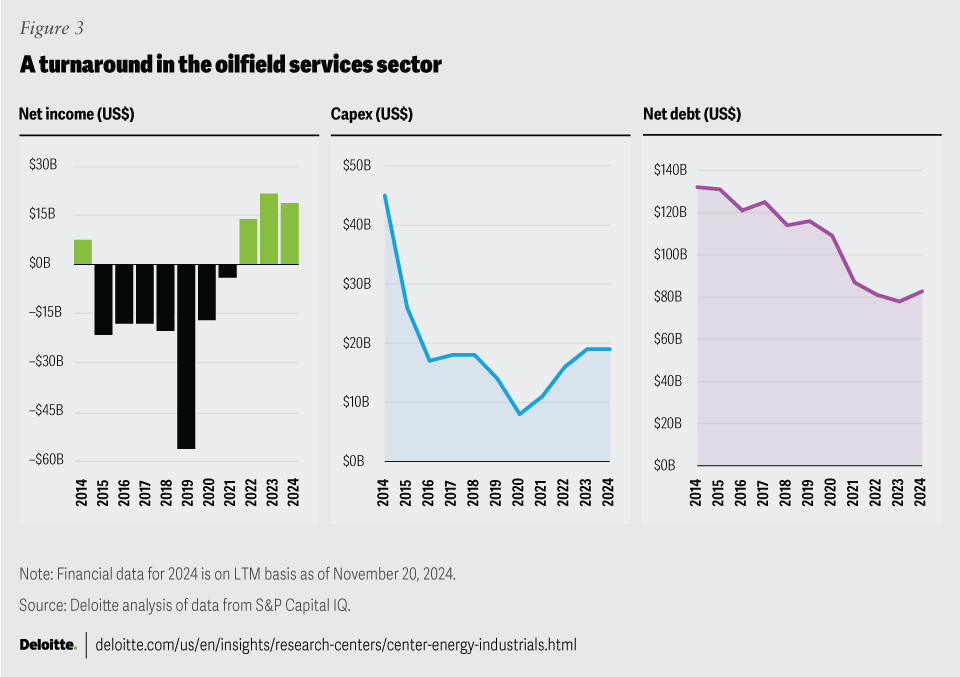
Oilfield Services Sector Sees Financial Turnaround
The development of DER hubs and industrial co-location projects often involves collaboration with the oilfield services sector. This chart, showing a financial turnaround in that sector, illustrates a key enabling factor and a positive external environment (‘Opportunity’ in a SWOT context) for Marathon’s projects, suggesting partners are more capable of executing complex work.
(Source: Deloitte)
$9.25 B in Spending, Marathon Petroleum Refining and Midstream Upgrades
Marathon Petroleum maintained its financial discipline by dedicating the majority of its capital to fortifying its core business while allocating substantial funds for modernization and strategic growth projects that enable its distributed energy ambitions. Total announced capital plans across MPC and MPLX exceed $9.25 billion, directed at high-return refinery projects, midstream expansion, and infrastructure upgrades that are foundational to its integrated energy strategy.
- For 2025, MPC announced a standalone capital budget of $1.25 billion for its Refining & Marketing segment, with 70% (approximately $875 million) targeted for high-return growth projects that improve commercial optionality and efficiency.
- A significant long-term investment was the announcement of a $2.5 billion multi-year initiative for a natural gas liquids (NGL) fractionation and export facility near Galveston Bay, Texas, an energy-intensive project that reinforces the need for cost-effective on-site power.
- MPLX, the primary vehicle for the distributed energy strategy, reported $5.5 billion in growth investments for 2025, funding the gas processing and logistics infrastructure that underpins the collaboration with Marathon Digital.
- Specific high-return projects within the refining network include a $100 million investment at the Robinson refinery with an expected return of 20% and a $150 million project at another facility projecting a 25% return.

Refining Segment EBITDA Rises to $1.38B
This chart directly validates the spending on refining and midstream upgrades mentioned in the section. The significant rise in the Refining Segment’s EBITDA serves as a key performance indicator, demonstrating a strong return on investment and the success of the modernization strategy.
(Source: Investing.com)
Table: Marathon Petroleum Strategic Investments (2025-2026)
| Partner / Project | Time Frame | Details and Strategic Purpose | Source |
|---|---|---|---|
| MPLX 2025 Growth Investments | Full-Year 2025 | $5.5 billion in growth capital to expand midstream infrastructure, providing the foundational assets for the distributed energy collaboration with Marathon Digital Holdings. | MPLX |
| NGL Fractionation & Export Facility | Announced Early 2025 | A multi-year, $2.5 billion project to develop a new NGL facility in Galveston Bay, increasing the strategic importance of reliable and cost-effective on-site power generation. | Marathon Petroleum |
| Refining & Marketing Capital Plan | Full-Year 2025 | $1.25 billion standalone capital plan, with $875 million (70%) dedicated to high-return projects enhancing efficiency and commercial flexibility in the refining network. | Matrix BCG |
| Comstock Inc. Investment | 2025 | A total of $33 million invested in decarbonization technology firm Comstock, securing access to emerging technologies for converting biomass into biofuel intermediates. | Comstock Inc. |

Marathon’s Cash Flow Shows Heavy Strategic Spending
The chart provides the high-level financial context for the detailed table of strategic investments. It visually confirms the company’s commitment to ‘Heavy Strategic Spending,’ which funds the specific projects listed for 2025-2026, linking the overall financial strategy to its execution.
(Source: Investing.com)
Marathon Petroleum 3 Key Energy Alliances with MARA, Tenasca, Corteva
Marathon Petroleum’s partnerships executed between 2024 and 2026 illustrate a sophisticated, multi-pronged strategy focused on both optimizing its current and future fuel production and pioneering new energy monetization models. These alliances secure feedstock for renewable fuels, establish offtake agreements for waste-to-energy projects, and create novel integrations between energy supply and demand.
- The most strategically significant partnership is the November 2025 collaboration between MPLX and Marathon Digital Holdings (MARA). This agreement establishes a framework to build integrated power generation and data center campuses, directly monetizing MPLX’s energy resources in the Permian Basin.
- To support its renewable fuels business, Marathon Petroleum is listed as a major energy offtake partner for Tenasca Biofuels as of January 2026. This secures a supply chain for waste-to-value renewable energy projects, which require stable, low-cost power to be economically viable.
- Reinforcing its vertical integration in the renewables space, Marathon Petroleum formed partnerships in late 2024 with agricultural leaders Corteva and Bunge. These deals are designed to secure a reliable supply of feedstock for renewable diesel production, mitigating cost volatility.

MPC Q1 2026 Update Shows Strong Performance
This chart serves as a timely scorecard for the company’s overall strategy, which includes the key energy alliances mentioned in the section. Strong performance in Q1 2026, a period during which these alliances are active, suggests the company’s strategic direction, including its partnerships, is proving successful.
(Source: Investing.com)
Table: Marathon Petroleum Strategic Partnerships (2024-2026)
| Partner / Project | Time Frame | Details and Strategic Purpose | Source |
|---|---|---|---|
| Tenasca Biofuels | Jan 2026 | Offtake agreement positioning MPC as a key partner for waste-to-value renewable energy projects, securing feedstock for renewable fuel production. | Net Zero Platforms |
| Marathon Digital Holdings (MARA) | Nov 2025 | Collaboration to co-locate power generation and data centers near MPLX gas processing facilities, monetizing energy and creating a flexible electrical load. | MPLX |
| Corteva and Bunge | Dec 2024 | Strategic partnerships to secure agricultural feedstock for renewable diesel production, improving cost control for energy-intensive refining processes. | Deloitte Insights |

MPLX Distribution Funds MPC Capital Strategy
This chart provides a specific, powerful example for the section on strategic partnerships. It illustrates the critical financial synergy between Marathon (MPC) and its affiliate MPLX, showing exactly how this key partnership structure funds the parent company’s broader capital strategy.
(Source: Investing.com)
Permian Basin Centric, Marathon Petroleum’s West Texas DER Strategy
Marathon Petroleum’s distributed energy initiatives are geographically concentrated in the Permian Basin of West Texas, a strategic decision to leverage its significant existing midstream infrastructure as a testbed for its industrial energy hub model. This regional focus allows MPC to pilot and prove its co-location concept in a target-rich environment before considering broader deployment across its national footprint.
- The Delaware Basin, a sub-basin of the Permian, is the explicit target for the MPLX-MARA collaboration. This region houses numerous MPLX gas processing facilities, providing a ready source of underutilized energy that can be captured and sold to the co-located data centers.
- The commissioning of the 200 MMcf/d Secretariat I gas processing plant in January 2026 further expands MPLX’s capacity in the Permian to 1.4 Bcf/d, increasing the available energy resource for monetization through the distributed energy partnership.
- While the distributed energy pilot is focused on Texas, MPC’s broader capital spending on “utility and infrastructure modernization” continues at its major refining centers, including Galveston Bay (Texas), Garyville (Louisiana), Robinson (Illinois), and El Paso (Texas), preparing these sites for potential future energy optimization projects.

Permian Production Growth Creates Gas Bottlenecks
This chart clearly defines the core problem in the Permian Basin that Marathon’s West Texas DER strategy is designed to address. By highlighting the ‘gas bottlenecks,’ it provides the essential market-driven rationale (‘the why’) for the strategic initiatives discussed in the section.
(Source: Deloitte)
1, 055 MW Capacity, Marathon Petroleum’s Proven On-Site Generation Tech
The technological foundation of Marathon Petroleum’s distributed energy strategy rests on its large and mature portfolio of on-site power generation assets, which it is now leveraging in innovative commercial applications. The core innovation is not the invention of new hardware but the commercial-scale integration of this existing, reliable technology with novel flexible loads like data centers to create new grid-balancing assets.
- As of its 2025 annual report, Marathon Petroleum already owns and operates 1, 055 megawatts of electrical production capacity across its facilities, demonstrating a long-standing competency in managing distributed generation at an industrial scale.
- Approximately 49% of the power generated from these assets is consumed directly by MPC’s refineries, providing operational resilience and a deep internal understanding of the interplay between power production and industrial demand.
- The MPLX-MARA project represents a shift from using this technology solely for internal needs to applying it as a commercial solution. The data centers act as a highly responsive, dispatchable load, allowing the system to participate in demand-response programs and enhance grid stability.
- This integration is supported by foundational digital technologies, such as the advanced gas detection and alarm management systems deployed in 2025, which provide the real-time monitoring and safety infrastructure needed to manage complex, integrated energy systems.
SWOT Analysis of Marathon Petroleum’s Flexible Load Strategy
Marathon Petroleum’s strategic evolution in 2025 reveals a company leveraging its immense legacy strengths to cautiously but deliberately enter the distributed energy sector. The analysis shows a shift from passive, external investments in decarbonization to an active strategy of integrating its own assets to create new value streams, exposing both unique opportunities and internal risks.
- The company’s primary strength is its vast and profitable refining and midstream asset base, including 1, 055 MW of existing generation, which provides the capital and infrastructure to pilot new energy models like the MARA partnership.
- A key weakness is the “follower” approach to the energy transition, which risks leaving it behind more aggressive competitors, along with a demonstrated vulnerability to market volatility, as seen in the 75% quarterly drop in its Renewable Diesel segment EBITDA in Q 4 2025.
- The main opportunity lies in scaling the industrial energy hub model, monetizing stranded energy assets and creating a new service line in grid stabilization, potentially amplified by federal incentives like the Inflation Reduction Act’s 45 Z tax credit.
- Threats include accelerating decline in demand for traditional fuels in key markets like California, persistent regulatory pressure, and the operational complexity of integrating disparate energy and digital infrastructures.

U.S. Diesel Market to Reach $123B by 2034
A SWOT analysis requires an assessment of external factors. This chart quantifies a significant ‘Opportunity’ for Marathon, a major refiner and producer of diesel. The projected growth of the U.S. diesel market is a critical positive factor for the company’s flexible load and overall refining strategy.
(Source: Market Data Forecast)
Table: SWOT Analysis for Marathon Petroleum’s Distributed Energy Initiatives
| SWOT Category | 2021 – 2024 | 2025 | What Changed / Validated |
|---|---|---|---|
| Strengths | High profitability from core refining; extensive midstream infrastructure (MPLX); operational efficiency. | Maintained high refinery utilization (95%); $3.3 B Q 2 Adjusted EBITDA; leveraged MPLX assets for new venture. | Validated that core business profitability provides the financial firepower ($1.25 B capex) to fund both traditional high-return projects and new strategic initiatives. |
| Weaknesses | Perceived as a “follower” in energy transition; heavy dependence on fossil fuel revenue; limited direct investment in clean energy generation. | Renewable Diesel segment EBITDA dropped 75% in Q 4 due to “weaker margins, ” showing sensitivity. Initial clean tech exposure was via a minority $33 M investment in Comstock. | The shift to the MPLX-MARA project validated that MPC prefers to leverage its own assets and expertise rather than compete directly in crowded renewable development markets. The margin weakness in renewables reinforced its cautious capital allocation. |
| Opportunities | Monetize flared or stranded gas; leverage industrial sites for new energy services; benefit from growing demand for data centers and grid stability. | Announced MPLX-MARA collaboration to directly monetize gas assets by powering data centers; IRA guidance on 45 Z credit enhances renewable fuel profitability. | The MARA deal is the first concrete validation of a strategy to turn industrial liabilities (stranded energy) into assets, creating a blueprint for an entirely new business line. |
| Threats | Long-term decline in gasoline demand; increasing regulatory pressure on emissions; competition from pure-play renewable companies. | California regulators highlighted declining gasoline demand. Competitors like Chevron state more explicit strategies to grow new energy businesses. | The external pressures were validated, pushing MPC to find innovative ways to leverage its existing fossil fuel infrastructure for new revenue streams, as a hedge against the decline of its core market. |

US Oil & Gas Infrastructure Market Shows Growth
For a SWOT analysis on Distributed Energy Initiatives, this chart illustrates a key external ‘Opportunity.’ The growth in the broader U.S. oil and gas infrastructure market indicates a favorable environment and growing need for new investments, justifying and supporting Marathon’s focus on DER projects.
(Source: Global Market Insights)
Scenario Modelling: Marathon Petroleum’s Future and Scaling the Data Center Energy Model
The primary indicator of success for Marathon Petroleum’s distributed energy strategy in 2026 will be the execution and scalability of the MPLX-MARA integrated energy hub pilot. The project’s progress will determine if this innovative model becomes a core part of MPC’s future or remains a niche experiment, with key signals emerging from project milestones, capital allocation, and new partnership formations.
- If construction and commissioning milestones for the first integrated power and data center campuses in the Delaware Basin are announced on schedule in 2026, watch for MPC to begin identifying other midstream assets suitable for similar co-location projects.
- The release of MPC’s 2027 capital budget will be a critical signal. An increased allocation for “utility and infrastructure modernization” at refineries beyond the Permian, or a new line item for “digital infrastructure integration, ” would indicate a strategic commitment to scaling the model.
- These events could be happening: Marathon Petroleum may seek to replicate the flexible load partnership model with other energy-intensive, dispatchable industries. Look for exploratory talks or pilot agreements with sectors like hydrogen electrolysis or advanced manufacturing that could co-locate at MPC facilities.
- The financial performance of the renewable fuels segment following the February 2026 guidance on the 45 Z tax credit will influence future investment. If margins recover, MPC may accelerate investments in on-site power at biofuel facilities to improve resilience and cost control.

Marathon Petroleum Financial Forecast to 2028
The section discusses future scenario modeling. This chart is a direct output of such an exercise, providing a long-term financial forecast for the company. It visually represents a potential future, making it a perfect illustration of the scenario planning and scaling models discussed.
(Source: Simply Wall Street)
The questions your competitors are already asking
This report covers one angle of Marathon Petroleum’s pivot into industrial distributed energy hubs. The questions that matter most depend on your work.
- MPLX’s $5.5B investment in distributed energy. Is the 1,055 MW capacity target on track for 2026?
- What is actually happening with the Marathon Petroleum and Marathon Digital co-location project in the Delaware Basin?
- Which other refining and midstream operators are adopting the industrial energy hub model?
- What are the opportunities for flexible loads, like data centers and crypto mining, at other industrial sites?
This report does not answer these. Enki Brief Pro does.
Your question, your angle, your framework. SWOT, PESTL, scenario modelling. The same niche depth, built around the decision your work actually depends on.
