

Advanced Reactor Supply Chain Risk, $9.7 B Investment, Google 200 MW PPA, and 5 Major Commercial Agreements (2021 to 2026)
Fusion Supply Chain Risk, $77 B Commercialization Gap, and 5 Key Bottlenecks
The primary constraint on fusion energy’s adoption has shifted from scientific feasibility to industrial scalability, exposing a critical gap between the projected $77 billion capital required for the first wave of commercial plants and the current manufacturing capacity for specialized components. While scientific milestones dominated the period from 2021 to 2024, the focus since 2025 has moved to the immense challenge of building a supply chain for an industry that does not yet fully exist.
- Between 2021 and 2024, industry progress was defined by physics breakthroughs, including net energy gain demonstrations and successful high-field magnet tests, which validated core technological concepts.
- Since 2025, the central issue has become the supply chain. Fusion Industry Association (FIA) reports now consistently identify critical bottlenecks in high-temperature superconducting (HTS) wires, power electronics, large-scale cryogenic systems, and specialized materials.
- The industry faces a “chicken-and-egg” dilemma, quantified in a 2025 FIA survey: while 75% of suppliers invested to expand fusion-related capacity, 69% cite a lack of large, long-term orders from developers as a major barrier to further investment.
- Fusion supply chain spending rose 24% in 2025 to $538 million, a positive signal but a fraction of the tens of billions needed to build out the required industrial base for mid-2030 s deployment targets.
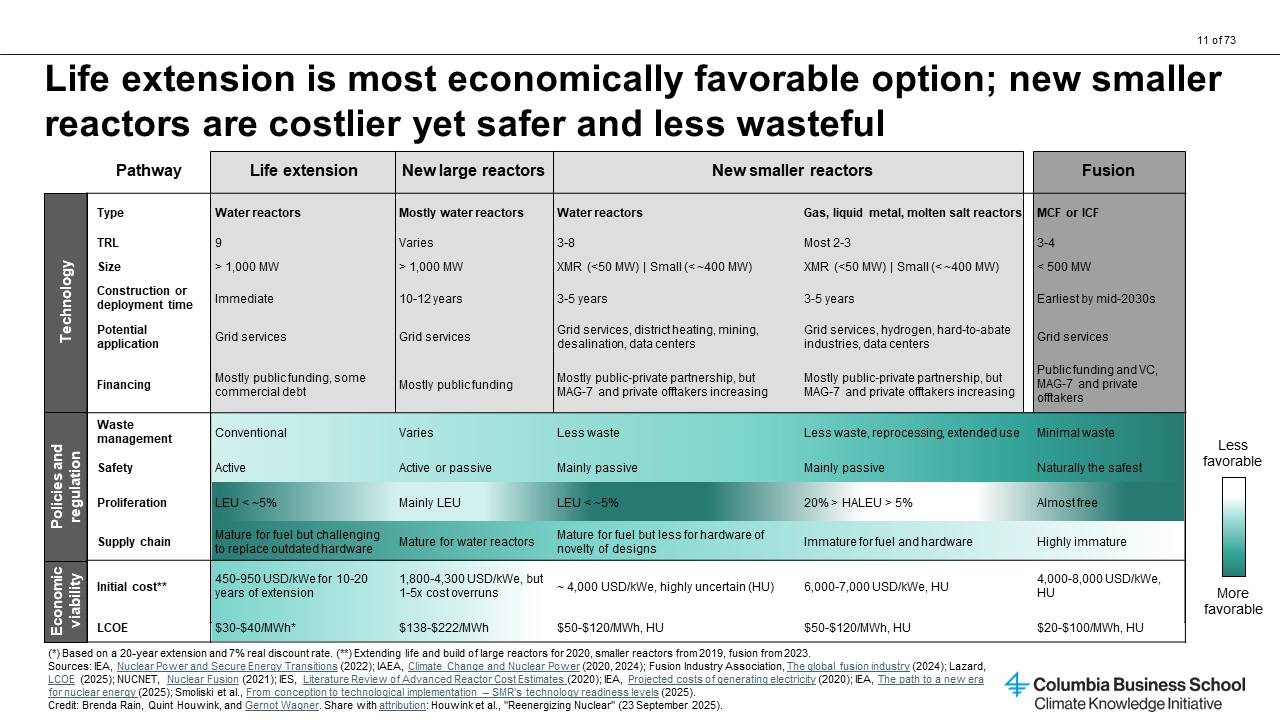
Fusion vs. Fission: Cost & Supply Chain Comparison
This chart’s comparison of fusion and fission supply chains and costs provides essential context for the section’s deep dive into fusion-specific supply chain risks and its commercialization gap.
$9.7 B in Private Capital, Fusion Industry Investment Volatility and Regional Concentration
While private investment in fusion surpassed $9.7 billion by mid-2025, the funding flow is highly volatile, with sharp peaks and subsequent drops that create significant uncertainty for suppliers who require stable, long-term demand signals to justify major capital expenditures on new manufacturing facilities.
- The period since 2021 has seen massive private funding rounds, such as Commonwealth Fusion Systems‘ (CFS) $863 million Series B 2 round in August 2025, which signaled strong investor confidence in market leaders.
- However, analysis of investment flows reveals significant volatility, including a sharp market-wide drop in funding in 2022 and another projected decline in 2025, complicating long-term capacity planning for the entire supply chain.
- Investment is also geographically concentrated. The USA continues to lead in attracting private capital, but China’s emergence as a major funding source, with over $1 billion invested in 2023 alone, signals rising geopolitical competition and a potential fragmentation of future supply chains.
- Tokamak Energy’s $125 million funding round in November 2024 was specifically targeted to grow its magnetics division, representing a direct investment into a critical supply chain segment.

VCs ‘Pivot to Atoms’ as Deep Tech Funding Soars
The chart’s headline about Venture Capitalists (VCs) investing in ‘atoms’ (fusion) directly illustrates the influx of private capital and investment trends discussed in this section.
(Source: LinkedIn)
Fusion Industry Key Investments
| Company / Initiative | Time Frame | Details and Strategic Purpose | Source |
|---|---|---|---|
| ARPA-E | April 2026 | Awarded a record $135 million in public funding to specifically address and remove the “toughest technical barriers” to commercial fusion, including supply chain and materials challenges. | ARPA-E awards record $135 million to speed commercial fusion … |
| TAE Technologies | December 2025 | Announced a merger agreement with Trump Media, providing TAE with up to $300 million in funding to advance the construction of a utility-scale demonstration plant. | Trump Media—TAE Merger: Fusion’s Public Market Leap |
| Helical Fusion | December 2025 | Secured $5.5 million in a strategic equity investment from Japanese supermarket chain Aoki Super, a deal that also included Japan’s first fusion power purchase agreement. | Helical Fusion Secures $5.5 M Funding, Signs Japan’s First Fusion … |
| Tokamak Energy | November 2024 | Raised $125 million in a funding round to commercialize its technologies and expand its magnetics division (TE Magnetics) to meet growing demand from fusion and other industries. | Tokamak Energy raises $125 m to commercialise transformative … |
Fusion Industry 5 Major Offtake Agreements, Google PPA, and Eni Partnership (2024 to 2026)
Strategic partnerships and corporate offtake agreements, particularly those signed since 2025, are becoming the most critical demand signal for de-risking supply chain investment. These binding commercial commitments provide the revenue certainty that suppliers need to move beyond speculative R&D support and invest in tangible manufacturing capacity.
- The power purchase agreement (PPA) between Google and CFS in June 2025 for 200 MW of power was a landmark deal, validating fusion as a potential power source for energy-intensive sectors like AI data centers.
- Major energy firms are now making substantial commitments, highlighted by Italian energy company Eni signing a PPA worth over $1 billion with CFS in September 2025 for electricity from its first ARC power plant.
- Helion’s agreement to provide power to Microsoft, announced before 2025, and its subsequent plan to build a 50 MW plant in Washington, established a model for corporate-developer partnerships driving commercialization.
- The emergence of smaller, strategic offtake deals, such as Japanese supermarket Aoki Super’s PPA with Helical Fusion in December 2025, indicates that the market for fusion power is beginning to broaden beyond tech giants and energy majors.

Fusion Contract Value Nears €8 Billion by 2026
This chart quantifies the growing financial commitment through contracts, directly supporting the section’s focus on major offtake agreements and partnerships leading up to 2026.
(Source: Clean Air Task Force)
Fusion Industry Strategic Partnerships
| Partner / Project | Time Frame | Details and Strategic Purpose | Source |
|---|---|---|---|
| Commonwealth Fusion Systems & Google | February 2026 | Following an earlier PPA, Google participated in an $863 million funding round for CFS and signed a long-term power offtake agreement, deepening the strategic alignment between the two companies. | Nuclear Fusion: 5 Ways to Invest in the Energy Breakthrough |
| Commonwealth Fusion Systems & Eni | September 2025 | Strategic investor Eni signed a PPA valued at over $1 billion for clean power from CFS‘s first ARC plant, providing a crucial, bankable revenue stream to support project financing. | Eni and Commonwealth Fusion Systems sign $1 billion+ power … |
| Helion & Public Utility Operators | June 2025 | Helion announced plans to build its eighth prototype, a 50 MW plant named Orion, in Everett, Washington, in collaboration with local public utility districts. | Helion advances fusion energy program |
US vs China, Fusion Supply Chain Investment and National Strategy
The geographic center of fusion innovation is consolidating in the United States, driven by a robust private sector and proactive federal policy, but China’s aggressive, state-led industrial strategy and massive funding injections present a significant long-term competitive and supply chain risk.
- From 2021 to 2024, the United States established itself as the undisputed hub for private fusion investment, attracting the majority of global venture capital and hosting the leading private fusion companies.
- Since 2025, this leadership position has been reinforced by a supportive policy framework. The U.S. Department of Energy finalized its *Fusion Science and Technology Roadmap* in June 2026, and legislative efforts are underway to extend the 45 X Advanced Manufacturing Tax Credit to fusion components, creating a strong incentive for domestic suppliers.
- China’s strategy shifted dramatically in July 2025 with the launch of China Fusion Energy Co. Ltd., a state-owned enterprise backed by $2.1 billion in initial capital. Its explicit goal is to dominate the sector by building a vertically integrated domestic supply chain.
- Other regions are also becoming active. Japan saw its first fusion PPA signed in December 2025, and the U.K. continues to support the industry through entities like UKAEA, though neither has matched the scale of private investment seen in the U.S. or the state-directed funding in China.

European Strategy for Fusion Supply Chain Integration
While the section focuses on the US and China, this chart on European strategy provides a crucial comparative perspective on the ‘National Strategy’ and geopolitical landscape of supply chain development.
(Source: Clean Air Task Force)
TRL Analysis for Fusion, Key Bottlenecks in Tritium Breeding and HTS Production
While core fusion plasma physics is advancing toward Technology Readiness Level (TRL) 6, a number of critical enabling technologies required for a commercially viable power plant, particularly tritium breeding blankets and mass-produced HTS magnets, remain at a low TRL of 2 to 4. This gap represents the most significant technical barrier to achieving the industry’s mid-2030 s deployment targets.
- The period between 2021 and 2024 was characterized by major plasma physics milestones that increased confidence in achieving and sustaining net energy gain in a laboratory setting.
- In 2025-2026, the focus on building pilot plants has exposed the profound immaturity of the balance-of-plant systems. For example, while Astral Systems announced a breakthrough as the first commercial company to breed tritium in June 2025, this process is at a low TRL and scaling it to supply a fleet of reactors remains a multi-decade challenge.
- The global production capacity for the specific high-performance HTS tape required for advanced tokamaks is limited. Scaling production to thousands of kilometers per year for each power plant, while maintaining quality and reducing cost, is a major unsolved industrial challenge.
- Materials science also remains a critical path risk. The development of structural materials that can withstand years of extreme heat and intense neutron bombardment is still at an early research stage (TRL 2-3), as identified in the U.K.’s Fusion Materials Roadmap.
Fusion Industry SWOT Analysis, Supply Chain Risks, and Policy Tailwinds (2021 to 2026)
The fusion industry’s primary strength is its accelerating private funding and strong government policy support, but this is directly countered by the profound weakness of a nascent and underdeveloped supply chain, which is further threatened by volatile investment cycles and intensifying geopolitical competition.
- The industry’s core opportunity lies in serving new, high-growth markets like AI data centers, which has been validated by recent corporate offtake agreements.
- The most significant threat is the “chicken-and-egg” dynamic, where suppliers are unwilling to make large capital investments without firm orders, and developers cannot place those orders without securing project financing, which itself depends on a credible supply chain.

US AI Data Center Power Demand to Boom
The chart showing booming power demand from AI data centers highlights a significant market ‘Opportunity,’ which is a key component of the SWOT analysis discussed in this section.
(Source: Deloitte)
SWOT Analysis for Fusion Supply Chain Development
| SWOT Category | 2021 – 2023 | 2024 – 2026 | What Changed / Validated / Worsened |
|---|---|---|---|
| Strengths | Growing private funding (reaching $6.21 B total by 2023); major physics breakthroughs validating scientific principles. | Investment surpasses $9.7 B; strong federal policy support emerges (DOE Roadmap, proposed tax credits); first major corporate PPAs are signed. | The financial and political foundations for commercialization have been significantly strengthened, moving beyond pure science into industrial strategy. |
| Weaknesses | Nascent, fragmented supply chain with limited capacity for specialized components; long development timelines. | The supply chain gap is now quantified, with 69% of suppliers citing lack of orders as a barrier; critical labor shortages in advanced manufacturing are identified. | The theoretical weakness of the supply chain has become a tangible, measured bottleneck that is actively impeding developer timelines. |
| Opportunities | Projected demand from grid decarbonization; potential for technology spillovers into other industries (e.g., magnets). | Massive new demand from AI data centers is confirmed by Google’s PPA; adoption of advanced manufacturing and AI can shorten design and production cycles. | New, tangible end markets have emerged, providing a clearer business case and stronger demand signals than the more general goal of grid decarbonization. |
| Threats | Investor skepticism due to long timelines; competition from other clean energy sources like renewables. | Investment volatility becomes a visible risk; China’s state-led industrial policy emerges as a major competitive threat; regulatory gaps remain a concern. | The competitive and financial landscape has become more complex and fraught with geopolitical risk, adding another layer of uncertainty for private companies. |

Fusion Cost Reduction Rate Lags Other Clean Tech
The chart illustrates a key ‘Weakness’ or ‘Threat’ for the fusion supply chain—its lagging cost reduction—making it a perfect fit for a section conducting a SWOT analysis of supply chain development.
(Source: Reddit)
2027 Outlook, Fusion Industry’s Path to Commercialization Hinges on Supply Chain Investment
For the fusion industry to have a credible chance of meeting its mid-2030 s commercialization targets, the critical action in 2027 must be a decisive shift in investment strategy: from primarily funding fusion reactor developers to directly financing the scale-up of component manufacturing capacity.
- If this happens, watch for announcements of major capital investment into new, large-scale manufacturing facilities for HTS wire, heavy forgings, or specialized power electronics, either by existing suppliers or new joint ventures.
- Watch this signal closely: the operational progress of the first commercial-scale pilot plants, including CFS‘s ARC and Helion’s Orion. Any significant delays or failures to meet milestones will have an immediate chilling effect on supply chain investment.
- These could be happening by the end of 2027: More traditional utilities and industrial companies sign offtake agreements, broadening the customer base and providing the revenue certainty needed for project financing. Federal incentives, such as the 45 X tax credit, are successfully extended to fusion components, creating a powerful domestic demand pull that justifies supplier expansion.

Fusion Development Roadmap to Commercial Power
The chart’s ‘Roadmap to Commercial Power’ provides a visual representation of the ‘Path to Commercialization’ that is the central theme of this outlook section.
(Source: Clean Air Task Force)
The questions your competitors are already asking
This report covers one angle of the industrial supply chain and investment risks facing commercial fusion energy. The questions that matter most depend on your work.
- What is the outlook for closing the $77 billion capital gap for the first wave of commercial fusion plants?
- What is the status of the fusion industry’s mid-2030s deployment targets given the current supply chain bottlenecks?
- Who are the key suppliers for critical fusion components like high-temperature superconducting (HTS) wires and power electronics?
- What are the opportunities for specialized manufacturers to de-risk investment in the emerging fusion supply chain market?
This report does not answer these. Enki Brief Pro does.
Your question, your angle, your framework. SWOT, PESTL, scenario modelling. The same niche depth, built around the decision your work actually depends on.
